Malaysian Trumpet Snail (Melanoides tuberculata) — Identification, Size, Care, and Control
If you have spent any time in the freshwater aquarium hobby, you have almost certainly encountered the Malaysian trumpet snail. It is one of those animals that divides opinion sharply.
Some aquarists call it an indispensable tank helper. Others consider it a pest that multiplies beyond control. Personally, I think the truth lies somewhere in the middle — and understanding this snail properly is the key to making that judgment for yourself.
The Malaysian trumpet snail (Melanoides tuberculata) is a small, cone-shaped freshwater snail originally found across Southeast Asia, East Africa, and parts of the Middle East. It is now found nearly everywhere.
| Common Name | Malaysian Trumpet Snail (MTS) |
| Scientific Name | Melanoides tuberculata |
| Family | Thiaridae |
| Order | Caenogastropoda |
| Origin | Southeast Asia, East Africa, Middle East |
| Shell Shape | Elongated, conical (turreted) |
| Shell Length | 1 – 3.5 cm (up to ~4 cm in ideal conditions) |
| Shell Color | Tan, brownish, or grayish with dark spots or stripes |
| Lifespan | Approximately 1 – 3 years |
| Reproduction | Parthenogenetic (females reproduce without males) |
| Diet | Algae, detritus, uneaten fish food, organic matter |
| Habitat | Freshwater: rivers, ponds, aquariums, rice paddies |
| Water Temperature | 20 – 28°C (68 – 82°F) |
| Water pH | 7.0 – 8.0 |
| Water Hardness | Moderately hard to hard (GH 8–15) |
| Invasive Status | Listed as invasive in parts of the USA, Europe, and Australia |
| Conservation Status | Not globally threatened; locally invasive |
| Common Use | Aquarium substrate cleaner, algae controller |
Taxonomy and Classification
The Malaysian trumpet snail belongs to the family Thiaridae, a diverse group of freshwater snails found mainly in tropical regions.
Its full taxonomic classification is as follows:
- Kingdom: Animalia
- Phylum: Mollusca
- Class: Gastropoda
- Order: Caenogastropoda
- Family: Thiaridae
- Genus: Melanoides
- Species: M. tuberculata
The species was formally described by Otto Friedrich Müller in 1774. It has also been recorded under several synonyms, including Melania tuberculata and Thiara tuberculata, though Melanoides tuberculata remains the accepted scientific name.
It is sometimes referred to as the red-rimmed melania, the ribbed melania, or simply MTS in hobbyist circles.
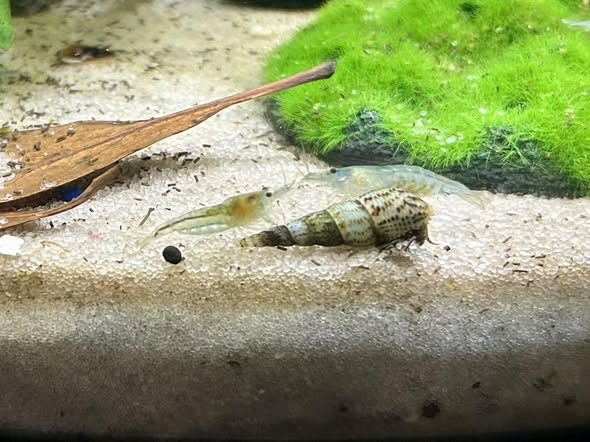
Physical Description: What Does a Malaysian Trumpet Snail Look Like?
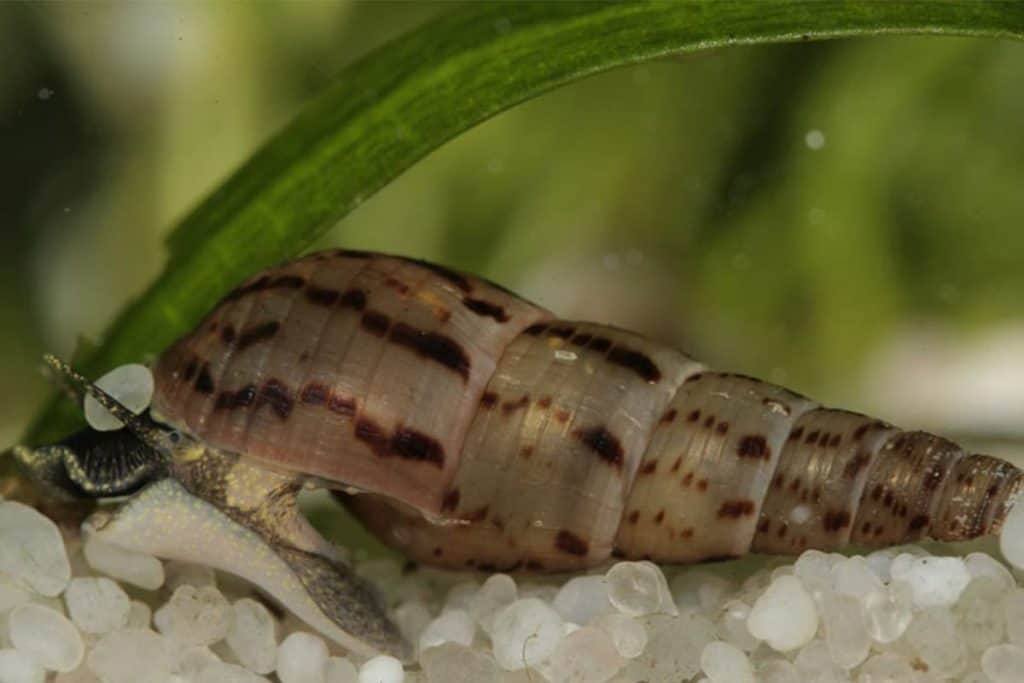
The Malaysian trumpet snail has a distinctly elongated, turreted (cone-shaped) shell that resembles a small unicorn horn or a twisted spire.
This shape sets it apart from rounder freshwater snails like ramshorn snails or mystery snails.
Key physical features include:
- Shell length: Typically 1 to 3.5 cm, though some individuals in optimal conditions can reach 4 cm
- Shell texture: The surface is usually ribbed or nodular, with a rough, sculptured appearance
- Shell color: Ranges from pale tan to grayish-brown, often marked with dark olive or brownish spots and streaks
- Aperture (opening): Oval and usually bordered with a reddish-brown edge — hence the name “red-rimmed melania”
- Operculum: Present and functional, allowing the snail to seal itself inside the shell when threatened
The body (foot) of the snail is usually grayish or cream-colored, and the animal is mostly nocturnal. During daylight hours, it tends to burrow beneath the substrate, making it easy to overlook even in heavily populated tanks.
Natural Habitat and Geographic Distribution
In its native range, the Malaysian trumpet snail is found in slow-moving or still freshwater environments. These include:
- River margins and backwaters
- Ponds and reservoirs
- Rice paddies and irrigation channels
- Lakeshores with soft, silty substrates
The snail thrives in warm, nutrient-rich waters with a moderate to high mineral content. It prefers sandy or muddy bottoms where organic matter accumulates — exactly the kind of substrate it spends most of its time burrowing through.
Geographically, the species is native to:
- Southeast Asia (Malaysia, Thailand, Indonesia, Vietnam, Philippines, Sri Lanka)
- East Africa (Kenya, Tanzania, Ethiopia)
- Parts of the Middle East (Egypt, Israel, Jordan)
Through human activity, it has spread to the United States, parts of Europe, Australia, South America, and island nations across the Pacific and Indian Oceans. In many of these regions, it is now classified as an invasive species.
Behavior and Lifestyle
One of the most distinctive behaviors of the Malaysian trumpet snail is its burrowing habit. Unlike most aquarium snails, which spend their time crawling on surfaces, MTS actively plows through the substrate.
This burrowing behavior is ecologically important for several reasons:
- It aerates the substrate, preventing the buildup of anaerobic pockets that produce toxic hydrogen sulfide gas
- It disrupts compacted areas of sand or gravel, promoting water circulation within the substrate
- It mixes organic detritus into the substrate, improving nutrient cycling
During the day, you will typically find Malaysian trumpet snails buried just beneath the surface of the substrate. At night, they emerge and become much more active — grazing on algae, biofilm, and organic matter on glass surfaces, decorations, and plant leaves.
When threatened or disturbed, the snail quickly retreats into its shell and seals itself with its operculum. This makes it somewhat resistant to predation from smaller fish.
Feeding Habits: What Do Malaysian Trumpet Snails Eat?
The Malaysian trumpet snail is an omnivorous detritivore — a fancy way of saying it eats almost everything that accumulates at the bottom of a tank or waterway.
Its diet typically includes:
- Algae (green algae, diatoms, and biofilm)
- Decaying plant material
- Uneaten fish food and fish waste
- Bacteria and microorganisms in the substrate
- Dead plant matter
This feeding behavior makes it genuinely useful in aquariums. It acts as a cleanup crew, processing organic waste before it can break down and spike ammonia or nitrite levels.
However, it is important to note that a large population of MTS can also compete with other bottom-dwelling animals for food.
Reproduction: Why Malaysian Trumpet Snails Multiply So Fast
This is where most aquarists run into trouble. The Malaysian trumpet snail is a prolific reproducer, and understanding why helps explain how populations can seem to explode overnight.
MTS reproduces through a process called parthenogenesis. In most populations, the snails are predominantly or entirely female, and they reproduce without the need for fertilization by a male.
Each female carries live young in a special brood pouch until the juveniles are large enough to survive independently.
Key reproductive facts:
- Females give birth to 10–60 live young at a time
- Reproduction is continuous under favorable conditions
- A single snail can establish an entire colony
- Population growth is exponential in tanks with plenty of food and stable water chemistry
The rate of population increase is directly tied to food availability. Overfeeding fish is the single biggest driver of MTS population explosions in aquariums.
If you are suddenly finding hundreds of snails in your tank, the first thing to review is your feeding habits.
Malaysian Trumpet Snails in the Aquarium
For many aquarists, MTS is a welcome addition to the tank. Its contributions are practical and well-documented:
1. Substrate Aeration
This is arguably the most important benefit. As the snail burrows through sand and fine gravel, it prevents the formation of anaerobic zones. These zones produce hydrogen sulfide — a toxic gas that can kill fish if a large pocket is suddenly disturbed. A healthy MTS population in a sandy substrate can essentially eliminate this risk.
2. Algae Control
MTS grazes on green spot algae, diatoms, and biofilm on glass and hard surfaces. While it is not as effective as dedicated algae eaters like Otocinclus or Nerite snails, it provides steady, low-level algae control as part of a broader cleanup crew.
3. Waste Processing
Uneaten food and fish waste are processed quickly by MTS populations. This can help maintain water quality between water changes, though it should never be used as a substitute for proper tank maintenance.
4. Plant Safety
Unlike some snails (notably Ramshorn snails), MTS generally does not eat healthy, living plant tissue. It prefers decaying leaves and organic matter. This makes it safe for most planted aquariums, though it may uproot small, delicate plants during burrowing.
Potential Drawbacks of Malaysian Trumpet Snails in Aquariums
It is only fair to present both sides of the picture.
The main concern is population control. In a well-fed aquarium, MTS numbers can grow to thousands within a few months. While a moderate population is beneficial, a very high number can:
- Overwhelm the tank aesthetically
- Compete with other invertebrates for food
- Uproot carpet plants and fine-rooted aquatic plants
- Become difficult to eliminate once established
Another concern is that Malaysian trumpet snails can serve as intermediate hosts for certain parasites, including trematode flatworms (flukes).
In natural water bodies, this has public health implications, particularly in regions where human populations consume undercooked freshwater organisms. In closed aquarium systems, this risk is minimal but worth noting.
Malaysian Trumpet Snails as an Invasive Species
Outside of aquariums, the Malaysian trumpet snail represents a significant ecological concern. It is listed as an invasive species in several countries, including the United States, Australia, and parts of Europe.
The primary pathways of introduction include:
- Aquarium trade releases — hobbyists releasing tank water or plants into local waterways
- Ornamental plant shipments carrying snail eggs or juveniles
- Deliberate introduction for biological control of algae or other snails (a practice now recognized as problematic)
Once established in a natural waterway, MTS can outcompete native snail species for food and habitat. It reproduces faster than most native species and tolerates a wide range of water conditions, giving it a competitive advantage in disturbed or degraded environments.
In the United States, Melanoides tuberculata has established wild populations in at least 30 states, particularly in warm-water springs, rivers, and canals in states like Florida, Texas, California, and Hawaii. The USGS Nonindigenous Aquatic Species database tracks its spread in real time.
Environmental consequences of invasion include:
- Displacement of native snail populations
- Alteration of benthic (bottom-dwelling) community structure
- Disruption of local food webs
- Potential spread of trematode parasites to wildlife
The broader lesson here is important: never release aquarium water, plants, or animals into natural water bodies. Even something as seemingly harmless as a small snail can have lasting ecological consequences.
Water Parameters for Keeping Malaysian Trumpet Snails
If you are keeping MTS intentionally in an aquarium, or if you want to understand what conditions allow them to thrive (which also helps in controlling them), here are the optimal water parameters:
| Parameter | Optimal Range |
| Temperature | 20 – 28°C (68 – 82°F) |
| pH | 7.0 – 8.0 |
| General Hardness (GH) | 8 – 15 dGH |
| Carbonate Hardness (KH) | 3 – 10 dKH |
| Ammonia / Nitrite | 0 ppm |
| Nitrate | Below 20 ppm (ideally) |
Hard water is especially important for MTS, as calcium is essential for healthy shell development. In soft or acidic water, the shells may become thin, pitted, or eroded — a condition called shell erosion or pitting.
Copper is lethal to all gastropod mollusks, including MTS. Even trace amounts of copper (from certain medications or plumbing) can kill an entire population of snails within hours.
How to Control Malaysian Trumpet Snail Populations
Population control is one of the most searched topics related to MTS. Here are the most effective and responsible methods:
1. Reduce Feeding
The single most effective long-term strategy. Feed your fish only what they consume within 2–3 minutes, once or twice a day. Without excess food, the snail population stabilizes or declines.
2. Manual Removal
Place a piece of raw vegetable (zucchini, cucumber, or lettuce) on the substrate at night. Snails will congregate on it by morning, and you can remove large numbers at once. Repeat over several nights.
3. Predatory Fish
Several fish species actively prey on MTS:
- Assassin snails (Clea helena) — highly effective and species-specific
- Pufferfish (Figure-8 Puffer, Dwarf Puffer) — voracious snail eaters
- Loaches (Clown loach, Yo-yo loach, Chain loach) — burrow into substrate to find MTS
- Botiid loaches in general are excellent biological control agents for MTS in home aquariums
Assassin snails are particularly recommended because they specifically target other snails without harming fish or plants.
4. Chemical Control (Last Resort)
Copper-based treatments or dedicated molluscicides (like those containing potassium permanganate) can eliminate MTS. However, these will also kill all other invertebrates in the tank, including shrimp, beneficial snails, and any other mollusks. Use only as a last resort and only in tanks without shrimp or other invertebrates.
5. Tank Reset
In extreme cases, a full tank reset (stripping the substrate, cleaning all décor, and starting fresh) is the only option. This is nuclear but definitive.
Malaysian Trumpet Snails and Human Health
In Southeast Asia and parts of Africa, Melanoides tuberculata serves as an intermediate host for the rat lungworm (Angiostrongylus cantonensis) and several trematode species, including Haplorchis taichui and Centrocestus formosanus.
These parasites can infect humans when undercooked or raw freshwater snails are consumed. This is a documented public health concern in countries where MTS is eaten, including Thailand, Vietnam, and the Philippines.
In aquarium settings in Western countries, the risk of human infection is negligible, as the full parasitic lifecycle requires specific animal hosts. However, in tropical regions with established wild populations, the snail’s role in trematode transmission is taken seriously by health authorities.
The World Health Organization (WHO) and regional health bodies in Southeast Asia have documented the association between Melanoides tuberculata and food-borne trematode infections in rural communities.
The Malaysian Trumpet Snail in Scientific Research
Beyond its role in aquariums and invasive ecology, Melanoides tuberculata has attracted scientific interest in several areas:
Toxicology testing: MTS is used as a sentinel organism in freshwater ecotoxicology studies due to its sensitivity to heavy metals and pollutants. Its response to copper, cadmium, and other toxicants has been well characterized.
Genetic research: The parthenogenetic reproduction of MTS makes it an interesting model for studying genetic diversity without sexual recombination. Clonal populations offer insights into how evolution proceeds without genetic mixing.
Parasitology: Its role as an intermediate host makes it a key subject in trematode lifecycle research, particularly in tropical medicine and public health contexts.
Differentiating Malaysian Trumpet Snails From Similar Species
Not every cone-shaped freshwater snail is a Malaysian trumpet snail. Several look-alike species can cause confusion:
| Feature | Melanoides tuberculata (MTS) | Tarebia granifera (Quilted Melania) | Thiara scabra |
| Shell Shape | Turreted, narrow spire | Similar spire, granular surface | More globose |
| Shell Texture | Ribbed with round knobs | Granular, bead-like texture | Coarse, irregular |
| Color | Tan/gray with dark spots | Olive-gray, darker overall | Brown to black |
| Red rim on aperture | Usually present | Usually absent | Absent |
| Burrowing habit | Strong | Moderate | Weak |
If you are unsure of the species, the aperture rim color and shell texture are the most reliable visual identifiers without a microscope.
Conservation Perspective: Pest or Participant?
It is worth stepping back and thinking about where this snail fits in the broader ecological picture.
In its native range, Melanoides tuberculata plays a legitimate ecological role. It contributes to nutrient cycling, provides food for fish and wading birds, and is part of a balanced freshwater ecosystem. It is not a pest at home — it is a pest when placed where it does not belong.
The problem is not the snail itself but how it has spread. This is a recurring theme in invasive species biology: the same organism that is beneficial in one context becomes destructive in another.
From a conservation standpoint, the aquarium trade bears a significant responsibility in the spread of MTS and many other invasive aquatic organisms. Responsible fishkeeping practices — including never releasing aquarium water into natural waterways — are essential in limiting further spread.
Frequently Asked Questions About Malaysian Trumpet Snails
Are Malaysian trumpet snails harmful to fish? No. MTS does not harm healthy fish. It cannot bite or injure fish in any way. The only indirect concern is very large populations competing with bottom-feeding fish for food.
Can Malaysian trumpet snails live out of water? Briefly. They can survive short periods of moisture but will die if kept fully dry for more than a few hours. This is relevant when disposing of substrate containing MTS — thoroughly dry it before disposing in trash.
Do Malaysian trumpet snails need a filter? They are tolerant of poor water quality but thrive with gentle filtration. Sponge filters are ideal for tanks where they are the primary inhabitants.
How fast do Malaysian trumpet snails reproduce? Under ideal conditions (warm water, abundant food), a single female can produce dozens of offspring per month. Populations can double within weeks.
Can Malaysian trumpet snails survive in brackish water? They show some tolerance for low salinity but are primarily freshwater animals. They do not thrive in true brackish or marine conditions.
Will Malaysian trumpet snails eat my live plants? Generally, no. They may nibble on very soft or decaying plant tissue, and they can uproot delicate carpeting plants through burrowing, but they do not consume healthy live plant leaves.
Conclusion: Knowing the Snail Means Better Decisions
The Malaysian trumpet snail is genuinely fascinating — a small animal with outsized ecological significance.
In an aquarium, it is a helpful, low-maintenance worker that keeps substrate healthy and processes waste — provided the population is kept in check through sensible feeding habits. In the wild, it serves as a cautionary tale about the unintended consequences of species introduction.
The Malaysian trumpet snail will not win any beauty contests. But in the underwater world it occupies, it quietly does important work. Respect it for what it is. Manage it responsibly. And never, ever release it into your local waterway.
References and Further Reading
- USGS Nonindigenous Aquatic Species (NAS) Database — Melanoides tuberculata Factsheet United States Geological Survey (USGS), Department of the Interior. https://nas.er.usgs.gov/queries/FactSheet.aspx?SpeciesID=1045
- Invasive Species Information — USDA National Invasive Species Information Center United States Department of Agriculture (USDA). Provides policy, identification, and management resources for invasive aquatic species.
- University of Florida IFAS Extension — Freshwater Snails of Florida Institute of Food and Agricultural Sciences, University of Florida. Educational publication covering native and non-native freshwater gastropods in Florida. https://edis.ifas.ufl.edu/publication/FA187
- CABI Invasive Species Compendium — Melanoides tuberculata Datasheet CAB International. Comprehensive invasive species datasheet including ecology, impact, management, and references. https://www.cabidigitallibrary.org/doi/10.1079/cabicompendium.33041