Mystery Snail vs Apple Snail: Key Differences Every Aquarist Should Know
I remember the first time someone at a pet shop handed me what they called an “apple snail” and assured me it was the same thing as the mystery snail I had been keeping for months. It was not. The distinction matters — and depending on what you are setting up, it can matter quite significantly.
The confusion between mystery snails and apple snails is one of the most common misidentifications. The two are related, they look superficially similar, and they are often sold under interchangeable names. But they are different species with very different sizes, behaviours, appetites, and impacts on an aquarium.
This article sets the record straight. By the time you finish reading, you will know exactly what distinguishes a mystery snail from an apple snail, which one suits your tank, and why getting the identification right matters more than most people realise.
First, Let Us Clarify the Terminology
This is where most of the confusion begins — and it is worth addressing directly before anything else.
“Apple snail” is a broad, informal name applied to multiple species in the family Ampullariidae. Technically speaking, mystery snails are apple snails. They belong to the same family.
But in common aquarium usage, “apple snail” almost always refers to one of the larger, more aggressive species — primarily Pomacea canaliculata (the channeled apple snail) or Pomacea insularum (the spike-topped apple snail).
“Mystery snail” refers specifically to Pomacea bridgesii, a smaller, more plant-safe member of the same family.
So when aquarists say “mystery snail vs apple snail,” they are almost always comparing Pomacea bridgesii against Pomacea canaliculata or similar large species. That is the comparison I will address in this article.
Understanding this naming confusion could save you from introducing a destructive species into a carefully planted tank on the basis of a misidentification.
A Brief Introduction to Each Species
Mystery Snails (Pomacea bridgesii)
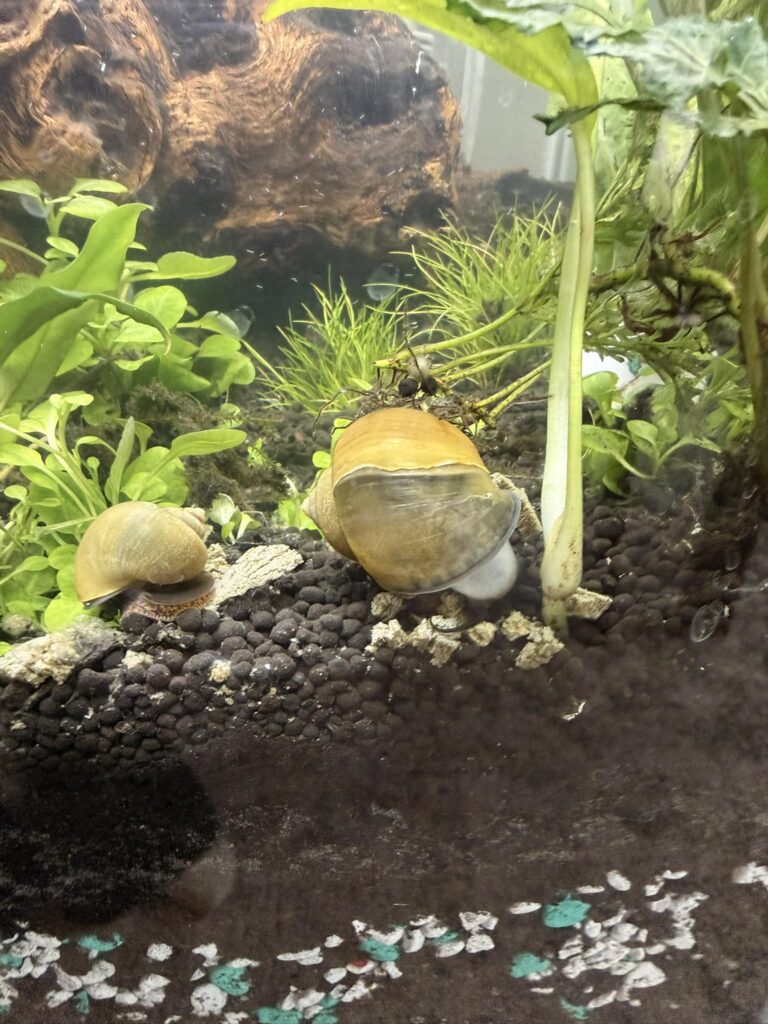
Mystery snails are native to Bolivia, Brazil, and Paraguay in South America. They are medium-sized freshwater snails that typically reach 1.5 to 2 inches (3.8 to 5 centimetres) in shell diameter, with exceptional individuals occasionally reaching 2.5 inches.
They are widely kept in community aquariums for their algae-grazing habits, detritus-cleaning behaviour, and visually appealing colour morphs — which include gold, ivory, blue, purple, brown, and jade varieties.
Mystery snails are relatively plant-safe and are considered one of the more beginner-friendly freshwater invertebrates available.
Apple Snails (Pomacea canaliculata and related species)
The channeled apple snail is also native to South America but has spread aggressively across Asia, North America, and other regions through the aquarium trade and agricultural introductions. It is now considered one of the world’s most significant invasive freshwater species.
Apple snails of this type are substantially larger than mystery snails, reaching 2.5 to 4 inches (6 to 10 centimetres) in shell diameter. Some individuals in optimal conditions have been recorded exceeding 6 inches.
They are voracious plant eaters and have caused catastrophic damage to rice paddies and wetland ecosystems in countries where they have been introduced. In the aquarium, they consume aquatic plants with remarkable speed and efficiency.
Size: The Most Immediately Obvious Difference
If you place a fully grown mystery snail and a fully grown channeled apple snail side by side, the size difference is striking.
A healthy adult mystery snail is roughly the size of a golf ball at its largest. A fully grown channeled apple snail can reach the size of a large apple — which, incidentally, is exactly where the common name comes from.
This size difference has real practical implications:
- Apple snails produce significantly more waste, adding a heavier biological load to the tank
- Apple snails require larger tanks to maintain stable water chemistry
- Apple snails are more destructive to tank decorations, plants, and substrate simply due to their mass and force of movement
- Apple snails are considerably more visible and dominant in the aquarium environment
For aquarists with smaller tanks — 10 to 20 gallons — the channeled apple snail is genuinely unsuitable. Mystery snails, by contrast, are appropriate for tanks as small as 5 to 10 gallons.
Plant Safety: The Defining Practical Difference
This is, for most planted tank aquarists, the single most important distinction between the two species.
Mystery snails are largely plant-safe. They graze on algae, biofilm, decomposing plant matter, and soft algae growth on leaves — without typically damaging healthy plant tissue. They will consume dying or very soft-leaved plants when hungry, but in a well-fed tank with robust plant species, they coexist peacefully with live plants.
Apple snails (Pomacea canaliculata) are not plant-safe — at all. They are active, enthusiastic consumers of living aquatic plant matter. Almost no common aquarium plant is reliably safe from a hungry channeled apple snail. Species that are regularly consumed include:
- Egeria densa (anacharis)
- Vallisneria species
- Cabomba species
- Elodea species
- Ludwigia species
- Ceratophyllum (hornwort)
- Hydrocotyle species
- Most soft-stemmed plants generally
Harder-leaved plants such as Anubias, Java fern, and some Cryptocoryne species may fare better — but even these are not immune to persistent feeding pressure from a large apple snail.
“I made the mistake of introducing what I thought were mystery snails into my planted 55-gallon. Within three weeks, I had bare stems where I used to have a lush aquascape. They were channeled apple snails. The damage was almost total. I had to rescape the entire tank.” — Pieter van den Berg, Dutch aquascape enthusiast and freshwater plant cultivator
This experience is tragically common, and it almost always traces back to misidentification at the point of purchase.
If you have a planted aquarium, the distinction between these two species is not academic — it is the difference between a thriving planted tank and a devastated one.
How to Tell Them Apart: Visual Identification
Since misidentification is the root cause of most problems, knowing how to visually distinguish the two species is essential.
Shell Shape
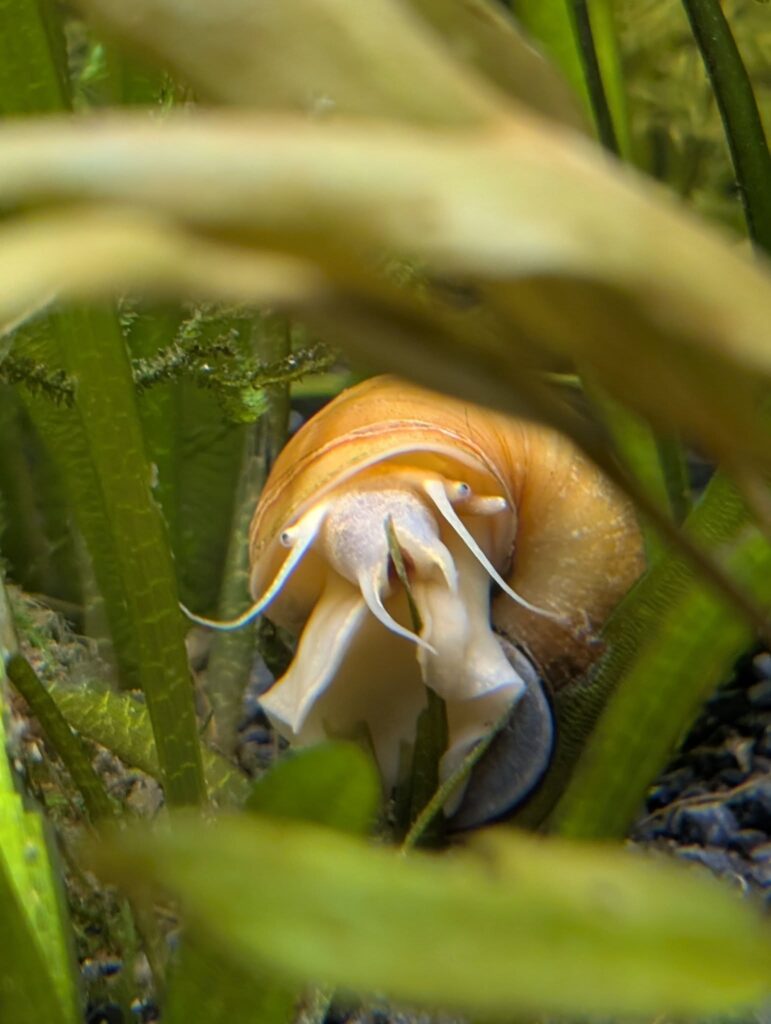
Mystery snail (Pomacea bridgesii): The shell has a distinctly elevated, pointed spire — the whorls stack upward to a noticeable apex. The overall shape is taller relative to its width. The sutures (the grooves between whorls) are deep and clearly defined.
Channeled apple snail (Pomacea canaliculata): The shell is rounder and more globe-like, with a lower, flatter spire relative to overall shell size. The sutures between whorls have a characteristic channeled groove — this is what gives the species its common name. The channeling is the most reliable visual identifier.
Body Tissue Colour
Mystery snails display a wide range of body colours corresponding to their colour morphs — dark body, light body, speckled, and so on.
Channeled apple snails typically display a yellowish-orange to brownish body, though variation exists.
Size at Maturity
If you are looking at an adult snail, size is a useful rough guide. A snail exceeding 2.5 inches in diameter is most likely a channeled apple snail or related large species. A snail under 2 inches is more likely a mystery snail — though juveniles of both species overlap in size range.
Shell Colour and Pattern
Both species come in a range of shell colours due to natural variation and selective breeding. Colour alone is not a reliable identifier. Both can appear gold, brown, or banded. Do not rely on colour as your primary means of identification.
“The suture channel is the giveaway. If you look at the groove between whorls and it has a distinct, almost excavated channel running along it, you are looking at Pomacea canaliculata. Bridgesii’s sutures are deep but clean — no lateral channel. Once you know what you are looking for, you will never confuse them again.” — Sandra Howell, planted tank specialist and aquarium maintenance professional with 20 years of experience
Behaviour and Temperament
Both species are peaceful toward fish and invertebrates — neither will harm tankmates directly. However, their behaviour in the aquarium differs in important ways.
Mystery snails are active explorers. They climb glass, investigate the filter, breathe air through their siphon at the surface, and occasionally wander near the waterline. They are engaging to watch without being disruptive.
Apple snails are more physically imposing in their activity. Their large body mass means they dislodge decorations, uproot plants, and bulldoze through substrate as they move. This is not aggression — it is simply the consequence of a large, heavy animal navigating a confined space.
Apple snails also exhibit more pronounced climbing behaviour, and their greater size means they can more easily escape from tanks without secure lids. An escaped channeled apple snail is a considerably more serious problem than an escaped mystery snail — both in terms of the potential mess and the ecological risk if it reaches an outdoor water source.
Both species are escape-prone. A secure, well-fitting lid is non-negotiable for either.
Breeding and Population Control
The reproductive strategies of the two species are similar in mechanism but differ in scale.
Both species are gonochoric (separate sexes), deposit egg clutches above the waterline, and require cross-fertilisation between a male and female.
Mystery snail clutches typically contain 30 to 200 eggs and are manageable in most home aquariums. Hatchlings are small but visible, and population growth is slow and controllable.
Apple snail (Pomacea canaliculata) clutches are typically larger in total egg count and are laid more frequently by larger, more prolific females. In optimal warm water conditions, their reproductive rate can be considerable.
More concerning is the broader ecological context. Pomacea canaliculata is classified as one of the 100 worst invasive species in the world by the Invasive Species Specialist Group (ISSG). In countries across Asia — the Philippines, Thailand, Japan, China — introduced channeled apple snail populations have caused billions of dollars in damage to rice crops.
“I am always cautious when I see large apple snails being sold without clear species labelling in aquarium shops. Most buyers have no idea what they are purchasing. If those snails end up in a nearby water body — through disposal or flooding — the consequences can be severe. This is not a hypothetical risk. It has happened repeatedly across Asia and parts of North America.” — Dr. Marcus Leifield, freshwater ecology researcher and aquarium hobbyist with over 20 years of combined academic and hobby experience
This is a genuinely important point. Responsible ownership of apple snails requires understanding their invasive potential and disposing of them, their eggs, and any aquarium water appropriately — never in natural waterways, garden ponds, or drains connected to natural systems.
Care Requirements: Side by Side
Both species share many care requirements as members of the same family, but there are meaningful differences.
Water Parameters
Mystery snails (Pomacea bridgesii):
- Temperature: 68°F to 82°F (20°C to 28°C)
- pH: 7.0 to 7.5
- GH: 8 to 18 dGH
- Tank size: Minimum 10 gallons per adult
Apple snails (Pomacea canaliculata):
- Temperature: 65°F to 82°F (18°C to 28°C)
- pH: 7.0 to 8.0
- GH: 8 to 18 dGH
- Tank size: Minimum 15 to 20 gallons per adult; larger is better
Both species are sensitive to copper, which is lethal. Always check medication labels before treating a tank containing either species.
Both species benefit from calcium supplementation — cuttlebone or crushed coral — particularly in soft water.
Diet
Mystery snails are flexible omnivores. They eat algae, biofilm, decaying organic matter, blanched vegetables, algae wafers, and sinking pellets. They are not particularly demanding and do well on a varied supplemental feeding schedule.
Apple snails eat all of the above — plus, as established, live aquatic plants. They have a higher food intake overall due to their greater body mass and metabolic demand. Keeping an apple snail adequately fed in a planted tank is effectively impossible without sacrificing the plants. They will always choose vegetation over pellets given the option.
Tankmates
Both species are compatible with the same range of peaceful community fish — tetras, rasboras, corydoras, livebearers, and similar. Both are vulnerable to the same predators: pea puffers, large cichlids, goldfish, loaches, and some bettas.
The main additional concern with apple snails is their size relative to potential predators. Very large apple snails may actually intimidate or outcompete small fish for food, simply by physically dominating feeding areas.
Legality: An Often-Overlooked Consideration
This is a practical matter that many aquarists do not consider until it is too late.
In several countries and US states, Pomacea canaliculata and Pomacea insularum are regulated or prohibited. Because of their invasive potential and documented agricultural damage, some jurisdictions restrict the importation, sale, or keeping of these species.
In the United States, for example, Pomacea canaliculata and Pomacea insularum are listed as federal noxious weeds under the Federal Noxious Weed Act — a classification that restricts their interstate transport and import.
In the European Union, Pomacea insularum is listed under the EU Invasive Alien Species Regulation.
Mystery snails (Pomacea bridgesii) are not subject to the same level of restriction in most jurisdictions, as they are considered significantly less invasive.
Before purchasing any large apple snail species, check the regulations in your country, state, or region. The responsibility lies with the keeper, not the seller — who may not always be well-informed about legal distinctions.
“I always advise beginners to confirm exactly what species they are buying before purchasing any Pomacea snail. The invasive species legislation around apple snails varies by region and is genuinely complex. Ignorance is not a defence if you are found in possession of a restricted species.” — Carlos Ferreira, aquarium educator and freshwater biology instructor based in Lisbon
Mystery Snails vs Apple Snails: Direct Comparison Table
| Feature | Mystery Snail (P. bridgesii) | Apple Snail (P. canaliculata) |
| Maximum size | ~2 to 2.5 inches | ~4 to 6+ inches |
| Shell spire | Tall, pointed | Rounder, lower |
| Shell suture | Deep, clean | Channeled groove |
| Plant safety | Generally safe | Destructive to most plants |
| Diet | Algae, detritus, vegetables | Plants, algae, detritus, vegetables |
| Minimum tank size | 10 gallons | 20 gallons or more |
| Egg clutch size | 30 to 200 eggs | Often larger clutches |
| Invasive risk | Low | Very high |
| Legal restrictions | Minimal in most regions | Restricted in several jurisdictions |
| Beginner-friendly | Yes | Requires careful management |
| Colour variety | Extensive | Limited in aquarium trade |
| Waste production | Moderate | High |
| Copper sensitivity | Yes | Yes |
| Escape tendency | Moderate | High (larger size) |
Which One Should You Keep?
I want to be direct here rather than diplomatic.
For the vast majority of community aquariums — and especially for planted tanks — mystery snails are the appropriate choice. They are smaller, plant-safe, manageable in population, visually diverse, and pose no meaningful invasive risk when responsibly kept.
Apple snails (Pomacea canaliculata) are better suited to species-only tanks or bare-bottom setups where plant safety is not a concern and where the keeper understands and accepts the responsibility involved in managing a large, potentially restricted, invasive-risk species.
There is genuine appeal in keeping large apple snails — they are impressive animals, active and visually striking in their size. But the appeal must be weighed honestly against the practical implications.
Choose mystery snails if:
- You have a planted aquarium
- You have a small to medium tank (under 30 gallons)
- You are a beginner or intermediate aquarist
- You want a manageable, legal, low-risk species with visual variety
- You want a species that contributes to tank maintenance without undermining it
Choose apple snails (P. canaliculata) if:
- You have a large, unplanted or minimally planted tank
- You have verified their legal status in your region
- You are an experienced keeper who understands their care, reproductive rate, and disposal responsibilities
- You are prepared to manage their considerably higher waste production and feeding demands
A Note on Responsible Disposal
This point deserves its own section because it is so frequently ignored.
Never release mystery snails, apple snails, their egg clutches, or aquarium water into natural waterways, outdoor ponds, or drainage systems. This applies even if you live in their native range in South America — introduced aquarium strains may carry diseases or parasites not present in local populations.
Egg clutches should be sealed in a bag and placed in general waste. Snails that need to be humanely euthanised can be placed in a sealed container in the freezer overnight. Tank water should be disposed of down a household drain — not outdoors.
These are not dramatic precautions. They are the basic responsibilities of every aquarium keeper, and they matter disproportionately with species like Pomacea canaliculata given its documented invasive history.
Suggested For You:
Mystery Snail Eggs Not Hatching: Common Reasons and How to Fix Them
Why Is My Snail Not Moving and Won’t Come Out of Shell?
Can Mystery Snails Eat Strawberries?
Do Mystery Snails Eat Fish Eggs? Let’s Find Out
Do Assassin Snails Kill and Eat Mystery Snails?
Final Thoughts
Mystery snails and apple snails come from the same family, share a superficial resemblance, and are regularly confused with each other — sometimes accidentally, sometimes through careless labelling in the aquarium trade. But they are genuinely different animals with meaningfully different implications for your tank and, in some cases, for the environment beyond it.
I have developed a genuine fondness for mystery snails over years of keeping them. There is something quietly companionable about watching one make its methodical way across the glass. Apple snails, I respect from a distance — beautiful animals, but not right for every keeper or every tank.
The key points to carry with you:
- “Apple snail” is a broad term; mystery snails are technically apple snails, but the two common names refer to different species in most hobby contexts.
- Mystery snails (Pomacea bridgesii) are smaller, plant-safe, and beginner-friendly.
- Channeled apple snails (Pomacea canaliculata) are larger, destructive to plants, and carry significant invasive risk.
- The channeled groove on the shell suture is the most reliable visual identifier for P. canaliculata.
- Legal restrictions on large apple snail species exist in several jurisdictions — check before you buy.
- Both species require responsible ownership, with responsible disposal being a non-negotiable obligation.
Know what you are buying. Know what it needs. And keep it responsibly. That is the standard every aquarist owes to their animals and to the ecosystems beyond their tanks.
References
- Cowie, R. H., & Hayes, K. A. (2012). Apple snails of the family Ampullariidae: biological invasions, ecology, and the impact of Pomacea species on freshwater ecosystems. University of Hawaii at Manoa, Pacific Biosciences Research Center, Honolulu. https://www.hawaii.edu
- Lach, L., Britton, D. K., Rundell, R. J., & Cowie, R. H. (2000). Food preference and reproductive plasticity in an invasive freshwater snail. Biological Invasions, 2(4), 279–288. University of Hawaii at Manoa, Department of Zoology. https://www.hawaii.edu
- Hayes, K. A., Cowie, R. H., Thiengo, S. C., & Strong, E. E. (2012). Comparing apples with apples: clarifying the identities of two highly invasive Neotropical Ampullariidae (Caenogastropoda). Zoological Journal of the Linnean Society, 166(4), 723–753. Smithsonian Institution, National Museum of Natural History. https://academic.oup.com/zoolinnean
- Rawlings, T. A., Hayes, K. A., Cowie, R. H., & Collins, T. M. (2007). The identity, distribution, and impacts of non-native apple snails in the continental United States. BMC Evolutionary Biology, 7(1), 97. Florida International University, Department of Biological Sciences. https://bmcevolbiol.biomedcentral.com
- Yusa, Y., Sugiura, N., & Wada, T. (2006). Predatory potential of freshwater animals on the invasive apple snail Pomacea canaliculata (Gastropoda: Ampullariidae) in Southern Japan. Biological Invasions, 8(2), 137–147. Nara Women’s University, Faculty of Science, Department of Biology. https://link.springer.com