Understanding Nerite Snail: Types, Size, Lifespan, Diet, Parameters, and Tank Setup
I have kept freshwater tanks for years, and few additions have impressed me as consistently as the nerite snail. It is small, peaceful, industrious, and strikingly beautiful — a rare combination in a single animal.
Nerite snails are widely regarded as the best algae-eating snails available for home aquariums. They consume algae voraciously without damaging live plants, they do not overpopulate a tank, and many species carry shells with patterns so ornate that they look almost hand-painted.
This guide covers everything you need to know about nerite snails — their biology, natural habitat, popular species, care requirements, feeding habits, tank compatibility, breeding behavior, and common health challenges.
Nerite Snail at a Glance
| Common Name | Nerite Snail |
| Scientific Name | Neritina spp. / Vittina spp. (Family: Neritidae) |
| Origin | Tropical regions — Africa, Asia, Caribbean, Pacific Islands |
| Natural Habitat | Freshwater rivers, brackish estuaries, marine shorelines |
| Adult Size | 0.5 – 1.5 inches (1.2 – 3.8 cm) |
| Lifespan | 1 – 3 years in captivity |
| Diet | Herbivorous — algae, biofilm, aufwuchs |
| Water Temperature | 72°F – 82°F (22°C – 28°C) |
| Water pH | 7.0 – 8.5 |
| Water Hardness | Moderately hard to hard (6 – 12 dGH) |
| Temperament | Peaceful |
| Tank Compatibility | Community tanks — safe with most fish and invertebrates |
| Breeding in Freshwater | Does not reproduce in freshwater (larvae require brackish/salt water) |
| Care Level | Beginner-friendly |
| Tank Size (Minimum) | 10 gallons |
What Is a Nerite Snail? Taxonomy and Biology
Nerite snails belong to the family Neritidae, a diverse group of gastropod mollusks with a fossil record stretching back over 100 million years. The most common aquarium species fall under the genera Neritina and Vittina, though older literature often groups them all under Nerita or Neritina.
The family Neritidae is extraordinarily ancient and ecologically versatile. Members have successfully colonized marine, brackish, and freshwater environments across the tropics. This adaptability is one reason why they thrive under a range of aquarium conditions.
Like all gastropods, nerite snails have a single coiled shell, a muscular foot for locomotion, and a rasping mouthpart called a radula. The radula functions like a biological file — it scrapes algae and biofilm off hard surfaces with remarkable efficiency.
Their eyes are located at the base of two tentacles on the head. A separate pair of sensory tentacles helps them detect chemical cues in the water.
Despite having no complex nervous system, nerite snails are surprisingly responsive to environmental changes — they will quickly move away from areas with poor water quality.
One feature that sets nerite snails apart from many other aquarium snails is their operculum — a hard, calcareous plate attached to the foot that seals the shell opening when the snail retreats inside.
This structure protects them from predators and helps them survive brief periods of air exposure, which is something they sometimes experience in the wild.
Natural Habitat and Global Distribution
Nerite snails are native to tropical and subtropical regions across multiple continents. Depending on the species, you can find them naturally occurring in:
- Africa — particularly along the eastern coast and the Great Rift Valley lakes
- South and Southeast Asia — including rivers in Sri Lanka, India, Indonesia, and the Philippines
- The Caribbean — where some species inhabit brackish coastal zones
- Pacific Islands — including Hawaii and various Polynesian islands
- Central America — along Atlantic coastal waterways
In the wild, most freshwater nerite snails are actually amphidromous. This means they live in freshwater as adults but their larvae must travel to brackish or fully saltwater environments to develop.
This unique life cycle is the primary reason they cannot reproduce successfully in a home freshwater aquarium — the larvae simply cannot survive without saltwater conditions.
Wild nerite snails are typically found clinging to rocks, submerged wood, and leaf litter in rivers and streams with moderate to strong water flow. They favor areas with plenty of algae growth and stable water chemistry.
Understanding their natural habitat helps us replicate ideal conditions in the aquarium. A tank with good water movement, stable parameters, and rocky or driftwood surfaces closely mimics the environment these snails evolved in.
Popular Species of Nerite Snails
There are dozens of nerite snail species used in the aquarium trade. Each has distinctive shell patterns, color variations, and slightly different care needs. Here are the most common and widely available types.
1. Zebra Nerite Snail (Neritina natalensis)
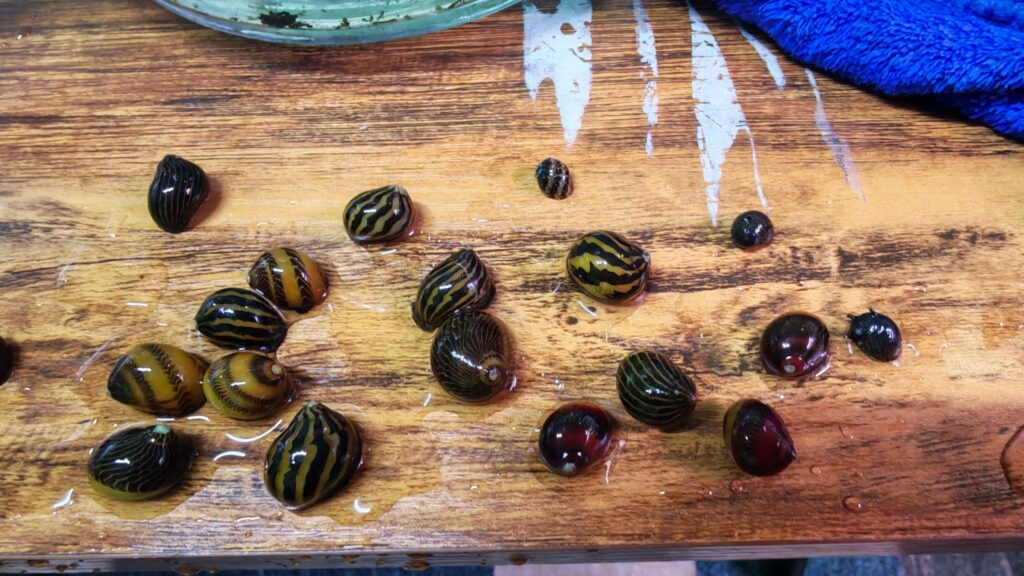
The zebra nerite snail is perhaps the most recognizable species. Its glossy black shell is marked with bright yellow stripes running along the whorls — resembling, as the name suggests, a zebra’s coat.
It is native to East Africa and grows to about 1 inch in length. Zebra nerites are hardy, adaptable, and excellent algae consumers. They are a top recommendation for beginners.
2. Tiger Nerite Snail (Vittina semiconica)
Tiger nerites have a dark olive or amber shell with irregular black markings that give a tiger-stripe appearance. They are slightly more compact than zebra nerites but just as effective at algae control.
Tiger nerites tend to be particularly active, often covering impressive distances across tank glass and decor in a single night.
3. Olive Nerite Snail (Neritina reclivata)
The olive nerite has a smooth, dark olive-green to brownish shell, sometimes with faint markings. It is native to freshwater and brackish environments in Florida and the Gulf of Mexico region.
This species is well-suited to tanks with driftwood and planted substrates, where it grazes on the thin algae and biofilm that other cleaners often miss.
4. Horned Nerite Snail (Clithon corona)
The horned nerite is among the most distinctive. Its shell carries small spike-like projections — the “horns” — along the ridge. Shell coloration varies widely, from black with yellow spots to dark brown with geometric patterns.
The horns are thought to be an anti-predator adaptation, making them difficult for fish to swallow. They tend to be a little more sensitive to water quality than other nerite species and do best in stable, mature tanks.
5. Tracked Nerite Snail (Neritina natalensis “tracked” variant)
The tracked nerite looks somewhat similar to the zebra nerite but with more irregular, maze-like markings rather than clean stripes. It is quite rare in the hobby compared to the zebra and tiger varieties.
6. Red Racer Nerite Snail (Vittina waigiensis)
The red racer nerite is a visually striking species with a elongated shell pattern of red-orange and black dashes — almost like a racetrack design. It is slightly rarer and more expensive than common nerites, but it is highly sought after for display aquariums.
7. Black Racer Nerite Snail (Neritina pulligera)
The black racer has a smooth, jet-black or dark olive shell with minimal markings. It is a larger species, sometimes reaching 1.5 inches, and is particularly effective at cleaning diatom algae from glass surfaces.
Setting Up the Ideal Tank for Nerite Snails
If you are planning to keep nerite snails, here are the important requirements.
Tank Size
Nerite snails can technically survive in tanks as small as 5 gallons, but a 10-gallon tank is the recommended minimum for comfortable, long-term keeping. Larger tanks naturally support more algae growth, giving the snails an adequate food supply.
For every 10 gallons of tank volume, 1 to 2 nerite snails is a reasonable stocking rate, depending on how much algae the tank produces.
Water Parameters
Getting the water chemistry right is critical. Nerite snails are more demanding about water quality than many people assume.
Recommended water parameters:
- Temperature: 72°F – 82°F (22°C – 28°C)
- pH: 7.0 – 8.5
- Hardness: 6 – 12 dGH (moderately hard to hard)
- Ammonia: 0 ppm
- Nitrite: 0 ppm
- Nitrate: Below 20 ppm ideally
Hard water is particularly important. Nerite snails build their shells from calcium carbonate. In soft or acidic water, their shells will gradually dissolve and develop pitting, a condition called shell erosion.
If your tap water is naturally soft, supplement calcium with crushed coral substrate, cuttlebone, or specialized mineral supplements.
Do not keep nerite snails in water with a pH below 7.0. Acidic conditions accelerate shell dissolution and cause significant stress.
Filtration and Water Flow
A good filtration system is essential. Nerite snails are sensitive to ammonia and nitrite spikes. Use a reliable hang-on-back filter or canister filter rated for your tank size.
Moderate water flow is beneficial. In the wild, nerite snails live in areas with active current. A gentle powerhead or the output flow from a canister filter can help replicate these conditions.
Make sure filter intakes are covered with a sponge pre-filter. Nerite snails — especially smaller individuals — can occasionally be sucked against strong filter intakes.
Substrate and Decor
Nerite snails are not picky about substrate. Sand and gravel both work fine, as snails mostly spend time on vertical surfaces — glass walls, rocks, driftwood, and decorations.
Rocks, ceramic decorations, and driftwood are ideal additions. These surfaces collect algae and biofilm, giving nerite snails the grazing area they love. Smooth river stones in particular make excellent browsing surfaces.
If you keep live plants, nerite snails are one of the few algae-eating snails that will not damage them. They graze on the algae growing on plant leaves rather than eating the plant tissue itself.
Lighting
Adequate aquarium lighting promotes algae growth, which is the snails’ main food source. If algae production is low, you may need to supplement with algae wafers or blanched vegetables (more on feeding below).
Avoid excessive lighting duration, as this can cause nuisance algae blooms that are harder to manage. A photoperiod of 8 to 10 hours per day is typically appropriate.
Lid and Escape Prevention
Here is something many new keepers learn the hard way: nerite snails are escape artists. They will crawl out of open tanks, particularly at night or when water conditions are not ideal.
A snail found dry outside the tank can sometimes be revived if caught within a few hours, but prolonged air exposure is usually fatal.
Always use a tight-fitting lid with as few gaps as possible. Weigh it down or secure it if necessary.
Feeding Nerite Snails: Diet and Nutrition
Primary Diet
The nerite snail is an obligate herbivore. In an established aquarium with natural algae growth, they may require little to no supplemental feeding. They are highly effective at consuming:
- Green spot algae (one of the few animals that can eat it)
- Brown diatom algae — a favorite food
- Soft green algae
- Biofilm on glass and hard surfaces
- Aufwuchs — the community of algae, bacteria, and microorganisms on surfaces
Green spot algae is particularly notable because it is notoriously difficult to remove by hand and resistant to many chemical treatments. Nerite snails handle it with ease.
Supplemental Feeding
In newer tanks or low-algae setups, supplemental feeding is necessary to keep nerite snails healthy. Offer:
- Algae wafers — sinking tablets designed for herbivorous invertebrates
- Blanched vegetables — zucchini, cucumber, spinach, and lettuce work well
- Spirulina tablets — an excellent nutritional supplement
- Dried seaweed sheets — the same nori used in sushi restaurants is fine
Blanch vegetables briefly in boiling water, allow them to cool, then anchor them to the substrate with a clip or small weight. Remove uneaten portions after 24 hours to prevent water quality issues.
What They Will Not Eat
Nerite snails will not eat living plant tissue under normal circumstances. This makes them one of the safest snails for planted tanks. They may graze on dead or decaying plant matter, but this is actually beneficial rather than harmful.
They will also not eat protein-based foods in any meaningful quantity. Do not confuse them with omnivorous snails like mystery snails, which will eat fish food and meaty items.
Tank Compatibility: Who Makes a Good Neighbor?
The peaceful, slow-moving nature of nerite snails makes them compatible with a wide range of tank inhabitants. However, some fish and invertebrates will harm or eat them.
Good Tank Mates
- Tetras (neon tetras, rummy-nose tetras, cardinal tetras) — peaceful and small-mouthed
- Rasboras (harlequin rasboras, lambchop rasboras)
- Corydoras catfish — bottom-dwellers that ignore snails
- Otocinclus catfish — excellent algae eaters that coexist peacefully
- Livebearers (guppies, platies, mollies) — generally safe
- Betta fish — most bettas tolerate nerites, though occasionally an aggressive individual may nip at them
- Dwarf shrimp (cherry shrimp, amano shrimp) — excellent companions in planted tanks
- Other peaceful snails (mystery snails, ramshorn snails)
Fish to Avoid
Avoid keeping nerite snails with any fish large enough to crush their shells or that are known snail predators. Problem species include:
- Cichlids — particularly large Central and South American species
- Clown loaches — these fish actively hunt snails
- Assassin snails (if overly stocked)
- Pufferfish — nearly all pufferfish will attack and eat snails
- Large goldfish — may pick at and damage snails
- Botia loaches — most species in this family prey on snails
The general rule is: if a fish has the instinct and ability to crush or eat a snail, it will. When in doubt, do your research on a specific fish species before combining with nerites.
Breeding Nerite Snails: What You Need to Know
This is one of the most discussed — and often misunderstood — aspects of nerite snail keeping.
Nerite snails will not breed successfully in a freshwater aquarium. This is perhaps their greatest advantage for aquarists who want algae control without the risk of overpopulation. Mystery snails, pond snails, and ramshorn snails can multiply rapidly and become pests. Nerite snails cannot.
The Breeding Cycle
Nerite snails are dioecious — meaning there are separate male and female individuals. Females in a freshwater aquarium will often lay small, white, seed-like eggs on hard surfaces — glass, rocks, driftwood, and even plant leaves. These eggs are infertile in freshwater.
The eggs can be annoying cosmetically as they are hard to remove and quite visible. Scraping them off with a razor blade or credit card is the most effective removal method.
For larval development to succeed, the eggs need to hatch in brackish or marine water with a salinity of around 15 – 34 ppt. The larvae are planktonic — meaning they drift in the water column and require microscopic organisms to feed on.
Raising nerite snail larvae to juvenile stage is technically possible but extremely difficult, It requires specialized equipment and knowledge. This is not a common practice among hobbyists.
Sexing Nerite Snails
Distinguishing male from female nerite snails is very difficult without close inspection. In some species, males have a small, pale protrusion near the right side of the mantle (the soft tissue bordering the shell opening). However, this feature is subtle and not always reliable.
Most aquarists simply purchase a small group of nerites — typically 3 to 6 individuals — and accept that they cannot determine sex visually.
Common Health Issues and How to Address Them
Shell Erosion and Pitting
Shell erosion is the most common health problem seen in captive nerite snails. The shell develops white patches, pits, or rough textures, particularly near the apex (tip) of the shell.
The primary cause is soft or acidic water, which dissolves the calcium carbonate in the shell. Secondary causes include nutritional deficiency (inadequate dietary calcium) and copper contamination in the water.
Solutions:
- Raise pH to 7.5 or higher
- Increase water hardness using crushed coral, limestone, or mineral supplements
- Add a small piece of cuttlebone to the tank as a calcium source
- Test water regularly and maintain stable parameters
Shell erosion in older parts of the shell may not be reversible, but new shell growth should be healthy once water conditions improve. You can often see the contrast between old damaged shell and new, smooth growth at the edge.
Inactivity or Lethargy
A nerite snail that remains motionless for extended periods — particularly if it retreats into its shell and seals the operculum shut — may be stressed. Common causes include:
- Poor water quality (ammonia, nitrite, or nitrate spikes)
- Temperature shock (especially during acclimation)
- Copper in the water — many aquarium medications contain copper, which is lethal to snails and invertebrates
- Inadequate food supply
Always perform a water test when snails appear lethargic. Check for copper if you have recently used medication.
A snail that has died will usually come out of its shell partially and produce a foul odor. If you suspect a snail has died, remove it promptly to prevent water quality deterioration.
Falling Over and Righting
Nerite snails sometimes fall off surfaces and land upside down. In most cases, they can right themselves using their muscular foot — given time and a surface to grip nearby. If a snail cannot right itself within a few hours, gently place it back on a vertical or horizontal surface to give it a starting point.
Repeated falling may indicate weakness related to water quality or nutritional issues.
Copper Toxicity
Copper is extremely toxic to all invertebrates, including nerite snails. Even at low concentrations, copper exposure causes rapid decline and death.
Never use medications containing copper in a tank housing nerite snails. Common culprits include many anti-ich treatments and some general disease medications. Always read labels before adding anything to a tank with invertebrates.
If copper contamination is suspected, perform large water changes immediately and use a copper-removing water conditioner.
Acclimation: Introducing Nerite Snails to a New Tank
Proper acclimation is important. Nerite snails are sensitive to sudden changes in water chemistry and temperature.
The drip acclimation method is recommended:
- Float the bag with the snails in the aquarium for 15 minutes to equalize temperature.
- Open the bag and place the snails in a clean container with their transport water.
- Using aquarium airline tubing tied in a loose knot to create a slow drip, drip tank water into the container at a rate of 2 to 3 drops per second.
- Continue for 30 to 60 minutes until the water volume has approximately doubled.
- Discard the container water and gently transfer the snails to the tank.
Never pour the bag water directly into your tank. Pet store water may carry pathogens, parasites, or chemical imbalances you do not want in your established system.
Ecological Importance and Role in the Wild
Beyond their value as aquarium pets, nerite snails play a meaningful ecological role in natural ecosystems.
In rivers, lakes, and coastal zones, they help control algae growth on rocks and submerged substrates, preventing algal overgrowth that could otherwise reduce light penetration and degrade aquatic habitats.
They are also part of the food web — serving as prey for fish, birds, and other predators in their native environments. Their shells, once abandoned, provide shelter for small invertebrates.
In intertidal and estuarine zones, nerite snails contribute to nutrient cycling by processing organic matter in biofilm and algal communities. Researchers studying ecosystem health in tropical waterways often use gastropod populations — including nerites — as biological indicators of water quality and habitat integrity.
It is worth noting that some nerite snail species have been flagged by scientists as potential invasive species when introduced outside their native range. The hard, resistant shells and generalist diet make them competitive in new environments.
This is why responsible aquarists should never release aquarium inhabitants into local waterways.
Purchasing Nerite Snails: What to Look For
When buying nerite snails, select individuals that are active and responsive. A healthy nerite snail should be moving, attached to a surface, or show a quick withdrawal into the shell when touched.
Avoid snails that:
- Smell foul (indicating death or dying)
- Have heavily pitted or cracked shells
- Float in transport water (this usually indicates illness or death)
- Are completely retracted and unresponsive for extended periods
Most aquarium stores carry zebra and tiger nerite snails reliably. For more unusual species like red racers, horned nerites, or tracked nerites, specialty aquarium vendors and online retailers are your best options.
Prices typically range from $2 to $6 per snail for common species, and $5 to $15 or more for rarer varieties.
How Many Nerite Snails Should You Keep?
A common question — and the answer depends on your tank size and algae production.
A general guideline:
- 10-gallon tank: 1 to 2 snails
- 20-gallon tank: 2 to 4 snails
- 40-gallon tank: 4 to 6 snails
If you notice snails grazing on algae wafers frequently or appearing thin and inactive, your tank may not be producing enough natural algae. Either supplement their diet more consistently or reduce the number of snails.
Overstocking nerite snails is not as dangerous as overstocking fish, but too many snails competing for limited algae will all be underfed. Striking the right balance ensures healthy, active snails and a well-maintained tank.
Frequently Asked Questions About Nerite Snails
Will nerite snails eat my live plants? No. Nerite snails do not eat healthy, living plant tissue. They are entirely safe for planted tanks.
How long do nerite snails live? In good conditions, nerite snails typically live 1 to 3 years in captivity. Consistent water quality, proper nutrition, and hard water with adequate calcium extend their lifespan.
Why is my nerite snail not moving? Check water parameters first — ammonia and nitrite are the most common culprits. Also check temperature and whether any medications were recently added. A healthy snail may simply be resting or grazing very slowly.
Can nerite snails live in a saltwater tank? Yes. Several nerite snail species, particularly Nerita species, are adapted to marine conditions and make excellent additions to saltwater aquariums and reef tanks, where they graze on algae without disturbing corals.
Why does my nerite snail keep escaping? This usually indicates that water conditions are not ideal, or that the snail is simply exploring. Check parameters. Ensure the tank has a tight-fitting lid with minimal gaps.
Do nerite snails need a filter? Yes. They require stable, clean water and are sensitive to ammonia and nitrite. Proper filtration is essential.
Final Thoughts
The nerite snail may be small, but its impact on an aquarium is anything but minor. It combines practical utility with genuine beauty — grazing on stubborn algae while decorating the tank with its patterned shell.
What makes nerite snails particularly valuable is that they solve problems without creating new ones. They will not multiply out of control, they will not damage plants, and they will not harass other tank inhabitants. For the price of a few dollars, they offer years of reliable, low-maintenance service.
If you haven’t added a nerite snail to your aquarium, I genuinely think you’re missing out on one of the hobby’s most well-rounded animals. Set up proper water conditions, give them surfaces to graze on, and they will reward you with a cleaner tank and a more dynamic, living environment.
The nerite snail is, without question, one of the best investments an aquarist can make.
References
- USGS Nonindigenous Aquatic Species Database https://nas.er.usgs.gov
- Smithsonian Ocean Portal, Smithsonian Institution https://ocean.si.edu
- University of Florida IFAS Extension (EDIS) https://edis.ifas.ufl.edu