Platinum Angelfish vs White Angelfish: Comparisons and Key Differences Explained
If you have spent any time browsing freshwater angelfish for sale, you have likely come across two varieties that look strikingly similar at first glance: the platinum angelfish and the white angelfish.
Both are pale, elegant fish that carry the graceful triangular silhouette that makes angelfish (Pterophyllum scalare) one of the most sought-after species in the aquarium hobby. Yet despite their visual resemblance, these two varieties are genetically, visually, and in some cases behaviorally distinct.
Understanding the difference between platinum and white angelfish matters — whether you are a hobbyist building a display tank, a breeder working to produce specific offspring, or simply someone who wants to know exactly what species is swimming in your aquarium.
This article breaks down every meaningful distinction between the two, covering genetics, appearance, breeding behavior, care requirements, and market availability.
What Are Angelfish? A Brief Overview
Before diving into the comparison, it helps to understand where both varieties come from. All domestically kept angelfish belong to the species Pterophyllum scalare, native to the slow-moving rivers and flooded forests of the Amazon Basin in South America.
Over decades of selective breeding in captivity, hobbyists and commercial breeders have developed dozens of color morphs — stripes, marbles, golds, smokeys, and the two varieties in focus here.
Both the platinum and white angelfish are products of selective breeding programs. They are not found in this form in the wild. They are the result of specific gene combinations that suppress or alter pigmentation, producing fish that appear predominantly pale or silvery white. That shared origin is also the source of the confusion between them.
Platinum Angelfish: What Defines This Variety
Appearance
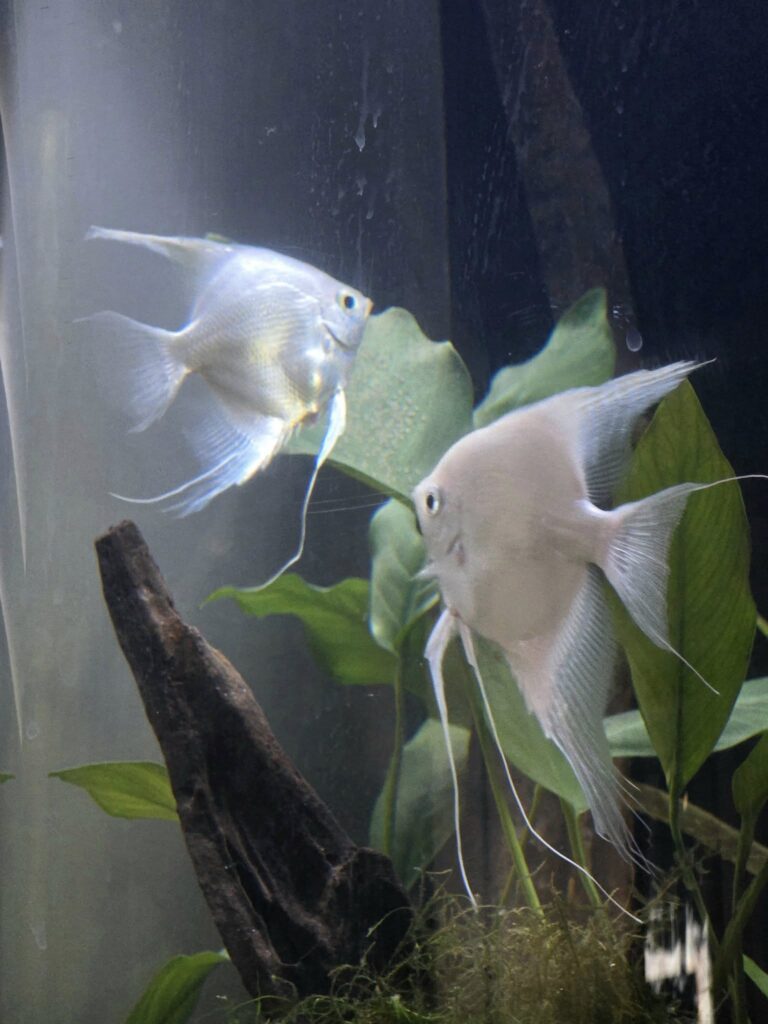
The platinum angelfish is known for its metallic, shimmering silver-white body that catches light with a distinct luminous quality. This is not simply a white fish — the body has an iridescent sheen, almost like polished metal, which gives the variety its name. When light hits a platinum angelfish from the right angle, the body appears to glow softly silver or even light gold.
The fins of the platinum angelfish are typically clear to slightly translucent, and the dorsal and ventral fins extend in the long, flowing manner typical of high-fin or veiltail breeding lines. The eyes are usually dark — a deep brown or black — which creates a visual contrast against the bright, pale body.
One important characteristic: many platinum angelfish show a very faint yellow or gold wash, particularly along the forehead and upper body near the dorsal fin. This is especially visible in strong aquarium lighting and is one of the subtle clues that distinguishes them from white angelfish.
Genetic Basis
The platinum phenotype is produced by a combination of the gold marble gene and the stripeless gene. More specifically, the platinum effect arises when a fish carries the gold gene in a double dose (homozygous gold, often written as g/g) along with other modifying genes that affect melanophore (dark pigment cell) distribution.
Some breeders refer to the genetics as involving the pearlscale gene in combination with other loci, depending on the breeding line. Because the genetics can differ between breeders, not all platinum angelfish are produced by the exact same gene combination, which is why there is some variation within the variety itself.
Some platinum angels appear more intensely metallic, while others look closer to white with a subtle sheen.
Size and Body Structure
Platinum angelfish follow the same general size range as other Pterophyllum scalare varieties. Adults typically reach 5 to 6 inches in body length (from the tip of the dorsal fin to the ventral fin), with a body height — measured from front to back — of around 3 to 4 inches. High-fin variants can appear significantly taller due to extended fin development.
White Angelfish: What Defines This Variety
Appearance
The white angelfish is sometimes called the albino angelfish or the ghost angelfish, though these terms are not always used consistently in the trade. The true white angelfish — the one most commonly sold under that label — is not an albino. It does not have the pink or red eyes that characterize albinism. Instead, it carries dark eyes, similar to the platinum, and a body that is a clean, matte white or very pale cream.
The key visual difference between white and platinum angelfish is the absence of metallic sheen in the white variety. The white angelfish body appears flat and opaque white, without the reflective quality of the platinum.
Under aquarium lighting, the white angelfish does not shimmer in the same way. What you see is a clean, solid pale fish — attractive in its own right, but distinctly different in tone and texture compared to the platinum.
Some white angelfish may carry a faint blue or lavender tint near the gill plates and along the body — a characteristic that breeders sometimes refer to as a ghostly quality, which likely explains the “ghost” nickname used in some regions.
Genetic Basis
The white phenotype in angelfish is generally produced by the stripeless gene (S locus) in combination with the gold gene at specific doses, but without the full metallic expression that produces the platinum effect.
Depending on the breeding line, a white angelfish may carry the stripeless gene in homozygous form (S/S), which removes nearly all vertical banding and reduces melanophore activity significantly.
Some white angelfish are produced using the albino gene in combination with other loci, which can result in a white-bodied fish with red or pink eyes. These are true albino angelfish and are a separate category, though sellers sometimes group them under the broad “white angelfish” label in retail settings, adding to buyer confusion.
It is worth noting that because the genetics underlying white angelfish can involve multiple combinations, the appearance within the variety is not always perfectly uniform across different breeders or suppliers.
Side-by-Side Comparison: Platinum vs White Angelfish
| Feature | Platinum Angelfish | White Angelfish |
| Body color | Metallic silver-white with sheen | Flat, opaque white or cream |
| Sheen/Iridescence | Yes — distinct metallic glow | Absent or very minimal |
| Eye color | Dark brown or black | Dark brown/black (or red if albino) |
| Yellow/gold tint | Often faint, especially near dorsal | Rarely present |
| Genetics | Homozygous gold + stripeless genes | Stripeless (homozygous) ± albino gene |
| Reflective quality | High under aquarium lighting | Low — appears matte |
| Common fin type | Standard, veiltail, or high-fin | Standard, veiltail, or high-fin |
| Adult size | 5–6 inches body height | 5–6 inches body height |
| Availability | Moderate to high | High |
| Price range | Moderate to premium | Moderate |
How to Tell Them Apart in a Store
This is the part that many hobbyists find most useful. When you are standing in front of a tank at a fish store or looking at photos from an online seller, here is what to look for:
Look at how light hits the body
Hold a light source at an angle or observe the fish when your aquarium light is directly overhead. A platinum angelfish will reflect light in a way that creates a visible shimmer or glow — the fish will appear almost luminous. A white angelfish, by contrast, will look consistently pale and flat regardless of the light angle.
Check the forehead area
Many platinum angelfish show a warm gold or yellow tint near the top of the head, between the eyes and the beginning of the dorsal fin. This tint is not always obvious, but it is frequently present. White angelfish typically do not show this warm tone — they remain uniformly pale.
Examine the eyes carefully
If the fish has red or pink eyes, it is almost certainly an albino angelfish, not a standard white. Both platinum and non-albino white angelfish have dark eyes.
Consider the source
Reputable breeders label their stock carefully. If you are purchasing from a knowledgeable breeder or a specialist aquarium shop, ask directly what gene combination the fish carries. A good seller should be able to tell you whether the fish is a platinum, a white, or a related morph like a ghost or pearl.
Behavior and Temperament: Are There Differences?
Broadly speaking, color morphs within the same species do not show dramatic behavioral differences driven by genetics alone. Both platinum and white angelfish are cichlids, and they carry all the personality traits that come with that territory — moderate aggression during breeding, territorial behavior when paired, and a generally bold disposition compared to many other community fish.
That said, there are some practical behavioral observations worth noting:
- Breeding aggression is common in both varieties. Angelfish form monogamous pairs and can become quite aggressive toward tankmates when guarding eggs or fry. This is not specific to either the platinum or white variety but is worth preparing for.
- Social hierarchy matters in angelfish tanks. Keeping a group of six or more juvenile angelfish and allowing natural pair formation tends to reduce aggression compared to forcing pairs together. This applies equally to platinum and white individuals.
Some experienced breeders suggest that heavily inbred lines — which certain color morphs can suffer from due to intensive selective breeding for specific traits — may produce fish that are slightly less robust or more prone to spawning issues. This is not a hard rule and depends entirely on the quality of the breeding stock rather than the color morph itself.
Care Requirements: What Both Varieties Need
Because platinum and white angelfish are both Pterophyllum scalare, they share identical care requirements. There is no meaningful difference in how you keep them.
Water Parameters
Angelfish thrive in water that mimics their Amazonian origins. Aim for:
- Temperature: 76°F to 84°F (24°C to 29°C)
- pH: 6.0 to 7.5, with soft to moderately hard water preferred
- Hardness: 3 to 8 dGH
- Ammonia and nitrite: 0 ppm at all times
- Nitrate: Below 20 ppm for optimal health
Tank Size
A single pair of adult angelfish requires a minimum of a 29-gallon tank, though a 55-gallon tank or larger is far preferable, especially if you intend to keep them with other fish. The tall body shape of angelfish means tank height matters — a minimum of 18 inches in height is recommended, and deeper tanks (24 inches or more) are better.
Filtration and Flow
Angelfish prefer gentle water flow. They are not strong swimmers and will become stressed or fatigued in tanks with powerful currents. A sponge filter or a canister filter with a spray bar or diffuser works well.
Diet
Both varieties are omnivores and accept a wide variety of foods. A quality pellet or flake food forms the base diet, supplemented with live or frozen foods such as bloodworms, brine shrimp, daphnia, and white worms. Variety in diet contributes to better color development, immune function, and reproductive readiness.
Tankmates
Good tankmates for both platinum and white angelfish include tetras (rummy nose, cardinal, and black skirt tetras work well), corydoras catfish, plecos, and peaceful dwarf cichlids. Avoid fin-nipping species such as tiger barbs, and avoid very small fish that adult angelfish may view as prey.
Breeding: Differences Between Platinum and White Lines
Breeding angelfish is one of the most rewarding experiences in the freshwater hobby. Both platinum and white angelfish will spawn under the right conditions, and the process is broadly the same for both varieties.
Breeding Setup
A breeding pair requires a tall, clean tank of at least 20 gallons with a spawning surface — a broad leaf (Amazon sword plants are ideal), a smooth vertical tile, or a PVC pipe. Water should be soft, slightly acidic, and warm — around 80°F to 82°F tends to trigger spawning.
Genetic Considerations in Breeding
This is where the distinction between the two varieties becomes practically important for breeders.
- Breeding platinum to platinum generally produces a high percentage of platinum offspring, though results depend on the precise gene makeup of the parent fish. If both parents carry the same gene combinations, offspring are predictable.
- Breeding white to white can similarly produce consistent white offspring, but again depends on the specific genetic lines involved.
- Crossing platinum with white will produce offspring whose appearance depends on which genes each parent carries. Some offspring may appear platinum, some white, and some may carry intermediate traits or produce striped or marbled patterns that are unexpected if the breeder does not understand the underlying genetics.
For hobbyists who simply want to breed beautiful angelfish for personal enjoyment or local sales, these crosses can produce a range of attractive fish. For breeders aiming to develop consistent, sellable lines, knowing the genetics of your breeding stock is essential.
Albino White Angelfish Breeding Note
If you cross an albino white angelfish (red eyes) with a standard platinum or white angelfish, be aware that the albino gene is recessive. This means most offspring from such a cross will not appear albino but will carry the gene. Crossing two of these carriers in the next generation will yield approximately 25% albino offspring.
Market Value and Availability
Both varieties are widely available in the aquarium trade, though their pricing varies depending on quality, fin type, and breeder reputation.
Platinum angelfish tend to command a slightly higher price in most markets due to their distinctive metallic appearance, which is visually striking and appealing to buyers. High-quality platinum angelfish from reputable breeders — particularly veiltail or high-fin variants — can retail for $15 to $40 or more per fish, with show-quality specimens fetching higher prices.
White angelfish are generally more affordable and widely available, particularly through mass market fish stores. Standard white angelfish often retail for $5 to $15. Specialty lines such as albino white or white veiltail may be priced higher.
Online breeders and aquarium specialty retailers tend to offer better quality stock than big box pet stores, and purchasing from a knowledgeable seller who can describe the genetics of their fish is always worth the effort.
Common Misconceptions
“Platinum and white angelfish are the same fish.” They are not. While both belong to the same species and look similar, they carry different genetic makeups and have distinct visual characteristics, particularly the presence or absence of metallic sheen.
“A white angelfish is always an albino.” This is false. Many white angelfish have dark eyes and are not albinos. True albino angelfish have red or pink eyes due to the absence of melanin in the iris.
“The platinum angelfish is a hybrid.” This is also false. The platinum angelfish is a selectively bred color morph of Pterophyllum scalare, the same species as all other commonly kept freshwater angelfish. It is not the result of crossing different species.
“Color morphs need different care.” Color has no meaningful impact on the care requirements of angelfish. Both platinum and white varieties need identical water parameters, diet, and tank conditions.
Suggesteed For You:
How Big Do Marble Angelfish Get? (Their Size, Growth, and Care Requirements)
Koi Angelfish Care Guide: Everything You Need to Know
10 Types of Freshwater Angelfish Breeds: A Complete Guide
Angelfish Turning Black on Body: Causes, Diagnosis, and Treatment
Angelfish Hole in the Head Disease Treatment: A Complete Guide
Final Thoughts
The platinum angelfish and the white angelfish are both remarkable fish — calm, graceful, and visually commanding in a well-maintained aquarium. They share a species, a body shape, and many behavioral traits. What separates them is subtler: a genetic difference that produces either a metallic shimmer or a clean matte whiteness, and a range of genetic implications that matter most to breeders.
For the casual hobbyist, either variety makes an excellent centerpiece fish. For the dedicated breeder, understanding the distinction is the foundation of producing consistent, healthy, attractive offspring. Whichever variety appeals to you, knowing what you are looking at — and why — makes the experience of keeping angelfish that much richer.
Take your time when selecting fish. Ask questions. Choose stock from sellers who can describe their fish clearly, and give your angelfish the clean, warm, well-filtered water they deserve. The reward is a fish that will live for 10 years or more, grow to an impressive size, and remain one of the most elegant residents any freshwater tank can host.
References
- Froese, R. & Pauly, D. (Eds.). FishBase — Pterophyllum scalare Species Summary. https://www.fishbase.se/summary/Pterophyllum-scalare.html
- Norton, J. (2003). Angelfish Genetics: An Introduction to the Basics. Angelfish Society. https://www.angelfishsociety.org/genetics
- Stawikowski, R. & Werner, U. (1998). The Cichlid Atlas, Volume 1. Mergus Publishers. https://www.fishbase.se/references/FBRefSummary.php?id=26282
- Molecular Expressions — Florida State University: Pigmentation and Chromatophores in Fish. https://micro.magnet.fsu.edu/optics/timeline/people/index.html
- Tullock, J. H. (2006). Freshwater Aquarium Models: Recipes for Creating Beautiful Aquariums. Wiley Publishing. https://www.wiley.com/en-us/Freshwater+Aquarium+Models-p-9780470044179