30 Types of Catfish Explained (With Pictures)
Catfish are one of the most varied fish groups on the planet. I’ve spent hours digging through species profiles for this guide, and honestly, the range still surprises me. Some catfish fit in your palm. Others grow larger than a grown man.
This guide covers 30 types of catfish, from tiny aquarium favorites to river giants. You’ll find aquarium species, wild freshwater catfish, and a few oddballs that break every rule you thought you knew about fish.
What Makes a Fish a Catfish?
Catfish belong to the order Siluriformes. This group holds over 3,700 described species, found on every continent except Antarctica.
The name comes from their barbels, whisker-like feelers around the mouth. These help catfish feel and smell their way through murky water where eyesight is not much use.
Most catfish share another trait: no scales. Instead, their skin is either bare or covered with bony plates. This is why catfish feel different in your hands compared to a bass or a trout.
Large Wild and River Catfish
These species live in open water. Most are too large for a home tank, but they matter for anglers, biologists, and anyone curious about what swims beneath the surface.
1. Channel Catfish
The Channel Catfish is the most farmed catfish in the United States. It has a forked tail and a slim, sloped profile just ahead of the dorsal fin.
This species tolerates a wide range of conditions. It survives in waters from just above freezing to nearly 100°F, though growth slows sharply below 65°F. That toughness explains why it thrives in ponds, rivers, and reservoirs alike.
Farmers love it for another reason. Channel catfish have firm, white flesh with a mild flavor that holds up well through different processing methods. That’s why it dominates supermarket fish counters across the South.
2. Blue Catfish
Blue Catfish are the heavyweight cousins of the channel catfish. They favor open water over shallow banks.
They prefer open waters of large reservoirs and main river channels, along with backwaters where the water runs turbid and the bottom ranges from gravel-sand to silt-mud. Big adults often sit below dams where the current runs fast.
This species has spread well beyond its native range. Blue Catfish have been introduced to states including Alabama, Arizona, Arkansas, California, Colorado, Florida, and several more. In some East Coast rivers, they’re now considered a problem for native fish.
3. Flathead Catfish
You can spot a Flathead Catfish by its head shape alone. It has a wide, flat head, more pronounced than any native catfish species, with yellow to purple-brown coloring on top and a pale belly.
This fish is a night hunter. It lives in shallower water at night and in summer, then moves to deeper water during the day and in winter.
Flatheads are also picky eaters, in a strange way. Unlike most catfish, they refuse dead bait and go after live prey only. That single trait separates them from nearly every other catfish on this list.
4. White Catfish
White Catfish look like a smaller, softer version of the channel catfish. You can tell them apart by a dusky or black adipose fin, a shorter anal fin base, and a tail that forks less deeply.
They’re native to the Atlantic and Gulf coast river systems, from New York down through Florida. I find this one gets overlooked next to its flashier relatives, but it holds its own as a table fish.
5. Wels Catfish
The Wels Catfish is Europe’s giant. It can stretch past 9 feet and easily outweighs an adult person.
This species hides during the day in deep river holes, then hunts at night. Anglers travel across Europe just to hook one, since a wels this size puts up a serious fight.
6. Mekong Giant Catfish
This is one of the largest freshwater fish alive. The Mekong Giant Catfish can reach 10 feet and weigh close to 650 pounds.
Sadly, this giant is critically endangered. Dams, overfishing, and habitat loss have pushed wild numbers dangerously low across the Mekong River basin.
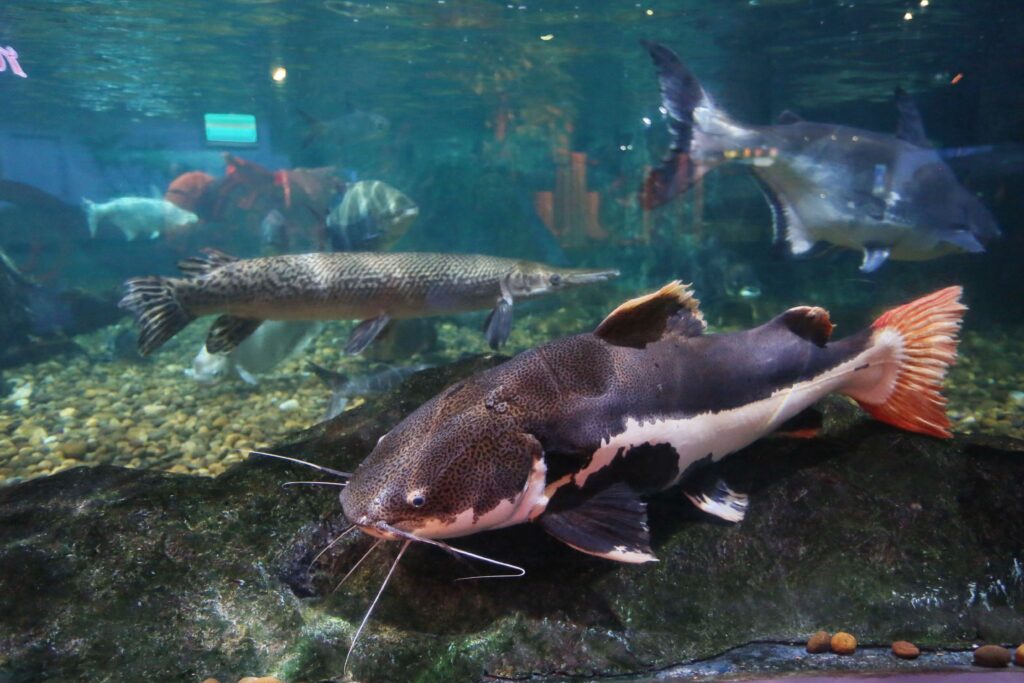
7. Redtail Catfish
The Redtail Catfish carries a striking look: a dark gray-black body, a white belly, and a bright reddish-orange tail. It’s popular in the pet trade as a juvenile.
Here’s the catch. This fish grows fast and can hit 4 feet in a home tank, which is exactly why rescue centers see so many surrendered redtails.
8. Tiger Shovelnose Catfish
This species gets its name from bold tiger-like stripes along a long, flattened snout. It’s a predator built for South American rivers, not glass boxes.
Like the redtail, it’s often sold small and grows into a problem. A tiger shovelnose needs pond-sized space by adulthood, not a standard aquarium.
9. Iridescent Shark Catfish
Despite the name, this isn’t a shark at all. It’s a Pangasius catfish, shiny and silver, sold cheaply to beginners who don’t realize its true adult size.
In the wild, it can top 4 feet. In captivity, that growth rate turns a cute juvenile into a fish that outgrows almost every home setup within two years.
Air-Breathing and Unusual Catfish
Some catfish break the normal rules of fish biology completely. These next few species breathe air, generate electricity, or live upside down.
10. Walking Catfish
The Walking Catfish can survive out of water for hours. It uses an air-breathing organ and wriggles across land to find a new pond during dry spells.
This trait made it a serious invasive species. It has invaded aquaculture facilities and eaten large numbers of stocked fish in Florida, and has caused damage to native fish populations in Sri Lanka and the Philippines.
The species first reached Florida in the early 1960s, imported from Thailand for the aquarium trade. Since then, it’s established wild populations that refuse to disappear.
11. Electric Catfish
Native to African rivers and lakes, the Electric Catfish generates a genuine electric shock. It uses this ability to stun prey and to defend itself against predators.
Its body looks almost featureless, smooth and rounded, without the typical dorsal fin most catfish carry. I think that plain look actually makes it more unsettling once you know what it can do.
12. Glass Catfish
This tiny species is nearly see-through. You can watch its spine and internal organs right through the skin as it swims.
Glass catfish are shoaling fish. Keep them alone and they hide constantly, but in groups of six or more, they swim actively out in the open.
13. Upside-Down Catfish
True to its name, this African species spends much of its time swimming belly-up. Scientists believe this posture helps it feed more easily off the water’s surface and the underside of leaves.
It’s a peaceful, nocturnal fish that does well in a planted community tank. Watching one glide upside down never really stops being strange, even after you know why it does it.
Beginner-Friendly Aquarium Catfish
Now for the species most home aquarists actually keep. These catfish are small, peaceful, and built for community tanks.
14. Cory Catfish
Corydoras make up a genus with more than 165 distinct species. Each species carries its own personality and look, though most only reach 1 to 4 inches long.
These fish are hardy and social. Keep them in groups of five or six, and you’ll see far more natural schooling behavior than with a lone cory.
15. Bristlenose Pleco
The Bristlenose Pleco earns its keep by cleaning algae off glass and driftwood. It has a downturned, suction-style mouth built for clinging onto algae-covered surfaces.
Its barbels grow in large numbers and even sprout from the top of its head, making it easy to identify. A 25-gallon tank suits this species well.
16. Common Pleco
This is the classic algae eater sold at nearly every pet store. Few buyers realize how large it grows.
The Common Pleco needs a tank of at least 75 gallons and can reach up to 24 inches long as an adult. That size mismatch is why so many end up rehomed within a year or two.
17. Clown Pleco
Unlike its oversized cousin, the Clown Pleco stays small and colorful. It rarely passes 4 inches, making it a much safer choice for smaller tanks.
This species needs driftwood in its diet, not just as decoration. Without it, a clown pleco won’t get the fiber it needs to digest properly.
18. Pictus Catfish
Pictus catfish stand out with a silver body, dark spots, and barbels that stretch nearly the length of their body. They typically reach around 5 inches and can live up to 8 years with good care.
They’re a common cause of surrendered fish, usually bought for community tanks where they end up eating smaller tank mates. Choose tankmates carefully with this one.
19. Otocinclus Catfish
Otocinclus, often called “otos,” are prized for eating soft algae without disturbing plants. They need a mature, established tank and rarely survive if added to a setup under three months old.
Keep them in groups of four to six. A single oto tends to stress out and hide rather than graze actively.
20. Bumblebee Catfish
This small species carries bold yellow-and-black banding, similar to its namesake insect. It’s nocturnal and territorial toward its own kind.
Bumblebee catfish do best alone or in a very large group. A pair or trio tends to bicker over hiding spots.
21. Striped Raphael Catfish
Also called the “talking catfish,” this species makes a squeaking sound using bones in its pectoral fins when it feels threatened. A soft, sandy substrate matters here, since the fish likes to bury itself when it senses danger.
It’s territorial but can live alongside larger fish in a community tank, and does best in groups of its own species. Feed it after dark for the best activity.
22. Gold Nugget Pleco
This species stands out from the usual dull-colored pleco crowd. It has a dark black body covered in evenly spaced yellow dots, with fin edges in a brighter yellow shade.
It grows fairly large and needs a spacious tank with plants, rocks, and driftwood. Keep it away from other territorial plecos, since it won’t tolerate rivals well.
23. Twig Catfish
True to its name, the Twig Catfish looks like a floating stick. Most are greenish-brown with slender bodies, and they carry small barbels along the throat and upper jaw.
Despite spending most of its time near the bottom, this species can also swim through mid-water zones when needed. It relies on hiding in plain sight rather than speed.
24. Hoplo Catfish
This armored species has a plated body and a distinctive dorsal fin shape. It’s a hardy fish, tolerant of a wide range of water conditions.
Hoplo catfish build bubble nests when breeding, a trait that surprises many first-time keepers. Watching the male guard that nest is genuinely fascinating to observe.
25. Sun Catfish
Also known as the Eclipse Catfish, this species carries a golden-yellow shine that catches the eye in any tank. It’s originally native to freshwater systems in southern India.
This is a nocturnal fish that can grow surprisingly large and, at times, aggressive when hungry. Pick tankmates with size in mind, since a hungry sun catfish won’t hesitate to eat smaller fish.
26. Emerald Catfish
The Emerald Catfish, or Brochis splendens, carries armor-like scales that shine green under aquarium lighting. It’s a peaceful, sociable bottom dweller from South America.
This species pairs well with most community fish. It rarely bothers tankmates and spends its day quietly foraging near the substrate.
27. Peppered Cory Catfish
This is one of the oldest aquarium fish on record. It was first documented by Charles Darwin in the 1830s during his exploration of South America, making it one of the earliest species ever kept in captivity.
It has a curious habit too. It tilts one eye down and back up in a motion that looks like winking at its owner, without moving its head. It’s a small detail, but it’s one reason this cory has stayed popular for nearly two centuries.
28. Pygmy Cory Catfish
This is one of the smallest catfish species you can keep. It rarely grows past one inch and lives around three years.
Despite its size, it schools actively and adds constant motion near the substrate. I’d call this the ideal choice for nano tanks where larger cories simply won’t fit.
29. Banjo Catfish
Named for its flattened, guitar-like shape, the Banjo Catfish buries itself in sand during the day. At night, it emerges to hunt small invertebrates.
Its camouflage is remarkable. Sitting still on a sandy bottom, this fish practically disappears from view, which is exactly the point.
30. Goonch Catfish
The Goonch is a massive predator from South and Southeast Asian rivers. Some local reports link unusually large individuals to human disappearances near fast-flowing river channels, though such claims remain unverified by biologists.
What’s confirmed is its size and strength. A Goonch can pass 6 feet and holds a reputation among anglers as one of the hardest freshwater fish to land.
Why Catfish Diversity Matters
Catfish fill a role that goes beyond the pet trade or the dinner plate. They clean up organic waste, control smaller fish and invertebrate populations, and support fishing economies across dozens of countries.
That said, not every catfish belongs in a home tank. Species like the redtail, common pleco, and Mekong giant catfish need far more space than most aquarists can provide. Research the adult size before you buy any catfish, no matter how small it looks in the store tank.
Frequently Asked Questions
How many catfish species exist worldwide? Estimates put the total above 3,700 described species, spread across every continent except Antarctica.
Which catfish is best for beginners? Cory catfish and bristlenose plecos are usually the safest picks. Both stay small, tolerate common water conditions, and rarely cause problems in a community tank.
Do all catfish have whiskers? No. Not every species shows visible barbels, and some carry only a single, hard-to-see pair.
Can catfish live without water for a while? A few species, like the walking catfish, can survive out of water for hours using an air-breathing organ. Most catfish cannot.
Final Thoughts
Writing this list reminded me how much variety hides inside one fish order. From a one-inch pygmy cory to a ten-foot Mekong giant, catfish stretch across nearly every extreme a fish can reach.
If you’re picking one for a tank, match the species to your setup, not the other way around. And if you ever spot one of these giants in the wild, you’ll understand why anglers chase them for a lifetime.
References
- U.S. Geological Survey. Channel Catfish (Ictalurus punctatus) – Species Profile. Nonindigenous Aquatic Species Database. https://nas.er.usgs.gov/queries/factsheet.aspx?SpeciesID=2341
- U.S. Geological Survey. Blue Catfish (Ictalurus furcatus) – Species Profile. Nonindigenous Aquatic Species Database. https://nas.er.usgs.gov/queries/greatlakes/FactSheet.aspx?Species_ID=740&Potential=Y&Type=2
- U.S. Geological Survey. Flathead Catfish (Pylodictis olivaris) – Species Profile. Nonindigenous Aquatic Species Database. https://nas.er.usgs.gov/queries/factsheet.aspx?SpeciesID=750
- U.S. Geological Survey. White Catfish (Ameiurus catus) – Species Profile. Nonindigenous Aquatic Species Database. https://nas.er.usgs.gov/queries/factsheet.aspx?SpeciesID=729
- U.S. Geological Survey. Walking Catfish (Clarias batrachus) – Species Profile. Nonindigenous Aquatic Species Database. https://nas.er.usgs.gov/queries/factsheet.aspx?SpeciesID=486
- U.S. Fish and Wildlife Service. Ecological Risk Screening Summary – Walking Catfish (Clarias batrachus). https://www.fws.gov/media/ecological-risk-screening-summary-walking-catfish-clarias-batrachus-high-risk
- Mississippi State University Extension Service. Biology of Catfish. https://extension.msstate.edu/agriculture/catfish/biology-catfish