60 Different Types of Guppies (Popular Species, With Pictures)
The first time I saw a proper guppy show tank, I honestly stopped counting after thirty fish. Every single one looked different.
That is the strange magic of this species. A single fish, Poecilia reticulata, has been bred into dozens of distinct tail shapes, colors, and patterns over the last century, until “guppy” barely describes one animal anymore. It describes a hobby.
If you have ever stood in front of a pet store tank wondering what you are actually looking at, you are not alone. Retailers rarely label guppies beyond “fancy” or “mixed,” even though breeders and show judges use precise, well-defined categories for every fin shape and color combination.
This guide breaks down 60 popular types of guppies, organized the way serious breeders actually think about them: by tail shape, by recognized color class, by specific named colors, and by unique genetic strains.
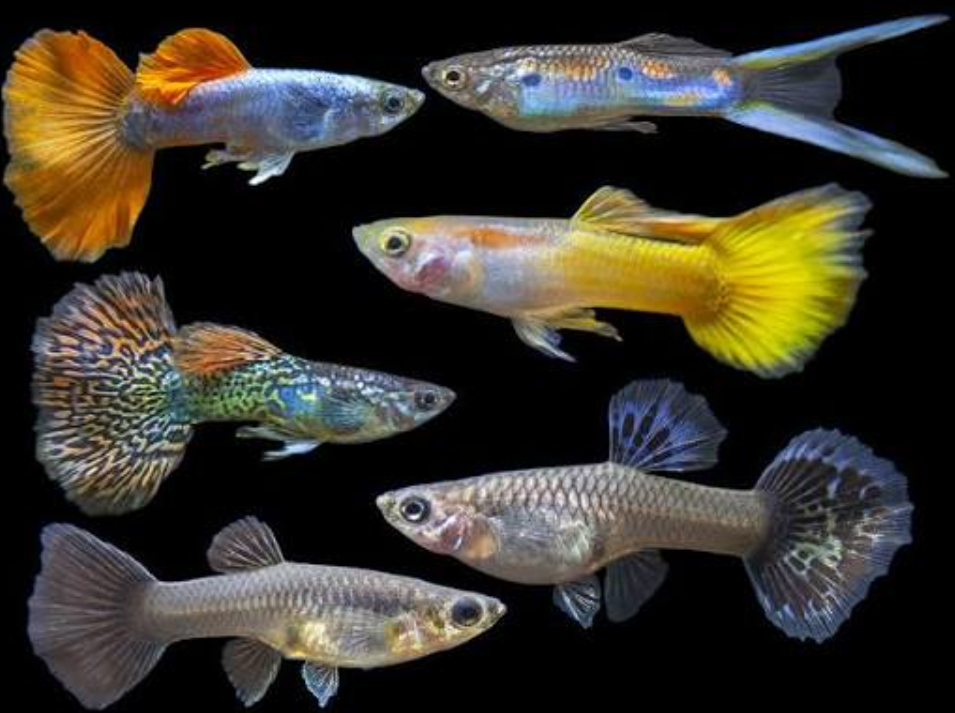
Quick Overview: How Guppies Are Classified
Before the list, it helps to understand the logic behind guppy naming.
The International Fancy Guppy Association (IFGA), the leading body for competitive guppy showing, sorts guppies first by tail shape, then by caudal fin color pattern. Hobbyists layer additional names on top for marketing and easy identification.
That means a single fish can carry multiple labels at once. A “Blue Delta Tail Guppy” is simply a delta-tail guppy that falls into the blue color class, for example.
Keep that structure in mind as you go through the list below. It will make the naming system click much faster.
Guppy Types by Tail Shape (1–13)
Tail shape is the first thing any breeder or judge looks at, and it remains the easiest way to sort guppies at a glance. IFGA shows split males into three main tail divisions, delta, veil, and sword, before color even enters the conversation.
1. Delta Tail Guppy
The Delta Tail Guppy carries a wide, triangular tail that fans out at roughly 60 to 80 degrees when fully spread. It is the shape most people picture when they hear the word “guppy.”
Breeders favor this tail because its broad, flat surface displays color and pattern more clearly than almost any other shape. That is exactly why it dominates pet store tanks worldwide.
I find delta tails the easiest entry point for new keepers. They breed fairly true to type, so a beginner’s first spawn usually looks close to the parents.
2. Veil Tail Guppy
The Veil Tail Guppy has a long, flowing tail with a gently rounded, draping edge, often paired with an equally extended dorsal fin.
This combination gives the fish a graceful, almost ribbon-like silhouette as it swims, which is why veil tails remain a favorite for display tanks rather than crowded community setups.
Their long fins are also their biggest weakness. Fin-nipping tankmates like barbs or aggressive tetras can shred a veil tail’s fins within days, so tank mates need careful selection.
3. Fantail Guppy
The Fantail Guppy produces a fan-shaped tail that is smaller and more compact than a full delta, though still clearly triangular.
It is one of the most common and easiest-to-find guppy varieties, sold widely across the aquarium trade under simple color names rather than formal show classifications.
Because the tail size is modest, fantails tend to be slightly hardier swimmers than longer-finned varieties, making them a solid pick for busier community tanks.
4. Lyretail Guppy
Named after the ancient U-shaped lyre instrument, the Lyretail Guppy has tail extensions that curve gracefully outward rather than running straight.
This tail shape sits visually between a double swordtail and a veil tail, giving the fish an elegant, slightly musical silhouette that show judges often single out for extra attention.
Lyretail genetics can be tricky to stabilize. Breeders sometimes see inconsistent curve angles across a single spawn, which keeps this variety rarer than more predictable shapes.
5. Double Swordtail Guppy
The Double Swordtail Guppy grows two elongated tail extensions, one on the top edge and one on the bottom, both roughly matched in length.
This symmetry is the whole point of the variety. Judges specifically look for balance between the top and bottom sword when scoring these fish in competition.
Uneven sword length is considered a fault, which pushes breeders toward tight, selective pairings to keep both extensions growing at the same rate across generations.
6. Top Swordtail Guppy
The Top Swordtail Guppy carries a single sword-like extension only along the upper edge of its tail, leaving the bottom edge shorter and rounded.
This asymmetry gives the fish a distinctive, slightly aggressive profile compared to its double-sworded cousin, and it remains a recognized standalone class in most IFGA shows.
Because only one sword needs to develop correctly, breeders often find top swordtails somewhat easier to produce consistently than the double variety.
7. Bottom Swordtail Guppy
The Bottom Swordtail Guppy mirrors the top sword variety, except the elongated extension grows only from the lower edge of the tail.
Visually, this creates a slightly downward-sweeping tail line that some hobbyists find more natural-looking in a planted tank, where the fish often swims closer to the substrate.
Like its top-sword counterpart, this shape is judged largely on how cleanly the single sword extends without curling or splitting.
8. Round Tail Guppy
The Round Tail Guppy carries one of the oldest tail shapes in the hobby, tracing directly back to early wild-type strains before selective breeding took over.
Its circular fin typically measures about half the length of the fish’s body, paired with a notably long, rounded dorsal fin that balances the overall look.
This variety has had a complicated show history. It was accepted as an official IFGA class in 2005 but removed again in 2007, which is part of why round tails feel like a hobbyist’s variety rather than a mainstream show class today.
9. Pin Tail (Needle Tail) Guppy
The Pin Tail Guppy, sometimes called a needle tail, has thin, needle-like strands making up both the tail and dorsal fin rather than a solid fanned membrane.
This delicate structure makes the fish look almost skeletal in a striking way, and it remains one of the rarer shapes you are likely to encounter outside of dedicated breeder circles.
Because the fin rays are so fine, pin tails are more vulnerable to physical damage than broader-tailed varieties, so gentle tankmates matter even more here.
10. Flag Tail Guppy
The Flag Tail Guppy has a rectangular tail shape with straight top and bottom edges, resembling a small flag rather than a fan or triangle.
This straightforward geometry makes flag tails easy to identify at a glance, even for beginners who are still learning to tell tail shapes apart.
The shape is less commonly bred for competition, but it remains popular among hobbyists who want something visually distinct from the typical delta or veil silhouette.
11. Spade Tail Guppy
The Spade Tail Guppy carries a tail shaped like the spade symbol from a card deck, narrow at the base and rounding out toward the tip.
This shape sits somewhere between a round tail and a delta, giving the fish a softer, less angular outline than most competition-standard varieties.
Spade tails tend to show up more often in mixed hobbyist lines than in strictly maintained show strains, which makes them a fun, less predictable variety to breed at home.
12. Spear Tail Guppy
The Spear Tail Guppy has a pointed tail resembling the tip of a spear, and it is usually seen paired with a noticeably larger overall body size.
That larger frame gives spear tails a bold, sturdy presence in the tank compared to some of the more delicate fin shapes on this list.
Because the point of the tail narrows sharply, this shape photographs particularly well from a side profile, which has made it a favorite among hobbyist photographers.
13. Half-Moon Guppy
The Half-Moon Guppy opens its tail to roughly a 180-degree spread when fully flared, creating a dramatic, half-circle silhouette.
This wide spread is often compared to half-moon betta fish, though the genetics behind the two species are completely unrelated.
The delta tail remains the most widely sold shape in pet stores, largely because it displays color patterns clearly and is relatively easy to breed consistently, but half-moon spreads are prized specifically for their show-stopping width.
Guppy Types by IFGA Color Class and Pattern (14–28)
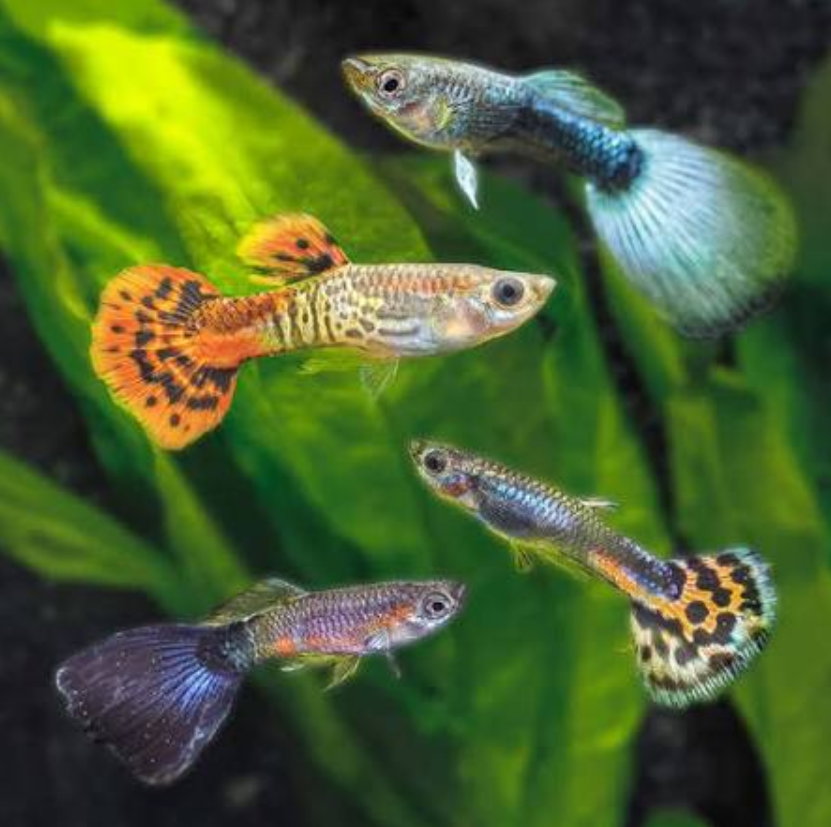
Once tail shape is settled, color pattern is the next major classification layer used in competitive showing. These fifteen patterns cover most of what you will encounter across both hobbyist tanks and formal competitions.
14. Solid (Single Color) Guppy
The Solid Guppy carries one uniform color covering the entire tail and body, with no secondary shading or contrasting pattern.
This simplicity is deceptive. Achieving a truly even, unbroken color across the whole fish actually takes careful line-breeding, since stray patches or fading are common faults judges look for.
Solid classes are broken down further by specific color, which is why you will often see a solid guppy labeled by its exact shade rather than just the word “solid.”
15. Bi-Color Guppy
The Bi-Color Guppy displays two distinct colors on the tail, with each one covering a meaningful share of the fin rather than appearing as a minor accent.
IFGA rules require the secondary color to make up at least 25 percent of the tail for the fish to qualify in this class, keeping the standard fairly strict.
This category produces some of the most visually striking show fish, since the contrast between two bold colors tends to catch the eye faster than a single solid tone.
16. Multi-Color Guppy
The Multi-Color Guppy blends three or more distinct colors across the tail and body, creating a busier, more layered appearance than bi-color strains.
Breeding for this class is genuinely difficult. Stabilizing three colors in consistent proportions across generations takes far more selective pairing than a two-color or solid line.
Because of that difficulty, well-balanced multi-color guppies often command higher prices among serious collectors than simpler solid or bi-color varieties.
17. AOC (Any Other Color) Guppy
The AOC Guppy, short for “Any Other Color,” is a catch-all class for fish whose color combination does not fit neatly into any standard IFGA category.
This class exists precisely because guppy genetics keep producing new, unpredictable combinations faster than formal classification systems can keep up.
If you ever see a guppy that looks genuinely unlike anything else in the store, there is a good chance it would be judged under this flexible category.
18. Snakeskin Guppy
The Snakeskin Guppy carries an intricate, interlocking pattern across the body that closely resembles the scales of a snake.
This pattern is one of the most technically demanding to breed cleanly, since the interlocking lines need to stay sharp and symmetrical rather than blurring into a muddled mess.
Snakeskin and cobra guppies remain among the most sought-after patterns in the breeding community, largely because achieving a clean, symmetrical pattern takes several generations of careful selection.
19. Cobra Guppy
The Cobra Guppy shares genetic roots with the snakeskin pattern but displays a denser, bolder netted look across the body that reads more dramatically from a distance.
Cobra patterns are often paired with solid-colored tails, creating a striking contrast between the patterned body and the clean, single-color fin.
Because the pattern genetics are closely linked to snakeskin, breeders sometimes see both traits appear unexpectedly within the same spawn.
20. Grass Guppy
The Grass Guppy shows fine, scattered spots across the tail that resemble blades of grass caught mid-motion.
This delicate speckling looks especially striking against pastel or pale base colors, which is why grass patterns are frequently paired with softer color strains.
Grass guppies tend to photograph beautifully under bright aquarium lighting, since the scattered spots catch and reflect light differently than a solid tail would.
21. Mosaic Guppy
The Mosaic Guppy carries an irregular, connected pattern of colored spots across the tail fin, with each spot linking loosely to its neighbors.
Unlike the fine speckling of a grass pattern, mosaic spots tend to be larger and more clustered, giving the tail a bold, almost painted appearance.
This pattern class remains a long-running favorite in competitive shows, largely because no two mosaic guppies ever look quite identical.
22. Tuxedo Guppy
The Tuxedo Guppy carries a dark, saddle-like patch covering the rear half of the body, creating a look that genuinely resembles formal wear.
This pattern works especially well against bright, contrasting tail colors, since the dark body naturally draws the eye toward the more colorful fin.
Tuxedo patterning is also a common building block in other named strains, including several half black and Moscow variations described later in this guide.
23. Metal (Full Metal) Guppy
The Full Metal Guppy carries reflective, metallic scales across the body that visibly shimmer and shift under aquarium lighting.
This metallic sheen comes from a specific genetic trait affecting how light reflects off the scale structure, distinct from standard pigment-based coloring.
Full metal strains are often crossed into other patterns, since the shimmering base tends to intensify whatever primary color sits underneath it.
24. Glass (Half Black) Guppy
The Half Black Guppy, sometimes called a glass guppy in older hobbyist literature, carries a solid black band running across the rear half of the body.
This dramatic split between a plain front half and a solid dark rear half creates one of the most recognizable silhouettes in the entire hobby.
Half black genetics show up repeatedly throughout this list, paired with red, blue, and several other tail colors to create distinct named varieties.
25. Lace Guppy
The Lace Guppy displays a delicate, web-like pattern across the tail fin, often paired with soft pastel base colors rather than bold, saturated tones.
The fine detail of this pattern is easiest to appreciate up close, which makes lace guppies a favorite subject for macro aquarium photography.
Because the pattern is so intricate, breeders consider clean lace lines a genuine mark of skill, and top examples are frequently entered into specialty show classes.
26. Leopard Guppy
The Leopard Guppy shows small, scattered dark spots across the tail, closely resembling the print pattern found on the wild cat of the same name.
This pattern tends to stand out most clearly against lighter base colors, where the dark spots have enough contrast to remain sharply visible.
Leopard patterning is considered a mid-difficulty trait to breed, easier than snakeskin or cobra but still requiring more careful selection than a simple solid color.
27. Tiger Guppy
The Tiger Guppy carries bold, streaked stripe patterns running through the tail fin, echoing the striped coat of its namesake animal.
These stripes tend to be thicker and more irregular than the fine lines seen in snakeskin patterns, giving tiger guppies a rougher, wilder visual texture.
The pattern pairs especially well with orange and red base colors, which is part of why tiger-patterned guppies are so commonly marketed under warm color names.
28. King Cobra Guppy
The King Cobra Guppy is an enhanced, high-contrast version of the standard cobra pattern, bred specifically to maximize the boldness of the netted body markings.
This intensified version is considered a premium strain within the cobra family, often commanding higher prices than a standard cobra of similar tail quality.
Breeders chasing king cobra lines typically work with closed, carefully documented breeding groups to keep the pattern’s contrast from softening over generations.
ALSO READ: Male vs. Female Guppies: How to Spot the Differences
Guppy Types by Named Color (29–45)
Color naming in the guppy hobby is less standardized than tail or pattern classification, but certain names have become industry standards recognized across nearly every aquarium retailer.
29. Albino Guppy
The Albino Guppy has a pink-white body and red eyes, caused by a genetic lack of melanin pigment production.
This trait can appear across almost any tail shape or pattern, since albinism affects pigment rather than fin structure, making albino strains a common cross into other named varieties.
Albino guppies are also slightly more light-sensitive than pigmented strains, so keepers often provide a bit more shaded cover within the tank.
30. Red Guppy
The Red Guppy carries deep, solid red coloring across the tail and body, and it remains one of the most consistently popular colors in the hobby.
Breeders have pushed red saturation further over the decades, and modern show-quality red strains display a noticeably deeper, richer tone than older lines from a generation ago.
Red pairs frequently with pattern classes like grass, mosaic, and cobra, making “red” one of the most common modifiers attached to other named varieties on this list.
31. Blue Guppy
The Blue Guppy displays a rich, solid blue that ranges from pale sky tones through deep, almost navy shades depending on the specific line.
This color is genuinely one of the most variable on the list, since lighting conditions and viewing angle can shift how saturated the blue appears.
Because of that visual range, blue guppies are frequently split into more specific named subclasses, several of which appear later in this section.
32. Green Guppy
The Green Guppy shows olive-to-avocado shading across the body and tail, a more muted and earthy tone compared to the brighter blues and reds nearby on this list.
This subtler coloring makes green guppies a good match for heavily planted tanks, where the fish can blend naturally rather than standing out sharply against the décor.
Pure green strains remain somewhat less common in mainstream pet stores than red or blue, which keeps them a slightly more specialized find.
33. Yellow Guppy
The Yellow Guppy carries bright tail coloring that ranges from a pale, almost cream shade through a deep, near-orange yellow in top strains.
This color family tends to photograph exceptionally well under standard aquarium lighting, since yellow reflects light differently than the cooler blue and green tones.
Yellow is also a common base for grass and mosaic pattern crosses, giving breeders a bright canvas to work the scattered-spot patterns against.
34. Purple Guppy
The Purple Guppy displays a deep violet shade that often shifts slightly depending on the angle of light hitting the scales.
This color-shifting quality comes from the same structural, light-reflecting scale traits found in metallic strains, rather than purple pigment alone.
Purple remains one of the rarer solid colors in casual pet store tanks, making it a variety many hobbyists specifically seek out from dedicated breeders.
35. Black Guppy
The Black Guppy carries solid black coloring across the entire body, producing one of the most visually dramatic solid color classes in the hobby.
Achieving true, deep black without any brown or gray undertone is genuinely difficult, which is why high-quality black strains are prized among serious collectors.
Black also serves as the foundation color behind several half black and tuxedo varieties described earlier in this guide.
36. White Guppy
The White Guppy has a clean, milky white body with minimal patterning, offering a striking contrast against darker gravel or planted backgrounds.
This color reads as almost ghost-like under bright lighting, and it pairs particularly well with black or dark blue tankmates for visual contrast in a display tank.
White strains are frequently crossed with platinum genetics, discussed later in this section, since the two colors share overlapping breeding lines.
37. Neon Blue Guppy
The Neon Blue Guppy displays a pale, glowing blue shade that is noticeably lighter than standard solid blue strains.
The exact shade can shift depending on tail type, ranging from a bright metallic sky tone through a deeper, almost electric hue in certain lines.
This variety tends to stand out even in dimly lit tanks, since the pale tone reflects available light more efficiently than deeper, more saturated colors.
38. Electric Blue Guppy
The Electric Blue Guppy carries a vivid, saturated blue that appears almost fluorescent under strong aquarium lighting.
This is generally considered the most intense blue variation available in the hobby, and it is frequently used as a benchmark color when judging other blue strains.
Because the color is so eye-catching, electric blue guppies are among the most commonly photographed fish shared across aquarium hobbyist communities online.
39. Turquoise Guppy
The Turquoise Guppy blends blue and green tones into a single color, sitting visually between the standard blue and green classes described above.
This in-between quality makes turquoise strains genuinely tricky to classify consistently, since the exact balance of blue versus green can vary noticeably between individual fish.
Turquoise pairs particularly well with metallic and lace pattern genetics, producing some of the more subtly complex color combinations in the hobby.
40. Panda Guppy
The Panda Guppy carries black and white patches arranged in a way that echoes the coloring of its namesake animal.
This is a genuinely rare and distinctive pattern, and finding a well-marked panda guppy with clean, sharply defined patches is considered a notable find even among experienced collectors.
The high contrast between the black and white patches makes this variety instantly recognizable, even to hobbyists unfamiliar with formal guppy classification.
41. Half Black Red Guppy
The Half Black Red Guppy combines a bright red tail with the solid black half-body marking described earlier in the half black pattern class.
This is one of the most popular named color combinations in the entire hobby, since the sharp black-to-red contrast reads clearly even from across a room.
Show judges specifically look for a clean, straight division between the black body and the red coloring, with any blurring or fading counted as a fault.
42. Half Black Blue Guppy
The Half Black Blue Guppy pairs the same solid black half-body marking with a blue tail instead of red, creating a cooler-toned version of the previous variety.
This combination tends to look particularly striking under blue-tinted aquarium lighting, which enhances the contrast between the dark body and vivid tail color.
Like its red counterpart, breeders prize a crisp, well-defined boundary between the black body section and the colored tail.
43. Coral Red Guppy
The Coral Red Guppy displays a warm, slightly orange-tinted red, distinct from the deeper, cooler red strains described earlier in this section.
This warmer undertone gives coral red guppies a softer, sunset-like glow compared to standard red varieties, making them a popular choice for warm-toned aquascapes.
The name draws a direct comparison to coral reef coloring, and the resemblance is genuinely close when the fish is viewed under natural light.
44. Pastel Guppy
The Pastel Guppy carries soft, muted color tones across the tail, and this palette is especially popular within lace and mosaic pattern strains.
Pastel colors tend to be gentler on the eye than the bold, saturated tones found in strains like electric blue or coral red, offering a calmer overall look.
Because the coloring is more subtle, pastel guppies often display their patterns more clearly than heavily saturated fish, where bold base color can sometimes overwhelm fine detail.
45. Platinum Guppy
The Platinum Guppy shows a bright, silvery-white body with a distinct metallic sheen, closely related genetically to the white and full metal strains described earlier.
This shimmering finish sets platinum apart from standard white guppies, giving the fish a noticeably more reflective, almost polished appearance under aquarium lighting.
Half black varieties consistently rank among the top sellers in the ornamental fish trade, since the sharp contrast between the black body and bright tail photographs and displays exceptionally well, and platinum strains are frequently crossed into half black lines for added shine.
ALSO READ: How Many Male Guppies Should You Keep Together? A Must-Read Guide for Beginner
Named Strains and Special Breeds (46–60)
The final category covers guppies bred as distinct, recognizable lines, often developed by specific breeders, clubs, or regions with their own established reputations.
46. Moscow Guppy
The Moscow Guppy was developed in Russia and is known for thick, saturated body color that extends noticeably further onto the head than most other strains.
This dense pigmentation is the defining trait of the entire Moscow family, and it shows up consistently across every color variation bred within the line.
Moscow guppies have also earned a reputation as “chameleon guppies” among hobbyists, since their color intensity can shift subtly depending on the fish’s mood and surroundings.
47. Moscow Blue Guppy
The Moscow Blue Guppy is a deep blue variation of the broader Moscow strain, and it remains one of the most widely recognized and traded versions of the line.
Compared to a standard blue guppy, the Moscow blue shows noticeably richer, more opaque coloring thanks to the underlying Moscow genetics.
This strain is frequently used as an entry point for hobbyists first exploring Moscow lines, since blue tends to be more widely available than rarer Moscow colors.
48. Moscow Black Guppy
The Moscow Black Guppy carries a solid black coloring prized specifically for its dense, opaque finish rather than the slightly translucent black seen in some standard strains.
Achieving this level of opacity takes careful, closed-line breeding, since introducing outside genetics too casually can quickly dilute the trait.
Serious Moscow black lines are often maintained within small, dedicated breeder circles rather than sold widely through general pet retailers.
49. Japan Blue Guppy
The Japan Blue Guppy is a refined blue strain developed through meticulous Japanese selective breeding programs, known for exceptionally clean, even coloring.
Japanese breeding culture places heavy emphasis on symmetry and consistency, and that same discipline shows clearly in how uniform this strain’s blue tone appears across the entire tail.
This strain is often held up as a benchmark for what dedicated, patient line-breeding can achieve within a single color class.
50. German Yellow Guppy
The German Yellow Guppy traces its roots to German competitive breeding lines, and it remains a benchmark strain within the broader yellow color family.
European guppy clubs have a long, well-documented show history, and German yellow lines specifically are often cited as some of the most stable and consistent yellow genetics available.
This strain tends to hold its bright coloring reliably across multiple generations, which is part of why it remains popular among breeders chasing consistent yellow results.
51. Endler Guppy
The Endler Guppy is technically a separate species, Poecilia wingei, closely related to the fancy guppy but distinguished by its smaller size and bold, neon-bright colors.
Endler guppies deserve special mention. Though closely related, they are classified as a separate species and are prized for retaining bright, undiluted colors that pure fancy guppy strains sometimes lose through generations of crossbreeding.
Because the two species can interbreed in captivity, dedicated Endler keepers often maintain strict, single-species tanks to preserve the purity of their lines.
52. Scarlet Livebearer
The Scarlet Livebearer, scientifically Micropoecilia picta, is a brackish-water relative of the standard guppy that remains genuinely rare in typical home aquariums.
Unlike fancy guppies, this species requires some level of salinity in its water to thrive, which sets it apart from the freshwater setups most guppy keepers are used to.
Its striking coloring and unusual water requirements make it a niche favorite among hobbyists specifically interested in livebearer diversity beyond standard Poecilia reticulata.
53. Dumbo Ear Guppy
The Dumbo Ear Guppy carries enlarged, wing-like pectoral fins that resemble the oversized ears of the famous Disney elephant character.
This trait adds a distinctive visual flair as the fish swims, since the enlarged fins flare out noticeably more than the compact pectoral fins seen on standard guppies.
Dumbo ear genetics can be combined with almost any tail shape or color pattern, making it one of the more flexible traits for breeders to work into existing lines.
54. Big Ear Guppy
The Big Ear Guppy shows a milder version of the dumbo trait, with pectoral fins that are moderately enlarged rather than dramatically oversized.
This subtler expression appeals to hobbyists who like the general look of enlarged fins without the more exaggerated proportions seen in full dumbo ear strains.
Breeders sometimes use big ear lines as a stepping stone toward developing more pronounced dumbo ear genetics over successive generations.
55. Blue Grass Guppy
The Blue Grass Guppy combines a blue base color with the fine, scattered grass pattern described earlier in this guide.
The result is a tail that reads as mostly blue from a distance but reveals delicate, speckled detail up close, rewarding closer inspection.
This combination remains a steady favorite among hobbyists who want pattern detail without sacrificing a strong, easily identifiable base color.
56. Red Grass Guppy
The Red Grass Guppy pairs the same scattered grass pattern with a red base color instead of blue, creating a warmer-toned version of the previous variety.
The fine speckling tends to stand out with particular clarity against red, since the contrast between the pattern and base color is often sharper than on cooler-toned strains.
Like its blue counterpart, this variety balances a strong, recognizable base color with intricate pattern detail that becomes more apparent on close viewing.
57. Golden Guppy
The Golden Guppy is a genetic strain producing a warm, metallic gold body tone distinct from the brighter, more orange-leaning standard yellow guppy.
This metallic quality links golden strains to the full metal pattern class described earlier, since both traits involve the same light-reflecting scale structure.
Golden guppies tend to catch the eye under warm-spectrum aquarium lighting, where the metallic sheen appears richest and most pronounced.
58. Chocolate Guppy
The Chocolate Guppy displays a rich, dark brown body color, notably less common in the hobby than standard black strains.
This warmer, earthier dark tone offers an alternative for hobbyists who want a deep, dramatic color without the stark contrast of true black.
Because chocolate genetics are less widely bred than black, sourcing a well-colored chocolate guppy often means seeking out a specialty breeder rather than a general retailer.
59. Tequila Sunrise Guppy
The Tequila Sunrise Guppy displays a gradient pattern blending orange, yellow, and red across the tail, named for its visual resemblance to the layered cocktail.
This gradient effect is genuinely difficult to breed consistently, since maintaining a smooth, layered color transition takes precise selection across each generation.
The name has become widely recognized shorthand in the hobby, and tequila sunrise strains are frequently featured in online guppy photography communities specifically for their striking gradient effect.
60. Cobra Full Red Guppy
The Cobra Full Red Guppy combines the dense, netted cobra body pattern with a fully saturated red tail, making it a favorite in modern competitive shows.
This pairing highlights both traits at once, letting the intricate body pattern and the bold tail color stand out clearly rather than competing visually with each other.
As cobra genetics have become more refined in recent years, full red pairings like this one have become one of the more consistently awarded combinations on the show circuit.
ALSO READ: Guppy Tank Size: How Many Guppies in a 5, 10, 20, 30, 55, 75 Gallon Tank
Popular Guppy Categories at a Glance
| Category | Examples | Defining Trait |
| Tail Shape | Delta, Veil, Lyretail | Shape and spread of the caudal fin |
| IFGA Color Class | Snakeskin, Cobra, Mosaic | Body and tail pattern structure |
| Named Color | Red, Blue, Half Black | Specific, consistent color naming |
| Special Strain | Moscow, Endler, Dumbo Ear | Distinct genetic lines or related species |
Why Guppies Come in So Many Varieties
Guppies did not start out this colorful. Wild guppies from Trinidad and northern South America are far plainer than the fish sold in stores today.
According to the U.S. Geological Survey, wild-type guppies were first introduced outside their native range largely through fish farm releases, aquarium releases, and intentional mosquito-control programs. That original wild population is the genetic base every fancy strain descends from.
Researchers have also relied heavily on this species for other reasons. Guppies have served as model organisms in ecology, evolutionary biology, and animal behavior research for more than a century, according to a peer-reviewed study published through the National Institutes of Health’s PubMed Central archive.
That long research history overlaps directly with the hobbyist breeding world. The same traits scientists study, like heritable color patterns and rapid reproduction, are exactly what breeders exploit to create new strains.
The Business Behind the Hobby
Guppy breeding is not just a hobbyist pastime. It supports a measurable slice of the ornamental fish industry.
According to University of Florida IFAS Extension research, the total value of aquacultured ornamental fish sold by U.S. farmers was estimated at over $41 million in a recent reporting year, with Florida alone accounting for the majority of national production.
Freshwater livebearers, including guppies, remain one of the most commonly farmed groups within that industry, prized for fast reproduction cycles and consistent consumer demand.
This economic backdrop explains why new strains keep appearing. Breeders who develop a distinctive, stable pattern can build a genuine niche within a market worth tens of millions of dollars annually.
How to Choose the Right Guppy Type for Your Tank
With 60 varieties to consider, a few practical questions can help narrow things down.
Are you keeping a community tank or a dedicated breeding setup? Long-finned varieties like veil tails and double swordtails are more vulnerable to fin-nipping tankmates than shorter-finned types.
Do you want to breed for a specific look? Named strains like Moscow or Endler guppies tend to hold their traits more consistently across generations than mixed-pattern fish from a typical pet store tank.
How much are you willing to spend? Rare patterns like pin tail or true cobra strains often cost significantly more than common delta tail varieties sold in bulk.
Frequently Asked Questions
What is the most common type of guppy sold in pet stores? The Delta Tail Guppy is the most widely available shape, largely because its wide, flat tail displays color patterns clearly and breeds true relatively easily.
Are Endler guppies the same species as fancy guppies? No. Endler guppies are classified as Poecilia wingei, a closely related but distinct species from the fancy guppy, Poecilia reticulata, though the two can interbreed in captivity.
What makes Moscow guppies different from standard guppies? Moscow guppies carry a genetic trait that produces thicker, more saturated body coloring that extends further onto the head, a look bred specifically by Russian breeders.
Can guppy color patterns change over the fish’s lifetime? Some strains, particularly Moscow guppies, can show subtle shifts in color intensity depending on mood, stress, and lighting, which is why hobbyists sometimes call them “chameleon guppies.”
Are wild guppies considered an invasive species? Yes, in some regions. According to U.S. Fish and Wildlife Service risk assessments, guppies have established populations outside their native range in several U.S. states and other countries, primarily through aquarium releases.
Final Thoughts
Sixty types barely scratches the surface of what dedicated breeders have created from a single small fish. New tail shapes, patterns, and named strains continue to appear every year through careful, patient selective breeding.
Whether you are shopping for your first tank or building a serious breeding project, understanding this classification system changes how you see every guppy in the store. What used to look like “just a guppy” now reads like a labeled catalog of genetics and generations of careful work.
Start simple if you are new to the hobby. A few delta tail or half black guppies will teach you the basics before you move toward rarer strains like Moscow blacks or true pin tails.
References
- U.S. Geological Survey. Guppy (Poecilia reticulata) — Species Profile, Nonindigenous Aquatic Species Database. https://nas.er.usgs.gov/queries/FactSheet.aspx?SpeciesID=863
- U.S. Fish and Wildlife Service. Guppy (Poecilia reticulata) Ecological Risk Screening Summary. https://www.fws.gov/sites/default/files/documents/Ecological-Risk-Screening-Summary-Guppy.pdf
- Hill, J.E. & Yanong, R.P.E. Freshwater Ornamental Fish Commonly Cultured in Florida (Circular 54/FA054). University of Florida IFAS Extension. https://edis.ifas.ufl.edu/publication/FA054/pdf
- Groover, E.M., DiMaggio, M.A., & Cassiano, E.J. Overview of Commonly Cultured Marine Ornamental Fish (FA224). University of Florida IFAS Extension. https://edis.ifas.ufl.edu/publication/FA224/pdf
- Livengood, E.J. & Chapman, F.A. The Ornamental Fish Trade: An Introduction with Perspectives for Responsible Aquarium Fish Ownership (FA124). University of Florida IFAS Extension. https://edis.ifas.ufl.edu/publication/FA124/pdf
- Hawaii Department of Land and Natural Resources. Guppy — Aquatic Invasive Species. https://dlnr.hawaii.gov/ais/other-ais/guppies/
- Fraser, B.A., Weadick, C.J., Janowitz, I., Rodd, F.H., & Hughes, K.A. Sequencing and Characterization of the Guppy (Poecilia reticulata) Transcriptome. National Institutes of Health, PubMed Central. https://www.ncbi.nlm.nih.gov/pmc/articles/PMC3113783/