30 Stunning Types of Tetra Fish (Complete Identification, With Pictures)
Tetras are, in my honest opinion, the fish that make an aquarium feel alive. A single neon tetra sitting still in a bag looks unremarkable. Put six of them in a planted tank, and suddenly you have a shimmering, moving cloud of color.
That contrast is exactly why tetras remain one of the most searched and most stocked freshwater fish groups in the world.
This guide covers 30 distinct types of tetra fish, organized so you can quickly find the species that fits your tank, your experience level, and your taste in color. I have included care basics, size, temperament, and origin for each one.
Why Tetras Dominate the Freshwater Aquarium Hobby
Tetras belong to the family Characidae, a group native mostly to Central and South America, with a few African relatives. The genus Aphyocharax alone contains at least ten species that share the same basic body plan and behavior pattern. Most tetras share three traits: small size, a schooling instinct, and a peaceful temperament.
Because they need company, tetras should never be bought as single fish. Schooling fish need more than just a handful of buddies by their side, and the safe minimum for a group is generally six individuals. Anything less, and the fish will hide, fade in color, and show visible stress.
Tank size matters just as much as group size. A good rule of thumb is one gallon of water per inch of fish, though small species like neon tetras need at least ten gallons regardless of how few you keep. I always tell new hobbyists to size the tank for the school, not for the individual fish.
Water flow and filtration also shape how well tetras thrive. A filter rated to process the entire tank volume at least four times per hour is the standard recommendation, though tetras generally prefer slow to moderate current rather than a strong one. This mirrors their natural habitat, which is usually a slow blackwater stream, not a rushing river.
The trade itself is enormous. The ornamental fish industry is valued at approximately one billion US dollars, with about 278 million dollars of that figure tied to imports, and freshwater species make up 90 to 96 percent of the annual trade. Tetras are a major part of that freshwater share.
Water chemistry is another area where tetras are more particular than casual buyers expect. Even though most tetras sold today are commercially raised in harder water than their wild ancestors ever experienced, their bodies still respond best to conditions that mimic a soft, slightly acidic stream. That is one reason color intensity often improves after a tank matures and tannins from driftwood or leaf litter begin to tint the water.
Sudden parameter swings cause more harm than most beginners realize. Even a healthy fish can go into shock from a fast pH or temperature shift, so slow acclimation matters just as much for a tetra as it does for a delicate marine species. I have seen entire schools struggle within hours simply because someone rushed the process of adding new fish to an established tank.
Salt is sometimes used in freshwater tetra tanks, but it deserves caution rather than routine use. If freshwater aquarium salt is added, the tank’s specific gravity should remain around 1.004 and should not fluctuate more than plus or minus 0.001 within a 24-hour period, since sudden salinity changes can stress fish.
Not every species tolerates it equally well, so research the specific tetra before reaching for the salt container.
Now let’s get into the list. I have grouped the 30 types by theme, moving from the easiest beginner fish through to the rarest specialist species, so the article stays easy to scan no matter your experience level.
Beginner-Friendly Tetras (Hardy and Widely Available)
1. Neon Tetra (Paracheirodon innesi)
The neon tetra is the fish most people picture when they hear the word “tetra.” It grows to about 1.5 inches and lives four to five years, displaying brilliant iridescent blue and red stripes that shimmer under aquarium lighting. It is a beginner-level fish, though a fully cycled tank and stable water quality are still required.
Neons originate from soft, dark water. Their natural range covers the blackwater streams and tributaries of the Amazon Basin, particularly in Peru, Colombia, and Brazil. This species has been farmed for so long that it has been a favorite in freshwater aquariums since the fish first appeared in the hobby during the 1930s.
2. Black Neon Tetra (Hyphessobrycon herbertaxelrodi)
This fish looks similar to the neon at a glance but carries a different mood entirely. Black neon tetras have a very different look overall but still feature an iridescent horizontal stripe, and they belong to a different genus while sharing many of the same peaceful traits. I find them underrated simply because they get overshadowed by their flashier cousin.
3. Cardinal Tetra (Paracheirodon axelrodi)
Cardinals are often confused with neons, but the difference is in the stripe. Cardinal tetras also have red and blue stripes, including a bright neon blue one, but the red and blue stripes run the entire length of the body instead of stopping halfway like the neon’s does.
4. Green Neon Tetra (Paracheirodon simulans)
Despite the name, this one is a separate species entirely. Green neons aren’t actually neon tetras at all; they are Paracheirodon simulans, with a smaller red stripe along the tail and a green-blue neon stripe instead of a pure blue one. They can live as long as eight years in an aquarium, which is impressive for such a tiny fish.
5. Rummy Nose Tetra (Hemigrammus rhodostomus)
Rummy nose tetras are prized for their tight, synchronized schooling behavior. Their bright red nose and horizontally striped tail make them a favorite centerpiece school for planted tanks, and they signal water quality problems fast, since their red color fades quickly under poor conditions.
6. Glowlight Tetra (Hemigrammus erythrozonus)
A calmer, more understated fish, the glowlight carries a single horizontal orange-red stripe along a translucent body. It handles community tanks with ease and rarely bothers other fish, making it a solid pick for mixed schools.
7. Lemon Tetra (Hyphessobrycon pulchripinnis)
Named for its pale yellow body and red-rimmed eye, the lemon tetra is hardier than its delicate appearance suggests. It tolerates a wider pH range than neons or cardinals, which makes it forgiving for households with harder tap water.
8. Head and Taillight Tetra (Hemigrammus ocellifer)
This species carries a distinctive glowing spot near the head and another near the tail base. It is native to the Amazon River basin across Ecuador, Guyana, Suriname, French Guiana, Peru, and Bolivia, and it is currently in trade throughout the United States. It is a calm, adaptable schooler that rarely causes trouble.
9. Bloodfin Tetra (Aphyocharax anisitsi)
Bloodfins are silver-bodied with bright red-orange fins, giving them a striking look in a dimly lit tank. This species belongs to a genus of at least ten related tetras that share the same basic characteristics. They are hardy enough to tolerate slightly cooler water than most tropical tetras.
10. Black Skirt Tetra (Gymnocorymbus ternetzi)
Also called the black widow tetra, this species has a distinctive black, flowing “skirt” fin. It is one of the popular beginner tetras alongside red eye, serpae, and bloodfin varieties, and it tolerates a wide range of water conditions. Long-finned and color-morph versions, including white and pink dyed variants, are also sold commercially.
Semi-Advanced and Larger-Bodied Tetras
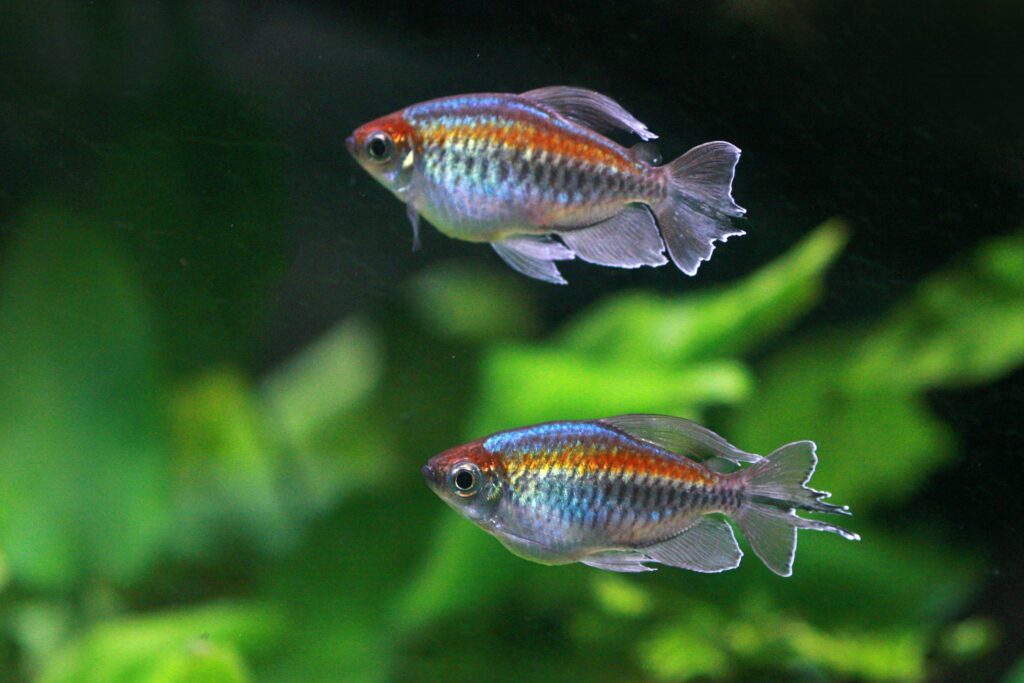
11. Congo Tetra (Phenacogrammus interruptus)
The Congo tetra is one of the few popular tetras from Africa rather than South America. It is native to the Middle Congo Basin, reaches about 8 centimeters for males and 6 centimeters for females, and prefers water with a pH between 6.0 and 8.0. Females can lay up to 300 eggs, which sink to the bottom and hatch within six days.
Its shimmering rainbow scales make it look almost metallic under the right lighting. Because of its larger size, it needs a bigger tank than the classic neon-sized species, and it does best with equally sized, calm tank mates.
12. Buenos Aires Tetra (Hemigrammus anisitsi)
This is a big, energetic tetra that some hobbyists underestimate. It grows larger and moves faster than most community tetras, and its activity level can intimidate smaller, more timid fish sharing the same tank.
13. Serpae Tetra (Hyphessobrycon eques)
Serpae tetras carry a deep red body with a black shoulder patch, and they are gorgeous in a school. However, they can sometimes be nippy, especially when kept in insufficient numbers, so a proper group size actually reduces aggression rather than increasing it.
14. Red Eye Tetra (Moenkhausia sanctaefilomenae)
A silvery, torpedo-shaped fish with a striking red ring around the eye, this species is calm, hardy, and grows a bit larger than typical nano tetras. It handles a wide temperature range and works well as a mid-tank dither fish for shier species.
15. Diamond Tetra (Moenkhausia pittieri)
This species is named for the sparkling, diamond-like flecks that cover its body under aquarium lighting. It is a somewhat overlooked gem in the hobby, deserving more attention than it usually gets from casual buyers.
16. Emperor Tetra (Nematobrycon palmeri)
Emperor tetras carry a deep violet body with a distinctive forked tail marked by a long central filament in males. They do best in well-established aquariums with softer, more acidic water, unlike some of the tougher beginner species.
17. Penguin Tetra (Thayeria boehlkei)
Named for its upward-tilted swimming posture, the penguin tetra has a bold black stripe running through the lower half of its tail. Like the emperor tetra, it is considered more challenging to keep and prefers a mature tank with stable, softer water.
18. X-ray Tetra (Pristella maxillaris)
The x-ray tetra earns its name from its semi-transparent body, which reveals the skeletal structure and internal organs beneath the scales. It is unusually tolerant of varying water hardness compared to most tetras, which makes it a flexible choice.
19. Bleeding Heart Tetra (Hyphessobrycon erythrostigma)
This species carries a distinctive red splash on its side that resembles a small wound, hence the dramatic name. It grows larger than nano tetras and pairs well with medium community fish rather than tiny shrimp-safe tanks.
20. Colombian Tetra (Hyphessobrycon columbianus)
A robust, rosy-pink fish with a black-and-white tail edge, the Colombian tetra is bigger and hardier than most tetras on this list. It suits larger community tanks with slightly more assertive tank mates.
Rare, Unique, and Specialist Tetras
21. Mexican Blind Cave Tetra (Astyanax mexicanus)
This is one of the strangest fish in the entire hobby. The blind cave tetra is a unique species that was discovered in a cave system in Mexico, and unlike nearly every other tetra, it lacks functional eyes entirely. It navigates using a highly developed lateral line system instead of sight.
22. Ember Tetra (Hyphessobrycon amandae)
A true nano species, the ember tetra rarely exceeds an inch in length and glows a warm orange color against dark substrate. It is one of the smallest tetras commonly sold and works beautifully in nano and shrimp tanks.
23. Von Rio Tetra (Hyphessobrycon flammeus)
Also called the flame tetra, this species carries a warm red-orange body with two small dark shoulder marks. It is an old aquarium staple, appearing in the hobby for decades because of its color and easygoing nature.
24. Silvertip Tetra (Hasemania nana)
Named for the pale, silvery tips on its otherwise coppery fins, this species is active and hardy. It can be slightly nippy in small groups, so keeping a full school reduces the fin-nipping tendency common in undersized shoals.
25. Pristella Tetra (Pristella maxillaris variants)
Some hobbyists distinguish golden and long-finned pristella strains separately from the standard x-ray tetra listing above, given how differently they present in a tank. These color and fin variants are farm-bred rather than wild forms.
26. Loreto Tetra (Hyphessobrycon loretoensis)
A lesser-known species with a subtle golden sheen and a faint stripe, the Loreto tetra is harder to find commercially but appeals to collectors seeking something outside the mainstream selection.
27. Black Phantom Tetra (Hyphessobrycon megalopterus)
This species carries a smoky gray-black body with a distinctive dark shoulder blotch shaped like a shield. Males display more vivid fin coloration than females, especially when competing for attention within the school.
28. Red Phantom Tetra (Hyphessobrycon sweglesi)
Closely related to the black phantom, this variant shows a soft rosy-red body instead of gray. It shares the same calm temperament and shield-shaped shoulder marking as its black-bodied relative.
29. Flame Tetra (Hyphessobrycon flammeus alternate strain)
Sometimes marketed separately from the Von Rio strain, this variant carries a deeper red saturation across the entire body. Selective breeding over decades has produced multiple color intensities within the same species line.
30. Long-Finned Tetra Varieties (Selectively Bred Strains)
Several species on this list, including black skirt, serpae, and neon tetras, are now sold in long-finned forms. Selectively bred color variants and long-finned strains of certain tetras are also available for hobbyists who want a different visual effect from the same species. These are not separate species biologically, but they are marketed and stocked as distinct varieties.
Tank Setup Tips That Apply to Nearly Every Tetra
Lighting and decor affect color intensity more than people expect. Neon tetras usually show their brightest colors when they feel secure and relaxed, whereas stressed fish often look faded and lack sparkle. Dark substrate and dense planting consistently bring out better coloration across almost every species on this list.
Water temperature stability matters more than the exact number. Tetras thrive in warm, stable temperatures between 72 and 82 degrees Fahrenheit, and fluctuations greater than plus or minus 2 degrees within 24 hours can stress the fish and lead to health issues. A reliable heater is not optional equipment here.
Diet should stay varied rather than repetitive. Most tetras are omnivorous and do well on flakes, granules, and shrimp pellets, with frozen or live foods fed as occasional treats or to encourage spawning. Overfeeding, not underfeeding, is the more common mistake I see from new keepers.
Breeding is possible but rarely simple. Tetras are egg layers that tend to spawn in groups, and extra effort is required to separate the adults from the eggs after spawning, since many tetras will eat their own eggs. For neon tetras specifically, eggs hatch in 24 to 36 hours at the right temperature, and the resulting fry are extremely tiny, needing infusoria or liquid fry food before they can accept larger meals.
Disease awareness protects your entire school. Neon tetra disease, caused by a microsporidian parasite, is the most serious health issue in the species, causing difficulty swimming and fading color, with no available cure once a fish is infected. Removing an infected fish immediately is the only way to protect the rest of the school.
Choosing the Right Tetra for Your Tank
If you are setting up your first aquarium, start with neon, black neon, glowlight, or lemon tetras. These species forgive small mistakes and adjust well to typical tap water once conditioned.
If your tank is already established with soft, slightly acidic water, cardinal, emperor, and penguin tetras will reward the extra effort with sharper color and steadier behavior. These are not fish I would recommend for a brand-new tank still cycling.
For anyone drawn to something unusual, the Mexican blind cave tetra is genuinely one of a kind. Watching an eyeless fish navigate a decorated tank without ever bumping into anything is oddly fascinating, and it never stops being a good conversation starter for guests.
Whatever you choose, remember the golden rule that applies across all 30 species: buy in proper school sizes, match the tank to the group, and keep water conditions stable. Do that, and nearly any tetra on this list will reward you with years of color and movement.
Common Mistakes to Avoid With Any Tetra Species
Buying too few fish is the single most common error. A group of two or three tetras will spend most of its time hiding rather than schooling, and colors fade noticeably under that kind of stress. Six is the honest floor, not a suggestion, and larger groups almost always look and behave better.
Skipping the nitrogen cycle is a close second mistake. Tetras are sensitive to ammonia and nitrite spikes, and a tank that has not fully cycled before fish are added puts the entire school at risk within the first week. Patience here saves both money and fish lives.
Mixing incompatible temperaments causes avoidable conflict. Nippy species like serpae tetras placed in groups that are too small, or paired with slow-moving, long-finned fish such as bettas or fancy guppies, can lead to torn fins and stressed tank mates. Matching temperament, not just size, keeps a community tank peaceful.
Overfeeding is more damaging than underfeeding. Tetras have tiny stomachs, and uneaten food breaks down into ammonia that stresses the whole tank. Feeding a small amount once or twice a day, only what the fish can finish within a couple of minutes, keeps water quality far more stable than free-feeding.
Frequently Asked Questions About Tetra Fish
How many tetras should I keep together? Six is the minimum for almost every species on this list, though ten or more looks and behaves noticeably better for shier fish like cardinals and rummy nose tetras.
Can different types of tetra fish live in the same tank? Yes, in most cases. Mixed schools of similarly sized, similarly tempered tetras generally coexist well, though very large species like the Buenos Aires tetra should be kept separate from tiny nano fish such as embers.
Do tetras need a heater? Almost all tropical tetras need one. Stable warm water between roughly 72 and 82 degrees Fahrenheit is essential, and unheated rooms rarely stay within that range year-round.
What is the easiest tetra for a total beginner? Black skirt, glowlight, and lemon tetras tend to be the most forgiving of inconsistent care, tolerating a wider range of water conditions than delicate species like cardinals or emperors.
Why do my tetras look pale instead of colorful? Pale coloring almost always signals stress, whether from too small a group, poor water quality, harsh lighting, or a lack of hiding spots. Correcting the underlying stressor usually restores color within days.
References
- U.S. Geological Survey. Nonindigenous Aquatic Species Database. Wetland and Aquatic Research Center, Gainesville, Florida. https://nas.er.usgs.gov/queries/default.aspx
- U.S. Fish and Wildlife Service. Ecological Risk Screening Summary: Neon Tetra (Paracheirodon innesi). https://www.fws.gov/sites/default/files/documents/Ecological-Risk-Screening-Summary-Neon-Tetra.pdf
- U.S. Fish and Wildlife Service. Ecological Risk Screening Summary: Bloodfin Tetra (Aphyocharax anisitsi). https://www.fws.gov/sites/default/files/documents/Ecological-Risk-Screening-Summary-Bloodfin-Tetra.pdf
- U.S. Geological Survey. Congo Tetra (Phenacogrammus interruptus) – Species Profile. Nonindigenous Aquatic Species Database. https://nas.er.usgs.gov/queries/FactSheet.aspx?SpeciesID=2632
- University of Florida, IFAS Extension (EDIS). Livengood, E. J., and Chapman, F. A. The Ornamental Fish Trade: An Introduction with Perspectives for Responsible Aquarium Fish Ownership (FA124). https://edis.ifas.ufl.edu/fa124
- The Ohio State University. Fish Basics – Pets 4 Life. https://u.osu.edu/pets4life/pet-care-basics/fish/
- Pennsylvania State University Extension. Your Own Freshwater Aquarium in the Classroom. https://ecosystems.psu.edu/youth/sftrc/lesson-plans/water/k-5/freshwater-aquarium