Do Mystery Snails Eat Plants? What You Need to Know Before Adding Them to a Planted Tank
When I set up my first proper planted aquarium, I spent weeks choosing the right plants, positioning them carefully, and waiting patiently for everything to settle into that lush, layered look I had been working toward.
The last thing I wanted was to introduce something that would quietly dismantle it all from the inside.
Mystery snails kept appearing on my shortlist of potential additions. Peaceful, visually striking, useful for algae control — everything pointed toward them being a good fit. But one question kept stopping me: do mystery snails eat plants?
The Direct Answer
Mystery snails are generally considered safe for planted aquariums. They are not plant predators in any meaningful sense. Under normal conditions, with healthy plants and well-fed snails, mystery snails will graze algae, biofilm, and decomposing organic material without targeting or consuming living plant tissue.
However — and this matters — there are specific circumstances under which mystery snails will eat plants. Understanding those circumstances is what allows you to make a genuinely informed decision rather than relying on a blanket reassurance that may not hold in every situation.
The full picture is more conditional than a simple yes or no. That conditionality is exactly what this article unpacks.
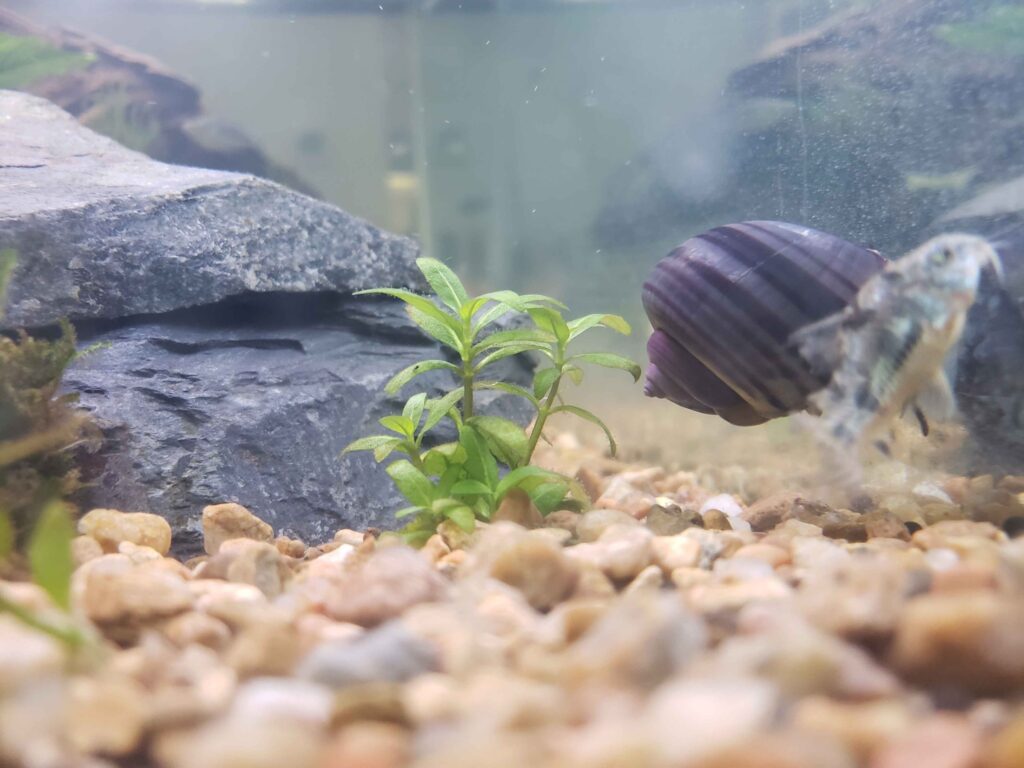
What Mystery Snails Are Designed to Eat
Understanding mystery snail feeding biology helps clarify why plants are usually safe.
Mystery snails (Pomacea bridgesii) are opportunistic omnivores and detritivores. Their natural diet in the wild consists primarily of:
- Algae and biofilm growing on hard surfaces
- Decomposing plant matter and leaf litter
- Fungal growth on submerged wood
- Soft organic debris in the substrate
- Uneaten food and decaying organic material
Their feeding mechanism — a radula, a rasping, tongue-like organ — is adapted for scraping surfaces. It works by moving across a substrate and pulling loose, soft material into the mouth. It is excellent for algae and biofilm removal. It is not designed for tearing into firm, living plant tissue.
This is the biological foundation of why mystery snails are broadly considered plant-safe. They are built to consume what is already breaking down, not what is actively growing.
“The radula of Pomacea bridgesii is a grazing tool, not a cutting one. It can rasp soft material off surfaces very efficiently, but it is not well-suited to penetrating the firm tissue of healthy aquatic plants. This is the fundamental reason mystery snails are considered plant-safe compared to species like Pomacea canaliculata — the feeding apparatus is simply different.” — Sandra Howell, planted tank specialist and aquarium maintenance professional with 20 years of experience
When Mystery Snails Do Eat Plants
This is the section that many care guides gloss over — and it is where the nuance lives.
Mystery snails will eat plants under certain conditions. Dismissing this entirely does a disservice to aquarists who have genuinely experienced plant damage in tanks with mystery snails. Here is when it happens and why.
Hungry snails in an underfed tank
This is the most common cause of plant damage from mystery snails — by a considerable margin.
A mystery snail that is not receiving adequate supplemental nutrition will expand its diet. When algae, biofilm, and detritus are insufficient, the snail turns to whatever soft organic material is available. In a planted tank, that means plant leaves — particularly soft-tissued or older leaves that are beginning to soften.
The snail is not behaving unusually or aggressively. It is simply responding to hunger by broadening its food sources. The solution is almost always more food, not the removal of the snail.
Soft-leaved or delicate plant species
Not all aquatic plants present the same level of resistance to a mystery snail’s radula. Soft-leaved, fast-growing, or particularly delicate plant species are more vulnerable than tough, waxy, or structurally dense plants.
Species that are frequently reported as vulnerable to mystery snail feeding when conditions are not optimal include:
- Egeria densa (anacharis / waterweed)
- Cabomba caroliniana (cabomba)
- Ceratophyllum demersum (hornwort)
- Vallisneria species (vallis / eelgrass)
- Ludwigia species (particularly softer varieties)
- Bacopa species
- Hygrophila polysperma
- Limnophila species
These plants have relatively soft, thin cell walls that a hungry snail can rasp into more easily than harder-leaved species.
Damaged, dying, or unhealthy plant tissue
Mystery snails are drawn to plant material that is already deteriorating. A leaf that is yellowing, rotting, or beginning to break down emits chemical signals that attract detritivores. The snail is not damaging a healthy plant — it is consuming material that was already failing.
This is actually useful behaviour in a well-maintained tank. Mystery snails remove dying leaf matter before it fully decomposes and contributes to ammonia build-up. The problem arises when the snail’s attentions are mistaken for the cause of plant decline, rather than the consequence of it.
If your plants are deteriorating and mystery snails are feeding on the damaged tissue, investigate the plants’ health first. Nutrient deficiency, inadequate lighting, CO₂ shortage, or root health issues are far more likely explanations for plant decline than snail feeding.
New or recently planted specimens
Plants that have been recently introduced to a tank go through a transition period during which they shed old leaves and adapt to new conditions. During this adjustment phase, leaves may soften and become more accessible to grazing. A mystery snail encountering these transitional leaves may consume them.
This is temporary. Once a plant is established and growing new, firm tissue, the incidental grazing typically stops.
“I had someone message me convinced their mystery snails had destroyed a freshly planted tank. When I asked what plants they had used, the list was almost entirely soft-stemmed species — Egeria, Cabomba, Hygrophila. And when I asked about feeding, they admitted they were relying on natural algae growth alone. The snails were underfed and the plants were soft-tissued. Both conditions working together made damage almost inevitable. Fix the feeding, replace the vulnerable plants with harder-leaved species, and the problem disappears.” — Pieter van den Berg, Dutch aquascape enthusiast and freshwater plant cultivator
Plants That Mystery Snails Generally Leave Alone
While some plants are vulnerable under poor conditions, others are reliably safe from mystery snail feeding in virtually all circumstances. These are the species that experienced planted tank aquarists with mystery snails consistently recommend.
- Anubias species (Anubias barteri, Anubias nana, etc.): The thick, waxy leaves of Anubias are essentially impervious to mystery snail rasping under normal conditions. Even hungry snails rarely make a mark on Anubias. These are among the safest choices for a mystery snail tank.
- Java fern (Microsorum pteropus): Java fern has firm, leathery fronds that mystery snails consistently ignore. It is also one of the most forgiving plants in terms of care requirements — a natural fit for a beginner’s planted tank with mystery snails.
- Java moss (Taxiphyllum barbieri): Surprisingly, despite its soft texture, java moss is rarely damaged by mystery snails. The fine, dense structure does not lend itself to easy rasping in the same way that flat, broad leaves do.
- Cryptocoryne species: Most Cryptocoryne varieties have firm, textured leaves that mystery snails do not typically consume. Well-established Crypts are very safe in a mystery snail tank.
- Bucephalandra species: Similar to Anubias in leaf texture, Bucephalandra is generally left entirely alone by mystery snails. The thick, somewhat waxy leaves present no easy feeding surface.
- Amazon sword (Echinodorus species): Established Amazon swords with firm, healthy leaves are generally safe. Newly planted specimens with softer, transitional leaves may experience minor grazing, but this typically stops once the plant is established.
- Bolbitis (Bolbitis heudelotii): This firm-leaved African fern is consistently reported as safe in tanks with mystery snails.
- Marimo moss balls (Aegagropila linnaei): Mystery snails will actually graze the surface of marimo balls without damaging them — consuming surface algae while leaving the ball intact. This is a beneficial interaction rather than a harmful one.
Plants That Carry Higher Risk
These are the plant species most frequently reported as experiencing damage in mystery snail tanks, particularly when snails are underfed or tank conditions are suboptimal.
| Plant Species | Risk Level | Notes |
| Egeria densa (anacharis) | High | Very soft-tissued; frequently consumed when snails are hungry |
| Cabomba caroliniana | High | Delicate, feathery leaves; highly vulnerable |
| Ceratophyllum demersum (hornwort) | Moderate-High | Brittle and soft when deteriorating |
| Vallisneria species | Moderate | Vulnerable at leaf tips when underfed |
| Ludwigia species | Moderate | Softer varieties more vulnerable than firmer ones |
| Bacopa species | Moderate | Reports vary; feeding is the main protective factor |
| Hygrophila polysperma | Moderate | Fast-growing; damage rarely keeps pace with growth |
| Limnophila sessiliflora | High | Very delicate; not recommended for mystery snail tanks |
| Rotala species | Moderate | Softer stem plants generally carry moderate risk |
How to Prevent Mystery Snails From Eating Plants
The good news is that plant damage from mystery snails is almost entirely preventable. These measures, applied consistently, create conditions where plant damage essentially does not occur.
Feed your mystery snails adequately
This is the single most effective preventive measure. A well-fed mystery snail has no reason to turn to living plant tissue. Supplement their diet three to five times per week with blanched vegetables — zucchini, spinach, kale, cucumber, sweet potato — as well as sinking algae wafers and high-quality pellets.
Do not rely on algae alone. In a clean, well-maintained tank, algae growth may be minimal. A tank that looks pristine may actually have insufficient food for snails grazing exclusively on natural algae production.
“Feeding is the answer to almost every question about mystery snails eating plants. A snail with a cuttlebone to rasp on, blanched zucchini three times a week, and algae wafers does not need to eat your Egeria. A starving snail in a spotless tank will find something to eat — and the plants are what is available.” — Yuki Tanaka, aquarium biology enthusiast and long-time contributor to freshwater invertebrate forums
Choose plant species wisely
If you are committed to keeping mystery snails, design your planted tank around species that are known to be safe. Anubias, Java fern, Cryptocoryne, and Bucephalandra can form the backbone of a beautiful, layered aquascape that mystery snails will not disturb regardless of feeding frequency.
Avoid building a planted tank primarily around the high-risk, soft-stemmed species listed above if you intend to keep mystery snails long-term.
Remove damaged and dying leaves promptly
Deteriorating plant material attracts scavenging behaviour. Remove yellowing, rotting, or physically damaged leaves during regular maintenance. This eliminates the chemical attractant and keeps the snails focused on algae, biofilm, and substrate detritus rather than plant material.
Maintain excellent plant health
A healthy, vigorously growing plant is far more resistant to any incidental grazing than a stressed or deficient one. Ensure your plants receive adequate lighting, appropriate nutrients, and — in high-tech planted tanks — sufficient CO₂. A fast-growing plant like Hygrophila can outpace any minor grazing by mystery snails almost indefinitely. A slow-growing, nutrient-deficient plant cannot recover from the same pressure.
Maintain appropriate stocking density
More mystery snails means more grazing pressure overall. In a heavily planted tank with multiple snails, the cumulative impact of grazing increases even if each individual snail is well-fed. Follow the general guideline of one mystery snail per 10 gallons as a baseline, and adjust based on your specific plant and algae situation.
“Stocking density is something people underestimate. One mystery snail in a well-planted 20-gallon rarely causes any plant issues. Four mystery snails in the same tank, with the same feeding routine, can create noticeable grazing pressure on softer plants. It is not about whether mystery snails eat plants in principle — it is about the total grazing load relative to what the tank can support.” — Theresa Baumgartner, freshwater invertebrate breeder with 18 years of aquarium experience
Mystery Snails vs Other Snail Species: Plant Safety in Context
It helps to understand where mystery snails sit relative to other commonly kept freshwater snails in terms of plant safety.
Nerite snails are more reliably plant-safe than mystery snails. They consume a narrower diet focused almost entirely on algae and biofilm, and reports of nerites damaging healthy plant tissue are exceptionally rare. For heavily planted tanks where plant safety is the absolute priority, nerites are the more conservative choice.
Ramshorn snails carry a higher risk to plants than mystery snails. They are more likely to consume healthy plant tissue, particularly softer species, and are known to multiply rapidly — which compounds the grazing pressure.
Malaysian trumpet snails are generally plant-safe and focus on substrate detritus and microorganisms. However, their burrowing behaviour can occasionally disturb plant roots in fine substrates.
Apple snails (Pomacea canaliculata) are not plant-safe under any conditions. They are voracious consumers of aquatic vegetation and will systematically destroy most planted tanks. Mystery snails (P. bridgesii) are frequently confused with channeled apple snails — this distinction is critical for planted tank aquarists. Always confirm the exact species before purchasing.
Among commonly available freshwater snails, mystery snails occupy a middle position — more plant-safe than ramshorns or apple snails, slightly less predictably safe than nerites, but manageable with appropriate care and feeding.
Real Experiences From the Aquarist Community
The aquarium hobby community has accumulated years of practical observation about mystery snails and plants. The consistent thread running through experienced accounts is this: feeding behaviour is the primary variable.
Aquarists who report no plant damage almost invariably describe a feeding routine that includes regular supplemental vegetables and wafers. Aquarists who report damage almost invariably describe reliance on natural algae growth alone, or tanks with high snail density relative to food availability.
This is not a coincidence. It is a pattern that repeats across accounts from keepers at every experience level, across different plant combinations and different tank sizes.
The biology supports it. The community experience supports it. Feeding your snails is the foundation of plant safety in a mystery snail tank.
I will admit that I eventually did add mystery snails to my planted tank. I feed them blanched zucchini and kale three times a week, keep a cuttlebone in the tank, and have built the planting scheme primarily around Anubias, Java fern, and Cryptocoryne, with a few stem plants that grow fast enough to tolerate any incidental attention. In over two years, I have not seen a single piece of living plant tissue consumed by the snails. The tank looks better than it did before they arrived.
Signs That Plant Damage Is From Mystery Snails (and Not Something Else)
If you are observing plant damage in a tank with mystery snails, it is worth confirming whether the snails are actually responsible before taking action.
Signs consistent with mystery snail grazing:
- Irregular, ragged edges on soft-leaved plants — not clean cuts, but rough, scraped margins
- Damage concentrated on older, softer, or already-deteriorating leaves rather than new growth
- Snails observed grazing directly on plant leaves
- Damage occurring predominantly at night or in low-light periods when snails are most active
Signs more consistent with other causes:
- Clean, precise cuts on plant stems or leaves — more consistent with fish nibbling or physical damage
- Holes appearing in the middle of otherwise intact leaves — often a sign of nutrient deficiency, particularly potassium
- Yellowing, melting, or translucent areas across multiple species simultaneously — typically a water chemistry or lighting issue
- Damage occurring on very new growth — mystery snails do not typically target fresh growth; nutrient deficiency often does
Distinguishing between these patterns prevents the common mistake of removing mystery snails from a tank where they are not actually the problem — and missing the real cause of plant decline in the process.
Plant Selection for Mystery Snail Tanks
If you are designing a planted tank specifically to include mystery snails, this plant selection framework provides a reliable starting point.
Safe foundation plants (virtually never damaged): Anubias nana, Anubias barteri, Java fern, Microsorum pteropus ‘Windelov’, Bucephalandra varieties, Cryptocoryne wendtii, Cryptocoryne parva, Bolbitis heudelotii, Java moss
Generally safe plants (safe with adequate feeding): Amazon sword, Sagittaria subulata, Staurogyne repens, Eleocharis species (hair grass), Hydrocotyle tripartita (fast-growing variety), Rotala rotundifolia (fast-growing, tolerant of grazing)
Use with caution (safe only with consistent supplemental feeding and careful monitoring): Ludwigia repens, Bacopa caroliniana, Hygrophila polysperma, Vallisneria spiralis
Avoid or use with significant risk management: Egeria densa, Cabomba caroliniana, Limnophila sessiliflora, Ceratophyllum demersum, most fine-leaved, delicate stem plants
Suggested For You:
Mystery Snail Eggs Fell in Water? What to Do
Mystery Snail Poop: Identification and Cleanup
7 Reasons Mystery Snail is Changing Color (Shell Turning White)
5 Ways to Tell if Mystery Snail Eggs are Fertile
Understanding Mystery Snail Water Parameters: Beginners Guide
Final Thoughts
The question “do mystery snails eat plants?” has an answer that is genuinely conditional — and that conditionality is not a weakness of the answer; it is the most useful thing about it.
Under normal conditions, with well-fed snails and appropriate plant choices, mystery snails do not eat living plants. They consume algae, biofilm, decomposing material, and the organic debris that accumulates naturally in any tank. In this role, they are genuinely helpful inhabitants of a planted aquarium.
Under poor conditions — inadequate feeding, hungry snails, soft-tissued plants, or deteriorating plant health — mystery snails will eat plants. This is predictable, understandable behaviour that can be prevented with relatively simple management decisions.
The key points to carry away from this article are these:
- Mystery snails are biologically equipped for surface grazing and detritivory — not for predating living plant tissue.
- Hunger is the primary driver of plant damage from mystery snails. Feed them well and consistently.
- Plant species selection matters significantly. Build a planted tank with mystery snails around harder-leaved, tougher species where possible.
- Damaged, dying, or soft plant tissue is far more vulnerable than healthy, actively growing tissue.
- Mystery snails are substantially more plant-safe than channeled apple snails. Confirm species identification at the point of purchase.
- Nerite snails are the more conservative choice if plant safety is your absolute priority.
Give mystery snails proper nutrition, choose plant species thoughtfully, and maintain your plants in good health. Do those three things consistently, and mystery snails will enhance your planted tank rather than undermine it.
References
- Cowie, R. H. (2002). Apple snails (Ampullariidae) as agricultural pests: their biology, impacts and management. In G. M. Barker (Ed.), Molluscs as Crop Pests (pp. 145–192). CAB International. University of Hawaii at Manoa, Pacific Biosciences Research Center. https://www.hawaii.edu
- Lach, L., Britton, D. K., Rundell, R. J., & Cowie, R. H. (2000). Food preference and reproductive plasticity in an invasive freshwater snail. Biological Invasions, 2(4), 279–288. University of Hawaii at Manoa, Department of Zoology. https://www.hawaii.edu
- Estebenet, A. L., & Cazzaniga, N. J. (1992). Food and feeding in Pomacea canaliculata (Gastropoda: Ampullariidae). Nautilus, 106(4), 94–99. Universidad Nacional del Sur, Departamento de Biología, Bahía Blanca, Argentina. https://www.uns.edu.ar
- Thomaz, S. M., Esteves, F. A., & Murphy, K. J. (2008). Aquatic macrophytes in tropical South America: ecology, management, and conservation implications in freshwater ecosystems. Brazilian Journal of Biology, 68(4), 1073–1089. Universidade Estadual de Maringá, Departamento de Biologia, Paraná, Brazil. https://www.uem.br
- Hayes, K. A., Cowie, R. H., Thiengo, S. C., & Strong, E. E. (2012). Comparing apples with apples: clarifying the identities of two highly invasive Neotropical Ampullariidae (Caenogastropoda). Zoological Journal of the Linnean Society, 166(4), 723–753. Smithsonian Institution, National Museum of Natural History & University of Hawaii at Manoa. https://academic.oup.com/zoolinnean