Understanding Mystery Snail Shell Growth: Key Indicator of Healthy Snail
The first time I noticed something wrong with my mystery snail’s shell, it was a small thing — a faint white line near the newest whorl, slightly thinner than the rest. I almost dismissed it. Within two weeks, the edge of the shell had become paper-thin and slightly translucent. Something was clearly not right.
Shell health is one of the most visible and reliable indicators of a mystery snail’s overall wellbeing. When shell growth is progressing normally, everything in the tank is likely going well. When growth slows, stops, or produces poor-quality shell material, it is almost always a signal that something in the environment needs attention.
This article covers how mystery snail shell growth works, what drives it, what interferes with it, and exactly what you can do to support strong, healthy shell development at every stage of your snail’s life.
How Mystery Snail Shells Grow
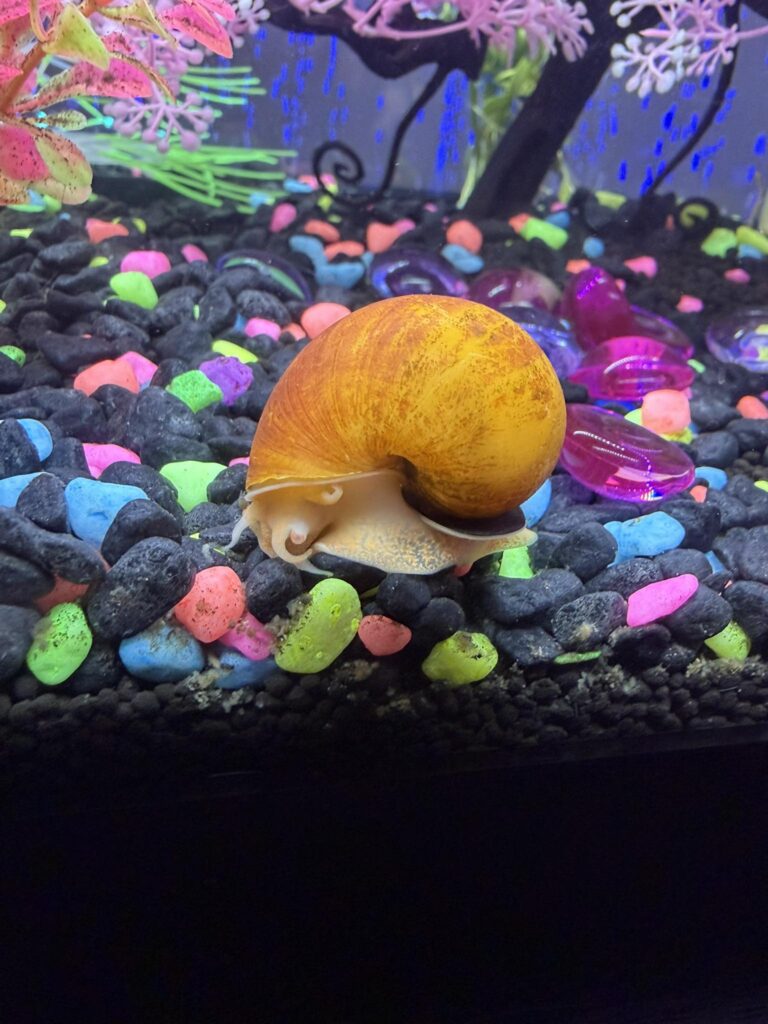
Mystery snail shells grow by continuous addition at the shell’s outer lip — the open edge where the snail’s body extends out. New shell material is deposited here by the mantle, a thin layer of specialised tissue that lines the inside of the shell and acts as the snail’s shell-building organ.
Each time new material is added at the outer lip, the shell expands slightly in both diameter and length. Over time, these incremental additions produce the characteristic spiral whorl pattern visible on the finished shell.
This is not a rapid or dramatic process. Shell growth in mystery snails is continuous but gradual — occurring in small, daily increments rather than visible bursts. You will rarely watch a shell grow in real time. What you will notice, over weeks and months, is that the snail has become measurably larger.
The mantle does not just produce new shell. It also maintains and repairs existing shell structure from within. This is why minor cracks and chips can sometimes heal — the mantle deposits fresh calcium carbonate over the damaged area, creating a visible repair patch that may differ slightly in colour or texture from the surrounding shell.
The Role of Calcium in Shell Growth
If there is one concept central to understanding mystery snail shell growth, it is calcium. Calcium is the primary structural component of the shell — specifically in the form of calcium carbonate (CaCO₃), the same mineral that forms limestone, chalk, and coral.
Without a consistent, adequate supply of calcium, shell growth slows or stops. The shell that does form becomes thin, fragile, pitted, and prone to cracking. In severe cases, the snail may begin to metabolise calcium from its own existing shell to maintain internal physiological functions — literally consuming itself from the outside in.
Calcium reaches the snail through two pathways:
Dietary calcium: Consumed through food. Calcium-rich vegetables, supplements, and substrate materials release calcium that the snail absorbs through its digestive system.
Environmental calcium: Absorbed directly from the water through the mantle tissue. This is why water hardness — specifically calcium hardness — is so directly linked to shell growth quality.
Both pathways matter. A snail in calcium-rich water that is being underfed, or a well-fed snail in very soft water, will both struggle to build optimal shell material.
“Calcium is not just a supplement for mystery snails — it is a structural necessity. I have seen snails in very soft water develop shells so fragile you could compress them with slight thumb pressure. The same snail, moved to harder water with cuttlebone supplementation, grew a noticeably thicker shell within two months. The difference is dramatic and visible.” — Theresa Baumgartner, freshwater invertebrate breeder with 18 years of aquarium experience
What Healthy Shell Growth Looks Like
Knowing what you are aiming for helps you identify problems early. A well-developing mystery snail shell displays several consistent characteristics.
Defined, clean whorls. Each spiral layer should be clearly visible with sharp, distinct suture lines. Blurring or irregularity between whorls can indicate periods of stress or nutritional deficiency during growth.
Consistent colour across the shell. The newer portion of the shell — near the outer lip — should match or closely resemble the older sections in thickness and opacity. A stark contrast between old and new shell material often indicates a change in conditions.
A firm, solid outer lip. The most recently grown part of the shell — the outer edge — should feel firm and solid, not thin, flexible, or translucent when held up to light.
Smooth surface texture. A healthy shell has a relatively smooth surface along each whorl. Pitting, scoring, and erosion suggest acidic water conditions or calcium deficiency affecting the shell from the outside.
An intact, well-fitted operculum. The operculum — the hard disc that seals the shell opening — grows alongside the shell. A healthy operculum is firm, properly sized, and flush with the shell opening.
Growth Rate: How Fast Do Mystery Snail Shells Grow?
Growth rate varies considerably depending on age, diet, water parameters, and genetics. These are realistic benchmarks under good conditions.
Hatchling to 1 month: Shell diameter grows from approximately 2 to 3 millimetres at hatching to around 5 to 8 millimetres. Growth is fastest during this early juvenile stage.
1 to 3 months: Continued rapid growth, with most well-fed juveniles reaching 1 to 1.5 centimetres by the end of this period.
3 to 6 months: Growth continues at a moderate pace. Shell diameter in healthy snails typically reaches 1.5 to 2.5 centimetres. Whorl structure becomes more pronounced and defined.
6 to 12 months: Growth gradually slows as the snail approaches adult size. Shell quality often improves — thickening and hardening — even as the rate of size increase declines.
12 to 18 months: Most mystery snails reach their near-maximum size of 1.5 to 2 inches (occasionally up to 2.5 inches) by the end of their first year or early second year. Growth beyond this point is minimal.
Temperature plays a meaningful role in this timeline. Warmer water — closer to 78°F to 80°F — accelerates growth and produces a larger snail faster. Cooler water slows growth but can extend lifespan. This is a trade-off every keeper navigates based on their priorities.
Factors That Affect Shell Growth Quality
Shell growth does not happen in isolation. It is the product of everything happening in and around the tank.
Water Hardness and pH
This is arguably the most critical environmental factor for shell growth. Water hardness — specifically general hardness (GH) and carbonate hardness (KH) — reflects the concentration of dissolved minerals in the water, primarily calcium and magnesium.
The ideal GH range for mystery snail shell growth is 8 to 18 dGH. In water below this range, calcium availability in the water column is limited, and the snail must rely more heavily on dietary sources alone.
pH matters because it affects calcium solubility. Acidic water (pH below 7.0) actively dissolves calcium carbonate — the very material the shell is made from. A mystery snail kept in water with a pH of 6.5 or lower is fighting a losing battle: the water is chemically attacking the shell at the same rate as the snail is trying to build it.
The ideal pH range for mystery snails is 7.0 to 7.5. Slightly alkaline water not only protects the shell from dissolution but also maintains calcium in a form the snail can more readily absorb.
“The pH-shell relationship is something I explain to every new mystery snail keeper. People focus on ammonia and nitrate — which matter — but they forget that even pristine water can destroy a shell if the pH is too acidic. I test pH as part of every routine check in tanks with invertebrates.” — David Akin, aquatic hobbyist and author of several freshwater invertebrate care guides
Dietary Calcium Supplementation
Even with adequate water hardness, dietary calcium makes a real difference — particularly during periods of rapid growth or egg production in females.
Cuttlebone is the single most practical and cost-effective calcium supplement available for mystery snails. Placed directly in the tank, it dissolves slowly, releasing calcium into both the water column and the snail’s diet as it grazes on the surface.
Other effective dietary calcium sources include:
- Crushed coral — added to the filter or substrate
- Calcium-rich blanched vegetables — kale, spinach, broccoli, and bok choy
- Blanched zucchini with the skin — the skin contains modest calcium levels
- Commercial invertebrate mineral supplements — available from aquarium suppliers
- Canned or fresh tuna and shrimp in small amounts — occasional protein sources that also contain calcium
Variety is beneficial. A mystery snail receiving multiple calcium sources in different forms absorbs minerals more reliably than one dependent on a single source.
Temperature
Temperature affects both the rate and the quality of shell growth through its influence on metabolism.
In warmer water, the snail’s metabolic rate increases. It eats more, processes nutrients faster, and deposits shell material more rapidly. This produces faster growth but — if calcium supply does not keep pace with the accelerated demand — can result in thinner, lower-quality shell material.
In cooler water, metabolism slows. Growth is more gradual but can produce denser, thicker shell material if calcium supply is consistent.
The ideal balance for strong shell growth is a temperature in the mid-range — approximately 74°F to 78°F (23°C to 26°C) — paired with excellent calcium availability. This allows steady growth without outpacing the snail’s ability to mineralise the new shell properly.
Feeding Frequency and Variety
A hungry mystery snail cannot grow a healthy shell. Underfeeding is one of the most common and most easily corrected causes of poor shell growth, particularly in tanks that appear clean but lack sufficient algae and biofilm for the snail to graze on.
Feed mystery snails supplementally three to five times per week with a rotation of blanched vegetables, algae wafers, and sinking pellets. Remove uneaten food after 24 hours to avoid ammonia spikes.
During periods of active growth — juveniles, breeding females, snails recovering from shell damage — increase feeding frequency and prioritise calcium-rich food sources.
Water Quality
Poor water quality affects shell growth indirectly but meaningfully. High ammonia, nitrite, or nitrate levels stress the snail and divert metabolic resources away from growth toward survival.
A stressed snail does not grow well. Consistent, regular water changes — 20 to 25 percent weekly — and a properly cycled tank are the foundation of everything else. No amount of calcium supplementation compensates for chronically poor water conditions.
Common Shell Growth Problems and What They Mean
Recognising shell problems early gives you the best chance of addressing them before they become severe.
Pitting and Erosion
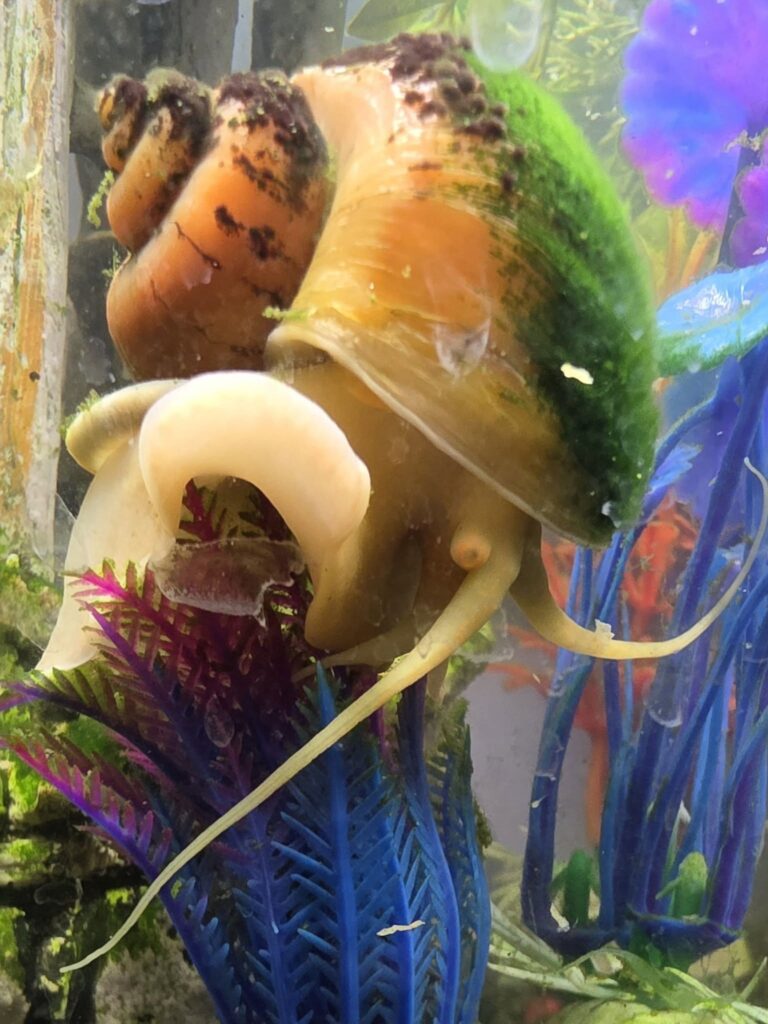
Small holes, pits, or rough, eroded patches on the shell surface are among the most common signs of a calcium or pH problem. Acidic water physically dissolves the outer shell layer, leaving a pitted, cratered texture.
Mild pitting is cosmetic and may not affect the snail’s health immediately. Severe pitting — particularly if it affects deep layers of the shell — compromises structural integrity and leaves the snail vulnerable.
Address this by raising pH toward 7.0 to 7.5, increasing water hardness, and adding cuttlebone.
Thin or Transparent Shell Edges
The newest growth at the outer lip should be firm and opaque within a few days of formation. If the outer edge remains thin, flexible, or partially transparent for extended periods, the snail is not mineralising new shell material properly.
This is almost always a calcium or GH deficiency. Add cuttlebone, test water hardness, and increase dietary calcium immediately.
White Lines or Stress Marks
Faint white lines running parallel to the outer lip across the shell are called growth rings or stress lines. They indicate a period during which shell growth was temporarily interrupted — by a water change shock, illness, transport stress, or sudden environmental change.
Occasional stress lines are normal and harmless. Multiple, closely spaced stress lines indicate chronic or repeated disruption and suggest the snail’s environment is persistently unstable.
Cracking and Chipping
Physical cracks and chips can result from impact — a snail falling from a height, a heavy decoration shifting — or from shell fragility due to calcium deficiency. Structurally weak shells crack more easily under normal mechanical stress.
Small chips at the outer lip often heal without intervention if calcium supply is adequate. The mantle deposits new material over the damaged area, creating a visible but functional repair.
Large cracks that extend into the older shell whorls are more serious. These may allow harmful bacteria access to the snail’s body. Keep the water especially clean during the healing process and ensure calcium supplementation is at its maximum.
“I have had mystery snails repair chips and even moderate cracks completely over the course of four to six weeks when given optimal conditions — excellent water hardness, daily cuttlebone access, and clean water. The shell repair is not invisible; you can always see where the damage was. But functionally, the snail can recover remarkably well if you catch it early and address the environment.” — Rachel Simmons, freshwater invertebrate breeder and aquarist educator with 14 years of experience
Discolouration of New Growth
New shell that appears noticeably paler, more chalky, or a different shade than the established shell can indicate nutritional deficiency, water chemistry instability, or a change in the snail’s diet.
Moderate colour variation is normal and not always cause for concern — shell colour in mystery snails is influenced by genetics, diet, and environment. Sharp, sudden discolouration of new growth alongside other symptoms (thinning, pitting) warrants a full water test and environmental review.
Shell Repair: Can Damaged Shells Heal?
This is one of the most common questions mystery snail keepers ask — and the answer brings genuine relief to many of them.
Yes. Mystery snails can repair shell damage. The mantle tissue deposits new calcium carbonate material over cracks, chips, and damaged areas, creating a biological patch that restores structural integrity over time.
The quality and speed of repair depend on:
- Severity of the damage — small chips heal faster and more completely than large fractures
- Calcium availability — repair requires the same raw materials as new growth
- Water quality — a stable, clean environment allows the snail to dedicate resources to repair
- Age and health of the snail — younger, healthier snails repair more efficiently
During the repair period, maximise calcium supply and maintain pristine water conditions. This is not the time for inconsistent feeding or delayed water changes.
Repairs are visible. The repaired area almost always appears slightly different in colour or texture — often a lighter patch or a slightly raised ridge. This is normal and expected. A visibly repaired shell is evidence that the snail is healing, not that it has been permanently damaged.
“People see a repair patch and worry. I tell them it is actually a good sign — it means the snail is actively rebuilding. What you do not want is a crack with no sign of healing over two or three weeks. That tells you the snail does not have enough calcium to repair, which is the real problem to fix.” — Yuki Tanaka, aquarium biology enthusiast and long-time contributor to freshwater invertebrate forums
Pro Tips for Supporting Strong Shell Growth
These practical measures make a consistent, measurable difference to shell quality in mystery snails.
- Keep cuttlebone in the tank permanently. Do not wait for signs of deficiency to add calcium supplementation. Make it a permanent fixture from the day you set up a mystery snail tank. Replace it when it has fully dissolved.
- Test water hardness regularly. GH and KH tests are inexpensive and take minutes. Many aquarists test pH but neglect hardness — and hardness is more directly linked to shell quality than pH alone. Test monthly at minimum; more frequently if you notice shell changes.
- Avoid large, sudden water changes during rapid growth phases. A 50 percent water change can abruptly alter water chemistry and produce visible stress lines in the shell. Stick to consistent 20 to 25 percent changes to maintain stable conditions.
- Feed calcium-rich foods before and during egg production in females. A gravid female deploys significant calcium reserves into egg production. Supplementing heavily during this period protects both the eggs and the mother’s shell.
- Do not house mystery snails in blackwater or planted tank setups with acidic substrates without addressing pH. Aquasoil substrates and blackwater environments are frequently acidic. If you want mystery snails in such a setup, buffer the pH upward and supplement calcium heavily — or accept that shell quality will be compromised.
- Inspect shells during every water change. A weekly visual check catches problems early. Run your finger lightly along the outer lip — thinness, flexibility, or softness you can feel before you can see it clearly.
Shell Growth Across the Snail’s Lifespan
It is worth noting that shell growth is not uniform across a mystery snail’s life. Understanding these natural changes prevents unnecessary alarm.
In the juvenile stage, shell growth is rapid and the shell wall is naturally thin. Young snails look somewhat fragile, and this is normal. Calcium supply is especially critical during this window.
In the adult stage, growth slows but shell quality typically improves. The shell thickens and hardens with each additional whorl. An adult snail in good conditions often has a noticeably denser, more solid shell than when it was young.
In the senior stage — typically beyond 18 months — shell growth may effectively stop. The snail may show erosion or minor deterioration of the oldest whorls (the apex, or tip of the spire) even with excellent care. This is a normal consequence of age. The apex is the oldest part of the shell and has had the longest exposure to water chemistry. Some apex erosion in an older snail is not a sign of failure — it is a sign of age.
Suggested For You:
Mystery Snails Stuck Together: What New Aquarium Owners Should Know
Mystery Snail Shell Cracked: What to Do
Signs of Unhealthy Mystery Snail Shell: Identification and Fixes
Mystery Snail Escaping Tank: Signs, Causes, and How to Prevent
Best Tank Mates for Mystery Snails: Peaceful Companions That Won’t Stress Your Snails
Final Thoughts
Shell growth is a window into your mystery snail’s world. When it is progressing well — smooth, firm, consistently coloured, and proportionate — it tells you that the water chemistry is right, the diet is adequate, and the snail is thriving. When it falters, it asks you to look more carefully at what you are providing.
I have come to think of a mystery snail’s shell as a living record — each whorl a chapter of its life in your care. The stress lines, the repair patches, the deepening colour of old whorls — they tell a story if you know how to read them.
The good news is that the most important things you can do for shell growth are also the most straightforward. Clean water. Stable chemistry. Adequate calcium. Regular feeding. These are not complicated interventions — they are the basic standards of good aquarium keeping.
Get those foundations right, and your mystery snail’s shell will take care of itself.
References
- Cowie, R. H. (2002). Apple snails (Ampullariidae) as agricultural pests: their biology, impacts and management. In G. M. Barker (Ed.), Molluscs as Crop Pests (pp. 145–192). CAB International. University of Hawaii at Manoa, Pacific Biosciences Research Center. https://www.hawaii.edu
- Wilbur, K. M., & Saleuddin, A. S. M. (1983). Shell formation and the role of the mantle in calcium carbonate deposition in molluscs. In K. M. Wilbur (Ed.), The Mollusca, Volume 4: Physiology (pp. 235–287). Academic Press. Duke University, Department of Zoology. https://duke.edu
- Ramnarine, I. W. (2009). Calcium metabolism and shell mineralisation in freshwater gastropods under varying water hardness conditions. Department of Life Sciences, University of the West Indies, St. Augustine, Trinidad and Tobago. Faculty of Science and Agriculture Publication Series. https://sta.uwi.edu
- Marin, F., Le Roy, N., & Marie, B. (2012). The formation and mineralisation of mollusc shell. Frontiers in Bioscience (Scholar Edition), 4(3), 1099–1125. Université de Bourgogne, UMR CNRS 6282 Biogéosciences, Dijon, France. https://www.u-bourgogne.fr
- Hayes, K. A., Cowie, R. H., Thiengo, S. C., & Strong, E. E. (2012). Comparing apples with apples: clarifying the identities of two highly invasive Neotropical Ampullariidae (Caenogastropoda). Zoological Journal of the Linnean Society, 166(4), 723–753. Smithsonian Institution, National Museum of Natural History & University of Hawaii at Manoa. https://academic.oup.com/zoolinnean