Why Is My Mystery Snail Floating in The Tank? A Complete Guide for New Aquarium Owners
When a mystery snail starts floating, worry sets in fast. Is it dead? Sick? Or just being a snail?
The good news is that floating is often normal. These snails come from slow-moving waters in South America. In the wild, they use air to drift with currents to find better food or spots.
In a tank, the same instinct kicks in. However, this is always not the case. Your snail might be having a problem. This article explores the common issue of mystery snails floating in aquariums. It covers the main reasons behind this behavior, how to tell if it’s normal or a sign of trouble.
Key Points Covered in This Article
- Mystery snails often float on purpose to breathe air or move around.
- Trapped air in the shell is a frequent harmless cause of floating.
- Poor water quality, stress, hunger, or illness can also make snails float listlessly.
- To check if a snail is alive, look for foot movement, smell test, and operculum position.
- Simple fixes include gentle air baths, better feeding, and water parameter adjustments.
- Prevention focuses on stable tank conditions, good diet, and regular maintenance.
- Expert opinions from aquarium forums and hobbyists provide real-world insights.
Normal Reasons Mystery Snails Float
Mystery snails are air breathers. They have a siphon tube to pull in air from the surface. This lets them survive in low-oxygen water. Many owners see their snail rise, extend the siphon, breathe, then sink again. That’s healthy behavior.
Another common cause is trapped air in the shell. When a snail retracts quickly or gets disturbed, air pockets form. This makes them buoyant, like a little balloon. The snail might flip upside down or bob around until the air releases.
Experienced aquarists often see this. On Aquarium Co-Op Forum, one user noted: “Floating is also a sign of poor water for them or excess hunger but they usually close up to do so. It is a defense mechanism to float to a more hospitable area.”
In many cases, floating helps the snail “travel.” A Reddit hobbyist explained: “They do this intentionally. They come from wetlands which have a slow current, and floating lets them ride this current to a new area much more quickly.”
If your snail is active—extending its foot, moving its siphon, or grabbing glass when you nudge it—floating is likely no big deal. It might just be exploring or breathing.
ALSO READ: Signs of Unhealthy Mystery Snail: Identification and Fixes
When Floating Signals a Problem
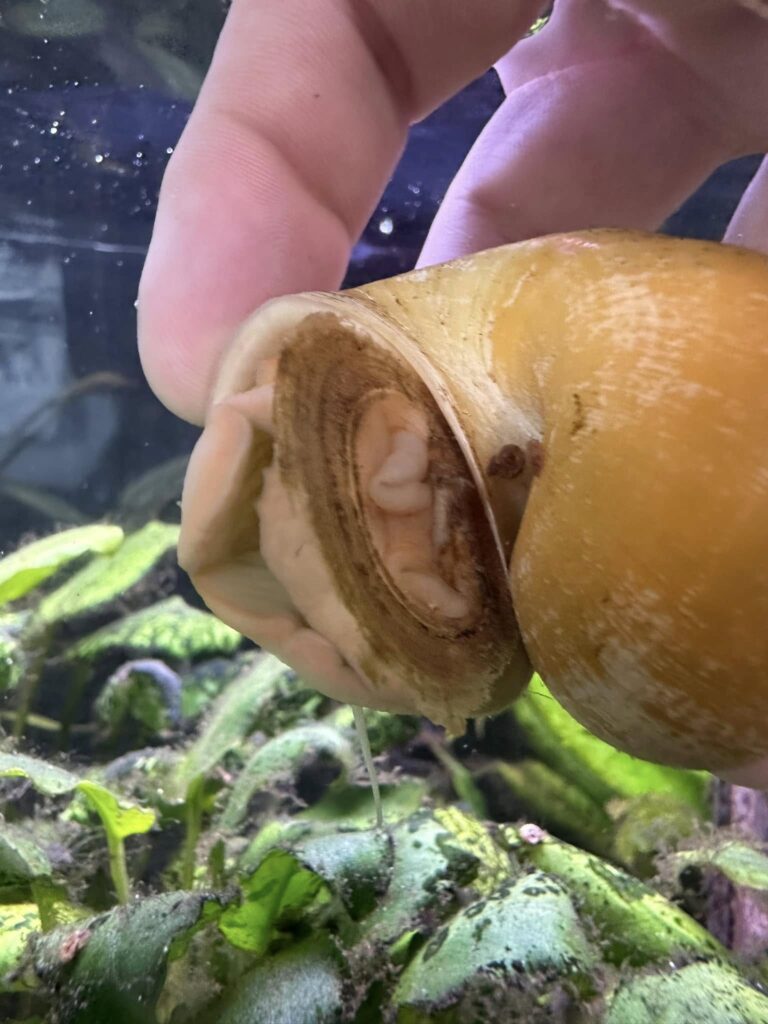
Not all floating is innocent. If the snail floats listlessly, body retracted deep into the shell, operculum (trap door) closed tight, and no response to touch, trouble is likely.
Common serious causes include:
- Poor water quality
Mystery snails are sensitive to ammonia, nitrite, nitrate, and low pH. High toxins stress them, causing buoyancy issues or weakness. They may float because they can’t hold position. So, if the snail is inactive and retracted while floating, test your parameters right away. - Hunger or malnutrition
Underfed snails lose strength. They float to search for food, but if no algae or veggies are available, they stay up top. One forum post advised: “Mystery snails will float to ride currents to better feeding grounds, so maybe providing more food options will convince them out.” - Stress from transport or tank changes
New snails often float for days while acclimating. Sudden pH swings or temperature drops make them withdraw and become buoyant. - Illness or parasites
Less common, but bacterial infections or parasites can weaken snails, leading to floating. - Death
The saddest reason. Dead mystery snails often float because gases build up. The body may loosen and fall out of the shell over time.
How do experts check if a snail is dead? The smell test is key. Remove the snail, sniff near the opening. If it smells rotten (like bad eggs), it’s gone. No smell? Gently touch the foot. If it retracts, it’s alive. Look at the operculum—if it’s sealed and the body doesn’t respond, wait a bit longer.
From Fish Lore forum: “If the snail doesn’t retract when you touch it, it may be dead. Take it out and see if it smells, if it does then it is definitely dead.”
Another practical tip from AquariaCentral: “Floating snails are fine. They do carry air in their shells and if they loose contact with a surface then they shoot to the top of the tank.”
ALSO READ: Mystery Snail Tank Setup: Size and Compatible Tankmates
How to Help a Floating Mystery Snail
If your snail has been floating too long and seems stuck, try these steps.
Step 1: Observe closely
Watch for 10-15 minutes. Does it move? Extend siphon? Grab surfaces?
Step 2: Try to release trapped air
Gently pick up the snail (wet hands). Hold it underwater upside down. Rock it side to side softly. Air bubbles may escape. Some owners do an “air bath”: Place the snail on a damp paper towel or rag soaked in tank water, spiral side up, in a covered container for 10-30 minutes. Humidity helps them relax and expel air.
A Reddit user shared: “Give her a longer air bath. Put her in a container with a clean rag or paper towel soaked in tank water. Give her an hour or two and she will…”
Another said: “One way to help with that is to take them out of the water and touch her foot till she clamps up completely, this will force the air out.”
Step 3: Check and fix water parameters
Test for:
- Ammonia: 0 ppm
- Nitrite: 0 ppm
- Nitrate: under 20-40 ppm
- pH: 7.0-8.0 (they like slightly alkaline)
- Temperature: 68-82°F (20-28°C)
Do a 20-30% water change with dechlorinated water matched to tank temp if needed. Add Indian almond leaves or driftwood for tannins if pH is low.
ALSO READ: Understanding Mystery Snail Water Parameters
Step 4: Offer food
Mystery snails love blanched veggies (zucchini, spinach, cucumber), algae wafers, or calcium-rich foods like cuttlebone. Drop food near the snail. Hunger often makes them active again.
Step 5: Give time
Some snails float for days during adjustment. One Aquarium Advice member recalled: “I had a mystery snail that floated for a week, then continued to live for another month or two.”
Prevention Tips for Healthy Mystery Snails
Keep floating issues rare with good care.
- Maintain stable parameters. Weekly tests and partial changes help.
- Feed a varied diet. Avoid overfeeding to prevent waste buildup.
- Provide hiding spots and surfaces to climb. Plants, driftwood, and decorations reduce stress.
- Quarantine new snails. Watch them for a week before adding to the main tank.
- Avoid copper-based meds. Mystery snails are very sensitive to copper.
Calcium is vital for shell health. Add crushed coral to the filter or supplement diet.
READ MORE: Calcium for Mystery Snails: Benefits and Sources
Expert Quotes from Aquarist Communities
Experienced keepers share valuable insights across forums.
From Reddit’s r/Aquariums: “Mystery snails will float to ride currents to better feeding grounds, so maybe providing more food options will convince them out. Make sure…”
An Aquarium Co-Op Forum user warned: “Floating while hanging out of the shell is often a sign they have passed.”
On Fish Lore: “Mystery snails will often float. They suck in too much air and it makes them too buoyant. Mine float for two days at a time sometimes.”
A long-time hobbyist on AquariaCentral described a fascinating moment: “He made his way back to the glass and crawled back down after a few minutes… I was amazed… I think he may be the most interesting guy in our tank.”
These quotes show floating is common and often benign. But always check for other signs.
Final Thoughts
Seeing your mystery snail floating can be alarming at first. Most times, it’s just their natural way to breathe, move, or deal with a bit of air. Watch behavior, test water, offer food, and try gentle help if needed. With proper care, mystery snails thrive for years, adding personality to your tank.
References
- Cowie, R. H. (2002).Apple snails (Ampullariidae) as agricultural pests: their biology, impacts and management. In G. M. Barker (Ed.), Molluscs as Crop Pests (pp. 145–192). CAB International. University of Hawaii at Manoa, Pacific Biosciences Research Center.https://www.hawaii.edu
- Wilbur, K. M., & Saleuddin, A. S. M. (1983).Shell formation and the role of the mantle in calcium carbonate deposition in molluscs. In K. M. Wilbur (Ed.), The Mollusca, Volume 4: Physiology (pp. 235–287). Academic Press. Duke University, Department of Zoology.https://duke.edu
- Ramnarine, I. W. (2009).Calcium metabolism and shell mineralisation in freshwater gastropods under varying water hardness conditions. Department of Life Sciences, University of the West Indies, St. Augustine, Trinidad and Tobago. Faculty of Science and Agriculture Publication Series.https://sta.uwi.edu
- Marin, F., Le Roy, N., & Marie, B. (2012).The formation and mineralisation of mollusc shell. Frontiers in Bioscience (Scholar Edition), 4(3), 1099–1125. Université de Bourgogne, UMR CNRS 6282 Biogéosciences, Dijon, France.https://www.u-bourgogne.fr
- Hayes, K. A., Cowie, R. H., Thiengo, S. C., & Strong, E. E. (2012).Comparing apples with apples: clarifying the identities of two highly invasive Neotropical Ampullariidae (Caenogastropoda). Zoological Journal of the Linnean Society, 166(4), 723–753. Smithsonian Institution, National Museum of Natural History & University of Hawaii at Manoa.https://academic.oup.com/zoolinnean