Ramshorn Snail Eggs: What They Look Like and What to Do About Them
The reproductive biology of ramshorn snails is one of the primary reasons they are so widespread — and so frequently labeled a pest. A single egg clutch can contain up to 40 embryos.
With multiple clutches laid per week and an incubation period as short as ten days in warm water, the population can quickly become overwhelming.
But there is another side to this story. For aquarists who keep pufferfish, assassin snails, or other invertebrate predators, ramshorn eggs represent a valuable and self-replenishing food resource.
This guide covers everything you need to know about ramshorn snail eggs, from identification and understanding their development, to protecting them if you want more snails, or managing them if you do not.
Ramshorn Snail Eggs at a Glance
| Species | Planorbarius corneus, Planorbella duryi, Gyraulus spp. |
| Egg Mass Shape | Flat, disc-like or oval gelatinous cluster |
| Egg Mass Size | 3 – 10 mm in diameter |
| Color | Clear to pale pink or pinkish-white |
| Eggs per Clutch | 10 – 40 individual eggs |
| Laying Surface | Glass, plant leaves, rocks, driftwood, decorations |
| Incubation Period | 10 – 40 days (temperature-dependent) |
| Optimal Temperature for Hatching | 24°C – 27°C (75°F – 80°F) |
| pH for Viable Eggs | 7.0 – 8.0 |
| Hatchling Appearance | Miniature coiled snails, 1 – 2 mm diameter |
| Frequency of Laying | Multiple clutches per week under ideal conditions |
| Self-Fertilization | Yes — a single snail can produce fertile eggs |
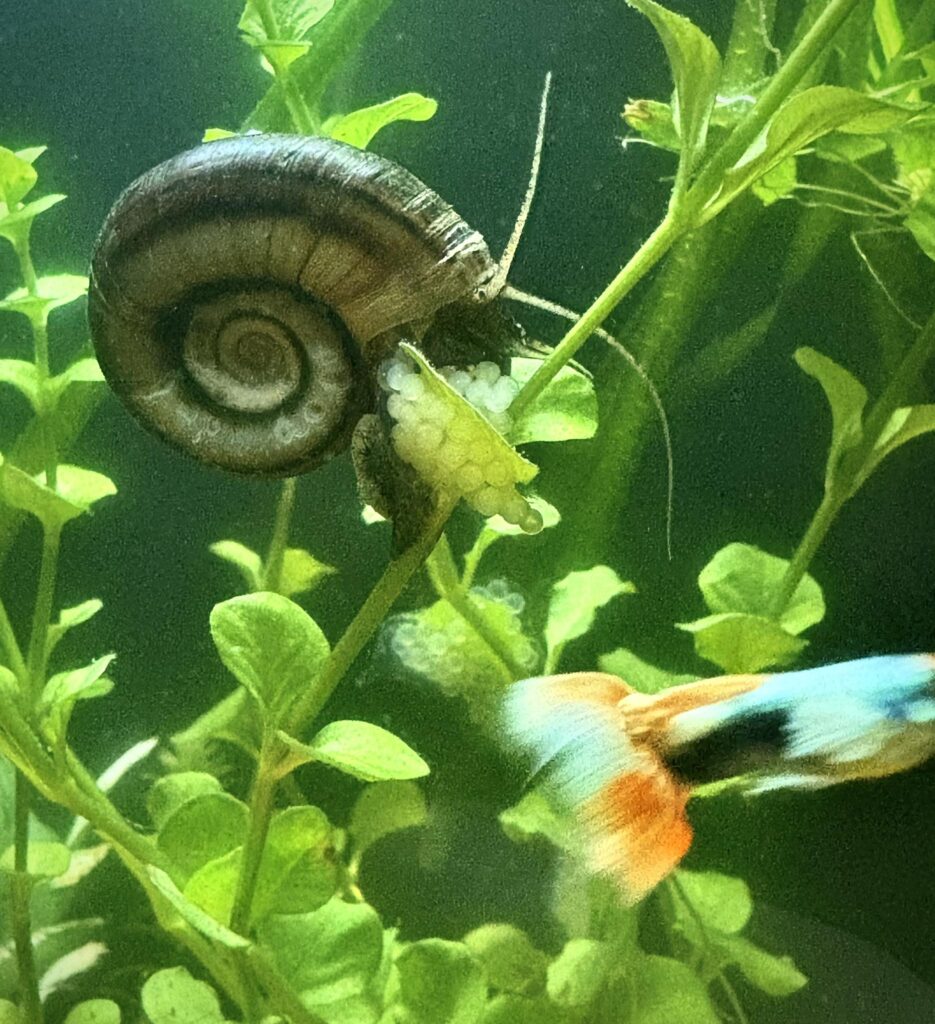
What Do Ramshorn Snail Eggs Look Like?
Ramshorn snail eggs are not laid individually. They are deposited in a cluster of individual eggs bound together in a clear, jelly-like matrix. This gel cushions the embryos, retains moisture, and may deter some predators with its texture.
The egg mass is flat and disc-shaped, though it can sometimes appear slightly oval or irregular depending on the surface it was laid on. A clutch measures between 3 and 10 millimetres in diameter — small enough to overlook if you are not specifically looking for it.
The gel matrix is completely transparent in fresh clutches, making the individual eggs clearly visible inside. Each egg appears as a small, round sphere — approximately 1 mm across — and is typically pale pink, pinkish-white, or off-white in color.
As the embryos develop over the incubation period, the egg mass gradually becomes less clear. The individual eggs darken slightly and take on a more defined shape as the snail embryos grow inside.
Where Are the Eggs Laid?
Ramshorn snails are not selective about egg placement, but they do show clear preferences. The most common locations include:
- The glass walls of the aquarium — the most frequently observed location; eggs are pressed firmly against the surface
- Broad plant leaves — Java fern, anubias, and Amazon sword leaves are popular choices
- Rocks and smooth stones
- Driftwood surfaces
- Aquarium decorations — the underside of caves, bridges, and similar ornaments
- Filter equipment — including the housing of sponge filters and intake tubes
- The underside of floating plants
Eggs deposited on glass are the easiest to observe and the easiest to remove. Those laid on plant leaves or hidden beneath decorations are often discovered only after they have hatched.
Distinguishing Ramshorn Eggs from Other Snail Eggs
If your tank contains multiple snail species, identifying which eggs belong to which snail matters.
| Snail Species | Egg Description |
| Ramshorn snail | Small flat gel disc, 10–40 eggs, pinkish-clear |
| Mystery snail | Above the waterline; pink or beige, clustered, hard-coated |
| Nerite snail | Hard, sesame seed-like capsules stuck to hard surfaces |
| Assassin snail | Single square capsules, one egg each, on hard surfaces |
| Malaysian trumpet snail | Live-bearing — no external eggs |
Ramshorn eggs are the only common freshwater aquarium egg mass that is entirely below the waterline, gel-like, and disc-shaped. Once you have seen one, they become easy to identify at a glance.
Understanding Ramshorn Snail Reproduction
Ramshorn snails are simultaneous hermaphrodites. Every individual possesses both male and female reproductive organs and is capable of functioning as either sex during mating.
When two snails meet under favorable conditions, they fertilize each other simultaneously. That means, both snails leave the encounter having exchanged sperm, and both subsequently lay eggs.
More significantly for population dynamics, ramshorn snails can also self-fertilize. A single snail, with no mate, can produce fertile eggs. This means that even one snail introduced into a tank is sufficient to establish a reproducing population.
This is not a flaw or an anomaly. It is a sophisticated evolutionary adaptation that allows the species to colonize new environments with extraordinary efficiency.
Sperm Storage
After mating, ramshorn snails can store viable sperm for weeks to months. This means a snail that has mated once continues to produce fertile eggs long after the mating event itself.
Even if all other snails are removed from a tank, a single remaining snail with stored sperm will continue laying fertile clutches.
This is an important fact for anyone attempting to eradicate ramshorn snails. Removing visible adult snails is necessary but not sufficient — the eggs already laid and the stored sperm in surviving individuals will continue producing new hatchlings.
How Often Do They Lay Eggs?
Under optimal conditions — warm water, abundant food, and stable water chemistry — a single ramshorn snail can lay multiple clutches per week.
The exact frequency varies by species, individual, and environmental conditions, but in a well-fed tank at 25°C, it is not unusual to find new egg masses every two to three days from an active snail.
This reproductive rate is the core reason ramshorn populations can grow from a handful of snails to hundreds within a few months.
Egg Development: From Clutch to Hatchling
Before hatching, ramshorneggs often undergo several transformations.
Stage 1: Fresh Eggs (Days 1–3)
A freshly laid ramshorn egg mass is fully transparent. The gel matrix is clear, and the individual eggs appear as pale pink or whitish spheres arranged loosely within it. The eggs are soft and slightly fragile at this stage.
If you examine a fresh clutch closely — especially with a magnifying glass — you may notice the eggs are not perfectly round but slightly oval. Each one is surrounded by a thin membrane within the gel.
Stage 2: Early Development (Days 4–10)
As cellular division begins inside each egg, the clutch starts to change in appearance. The individual eggs become slightly larger and more opaque, and the gel matrix may take on a faintly yellowish or brownish tint.
In some cases, you can begin to see the faint outline of a developing shell within the egg.
Infertile eggs typically become visibly white or opaque much faster than developing eggs. A clutch with many white, chalky-looking eggs is likely to have a lower hatch rate.
Stage 3: Advanced Development (Days 11–25)
This is the most visually rewarding stage for those watching development. The coiled shells of the developing snails become clearly visible within each egg.
Under a magnifying glass or macro lens, you can see the miniature planispiral shape forming inside the transparent egg membrane.
The snails at this stage are pigmented — ramshorn snails bred for the red morph will show their color even as embryos. The developing snails can be seen slowly moving within the egg in the final days before hatching.
Stage 4: Hatching (Days 12–40)
When ready, the hatchling snails dissolve a small opening in the egg membrane and emerge as fully formed, copies of the adults. Newly hatched ramshorn snails typically measure 1 to 2 mm in diameter — barely visible to the naked eye.
They begin feeding immediately, starting with the biofilm and algae that coat aquarium surfaces. They are entirely independent from the moment of hatching and require no parental care.
Temperature is the single most important variable affecting incubation time:
| Water Temperature | Approximate Incubation Period |
| 18°C (64°F) | 35 – 40 days |
| 21°C (70°F) | 25 – 30 days |
| 24°C (75°F) | 15 – 20 days |
| 27°C (80°F) | 10 – 14 days |
Hatch Rate
Not every egg in a clutch will hatch. In a healthy, well-maintained tank, hatch rates of 70 to 90 percent are typical.
Lower hatch rates may indicate poor water quality, calcium deficiency, temperature instability, or eggs that were infertile from the outset.
How to Protect Ramshorn Snail Eggs (If You Want Them to Hatch)
Some aquarists actively want to breed ramshorn snails — either for the pleasure of watching their development, to maintain a live food culture, or to build up a population of a specific color morph.
If that is your goal, here is what to do.
Maintain Stable Water Parameters
Egg viability is strongly linked to water quality. The most important factors are:
- Temperature: Keep it stable between 24°C and 27°C for optimal development
- pH: Maintain at 7.0–8.0; acidic water (below 6.8) can dissolve the gel matrix and damage the eggs
- Calcium: Adequate calcium is essential — developing snails begin absorbing calcium from the water and gel matrix early in development
Avoid Disturbing the Eggs
Ramshorn eggs adhere strongly to surfaces but can be dislodged by vigorous water movement or physical scraping. Do not clean the areas where eggs are present until they have hatched. If eggs are on a plant leaf, avoid moving that plant.
Protect Hatchlings from Filtration
Newly hatched snails are tiny and easily drawn into filter intakes. Use a sponge filter or cover power filter intakes with a pre-filter sponge to prevent hatchling losses.
Separate Eggs If Necessary
If your display tank contains fish or other snails that may eat the eggs, transfer the egg mass to a separate small container or breeding tank.
Eggs laid on a piece of glass or a smooth stone can be carefully removed by sliding a thin, flexible blade underneath the clutch and placing the surface in the new container.
Eggs laid directly on glass can be difficult to move without damaging them — in that case, a gentle scrape to reattach them to a piece of slate or a glass tile may be easier than moving the whole tank pane.
How to Prevent and Remove Ramshorn Snail Eggs
If you are dealing with an unwanted population explosion, managing the eggs is the most proactive control strategy available.
Removing adult snails helps, but addressing the eggs stops the next generation before it starts.
Regular Glass Inspections
Make it a habit to inspect the aquarium glass during every water change. Ramshorn eggs are small but visible — particularly if you look at the glass from the side with a flashlight. Establish a weekly or twice-weekly routine and remove any clutches you find.
Physical Removal
The simplest removal method is a magnetic algae scraper or a soft-edged razor blade. Egg masses peel off glass relatively easily when scraped at a shallow angle.
Dispose of the eggs by drying them thoroughly before discarding — do not flush them, as they can survive water treatment in some systems.
For eggs on plant leaves, remove and rinse the affected leaf or trim it entirely if the plant health allows.
Vegetable Traps for Adults
Controlling the egg-laying snails is as important as removing the eggs themselves. Place a slice of blanched zucchini or cucumber in the tank at night. In the morning, remove the vegetable along with the snails clinging to it.
Repeat this several times per week to reduce the breeding population significantly.
Reduce Feeding
Overfeeding is the primary driver of ramshorn population growth. Excess food fuels reproduction. Feed fish only what they consume in two to three minutes.
Remove uneaten food promptly, and allow any green algae on the glass to be consumed naturally before removing it. As food availability drops, egg-laying frequency decreases.
Introduce Predators
Natural predators consume both adult snails and, in some cases, eggs:
- Assassin snails (Clea helena) — effective against adult snails; do not typically eat the egg masses directly but reduce the population of egg-laying adults
- Dwarf pufferfish (Carinotetraodon travancoricus) — will actively hunt snails and may consume egg masses
- Clown loaches and yoyo loaches — enthusiastic snail hunters; less likely to target egg masses directly
- Goldfish — known to consume snail eggs along with algae and biofilm from the glass
Chemical Control
If the population is severely out of control, commercial snail-control products containing potassium permanganate or copper sulfate can be used — but with significant care.
These chemicals are harmful to shrimp, other invertebrates, and some plant species. They should only be used in tanks without sensitive inhabitants and as a genuine last resort.
Always perform a large water change after chemical treatment to remove residual compounds.
Ramshorn Snail Eggs as a Food Source
One of the most practical and underappreciated uses of ramshorn snail eggs is as live food for fish and invertebrates.
The eggs are soft, protein-rich, and sized appropriately for several commonly kept predatory species.
Suitable Consumers
- Pufferfish — all puffer species will readily consume egg masses along with adult snails
- Assassin snails — known to consume freshly laid, soft egg masses when other food is scarce
- Bettas — some individuals will eat egg masses from the glass
- Guppies and small tetras — may pick at freshly hatched snails and exposed eggs
- Dwarf cichlids — apistogrammas and similar species will consume eggs opportunistically
If you have a dedicated pufferfish tank, maintaining a separate ramshorn breeding container — even a small plastic tub — allows you to provide a continuous supply of egg masses and hatchlings without disrupting your main aquarium.
Identifying Healthy vs. Infertile Eggs
Not all ramshorn eggs will develop into snails. Learning to distinguish healthy eggs from infertile or failed ones helps you assess breeding success and water quality.
| Appearance | Likely Meaning |
| Clear gel, pinkish round eggs | Fresh, healthy clutch — newly laid |
| Slightly opaque eggs, developing color | Normal mid-stage development |
| Dark, coiled shapes visible inside eggs | Late-stage development — close to hatching |
| Uniformly white or chalky eggs | Infertile or failed to develop |
| Eggs turning black or dark brown | Fungal infection or bacterial decomposition |
| Gel matrix dissolving or disappearing | Water too acidic; pH below 6.5 |
A mix of developing and non-developing eggs in one clutch is normal. A clutch where all eggs remain white or opaque after two weeks is likely infertile or has failed due to poor water conditions.
Frequently Asked Questions About Ramshorn Snail Eggs
Q: How do I know if ramshorn snail eggs are fertile? Watch them over 7 to 10 days. Fertile eggs gradually darken and develop visible internal structures. Infertile eggs remain uniformly pale or white and show no change.
Q: Can I move ramshorn snail eggs to another tank? Yes, with care. Slide a thin blade under the clutch to detach it from the surface, then transfer the surface or the clutch itself to the new tank. Avoid exposing eggs to air for more than a few seconds.
Q: How long until ramshorn eggs hatch? Between 10 and 40 days, depending on water temperature. At 25°C, expect hatching in approximately 14 to 20 days.
Q: Will my fish eat the eggs? Many fish will. Goldfish, loaches, pufferfish, and cichlids are known egg consumers. Most small community fish (tetras, rasboras, small danios) tend to ignore the gel-encased eggs.
Q: Why do my ramshorn eggs keep disappearing? Either something is eating them, they are being dislodged by water flow, or the gel matrix is dissolving due to low pH. Check your water chemistry and observe the tank at night to identify any predator activity.
Q: Can ramshorn snail eggs survive out of water? Briefly — the gel matrix retains moisture for a short time. However, eggs that dry out completely will not survive. This is why drying removed eggs thoroughly before disposal is an effective way to ensure they do not hatch elsewhere.
Conclusion
Ramshorn snail eggs are small, easy to miss, and extraordinarily productive. Whether you find them thrilling, understanding them puts you firmly in control of the situation.
The egg stage is the most manageable point in the ramshorn snail’s life cycle. An egg mass removed today is dozens of snails that will never need to be dealt with later.
Conversely, an egg mass protected and hatched successfully is a new generation of cleaners, live food, or carefully bred color morphs, depending on your goals.
References
- United States Geological Survey (USGS) — Nonindigenous Aquatic Species Database https://nas.er.usgs.gov
- University of Florida — IFAS Extension: Aquatic and Wetland Plants and Invertebrates https://edis.ifas.ufl.edu
- Florida Museum of Natural History — Invertebrate Zoology https://www.floridamuseum.ufl.edu/iz/
- United States Environmental Protection Agency (EPA) — Wetlands and Aquatic Ecosystems https://www.epa.gov/wetlands
- Smithsonian Institution — National Museum of Natural History, Division of Mollusks https://naturalhistory.si.edu/research/invertebrate-zoology
- California Department of Fish and Wildlife — Invasive Species Program https://wildlife.ca.gov/Conservation/Invasives
- National Oceanic and Atmospheric Administration (NOAA) — Habitat Conservation and Freshwater Biodiversity https://www.fisheries.noaa.gov/topic/habitat-conservation