Understanding Ramshorn Snail: Identification, Care, and Pictures
The ramshorn snail is one of the most recognizable freshwater gastropods in the world. Its distinctive flat, coiled shell — shaped like the curved horn of a ram — makes it immediately identifiable.
It is found naturally across multiple continents and has established itself in virtually every corner of the freshwater aquarium hobby.
What makes the ramshorn snail particularly interesting is its dual reputation. In some tanks, it serves as an invaluable cleaner, consuming algae, rotting plant material, and fish waste with quiet efficiency.
In others, it spirals into a population explosion that overwhelms the aquarium and frustrates its keeper.
Understanding how the ramshorn snail lives, reproduces, and behaves gives you the tools to manage it effectively — whether your goal is to encourage it or control it.
This guide covers species identification, anatomy, behavior, water requirements, diet, breeding biology, population management, tank compatibility, and the broader ecological significance of this remarkably widespread gastropod.
Ramshorn Snail at a Glance
| Common Name | Ramshorn Snail |
| Main Species | Planorbarius corneus, Planorbella duryi, Gyraulus spp. |
| Family | Planorbidae |
| Origin | Cosmopolitan — North America, Europe, Asia, Africa |
| Adult Size | 0.5 cm – 3.5 cm (varies by species) |
| Shell Shape | Flat, disc-like coil (planispiral) |
| Shell Colors | Brown (wild), red, pink, blue, leopard-spotted |
| Lifespan | 1 – 3 years |
| Diet | Algae, biofilm, decaying plant matter, detritus, fish food |
| Water Temperature | 18°C – 28°C (64°F – 82°F) |
| pH Range | 7.0 – 8.0 (tolerates 6.5 – 8.5) |
| Water Hardness | 5 – 15 dKH |
| Tank Size | No minimum — adaptable to nano and large tanks alike |
| Behavior | Active, diurnal and nocturnal; non-aggressive |
| Breeding | Hermaphroditic; rapid self-fertilization possible |
| Conservation Status | Not evaluated (common and widespread) |
| Care Level | Easy |
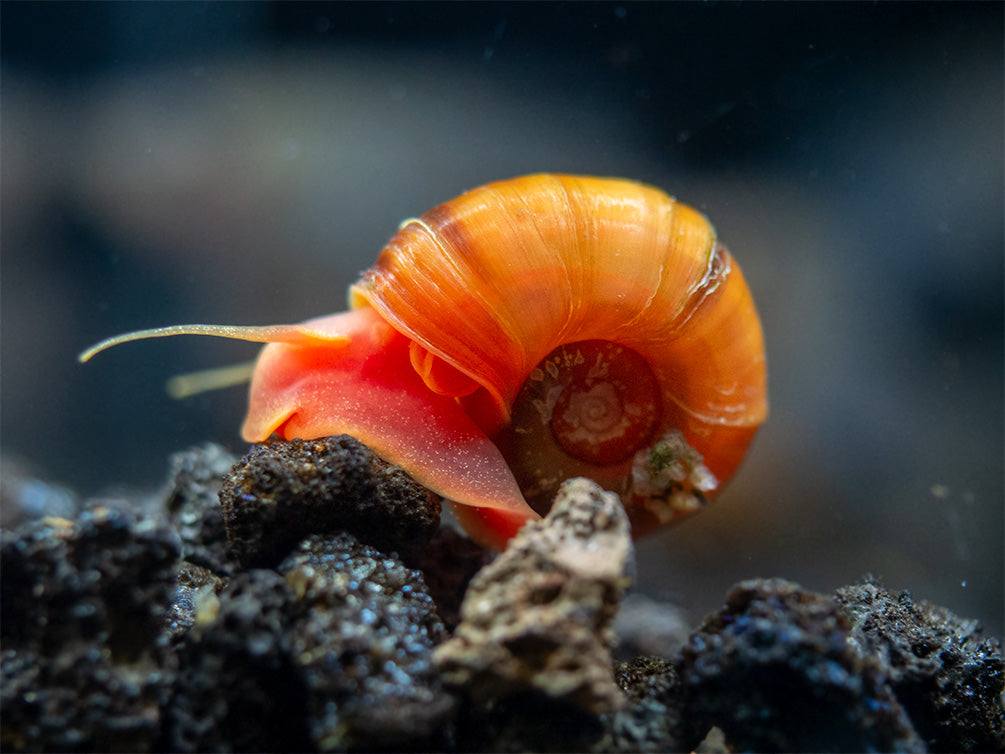
Species Overview: Which Snail Is a “Ramshorn”?
The term “ramshorn snail” is used loosely in the aquarium hobby to describe several species in the family Planorbidae — all of which share the characteristic flat, coiled shell. It is important to distinguish between them, as they differ in size, appearance, and origin.
1. Planorbarius corneus — The Great Ramshorn Snail
This is the largest and most striking of the commonly kept ramshorn species. Originally from Europe and western Asia, P. corneus can reach 3 to 3.5 cm in diameter — significantly larger than most ramshorn snails encountered in the hobby.
It is frequently sold as a deliberate aquarium purchase rather than an accidental introduction. The great ramshorn is less prolific than smaller species, making it easier to manage.
2. Planorbella duryi — The Florida Ramshorn
A North American native, Planorbella duryi is the species most commonly encountered in tropical aquariums in the United States. It is smaller than P. corneus, typically reaching 1 to 2 cm, and is often sold alongside aquatic plants.
This species is the one most frequently labeled a “pest” — primarily because of its exceptional reproductive rate.
3. Gyraulus spp. — The Dwarf Ramshorn
Species within the genus Gyraulus are tiny — usually under 1 cm in diameter. They are often introduced accidentally on plants and are almost impossible to see until the population grows large. Despite their small size, they play a similar ecological role to their larger relatives.
4. Red, Pink, and Blue Ramshorn Snails
These are selectively bred color morphs of Planorbella duryi and related species. They are the same snail genetically, but bred to express different pigmentation:
- Red ramshorn: The result of reduced melanin production. The snail’s red hemoglobin-based blood shows through the shell.
- Blue ramshorn: A recessive genetic trait that produces a bluish-grey shell with a cool visual effect.
- Pink and leopard-spotted: Further selective breeding results in speckled or pastel-toned individuals.
These color morphs are intentionally kept by aquarists for their visual appeal. They are especially popular in planted tanks and aquascapes.
Taxonomy and Classification
| Kingdom | Animalia |
| Phylum | Mollusca |
| Class | Gastropoda |
| Order | Hygrophila |
| Family | Planorbidae |
| Common Genera | Planorbarius, Planorbella, Gyraulus, Helisoma |
The family Planorbidae is large and diverse, containing over 100 genera and hundreds of species worldwide.
All planorbid snails share the defining flat coil shell structure — a shape technically called planispiral — and all breathe air through a lung-like structure called a pallial lung, though they can also absorb oxygen directly from the water.
Anatomy: What Makes the Ramshorn Snail Unique
The Shell
The most immediately distinctive feature of any ramshorn snail is its flat, disc-shaped shell, which coils in a single plane.
Unlike the conical, spiraling shells of most aquarium snails (such as mystery snails or assassin snails), the ramshorn shell looks like a tightly wound rope or, as the name suggests, a ram’s curved horn.
Shell diameter depends on species and age, ranging from under 1 cm in dwarf varieties to over 3 cm in the great ramshorn.
The shell surface is smooth to slightly ribbed, and its color ranges from translucent brown in wild-type individuals to vivid red, pink, blue, or spotted in selectively bred morphs.
One fascinating detail: the shell coil can spiral in either direction — clockwise or counterclockwise — depending on the individual snail. This is determined genetically and has no effect on the snail’s health or behavior.
Red Blood: A Biological Rarity
Here is a fact that genuinely surprises many aquarists when they first learn it: ramshorn snails have red blood.
Most mollusks use a copper-based molecule called hemocyanin to carry oxygen, which gives their blood a bluish color.
Ramshorn snails are unusual in the mollusk world because they use hemoglobin — the same iron-based oxygen-carrying protein found in human blood — which is red.
This hemoglobin does more than just transport oxygen. It also means that red-colored ramshorn snails are not actually red because of pigment.
Their vivid red or pink hue comes directly from the hemoglobin showing through a shell that has reduced or absent melanin. In essence, you can see the snail’s blood through its shell and body.
Breathing: Lungs and Gills Combined
Ramshorn snails are pulmonate gastropods — meaning they have a lung-like structure rather than gills. They periodically surface to breathe air directly.
However, they are also able to absorb dissolved oxygen directly from the water through their skin, which means they can survive in moderately low-oxygen environments without surfacing constantly.
This dual-breathing ability makes them remarkably tolerant of varied water conditions — another reason they thrive in a wide range of aquarium settings.
Sensory Organs
Ramshorn snails have two long tentacles on their head, which serve as their primary sensory tools. These tentacles detect chemical signals, light intensity, and physical contact.
Unlike snails with eyes on stalks, ramshorn snails have eyes at the base of their tentacles — tiny and not particularly powerful, but sufficient for detecting changes in light and shadow.
Natural Habitat and Global Distribution
Ramshorn snails are among the most widely distributed freshwater snails on the planet. They are found naturally on every inhabited continent and have also established populations in many non-native regions through accidental introduction.
Preferred Wild Habitats
In nature, ramshorn snails favor:
- Slow-moving rivers and streams
- Ponds and lakes with abundant aquatic vegetation
- Marshes, swamps, and wetland edges
- Irrigation canals and rice paddies
- Temporary pools (some species can survive brief dry periods by sealing their shell with mucus)
They thrive in environments rich in organic material and algae — their primary food sources. Dense aquatic plant growth provides shelter, egg-laying surfaces, and feeding opportunities simultaneously.
Invasive Presence
Several ramshorn species are classified as invasive or nuisance species in regions outside their native range. Their combination of rapid reproduction, broad dietary tolerance, and adaptability to varied water conditions makes them highly competitive in new environments.
This is a critical point for responsible aquarium keeping. Releasing ramshorn snails into local waterways — intentionally or accidentally — can have significant negative consequences for native freshwater ecosystems.
Behavior and Activity Patterns
Activity Schedule
Unlike assassin snails, which are primarily nocturnal, ramshorn snails are active at all hours. You are likely to see them grazing on the glass, moving across plant leaves, or navigating the substrate at any time of day or night.
This constant activity is one reason they are such effective tank cleaners — they do not wait for lights-out to start working.
Feeding Behavior
Ramshorn snails graze using a radula — a ribbon-like feeding structure covered in tiny teeth, similar in function to a tongue. They drag this structure across surfaces to scrape off algae and biofilm.
Watch a ramshorn snail on the glass and you will often see its radula in action — a rhythmic, rasping motion that leaves clear feeding trails. It is one of the more visually satisfying behaviors in the aquarium hobby.
Social Behavior
Ramshorn snails have no social behavior in any meaningful sense. They do not form groups, establish territories, or recognize each other as individuals. Multiple snails will, however, congregate wherever food is concentrated — such as around a piece of zucchini or a sinking algae wafer — giving the impression of social gathering.
They are entirely peaceful and pose no threat to fish, shrimp, or other invertebrates.
Response to Threat
When disturbed or exposed to a threat (such as a curious fish), ramshorn snails will retract quickly into their shell.
Unlike many snails, they do not have an operculum (a hard trap door to seal the shell opening), so they rely entirely on pulling deep into the shell and waiting out the disturbance.
Diet: What Do Ramshorn Snails Eat?
Primary Food Sources
Ramshorn snails are opportunistic omnivores with a strong preference for plant-based and decaying organic material. Their primary diet includes:
- Algae — soft green algae, brown diatom algae, and biofilm on glass, rocks, and plants
- Decaying plant matter — fallen leaves, dying stems, and rotting roots
- Biofilm — the thin layer of microbial life that coats all aquarium surfaces
- Uneaten fish food — sinking pellets, flakes, and leftover carnivore wafers
- Fish and invertebrate waste — an important contribution to the nitrogen cycle management
Do Ramshorn Snails Eat Live Plants?
This is one of the most frequently asked questions — and the answer requires nuance.
Healthy, vigorous live plants are generally safe from ramshorn snails. The snails prefer soft, decaying, or damaged tissue and will typically choose it over healthy plant cells.
However, weak, slow-growing, or damaged plants can be attacked. If a ramshorn snail is hungry and finds a delicate plant species with thin, soft leaves (such as some mosses or fine-leaved stem plants), it may graze on the living tissue.
The best prevention is simple: do not overfeed your fish (which creates excess food for the snails, driving population booms), and maintain plant health through appropriate lighting, CO₂, and fertilization.
Supplementary Feeding in a Dedicated Setup
If you are intentionally keeping ramshorn snails as display animals or as food for other species, you can supplement their diet with:
- Blanched vegetables — zucchini, cucumber, spinach, and lettuce are favorites
- Sinking algae wafers
- Spirulina tablets
- Calcium-rich foods — crushed cuttlebone or eggshell can supplement shell-building minerals
Aquarium Care Requirements
Water Parameters
Ramshorn snails are extremely adaptable and tolerate a wider range of water parameters than most aquarium snails. That said, they thrive best within the following ranges:
| Parameter | Ideal Range | Tolerated Range |
| Temperature | 21°C – 26°C (70°F – 79°F) | 18°C – 28°C |
| pH | 7.0 – 7.5 | 6.5 – 8.5 |
| Hardness | 6 – 12 dKH | 5 – 15 dKH |
| Ammonia | 0 ppm | 0 ppm |
| Nitrite | 0 ppm | 0 ppm |
| Nitrate | < 20 ppm | < 40 ppm |
The Calcium Requirement
Like all snails, ramshorn snails require adequate calcium to maintain healthy shells. In soft or acidic water, their shells become thin, translucent, and fragile — with visible pitting or cracking along the whorls.
If your tap water is naturally soft, address this by:
- Adding crushed coral to your filter media
- Placing cuttlebone in the tank (it dissolves slowly and releases calcium)
- Using a mineral supplement formulated for invertebrates
- Performing regular partial water changes with slightly harder water
Shell quality is a reliable indicator of ramshorn snail health. Clear, smooth shells with no pitting indicate good water quality. Eroded or cracked shells indicate a calcium or pH problem.
Tank Size
Ramshorn snails have no minimum tank size requirement from a welfare perspective. They are kept successfully in nano tanks as small as 5 litres, though larger tanks provide more stable water conditions.
For intentional ramshorn keeping as display animals, a 20 to 40-litre planted tank provides excellent viewing conditions.
Substrate
Ramshorn snails are not burrowers. They do not have strong substrate preferences — they will move equally well across sand, fine gravel, or coarser substrate. Soft substrates are slightly preferable because they are less likely to damage the snail’s foot as it moves.
Filtration
Sponge filtration is ideal for tanks containing ramshorn snails, especially if you have juveniles or eggs. Power filters with strong intake flow can suck up small snails or damage their delicate shells.
If you are using a hang-on-back or canister filter, cover the intake with a sponge pre-filter to protect small individuals.
Breeding: Understanding the Population Dynamics
Ramshorn snails are simultaneous hermaphrodites — every individual possesses both male and female reproductive organs. This means:
- Any two ramshorn snails can mate with each other, regardless of individual
- A single snail can fertilize its own eggs under the right conditions (self-fertilization)
- After mating, a snail can store sperm and use it to fertilize eggs for weeks or months afterward
This reproductive flexibility is the main reason ramshorn snails are so prolific and so difficult to eradicate once established in a tank.
The Mating Process
When two snails meet and conditions are favorable, they will mate — a process that involves the transfer of sperm packets between both individuals simultaneously. The snails intertwine their bodies and remain joined for 15 to 30 minutes.
Egg Laying
After mating (or self-fertilization), the snail deposits gel-like egg masses on hard surfaces — glass walls, plant leaves, rocks, and driftwood.
Each egg clutch is a flat, transparent disc roughly 3 to 6 mm in diameter, containing 10 to 40 individual eggs arranged in a gelatinous matrix.
The eggs are visible to the naked eye and appear as tiny, round, pinkish-white spheres inside the clear gel. Many aquarists find the egg masses surprisingly elegant under magnification.
Under optimal conditions, a single ramshorn snail can produce multiple clutches per week.
Incubation and Hatching
Eggs hatch in 2 to 5 weeks, depending on water temperature. Warmer water accelerates development — at 26°C, eggs may hatch in as little as 10 to 14 days. Cooler water extends the incubation period significantly.
Baby ramshorn snails emerge as tiny, fully coiled juveniles — miniature versions of the adults. They are immediately independent and begin grazing on biofilm and algae within hours of hatching.
Why Populations Explode
The combination of hermaphroditism, self-fertilization, rapid hatching, and early sexual maturity creates the conditions for exponential population growth when food is abundant.
The single most important factor driving ramshorn snail population size is food availability.
Overfeeding fish creates excess nutrients that feed algae growth and leave uneaten food in the tank — both of which fuel snail reproduction. Reduce food input, and the population naturally stabilizes.
Population Management: Controlling Ramshorn Snails
If ramshorn snails have become overpopulated in your tank, you have several management options.
1. Reduce Feeding
This is the most effective and least disruptive approach. Feed your fish only what they can consume within two to three minutes, twice daily. Remove any uneaten food promptly. As food becomes scarce, snail reproduction slows and the population gradually declines.
2. Manual Removal
Remove snails by hand during water changes or substrate cleaning. Use a vegetable trap — place a blanched slice of zucchini or cucumber in the tank at night and remove it (along with the snails clinging to it) in the morning. This is surprisingly effective over several weeks.
3. Introduce Natural Predators
Several fish and invertebrates will eat ramshorn snails:
- Assassin snails (Clea helena) — highly effective against smaller ramshorn snails
- Clown loaches (Chromobotia macracanthus) — enthusiastic snail hunters
- Yoyo loaches (Botia almorhae)
- Dwarf chain loaches (Ambastaia sidthimunki)
- Pufferfish — extremely effective but require species-specific care
- Bala sharks (less reliable but will take small snails)
Each of these options comes with its own care requirements — always research compatibility before adding new species.
4. Egg Removal
Inspect the tank glass and remove egg masses as soon as you spot them. This takes patience and consistency, but it meaningfully reduces population growth over time. A soft magnetic algae scraper can dislodge egg masses from the glass easily.
5. Chemical Treatments
Several commercial products are marketed for snail control. Most contain copper sulfate or similar compounds. These work, but they also kill beneficial invertebrates (including shrimp, other snails, and sensitive fish) and can disrupt the nitrogen cycle.
Chemical treatments should be considered a last resort and used only in tanks without other sensitive invertebrates.
Tank Compatibility
With Fish
Ramshorn snails are compatible with virtually all peaceful freshwater fish. They are too small to threaten fish, and most community fish ignore them entirely. However, several fish species are natural snail predators and will hunt and eat ramshorn snails:
- Pufferfish (strong predators — will eat snails aggressively)
- Loaches of most species
- Goldfish (will eat smaller snails and egg masses)
- Cichlids — many species, particularly larger ones, will dig up and eat snails
- Bettas — some individuals will harass or nip snails; others ignore them entirely
With Shrimp
Ramshorn snails are safe with shrimp of all species. They compete mildly for the same food sources but do not prey on shrimp and do not damage shrimp eggs or juveniles.
They are a popular co-inhabitant in shrimp-focused planted tanks because they clean up uneaten food and algae without threatening the shrimp colony.
With Other Snails
Ramshorn snails are compatible with most other aquarium snail species:
- Mystery snails — peaceful coexistence; ramshorns will clean up around mystery snail feeding areas
- Nerite snails — no issues; both are peaceful grazers
- Assassin snails — assassin snails will prey on ramshorn snails, especially smaller individuals. Keep this in mind when choosing tankmates.
- Malaysian trumpet snails — peaceful coexistence; different ecological niches (ramshorns graze surfaces; trumpets burrow in substrate)
Ramshorn Snails as Live Food
One practical use of ramshorn snails that experienced aquarists often overlook is their value as live food for other species. Their soft shells and nutrient-rich bodies make them an excellent dietary supplement for:
- Pufferfish — all puffer species benefit from hard-shelled prey for beak maintenance; ramshorn snails are ideal
- Assassin snails — fed as prey in a controlled breeding setup
- Large cichlids — Oscar fish, flowerhorns, and green terrors will eat ramshorn snails readily
- Axolotls and aquatic salamanders — ramshorn snails are an appropriate and nutritious food item
If you find yourself with an overabundance of ramshorn snails, consider maintaining a separate breeding tank to provide a sustainable live food culture. This converts a “pest” problem into a practical resource.
Ramshorn Snails in Aquascaping
In the world of Nature Aquarium-style aquascaping — where visual harmony and ecological balance are priorities — ramshorn snails occupy an interesting role.
Their grazing activity keeps glass clean and algae in check without requiring the keeper to use algaecides or chemical treatments. A small, managed population of ramshorn snails contributes to the natural look of a planted tank.
The red color morph is particularly popular in aquascapes, where its vivid hue contrasts beautifully with green plant leaves and dark substrates. Several prominent aquascaping hobbyists deliberately cultivate red ramshorn snails as aesthetic elements of their designs.
The key — as always — is management. A small, controlled population enhances the tank; an unchecked one overwhelms it.
Ecological and Scientific Significance
Role in Freshwater Ecosystems
In natural freshwater environments, ramshorn snails play several important ecological roles:
- Detritivores: They break down organic material, accelerating decomposition and nutrient cycling.
- Algae regulators: They graze on algae, preventing excessive growth that can deplete oxygen.
- Food source: They are consumed by fish, birds, amphibians, and other invertebrates throughout their range.
- Substrate conditioners: Their waste contributes to the organic layer of sediment that supports microbial communities.
Research Applications
Ramshorn snails — particularly Planorbarius corneus — have been used extensively in scientific research related to:
- Ecotoxicology: Testing the effects of pollutants, pharmaceuticals, and agricultural chemicals on aquatic invertebrates
- Parasitology: Ramshorn snails serve as intermediate hosts for several trematode parasites, making them important in studies of parasitic life cycles
- Neuroscience: The large, accessible nerve cells (neurons) of Planorbarius corneus have made it a useful model organism for studying learning and memory at the cellular level
- Developmental biology: Their transparent eggs allow direct observation of embryonic development
This scientific utility underscores why ramshorn snails are more than just aquarium inhabitants — they contribute meaningfully to biological research.
Invasive Species Concerns
Ramshorn snails are listed as nuisance or invasive species in several jurisdictions outside their native range.
In parts of North America, Australia, and Asia, introduced populations have established in local waterways, competing with native gastropods and in some regions serving as vectors for parasites that affect native fish and wildlife.
Responsible aquarium keeping demands that no ramshorn snails — or any aquarium organism — be released into natural waterways. This includes seemingly harmless disposal methods such as flushing.
If you need to reduce your snail population, offer excess snails to other hobbyists, donate them to a local fish store, or use them as live food.
Common Questions Answered
Are ramshorn snails bad for my aquarium? Not inherently. A small, managed population is beneficial. The problems arise when populations grow unchecked — and that is almost always a result of overfeeding rather than the snails themselves.
Can a single ramshorn snail reproduce? Yes. Through self-fertilization, a single snail can produce fertile eggs without a mate. This is why a “just one snail” situation can still result in a population.
Will ramshorn snails eat my fish eggs? They may consume unfertilized or dead eggs. Healthy, fertilized fish eggs are generally left alone, though in a tank with a very large snail population, eggs placed in the open may be at risk. Use a breeding box or separate the eggs if you are trying to raise fry.
How do I get rid of ramshorn snails completely? Complete eradication is difficult without chemical treatment or stripping the entire tank. The most sustainable approach is a combination of feeding reduction, manual removal, and predator introduction — bringing the population to a manageable level rather than zero.
Do ramshorn snails clean the tank? Yes — meaningfully so. They consume algae, leftover food, and decaying matter that would otherwise decompose and spike ammonia and nitrate levels. A small ramshorn snail population genuinely improves water quality in a planted tank.
Why is my ramshorn snail floating? Floating is a survival behavior, not necessarily a sign of illness. Ramshorn snails can trap air inside their shell and use it to float to the surface. If the snail is responsive when touched, it is likely fine.
Conclusion
The ramshorn snail is one of the most misunderstood animals in the freshwater aquarium hobby. Dismissed as a pest by some and celebrated as a living work of art by others, the reality of this gastropod is nuanced, fascinating, and genuinely useful — when properly understood.
Its strengths are real: it cleans algae, processes waste, poses no threat to tankmates, and in its color morphs, adds genuine visual interest to a well-planted aquarium.
Its challenges are equally real: unchecked, it can multiply beyond what any tank can comfortably support, and its ability to self-fertilize makes population control a consistent effort rather than a one-time intervention.
Manage your tank well, feed your fish appropriately, and the ramshorn snail becomes an asset. Neglect those fundamentals, and it becomes a symptom of the imbalance. The snail, in that sense, is always just doing what it was designed to do.
References
- United States Geological Survey (USGS) — Nonindigenous Aquatic Species (NAS) Database https://nas.er.usgs.gov
- University of Florida — IFAS Extension: Aquatic Invertebrates and Mollusks https://edis.ifas.ufl.edu
- Florida Museum of Natural History — Invertebrate Zoology Division https://www.floridamuseum.ufl.edu/iz/
- United States Environmental Protection Agency (EPA) — Aquatic Invasive Species and Wetland Health https://www.epa.gov/wetlands
- Smithsonian Institution — National Museum of Natural History, Division of Mollusks https://naturalhistory.si.edu/research/invertebrate-zoology
- California Department of Fish and Wildlife — Invasive Species Program https://wildlife.ca.gov/Conservation/Invasives
- National Oceanic and Atmospheric Administration (NOAA) — Freshwater Habitat Conservation https://www.fisheries.noaa.gov/topic/habitat-conservation