25 Types of Crabs Explained (Different Species, With Pictures)
Crabs are some of the most recognizable animals on Earth. They live in oceans, rivers, mangroves, and even on dry land. Most people know them from the dinner table, but their lives are far more interesting than their menu role.
Scientists group true crabs in the infraorder Brachyura, which includes thousands of species. A few well-known “crabs,” such as king crabs and hermit crabs, actually belong to a related group called Anomura.
Crabs matter to people and to nature. They feed millions of families, support coastal economies, and keep shorelines clean. Some also cause serious ecological problems when they travel to new places.
The numbers show their economic weight. According to NOAA Fisheries, commercial landings of all king crab in Alaska totaled 9 million pounds in 2023 and were valued at $96 million. That is just one region and one group of crabs.
In this guide, I describe 25 types of crabs, covering appearance, habitat, diet, and why the species is worth knowing.
Quick facts before we begin:
- Crabs have ten legs, including the pair of claws.
- Most crabs walk sideways because of how their leg joints bend.
- Crabs grow by molting, which means shedding their hard shell.
25 Types of Crabs
1. Blue Crab (Callinectes sapidus)
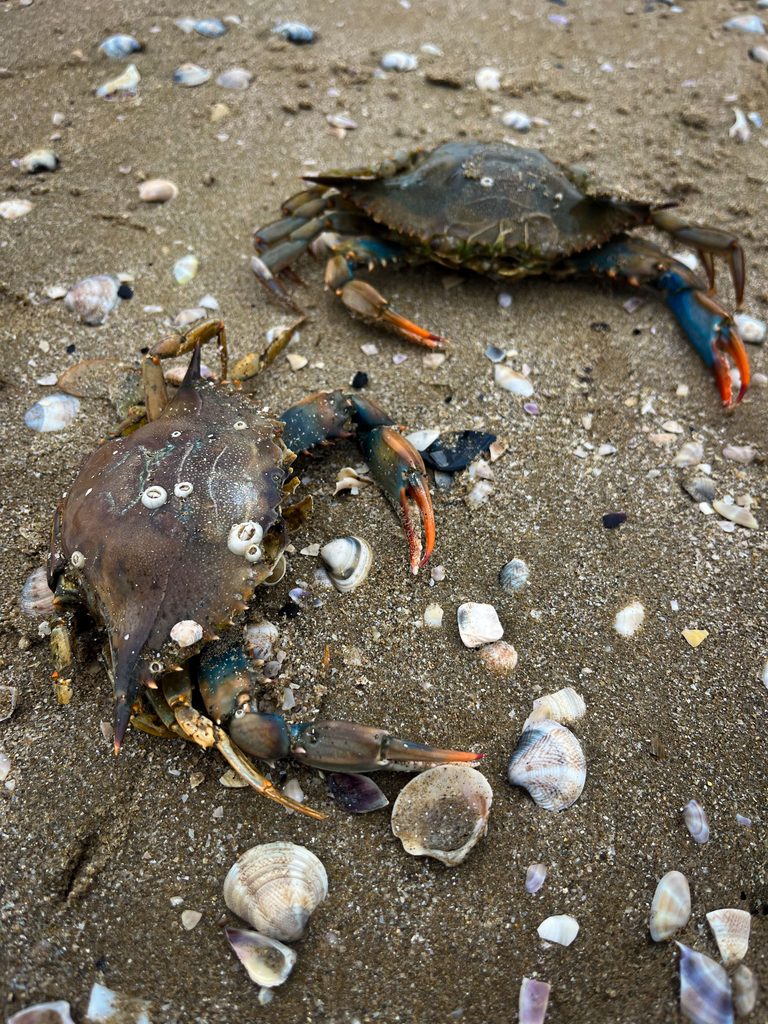
The blue crab is an icon of the Atlantic coast. It has olive-green shell, bright blue claws, and paddle-shaped back legs for swimming. Females have red-tipped claws, which some people say look like nail polish.
According to the Smithsonian, blue crabs live in estuaries from Nova Scotia to Uruguay and are the Maryland state crustacean. Their scientific name means “savory beautiful swimmer.” I think that name fits them well.
They are active predators and scavengers. They eat clams, small fish, and plant matter. Blue crabs also support major fisheries, especially in the Chesapeake Bay and the Gulf of Mexico.
2. Dungeness Crab (Metacarcinus magister)
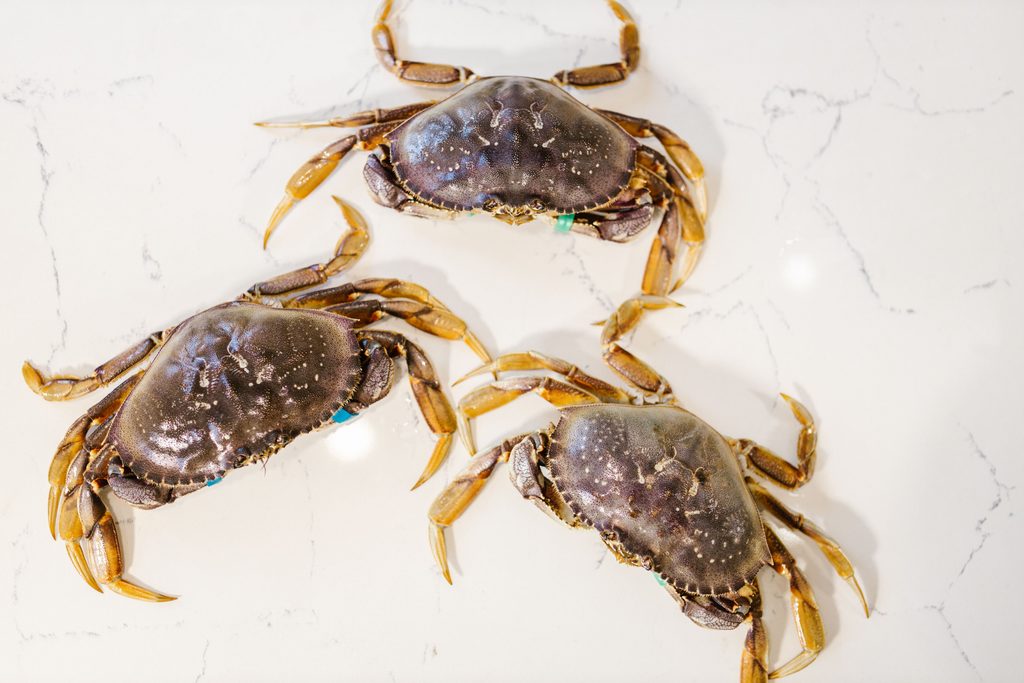
The Dungeness crab is the pride of the Pacific coast. It has a broad, oval shell that is purplish-brown on top and lighter beneath. Adults often reach about 20 centimeters across.
It lives in sandy and eelgrass-rich waters from Alaska to California. Young crabs hide in eelgrass beds for protection. This is why healthy eelgrass matters so much to the fishery.
Fishers usually harvest only large males, which helps protect the population. Many people say the meat is sweet and tender. It is a staple of West Coast seafood.
3. Red King Crab (Paralithodes camtschaticus)
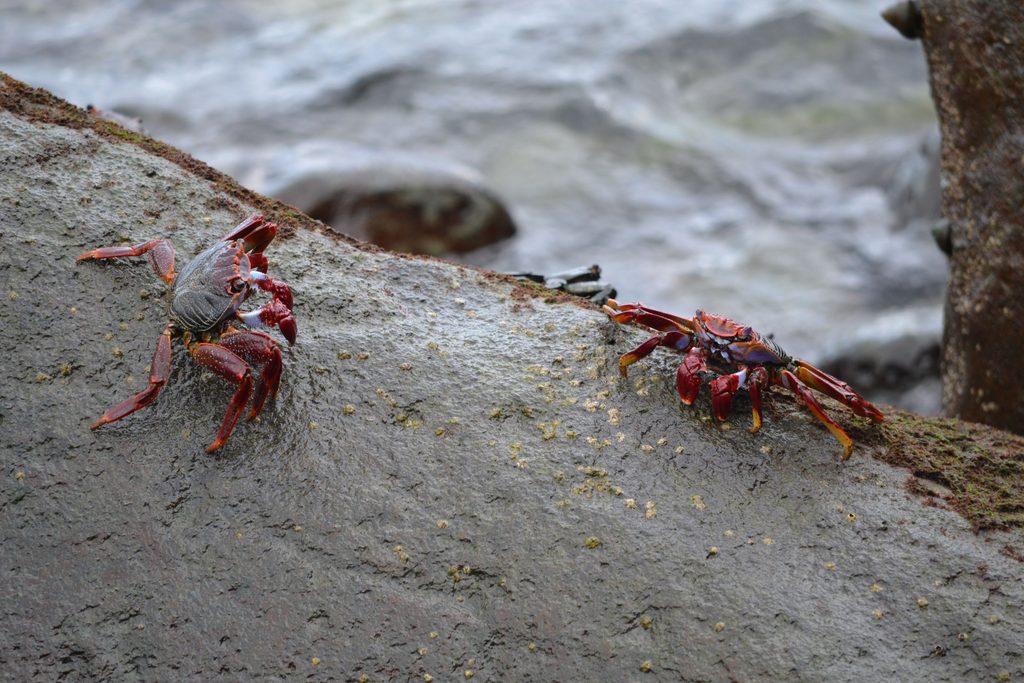
The red king crab is a giant of the cold north. It has a spiny, brick-red shell and long legs. NOAA states that red king crabs are the largest of the commercially harvested crabs.
Most of the harvest comes from Bristol Bay, Alaska. NOAA divides red king crab into four stocks: Bristol Bay, Pribilof Islands, Norton Sound, and Western Aleutian Islands. Some stocks have been closed to fishing for many years.
Managers follow the “three S’s”: size, sex, and season. Only large males can be caught, and only at set times. This approach helps protect breeding females.
4. Golden King Crab (Lithodes aequispinus)
The golden king crab is smaller than the red king crab. It has a golden-orange shell covered in sharp spines. It lives in deep, cold water, often along the Aleutian Islands.
Because it lives deep, it is harder to catch. Fishers use baited pots set on the seafloor. The fishery has stayed more stable than some other Alaskan crab fisheries.
Golden king crab has a slightly sweeter flavor, according to many chefs. Its deep-water home also keeps it away from many surface threats.
5. Blue King Crab (Paralithodes platypus)
The blue king crab looks much like the red king crab. Its shell is often reddish-brown or tan, though young crabs can look bluish. The name can be confusing. Experts tell the two apart by small spine patterns.
It lives in cold waters around the Bering Sea. Some populations, such as the one near the Pribilof Islands, have declined sharply. Fishing there has been closed for decades.
This species shows how fragile cold-water crabs can be. Recovery takes a long time, and scientists continue to study it.
6. Snow Crab (Chionoecetes opilio)
The snow crab has a flat, rounded shell and very long, thin legs. Its color is orange-brown above and pale below. Males are much larger than females.
It lives in cold waters of the North Atlantic and North Pacific. The meat is white, delicate, and slightly sweet. Many restaurants sell it as “snow crab legs.”
Snow crab is sensitive to ocean temperature. Warming waters in the Bering Sea have been linked to a major population decline in recent years. This shows how climate can reshape a fishery.
ALSO READ: 15 Types of Flying Ants (Identification, With Pictures)
7. Tanner Crab (Chionoecetes bairdi)
Tanner crabs are close relatives of snow crabs. They are bigger, with a wider shell and longer legs. In Alaska they are also called bairdi crab.
They live on soft ocean bottoms in cold water. They eat clams, worms, and small fish. Males can grow quite large, and only males above a minimum size may be harvested.
Alaska’s crab guide lists several Tanner species, including Southern, Triangle, and Grooved Tanner crabs. Identification can be tricky, so biologists check shell shape and spines carefully.
8. Stone Crab (Menippe mercenaria)
The stone crab is famous for its massive claws. Its shell is reddish-brown with dark tips on the claws. It lives in the warm waters of Florida and the Gulf of Mexico.
Fishers do not take the whole crab. They remove one or both claws and return the crab to the sea. The crab can grow a new claw over time.
Stone crab claws are a seasonal delicacy. People eat them chilled, often with mustard sauce. This practice is a rare example of harvesting without killing the animal.
9. Jonah Crab (Cancer borealis)
The Jonah crab is a sturdy crab of the North Atlantic. Its shell is oval and reddish-brown, with a scalloped edge. The claws are thick and strong.
It lives on rocky and sandy bottoms, from shallow water to deep ocean. It eats mussels, snails, and other small animals. Fishers often catch it in lobster traps.
Jonah crab has become more popular in recent years. Many people see it as a good alternative to other crabs, although it is still less known.
10. Japanese Spider Crab (Macrocheira kaempferi)
This is the largest crab in the world by leg span. Its legs can stretch about 3.7 meters from tip to tip. That is wider than a small car.
It lives deep in the Pacific Ocean around Japan, often several hundred meters down. Despite its size, it is quite gentle. It feeds on dead animals and small sea life.
Japanese spider crabs can live for many decades. I find it remarkable that such a delicate-looking giant has survived in the deep for so long.
11. Coconut Crab (Birgus latro)
The coconut crab is the largest land-living arthropod in the world. Adults can weigh several kilograms and span nearly a meter with their legs. It lives on islands in the Indian and Pacific Oceans.
It is actually a giant hermit crab. Young ones use shells, but adults leave them behind. Their claws are strong enough to open coconuts, though this takes time and effort.
Coconut crabs are in decline in many places. Hunting and habitat loss are the main threats. Several island nations now protect them.
12. Christmas Island Red Crab (Gecarcoidea natalis)
This bright red land crab lives only on Christmas Island in the Indian Ocean. Each year it makes one of the world’s great animal migrations. Millions of crabs march from the forest to the sea.
They move in a great red wave, crossing roads and gardens. Locals build bridges and barriers to protect them. The scene is unforgettable, and I would love to see it in person.
The crabs release their eggs into the sea, then return to the forest. The timing depends on rainfall and the lunar cycle.
13. Chinese Mitten Crab (Eriocheir sinensis)
The mitten crab is easy to identify. Its claws are covered in thick, furry hair that looks like mittens. Its shell is greenish-brown and about 8 centimeters wide.
It is native to East Asia but has spread to Europe and North America. It lives in rivers and migrates to the sea to breed. In some places it is a popular food.
Elsewhere it is a pest. It burrows into riverbanks, causing erosion, and it can clog water intakes. Many governments treat it as an invasive species.
14. Fiddler Crab (Genus Uca)
Fiddler crabs are small crabs of mudflats and salt marshes. Males have one oversized claw and one small claw. They wave the large claw to attract females and warn rivals.
The movement looks like a person playing a violin. That is how the crab got its name. Females have two small, equal claws.
Fiddler crabs also dig burrows, which helps aerate the soil. This improves marsh health. They are small, but they do important work.
15. Ghost Crab (Genus Ocypode)
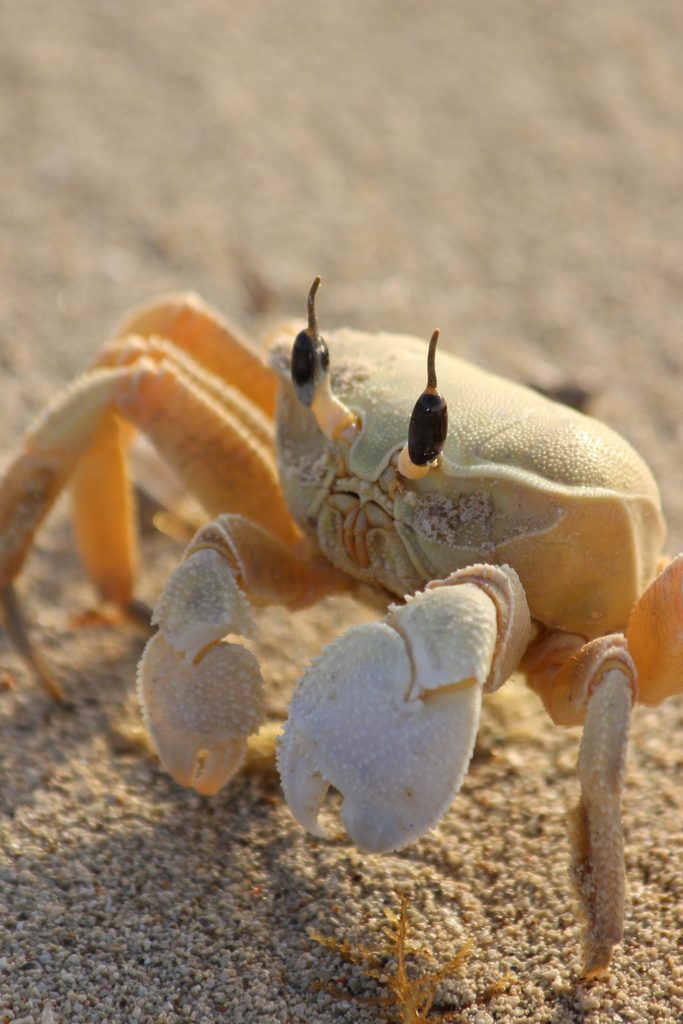
Ghost crabs are pale, sandy-colored crabs that live on beaches. They are fast runners and active mostly at night. Their eyes sit on tall stalks, which give them a wide view.
They dig deep burrows above the high-tide line. During the day, they stay hidden. At night, they hunt small insects, sea turtle hatchlings, and beach debris.
Because they are sensitive to disturbance, scientists use ghost crabs to measure beach health. Fewer crabs can signal heavy foot traffic or vehicle use.
16. Sally Lightfoot Crab (Grapsus grapsus)
This crab is one of the most colorful shore crabs. Its shell is red, orange, and yellow, sometimes with blue markings. It lives on rocky shores along the Pacific coast of the Americas and the Galápagos Islands.
It is very quick. It leaps from rock to rock, often escaping predators with ease. Its name reflects this lightness on its feet.
Sally Lightfoot crabs eat algae and clean other animals. In the Galápagos they even pick parasites off marine iguanas. It is a pleasant partnership.
17. Halloween Crab (Gecarcinus quadratus)
The Halloween crab has an orange-and-black shell with bright yellow spots. Its colors make it seem like it came straight out of a costume shop. It lives in Central America, often far from the sea.
It is a land crab. Adults live in burrows in forests and mangroves. They return to the ocean only to release eggs.
Because of its striking look, it is popular in the pet trade. Keeping one is not simple, though. It needs humid air and access to both fresh and salt water.
18. European Green Crab (Carcinus maenas)
The European green crab is one of the world’s most widespread invasive marine species. The carapace grows up to about 9 centimeters wide. Despite the name, its color varies, and the five spines along each side of the eyes are a better clue.
Green crabs were first found on the Pacific coast in 1989 near San Francisco Bay. According to the U.S. Geological Survey, they reached Washington in 1996, and their numbers there grew by nearly 5,500% between 2019 and 2021.
They eat clams, mussels, and young crabs. They also damage eelgrass, which many young Dungeness crabs need. Females can produce up to 500,000 eggs each year, so control is difficult.
19. Asian Shore Crab (Hemigrapsus sanguineus)
The Asian shore crab is a small, square-shaped crab with banded legs. Its colors range from green to purple-brown. It is native to the western Pacific.
It arrived on the U.S. East Coast in the late 1980s, probably in ship ballast water. It now lives on rocky shores from North Carolina to Maine. Populations can be very dense.
It competes with native crabs for food and shelter. It also eats small mussels and snails. This can change the balance of rocky shore communities.
20. Mud Crab (Scylla serrata)
The mud crab is a large, powerful crab of the Indo-Pacific. Its shell is greenish-brown, and its claws are heavy. It lives in mangroves and muddy estuaries.
It is one of the most valued crabs in Asia and Australia. Chefs prize its dense, sweet meat. It is often served in spicy or garlic sauces.
Mud crabs are strong enough to injure a careless handler. Fishers tie their claws as soon as they are caught. Mangrove loss threatens their nursery habitat.
21. Helmet Crab (Telmessus cheiragonus)
The helmet crab is a hairy, reddish-brown crab of the North Pacific. Its shell has a rounded, helmet-like shape. Short bristles cover its legs and body.
Alaska’s official crab identification guide lists it among species that fishers may meet. It lives in shallow, kelp-rich waters. It hides among seaweed and rocks.
Helmet crab is not a major commercial species. Still, it plays a role in the food web. It eats small animals and, in turn, feeds larger fish.
22. Hermit Crab (Family Paguridae and others)
Hermit crabs do not grow their own hard shell. Instead, they use empty snail shells to protect their soft abdomen. When they grow, they move to a bigger shell.
Sometimes they line up by size and swap shells in a chain. Scientists call this a “vacancy chain.” I find this behavior charming and a little humorous.
Hermit crabs live in oceans and on land. Land hermit crabs are popular pets, but many die from poor care. They need humidity, warmth, and a choice of shells.
23. Decorator Crab (Oregonia gracilis and relatives)
Decorator crabs cover themselves with living material. They attach algae, sponges, and small animals to their shells. This makes them nearly invisible to predators.
They use tiny hooked hairs to hold the decorations in place. When they molt, they often move the decorations onto their new shell. Some even choose items that match their surroundings.
This is clever camouflage. It shows how an animal can use its environment as a tool.
24. Pea Crab (Family Pinnotheridae)
Pea crabs are some of the smallest crabs in the world. Some are only a few millimeters wide. They often live inside the shells of oysters, mussels, and clams.
Their relationship with the host varies. In some cases the crab takes food from the host’s gills. In others the harm is minimal. Scientists continue to study these partnerships.
Pea crabs are found in many seafood markets without notice. They are harmless to people and safe to eat, though most people never see one.
25. Porcelain Crab (Family Porcellanidae)
Porcelain crabs look like tiny crabs, but they are more closely related to hermit crabs. They are flat, delicate, and often brightly patterned. Many live under rocks or in anemones.
They have long, thin antennae that they use to filter food from the water. Unlike most crabs, they feed by combing plankton from the current. Their claws are used mostly for defense.
If a predator grabs a leg, a porcelain crab can drop it. The leg grows back after a few molts. This escape trick helps them survive.
Why Crabs Matter
Crabs support food, jobs, and healthy coasts. They clean the seafloor, recycle nutrients, and feed fish, birds, and mammals. Many coastal communities depend on them.
Crabs are also warning signs. Falling snow crab numbers, shrinking king crab stocks, and exploding green crab populations all show that oceans are changing. Warming water and human movement of species play a large role.
I believe smart management is possible. Catch limits, size rules, and seasonal closures have helped some fisheries recover. Early reporting of invasive crabs also helps.
Simple ways to help crabs and coasts:
- Choose seafood from well-managed fisheries.
- Never release pet crabs or aquarium animals into the wild.
- Keep beaches clean and respect nesting and burrow areas.
- Report unusual or invasive crabs to local wildlife agencies.
Conclusion
From the giant Japanese spider crab to the tiny pea crab, these animals show great variety. Each one has found its own way to survive on the shore, in the deep sea, or even in the forest.
I hope this guide helps you recognize the crabs you meet and understand why they matter. The next time you see one scuttle sideways, take a moment to look closely. There is always more to learn.
References
- NOAA Fisheries. “Red King Crab.” https://www.fisheries.noaa.gov/species/red-king-crab
- NOAA Fisheries. “Crab Species Identification in Alaska Fisheries (2023 Crab Guide).” https://www.fisheries.noaa.gov/s3/2023-09/2023-Crab-Guide.pdf
- Smithsonian Institution. “Blue Crab (3D Digitization).” https://3d.si.edu/explorer/blue-crab
- Smithsonian Environmental Research Center. Lipcius, R. N., and Stockhausen, W. “Concurrent Decline of the Spawning Stock, Recruitment, Larval Abundance, and Size of the Blue Crab in Chesapeake Bay.” https://repository.si.edu/handle/10088/17942
- National Invasive Species Information Center (USDA). “European Green Crab.” https://www.invasivespeciesinfo.gov/aquatic/invertebrates/european-green-crab
- U.S. Geological Survey. “Invasive European Green Crabs.” https://www.usgs.gov/index.php/media/images/invasive-european-green-crabs
- NOAA Institutional Repository. “Global Invader: The European Green Crab.” https://repository.library.noaa.gov/view/noaa/44992