50 Types of Beetle Insects (Identification, With Pictures)
Beetles are everywhere. They live in forests, deserts, ponds, farms, and even your kitchen cupboard. If you have ever seen a ladybug or a firefly, you have already met a beetle.
Beetles belong to the order Coleoptera. Scientists have described about 350,000 species in this order. That is roughly 40% of all known insect species. I find this number humbling. One in every few insects you meet is a beetle.
The Smithsonian takes this diversity seriously. Its National Museum of Natural History holds more than seven million beetle specimens. That collection helps researchers study how beetles live, spread, and change over time.
Beetles are easy to recognize once you know the key feature. They have hardened front wings called elytra, which cover and protect the delicate flying wings underneath. This shell-like cover gives beetles their armored look.
In this guide, I describe 50 types of beetle insects, covering appearance, habitat, and the role the beetle plays in nature or in our lives. Some are helpful. Some are harmful. Many are simply remarkable.
Quick facts before we begin:
- Beetles live on every continent except Antarctica.
- Weevils form the largest beetle family, and arguably the largest insect family. si
- Beetles go through complete metamorphosis: egg, larva, pupa, adult.
Part 1: Common Garden and Backyard Beetles
1. Seven-Spotted Lady Beetle (Coccinella septempunctata)
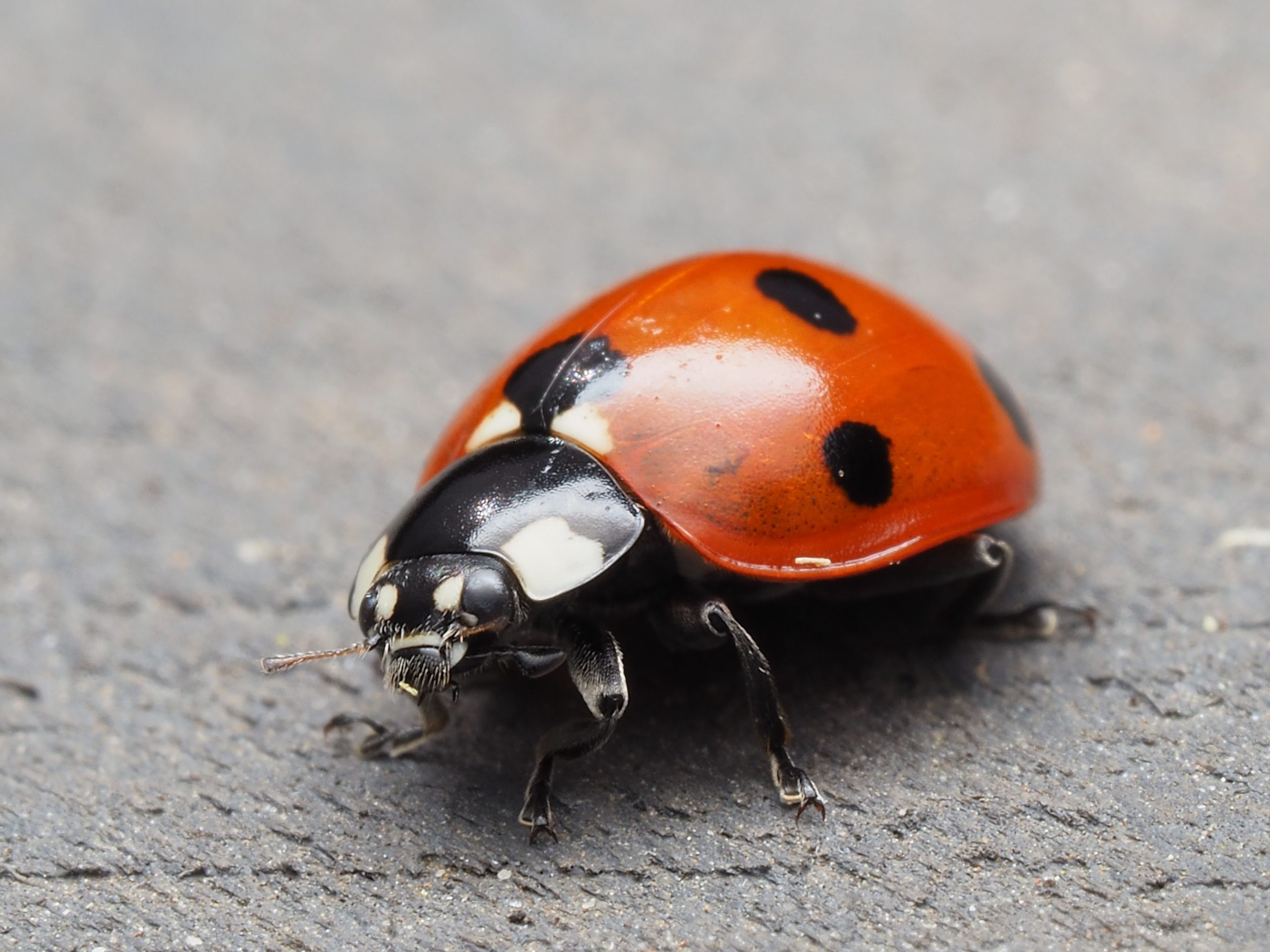
This is the classic ladybug. It has a red, domed body with seven black spots. Most people recognize it at once, and many children love it.
Adults and larvae feed on aphids, which damage garden plants. One lady beetle can eat many aphids in a day, so gardeners often welcome them.
It is native to Europe and Asia but now lives in North America too. Look for it on roses, beans, and weeds near fields.
2. Asian Lady Beetle (Harmonia axyridis)
This species looks like a ladybug but varies a lot in color. It can be orange, red, or even black with spots. A white marking behind its head, shaped like an “M,” helps identify it.
It was introduced to many countries to control crop pests. It does that job well. However, it can become a nuisance in autumn.
Large groups often enter homes to spend the winter. They are harmless to people, but they can stain surfaces and give off a bad smell when disturbed.
3. Japanese Beetle (Popillia japonica)
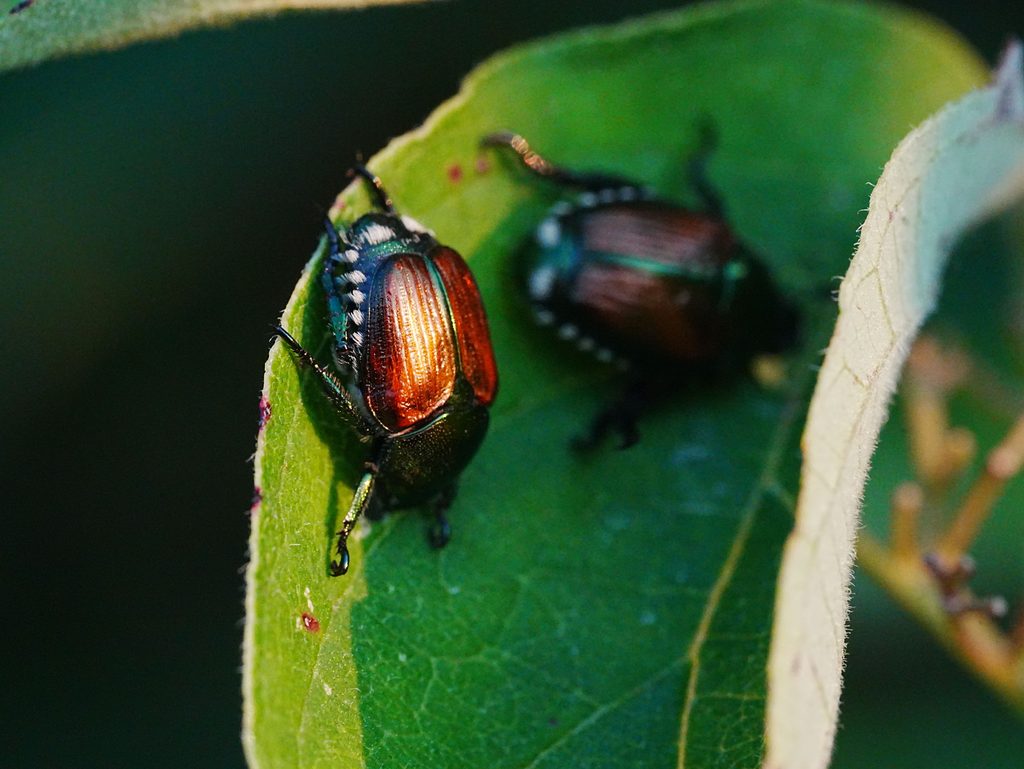
The Japanese beetle is small but destructive. It has a metallic green head and copper-brown wing covers. Tufts of white hair line its sides.
Adults feed on more than 300 plant species, including roses, grapes, and beans. The grubs live in soil and eat grass roots. This makes lawns turn brown in patches.
It is an invasive insect from Japan with a very wide range of host plants. Gardeners in many regions fight it every summer.
4. Colorado Potato Beetle (Leptinotarsa decemlineata)
This beetle is easy to spot. It has a yellow-orange body with ten black stripes running down its back. Its larvae are plump, reddish, and soft.
As the name suggests, it feeds mainly on potato plants. Heavy attacks can strip a field of leaves in a short time. This reduces the harvest sharply.
The beetle is famous for resisting insecticides. Farmers now rely on crop rotation and careful monitoring to keep it under control.
5. Ten-Lined June Beetle (Polyphylla decemlineata)
This large beetle appears in early summer. It is brown with white stripes along its wing covers. Males have fan-shaped antennae that look almost like feathers.
Adults come to lights at night. They often bump against windows and porch lamps. Many people mistake them for something dangerous, but they do not bite.
The larvae feed on roots in sandy soil. Damage is usually minor, though heavy infestations can harm grass and young trees.
6. Green June Beetle (Cotinis nitida)
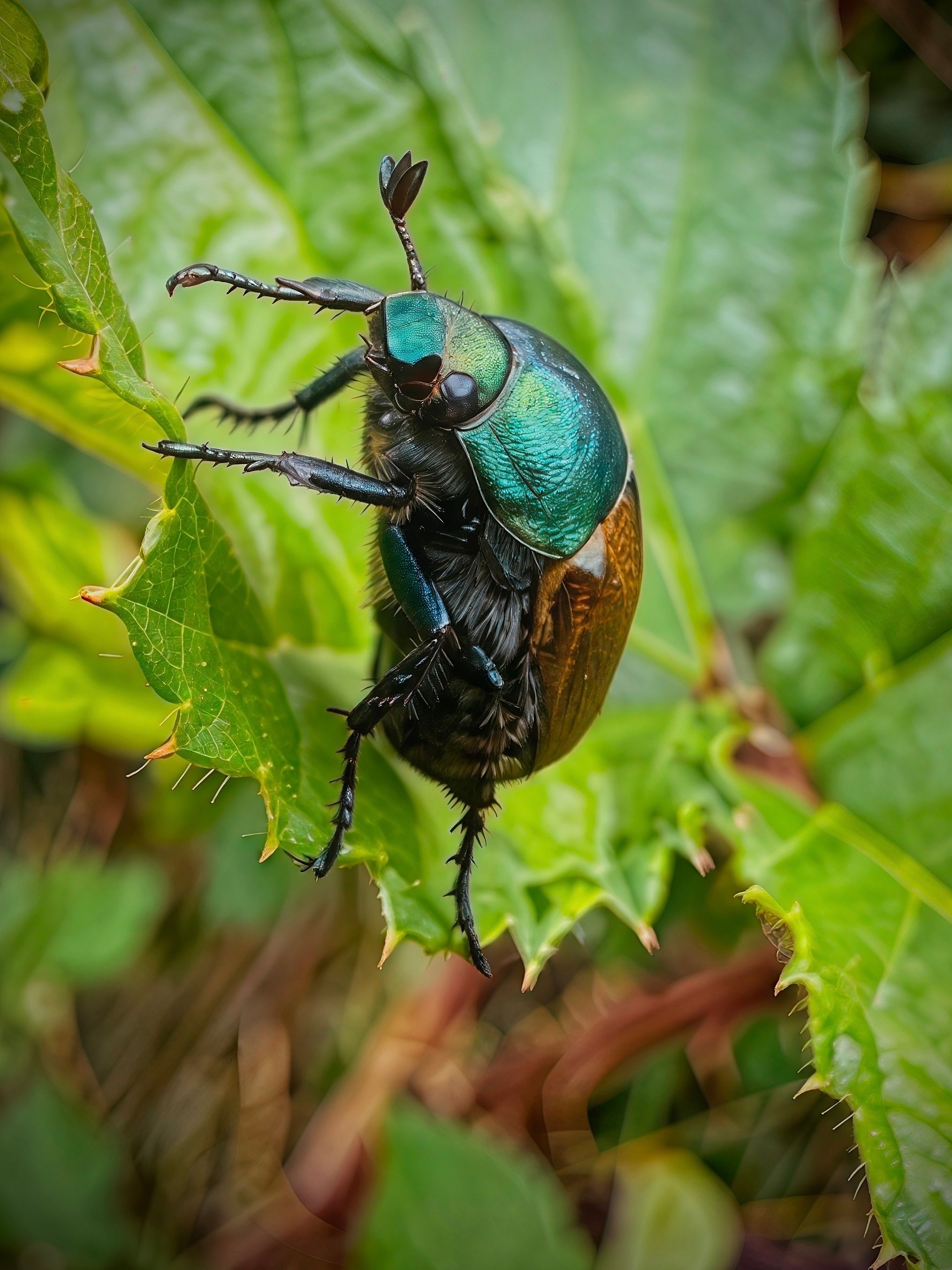
This is a bright, metallic green beetle with tan edges. It looks almost like a jewel. In the southeastern United States, it is common in summer.
Adults feed on ripe fruit such as peaches, figs, and berries. They fly low and buzz loudly, which often startles people.
The grubs have an odd habit. They crawl on their backs, using their body hairs to move. I find this one of the funniest sights in the insect world.
7. Cucumber Beetle (Diabrotica undecimpunctata)
The spotted cucumber beetle is yellow-green with black spots. It is small but a serious pest in vegetable gardens. It attacks cucumbers, squash, and melons.
The beetle chews leaves and flowers. It also spreads bacterial wilt, a disease that can kill whole plants. This makes it more dangerous than its size suggests.
Row covers and early planting help protect crops. Checking plants often is the best defense.
ALSO READ: 25 Types of Crabs Explained (Different Species, With Pictures)
8. Flea Beetle (Family Chrysomelidae)
Flea beetles are tiny, shiny beetles. They get their name from their strong back legs, which let them jump like fleas when disturbed.
They leave small, round holes in leaves. These “shot-hole” patterns are common on eggplant, radish, and cabbage. Young seedlings suffer the most.
Healthy, established plants usually survive light feeding. Gardeners should protect new seedlings with light fabric covers.
9. Tortoise Beetle (Subfamily Cassidinae)
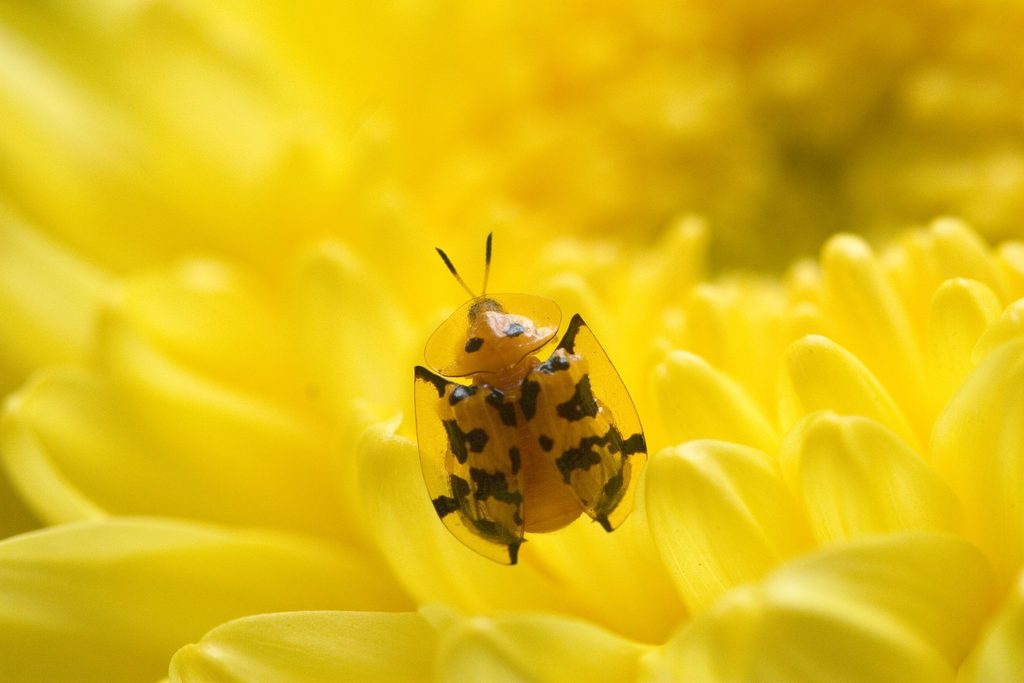
Tortoise beetles look like tiny shields. Their wing covers spread out like a dome. Some species shine like gold, and this has earned them the nickname “golden tortoise beetle.”
Their color can change when the beetle is stressed or disturbed. Scientists still study how this works. It is a lovely example of nature’s quiet surprises.
They feed on plants in the morning glory family, including sweet potato. Damage is usually small.
10. Soldier Beetle (Family Cantharidae)
Soldier beetles are slim and soft-bodied. Many are orange or yellow with dark wing tips. They are often seen on flowers in late summer.
Adults eat pollen and nectar, and they also hunt small insects. This makes them useful allies in the garden, since they feed on aphids.
Their larvae live in leaf litter and hunt other small creatures. You can attract them by planting goldenrod and other wildflowers.
ALSO READ: 15 Types of Flying Ants (Identification, With Pictures)
Part 2: Giant and Spectacular Beetles
11. Goliath Beetle (Goliathus goliatus)
Goliath beetles are among the heaviest insects on Earth. Adults can reach about 11 centimeters long. Their larvae are even heavier than the adults.
They live in the tropical forests of Africa. Adults feed on tree sap and fruit. Their bodies are black and white or brown, and they look very solid.
Despite their size, they are gentle. They are not dangerous to people.
12. Hercules Beetle (Dynastes hercules)
The Hercules beetle is a rhinoceros beetle from Central and South America. Males carry two long horns, one on the head and one on the thorax. Together they look like giant pincers.
Males can reach about 17 centimeters, including the horns. The length of the horns, not the body, makes them so large. Females have no horns at all.
The beetle’s wing covers can change color with humidity. They can turn from olive green to black. It is a striking trick that few insects share.
13. Atlas Beetle (Chalcosoma atlas)
The Atlas beetle lives in Southeast Asia. Males have three prominent horns and a glossy black body. They look powerful, almost like tiny tanks.
Males use their horns to fight for females. They push and lift rivals off tree branches. The winner earns the right to mate.
The larvae feed on rotting wood. Because of this, they help return nutrients to the forest floor.
14. Titan Beetle (Titanus giganteus)
The titan beetle is one of the largest beetles in the world. It can grow over 16 centimeters long. It lives in the rainforests of northern South America.
Its jaws are strong enough to snap a pencil. I would never want to test this myself. Adults seldom eat, and the larvae live deep inside rotting wood.
Few people have ever seen one alive. Its life cycle is still poorly known, which adds to its mystery.
15. Elephant Beetle (Megasoma elephas)
The elephant beetle is a heavy, hairy rhinoceros beetle. It lives in Central and South America. Males have two curved horns on the head and a third on the thorax.
Its body can be over 10 centimeters long. Females lack horns but are still large and strong. Both look rugged and ancient.
Adults feed on sap and rotting fruit. The grubs grow slowly inside decaying logs.
16. European Stag Beetle (Lucanus cervus)
The stag beetle is Europe’s largest land beetle. Males have huge jaws shaped like deer antlers. They use them to wrestle rivals, not to bite.
Adults appear in early summer and fly at dusk. Their larvae live for several years in decaying wood, often in old oak stumps. Because of this, the species needs old trees.
The stag beetle is protected in several countries. Loss of dead wood and old woodland has caused its decline.
17. European Rhinoceros Beetle (Oryctes nasicornis)
This glossy brown beetle carries a single curved horn on its head. Males have a larger horn than females. The horn gives the species its name.
It is found in Europe, North Africa, and parts of Asia. Adults are active at night and feed little. The larvae are the real eaters.
They live in compost heaps, sawdust piles, and rotting wood. Gardeners may find the grubs while turning their compost.
18. Harlequin Beetle (Acrocinus longimanus)
The harlequin beetle looks like a work of art. Its wing covers show red, black, and yellow patterns. Males have extremely long front legs.
It lives in tropical forests from Mexico to Brazil. Adults often climb on fallen figs and dead trees. Tiny pseudoscorpions sometimes ride on their bodies.
The long front legs help males hold on to females and tree trunks. They also make this beetle unforgettable.
Part 3: Famous Specialists with Unusual Skills
19. Sacred Scarab (Scarabaeus sacer)
This dung beetle was sacred in ancient Egypt. Egyptians linked it to the sun god because it rolls a ball of dung across the ground. They saw the ball as the sun crossing the sky.
The beetle rolls dung to feed its young and to lay eggs. Some dung beetles even use the Milky Way to navigate in a straight line at night.
Dung beetles also clean the land. They bury waste, improve soil, and reduce flies. Farmers around the world benefit from them.
20. Tiger Beetle (Subfamily Cicindelinae)
Tiger beetles are among the fastest insects on land. Some species run so fast that they briefly go blind. They must stop and look again to find their prey.
They often have shiny, metallic colors and long legs. Their large eyes and sharp jaws make them skilled hunters. They live on sandy trails and riverbanks.
Many tiger beetle species are now threatened by habitat loss. Their presence is a sign of clean, healthy ground.
21. Bombardier Beetle (Tribe Brachinini)
The bombardier beetle has a unique defense. When threatened, it sprays a hot, toxic liquid from the tip of its abdomen. The spray can reach about 100°C.
The beetle mixes two chemicals inside its body. When they meet, a rapid reaction produces the hot spray with a popping sound. Scientists have studied this system for decades.
It is small, usually less than two centimeters. Still, it can drive away ants and even frogs.
22. Firefly or Lightning Bug (Family Lampyridae)
Fireflies are beetles, not flies. Their glowing abdomens produce light through a chemical reaction. Each species uses its own flash pattern to find a mate.
Many people remember fireflies from childhood evenings. I certainly do. Watching them blink over a dark field is a quiet, magical experience.
Sadly, some populations are declining. Light pollution, pesticides, and habitat loss are the main concerns.
23. Eastern Eyed Click Beetle (Alaus oculatus)
This large click beetle is gray with two big black “eyespots” on its back. The spots are not real eyes. They scare off birds and other predators.
When placed on its back, the beetle flips itself into the air with a loud click. This helps it right itself and escape. The sound surprises many first-time observers.
Its larvae, often called wireworms in other species, live in rotting logs. They eat other insect larvae.
24. Great Diving Beetle (Dytiscus marginalis)
This large water beetle is a skilled swimmer. It has a smooth, oval body and long, hairy back legs that work like oars. It lives in ponds and slow streams across Europe and Asia.
Adults carry a bubble of air under their wing covers. This lets them stay underwater for a long time. They hunt tadpoles, insects, and small fish.
The larvae are fierce too. They are nicknamed “water tigers” for good reason.
25. Whirligig Beetle (Family Gyrinidae)
Whirligig beetles spin in circles on the water’s surface. They often move in large groups. The sight is both funny and beautiful.
Each eye is split in two. One half looks above the water, and the other looks below. This helps them spot both food and danger.
They also release a milky, bad-smelling fluid when threatened. Predators learn to leave them alone.
26. Water Scavenger Beetle (Family Hydrophilidae)
These beetles live in still water. They look a lot like diving beetles but swim differently. They move their legs alternately instead of together.
Adults mostly eat plants and decaying matter, while the larvae are predators. This change in diet is common in beetles.
They breathe by trapping air against their bodies. They can often be found near ponds in the evening.
Part 4: Major Forest and Tree Pests
27. Emerald Ash Borer (Agrilus planipennis)
The emerald ash borer is a small, metallic green beetle from Asia. It was discovered in Michigan in 2002. Since then, it has spread across much of North America.
Its larvae tunnel under the bark of ash trees. This cuts off the tree’s food and water. The insect has caused the decline and death of tens of millions of ash trees in the United States. usu
Adults leave D-shaped exit holes in the bark. Spotting these early can help save nearby trees.
28. Asian Longhorned Beetle (Anoplophora glabripennis)
This large beetle is shiny black with white spots and long, banded antennae. It can reach about 3 to 4 centimeters long. It is hard to miss.
It attacks hardwoods such as maple, birch, and horse chestnut, and it was first found in Worcester, Massachusetts, in 2008. Earlier outbreaks appeared in New York.
Officials ask the public to report any sightings. Early detection is the best tool to stop its spread.
29. Mountain Pine Beetle (Dendroctonus ponderosae)
This small, dark beetle is about the size of a grain of rice. It lives in western North America. Despite its size, it has killed vast areas of pine forest.
Adults bore into the bark and carry a blue-stain fungus. The fungus blocks the tree’s water flow. Warm winters and drought have helped outbreaks grow.
Large outbreaks change entire landscapes. They raise wildfire risk and affect water supplies.
30. Deathwatch Beetle (Xestobium rufovillosum)
The deathwatch beetle is a small brown beetle that attacks old timber. It damages historic buildings, churches, and beams in Europe. Hardwoods like oak are its favorite.
Adults tap their heads against wood to attract mates. In the quiet of old houses, this ticking sound was once linked to death. The superstition gave the beetle its name.
Damp wood is more likely to be attacked. Keeping timber dry is the best prevention.
31. Powderpost Beetle (Family Bostrichidae and Lyctinae)
Powderpost beetles turn wood into fine, flour-like dust. The larvae tunnel inside the timber for months or years. You often notice them only when tiny exit holes appear.
They attack furniture, flooring, and tool handles. Seasoned hardwoods are especially at risk. A small pile of powder under an object is a common sign.
Treating infested wood early can prevent serious damage. In many cases, heat or professional treatment is needed.
32. Jewel Beetle (Family Buprestidae)
Jewel beetles shine in metallic green, blue, gold, and copper. Their colors come from the structure of their wing covers, not from pigment. This is why they sparkle in the light.
Their larvae bore into wood, and some species are major tree pests. The emerald ash borer belongs to this family. Others are harmless and beautiful.
In some parts of Asia, jewel beetle wings are used in traditional crafts. They have been valued as decoration for centuries.
33. Bess Beetle (Odontotaenius disjunctus)
The bess beetle, or horned passalus, is a shiny black beetle found in eastern North America. It lives in rotting logs and often in family groups. This is unusual for beetles.
Parents care for their young. They chew wood to make it easier to digest and feed the larvae. Adults also squeak by rubbing body parts together.
They help break down dead trees. Forests depend on this slow, quiet work.
Part 5: Beetles Found in Homes and Stored Food
34. Red Flour Beetle (Tribolium castaneum)
This small, reddish-brown beetle is a common pantry pest. It infests flour, cereals, dried fruit, and spices. Adults are only about 3 to 4 millimeters long.
An infestation can spread quickly in warm kitchens. Infested food may smell sour and look gray. It should be thrown away.
Storing food in sealed containers is the simplest prevention. Clean shelves regularly, too.
35. Rice Weevil (Sitophilus oryzae)
The rice weevil has a long snout and a dark brown body with faint reddish spots. It attacks rice, wheat, corn, and other grains. Females lay eggs inside single kernels.
The larvae develop inside the grain. By the time you see the adult, the damage has already begun. This hidden life cycle makes weevils hard to detect.
They are a major problem in grain storage worldwide. Cool, dry storage slows their growth.
36. Cigarette Beetle (Lasioderma serricorne)
This small, tan beetle feeds on dried plant products. Despite its name, it eats much more than tobacco. It also attacks spices, dried herbs, and pet food.
Adults fly toward light and often appear on windowsills. They are tiny, about two to three millimeters long. Their rounded shape helps identify them.
Throwing out old spices and sealing food are the best steps. Check dried goods you have kept for a long time.
37. Khapra Beetle (Trogoderma granarium)
The khapra beetle is one of the most feared stored-grain pests. It can survive without food for long periods and resist many treatments. It feeds on grains, nuts, and dried foods.
Governments watch for it at ports and borders. In the United States, USDA inspectors treat it as a serious quarantine pest. A single infestation can cost heavily in lost trade.
Because it is so hard to control, prevention is critical. Imported goods are inspected with great care.
38. Carpet Beetle (Family Dermestidae)
Carpet beetles are small, oval, and often spotted with white, brown, or orange. The adults feed outdoors on pollen. The larvae cause the damage indoors.
Larvae eat wool, fur, silk, feathers, and stored items. They leave small holes in clothing and rugs. Shed larval skins are a clear warning sign.
Regular vacuuming and washing help prevent them. Store wool items in sealed containers.
39. Hide Beetle (Dermestes maculatus)
Hide beetles feed on dried animal tissue. This trait makes them pests in food-processing places. It also makes them very useful in science.
Museums use them to clean animal skeletons. The beetles eat the flesh and leave the bones in good condition. Many natural history collections depend on them.
I find it fascinating that a pest in one setting is a trusted assistant in another. Context changes everything.
40. Yellow Mealworm Beetle (Tenebrio molitor)
The yellow mealworm beetle is a dark brown darkling beetle. Its larvae, known as mealworms, are famous as pet food and fishing bait. They are found in stored grain.
Researchers are now exploring mealworms as a source of protein for animal feed and human food. They can also eat certain plastics, according to some studies. This has sparked wide interest.
The beetle itself lives for a few months. Its life cycle is simple to study, so it is common in school classrooms.
Part 6: Fascinating Ground Dwellers and Scavengers
41. Ground Beetle (Family Carabidae)
Ground beetles are one of the largest beetle families. Most are black or dark, with long legs and a fast, running style. They hide under stones and logs during the day.
They hunt at night. Their prey includes slugs, caterpillars, and other pests. Gardeners and farmers value them as natural pest controllers.
Many species cannot fly well. As a result, they are sensitive to habitat change and are used as indicators of ecosystem health.
42. Rove Beetle (Family Staphylinidae)
Rove beetles have short wing covers and long, exposed abdomens. They look more like earwigs than beetles. This is a very large family, with tens of thousands of species.
Many are predators of flies and mites. Some live in compost, dung, or leaf litter. Others live with ants and termites.
Their flexible abdomen helps them squeeze into tight spaces. Some raise it like a scorpion’s tail when alarmed, although they cannot sting.
43. American Burying Beetle (Nicrophorus americanus)
This is one of the most remarkable beetles in North America. It is black with bright orange-red markings. It buries small dead animals to feed its young.
Both parents care for the larvae. That is rare among insects. The species was listed as endangered in 1989.
In 2020, the U.S. Fish and Wildlife Service moved it from endangered to threatened. That is a hopeful sign, though the beetle still needs protection.
44. Darkling Beetle (Family Tenebrionidae)
Darkling beetles are tough, dark insects. Many live in deserts, where they cope with heat and little water. They are common under rocks and in leaf litter.
Some species stand on their heads in the morning fog. Water collects on their bodies and runs to their mouths. It is a clever way to drink in dry places.
The darkling beetles are one of the large beetle families. They show how adaptable beetles can be.
45. Ironclad Beetle (Phloeodes diabolicus)
The ironclad beetle is famous for its toughness. It can survive being crushed by a heavy force. Scientists have studied its body to learn how it resists damage.
Its wing covers are tightly joined and very hard. They work like strong, flexible armor. Engineers hope to copy this design for new materials.
It lives in dry parts of the western United States. It cannot fly, but it can take a great deal of punishment.
Part 7: Colorful and Unusual Beetles
46. Blister Beetle (Family Meloidae)
Blister beetles contain a chemical called cantharidin. When crushed, it can cause painful blisters on human skin. For this reason, people should not handle them.
The chemical can also poison horses that eat contaminated hay. Farmers must watch for these beetles in alfalfa fields. Livestock safety depends on clean forage.
The “Spanish fly” is a famous blister beetle. In history, its chemical was misused, often with dangerous results.
47. Oil Beetle (Genus Meloe)
Oil beetles are large, dark, and slow-moving. They have short wing covers and swollen bodies. When threatened, they release oily droplets from their joints.
Their life cycle is strange. The tiny larvae climb onto flowers and hitch a ride on solitary bees. They then feed on the bee’s eggs and food stores.
Several oil beetle species are declining in Europe. This follows the decline of wild bees, on which they depend.
48. Cardinal Beetle (Pyrochroa serraticornis)
The cardinal beetle is bright scarlet. It has a flat body and comb-like antennae in males. It is found in woods and hedgerows in Europe.
Adults are often seen on flowers in early summer. They feed on pollen and small insects. Their larvae live under loose bark and hunt other larvae.
The red color warns predators. It suggests the beetle may taste bad or be harmful.
49. Cockchafer or May Bug (Melolontha melolontha)
The cockchafer is a large brown beetle with fan-shaped antennae. It appears in late spring across Europe. Adults fly noisily at dusk and bump into lights.
The larvae live underground for three to four years. They feed on roots and can damage crops and lawns. Heavy flights occur in cycles in some regions.
In the past, outbreaks were serious enough to alarm farmers. Today they are less common but still notable.
50. Pleasing Fungus Beetle (Family Erotylidae)
These small beetles are glossy and often red, orange, or black. Many have bold markings. They live on fungi growing on logs and under bark.
Both adults and larvae feed on fungi. This role helps recycle dead wood. It also helps control fungus growth in forests.
Their name suits them well. They are small, bright, and easy to enjoy under a magnifying glass.
Why Beetles Matter
Beetles shape the world around us. They pollinate flowers, recycle waste, and control pests. Without them, forests and farms would struggle.
Some beetles also cause serious harm. Invasive species like the emerald ash borer and Asian longhorned beetle damage trees and cost billions in control efforts. Early reporting helps limit this damage.
I believe the best response is curiosity paired with care. Learn to recognize the beetles near you. Protect the helpful ones and report the harmful ones.
Simple ways to help beetles and your local ecosystem:
- Leave some dead wood and leaf litter in your garden.
- Plant native flowers and avoid unnecessary pesticides.
- Report unusual or invasive beetles to local agricultural officials.
- Support protected areas for rare species.
Conclusion
Beetles are small, but their impact is enormous. They range from the gentle ladybug to the mighty Goliath beetle. Each type has a role, whether helpful, harmful, or simply wonderful.
I hope this guide helps you identify the beetles you meet and appreciate them more. With so many species still unknown, there is always something new to discover.
References
- Smithsonian Institution. “Beetles (Coleoptera).” https://www.si.edu/spotlight/buginfo/beetle
- Smithsonian Institution. “Bug Info.” https://www.si.edu/spotlight/buginfo
- Smithsonian National Museum of Natural History. “Entomology Collections Overview.” https://naturalhistory.si.edu/research/entomology/collections-overview
- National Invasive Species Information Center (USDA). “Asian Long-horned Beetle Resources.” https://www.invasivespeciesinfo.gov/terrestrial/invertebrates/asian-long-horned-beetle/resources
- Utah State University Extension. “Invasive Pests: Top Five to Watch For.” https://extension.usu.edu/planthealth/invasives/top-five-watch-for.php
- U.S. Fish and Wildlife Service. “Reclassification of the American Burying Beetle From Endangered to Threatened With a Section 4(d) Rule.” https://www.fws.gov/species-publication-action/reclassification-american-burying-beetle-endangered-threatened-section
- University of Nebraska–Lincoln / U.S. Fish and Wildlife Service Endangered Species Bulletin. “Determination of Endangered Status for the American Burying Beetle.” https://digitalcommons.unl.edu/endangeredspeciesbull/1