Angelfish Not Eating for Days: Reasons, Solutions, and When to Worry
Angelfish are among the most elegant freshwater fish kept in home aquariums. Their graceful fins and calm temperament make them a favourite for both beginners and experienced hobbyists. But when your angelfish stops eating — and days pass with no change — it can feel genuinely alarming.
The good news is that food refusal in angelfish is rarely a death sentence. In most cases, there is a clear, manageable reason behind it.
This guide explains why angelfish stop eating, how to identify the root cause, what you can do at home, and when professional or veterinary advice becomes necessary.
How Long Is Too Long for an Angelfish Not to Eat?
Before panic sets in, it helps to understand what is considered normal. Angelfish can survive without food for up to two weeks under healthy conditions, according to general aquatic biology principles. A day or two of food refusal is not, by itself, a crisis.
However, if your angelfish has not eaten for more than three to five days and is showing other signs such as lethargy, colour loss, clamped fins, or unusual swimming patterns, then the situation deserves closer attention.
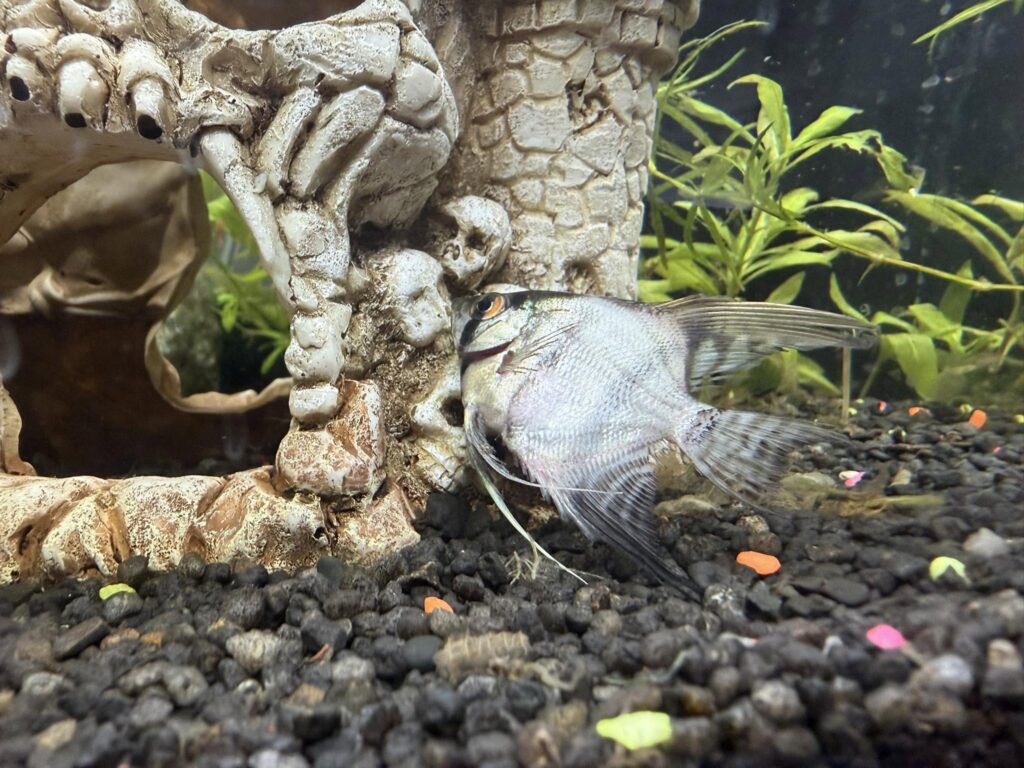
Common Reasons Angelfish Stop Eating
1. Stress From Environmental Changes
Stress is the single most common reason an angelfish refuses food. These fish are sensitive to changes in their environment. Moving them to a new tank, rearranging decorations, adding new tank mates, or even changing the lighting schedule can trigger a period of stress-related fasting.
When an angelfish feels unsafe or unsettled, its natural response is to withdraw. This includes avoiding food. Give the fish a few days to adjust. If the environment remains stable, eating usually resumes on its own.
2. Poor Water Quality
Angelfish are particularly sensitive to water chemistry. High levels of ammonia, nitrite, or nitrate can suppress appetite and cause visible discomfort. Similarly, water that is too cold or too warm, outside the ideal range of 24–29°C (75–84°F), can slow metabolism and reduce the desire to eat.
Test your water immediately if your angelfish stops eating. Key parameters to check include:
- Ammonia: should be 0 ppm
- Nitrite: should be 0 ppm
- Nitrate: ideally below 20 ppm
- pH: stable between 6.0 and 7.5
- Temperature: consistent within the ideal range
Even a small spike in ammonia or a sudden temperature drop can be enough to turn an otherwise healthy fish away from its food.
3. Disease or Parasitic Infection
Several diseases can cause loss of appetite in angelfish. Internal parasites, such as hexamita or intestinal worms, are a common culprit. These organisms damage the digestive tract, making eating uncomfortable or painful.
External parasites like ich (white spot disease) or velvet can also cause food refusal, especially when they affect the gills or skin and make the fish feel unwell overall.
Watch for additional symptoms alongside food refusal:
- White spots or dusty coating on the body
- Rapid gill movement or gasping at the surface
- Bloated or sunken belly
- Stringy, pale, or white faeces
- Rubbing against tank surfaces
If any of these signs appear, disease should be treated as a likely cause.
4. Overfeeding History and Digestive Issues
Surprisingly, a fish that has been overfed in the past may refuse food as a result of digestive issues or constipation. Angelfish fed excessive amounts of dry food without variety can develop a sluggish digestive system. When this happens, food refusal is often the body’s way of self-regulating.
A short, deliberate fast of two to three days — combined with a shift to live or frozen foods afterward — can help reset digestion.
5. Incompatible Tank Mates or Bullying
Angelfish are semi-aggressive by nature. If another fish in the tank is chasing, nipping, or otherwise intimidating your angelfish during feeding time, it may simply give up trying to eat. This is especially common when larger, more dominant fish are present.
Observe feeding behaviour carefully. If one fish monopolises the food or chases others away, rearranging the tank or separating aggressive individuals may be necessary.
6. Breeding Behaviour
If your angelfish are a bonded pair, food refusal during or just before spawning is entirely normal. Angelfish focused on breeding may ignore food for several days. You may notice them guarding a surface, cleaning a leaf, or exhibiting territorial behaviour. In this case, patience is the appropriate response.
7. Food Preference and Boredom
Angelfish can develop preferences. A fish that has been fed exclusively on one type of food may simply lose interest in it over time. This is not unusual, and it is worth trying different options.
High-quality foods that angelfish typically respond well to include:
- Live or frozen bloodworms
- Brine shrimp (live or frozen)
- Daphnia
- Quality flake or pellet food formulated for cichlids or angelfish
Switching food type often produces a quick response.
Step-by-Step Approach When Your Angelfish Stops Eating
Step 1 — Test the water first. Before assuming disease, rule out water quality problems. A reliable test kit is essential for any aquarium keeper.
Step 2 — Check tank temperature. Verify the heater is working correctly and that the temperature is within the acceptable range.
Step 3 — Observe the fish closely. Note any physical changes, unusual behaviour, or signs of other fish causing stress.
Step 4 — Try a different food. Offer live or frozen food as a test. If the fish responds, food preference was likely the issue.
Step 5 — Perform a partial water change. A 25–30% water change with dechlorinated water often provides relief if mild water degradation is present.
Step 6 — Fast the fish briefly if constipation is suspected. Skip feeding for two to three days, then offer daphnia or live brine shrimp to encourage gut movement.
Step 7 — Quarantine and treat if disease signs are visible. If parasites or infection are suspected, move the fish to a quarantine tank and consult a product designed for the specific condition.
When to Seek Professional Help
Most cases of food refusal in angelfish can be resolved at home. However, some situations require expert guidance. Consult an aquatic veterinarian or experienced fish health professional if:
- The fish has not eaten for more than ten days
- Severe physical symptoms are present (extreme bloating, open wounds, loss of balance)
- Multiple fish in the tank are affected simultaneously
- Treatment with standard over-the-counter medications has produced no improvement after the recommended treatment period
Aquatic veterinarians are more accessible today than many hobbyists realise, and they can run diagnostic tests to identify specific pathogens or deficiencies.
Prevention: Building Habits That Support a Healthy Appetite
The best approach to food refusal is preventing the conditions that cause it. A few consistent habits make a significant difference:
- Maintain stable water parameters. Regular testing and partial water changes — approximately 20–30% weekly — keep conditions predictable and safe.
- Feed varied, high-quality food. Rotating between flake, pellet, and live or frozen food ensures nutritional balance and keeps feeding interesting for the fish.
- Avoid overstocking. Crowded tanks lead to stress, competition, and deteriorating water quality — all of which reduce appetite.
- Introduce tank mates carefully. Research compatibility before adding new fish. Angelfish do best with calm species of similar size.
- Monitor regularly. A few minutes of daily observation can catch early warning signs before they become serious problems.
A Note on Patience
It is worth saying plainly: fish keeping requires patience, especially with a species as sensitive as the angelfish. When something goes wrong, the instinct is often to act quickly — to add medication, change the water, or rearrange the tank all at once. More often than not, this increases stress rather than relieving it.
Start with the simplest explanation. Test the water. Check the temperature. Observe carefully. In most cases, your angelfish will return to normal feeding once the underlying issue is addressed — sometimes within a day or two, sometimes after a week. The important thing is to act thoughtfully, not hastily.
Suggested For You:
Angelfish Clamped Fins Treatment: Causes, Diagnosis, and Recovery
Why Is My Angelfish Hiding All the Time? (Reasons and What to Do)
Why is My Angelfish Swimming Sideways? (Causes and Treatment)
Angelfish with Red Eyes: Causes, Diagnosis, and What You Should Do
Angelfish Tank Size: Minimum Gallons and Everything You Need to Know
Conclusion
An angelfish not eating for days is a concern that deserves attention, but it is rarely cause for immediate panic. The causes range from something as simple as food preference or post-move stress, to more serious issues like disease or water chemistry problems.
By working through the likely causes methodically — starting with water quality — most aquarium keepers can identify and resolve the problem at home.
When in doubt, seek qualified advice. Your fish’s health is worth the effort, and with the right care, most angelfish return to their normal, appetite-driven selves.
References
- Evans, D. H., Claiborne, J. B., & Currie, S. (2014). The Physiology of Fishes (4th ed.). CRC Press. https://www.routledge.com/The-Physiology-of-Fishes/Evans-Claiborne-Currie/p/book/9781439880302
- Noga, E. J. (2010). Fish Disease: Diagnosis and Treatment (2nd ed.). Wiley-Blackwell. https://www.wiley.com/en-us/Fish+Disease%3A+Diagnosis+and+Treatment%2C+2nd+Edition-p-9780813806976
- University of Florida IFAS Extension — Common Diseases of Ornamental Fish. https://edis.ifas.ufl.edu/publication/FA005
- Yanong, R. P. E. (2003). Nutrition of Ornamental Fish. University of Florida IFAS Extension. https://edis.ifas.ufl.edu/publication/VM055
- Greenwell, M. G., Sherrill, J., & Clayton, L. A. (2003). Osmoregulation in Fish: Mechanisms and Clinical Implications. Veterinary Clinics of North America: Exotic Animal Practice, 6(1), 169–189. https://doi.org/10.1016/S1094-9194(02)00021-X