Angelfish Tank Size: Minimum Gallons and Everything You Need to Know
Angelfish are among the most admired freshwater fish. Their triangular bodies, flowing fins, and calm yet dignified presence make them a centerpiece in any aquarium. But one mistake new keepers make is housing them in tanks that are simply too small.
So, what is the tank size for angelfish?
The widely accepted minimum tank size for a single pair of angelfish is 29 gallons. However, most experienced aquarists and fish-keeping organizations recommend 55 gallons as a more comfortable and sustainable option, especially when keeping a group or adding tank mates.
Here is a quick reference:
| Setup | Minimum Recommended Tank Size |
| One angelfish (solo) | 20 gallons tall |
| A pair of angelfish | 29 gallons |
| A small group (4–6 fish) | 55 gallons |
| Community tank with angelfish | 55–75 gallons |
These numbers are not arbitrary. They come from the physical needs of the fish — their size, swimming behavior, territorial instincts, and water chemistry demands.
Why Tank Size Matters More Than People Think
Angelfish (Pterophyllum scalare) are native to the Amazon Basin, where they live in slow-moving, warm, and deep waters. In the wild, they have vast space to roam. In captivity, that space must be replicated as closely as possible.
A tank that is too small causes real problems:
- Stunted growth — Angelfish can grow up to 6 inches in body length and nearly 10 inches tall including fins. In a cramped space, their growth may slow, but internal organ development does not. This leads to health complications.
- Aggression — Angelfish are cichlids. They are territorial, particularly during breeding. Limited space escalates conflict between fish, often resulting in fin damage or death.
- Poor water quality — Smaller tanks accumulate waste faster. Ammonia and nitrite spikes are more frequent, and they are difficult to control without constant intervention.
- Stress — Chronic stress from cramped conditions weakens the immune system. A stressed angelfish is far more susceptible to disease, including ich, hole-in-the-head disease, and bacterial infections.
In short, tank size directly impacts the health, behavior, and lifespan of your fish. Angelfish in proper tanks can live 10 years or more. In undersized tanks, their lifespan often drops to 3–5 years.
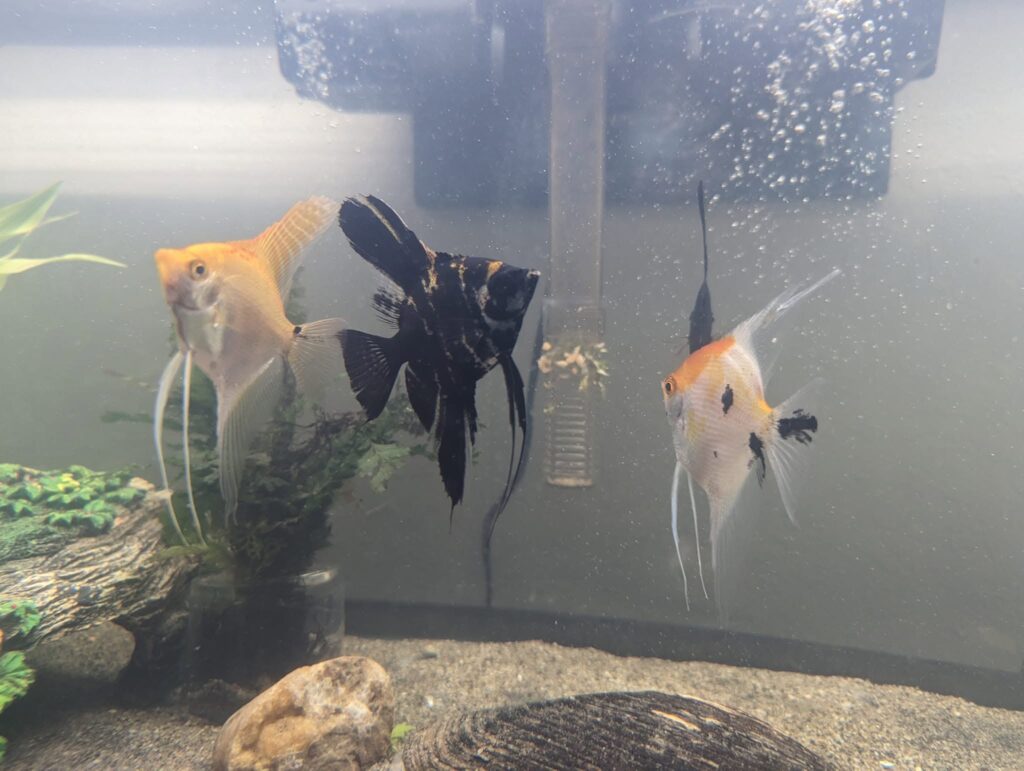
The Importance of Tank Height
Most fish are measured by tank length and width. With angelfish, height is equally important — and this is a detail many beginners overlook.
Angelfish are tall fish. Their dorsal and anal fins extend dramatically, giving them that iconic triangular silhouette. A standard 29-gallon tank is typically 30 inches long and 12 inches deep. That depth is borderline for a full-grown angelfish and may not allow them to swim naturally.
A tall 29-gallon tank, which is roughly 18–20 inches deep, is a better choice if you are working with a 29-gallon minimum. Even better, consider a 55-gallon tank, which offers both length and height for comfortable movement.
The general rule of thumb: aim for at least 18 inches of water depth to house adult angelfish comfortably.
How Many Angelfish Per Gallon?
There is no perfectly precise formula, but a working guideline is:
- One angelfish per 10 gallons — as a very rough minimum baseline
- Better practice: Plan for the adult size, not the juvenile size
Angelfish sold at pet stores are usually juveniles — about 1–2 inches tall. They look small and manageable. But within 6–12 months, they will grow considerably, and a tank that seemed adequate will quickly feel inadequate.
Always plan for the adult size of the fish, not the size at purchase.
Read More on Angelfish Stocking: How Many in 75, 55, 29, 25 Gallon Tank
Can You Keep One Angelfish Alone?
Yes, one angelfish can be kept alone, and some keepers prefer this. A solo angelfish tends to be less aggressive and easier to manage. For a single angelfish, a 20-gallon tall tank is the minimum, but a 29-gallon is far more comfortable.
That said, angelfish are social animals. They exhibit interesting behavior when kept in pairs or small groups — schooling, establishing hierarchies, and bonding with tank mates. Many aquarists find a group more rewarding to observe.
Tank Size for a Community Setup
Angelfish can live peacefully with many other species — corydoras catfish, tetras (certain species), plecos, and peaceful dwarf cichlids, among others. However, adding tank mates means adding bioload and territorial complexity.
For a community tank with angelfish, do not go below 55 gallons. A 75-gallon tank is ideal if you plan a diverse community. More gallons means more stability, fewer territorial disputes, and more flexibility in aquascaping.
Avoid keeping angelfish with small nano fish like neon tetras in smaller tanks. Neon tetras are often eaten by adult angelfish — not out of aggression, but simply because they are within the natural prey size. If you want that combination, a larger and heavily planted tank gives smaller fish more places to hide.
Tank Shape: Long vs. Tall vs. Cube
Not all tanks of the same gallon capacity are equal. Shape matters.
- Long tanks provide better horizontal swimming space and make filtration more efficient. They are generally better for community setups.
- Tall tanks suit angelfish well due to the depth, but may limit filtration coverage across the bottom.
- Cube tanks can work for a single angelfish but are not ideal for groups.
When choosing between a 40-gallon breeder (which is long and wide but short) and a 40-gallon tall, choose the tall variant for angelfish specifically.
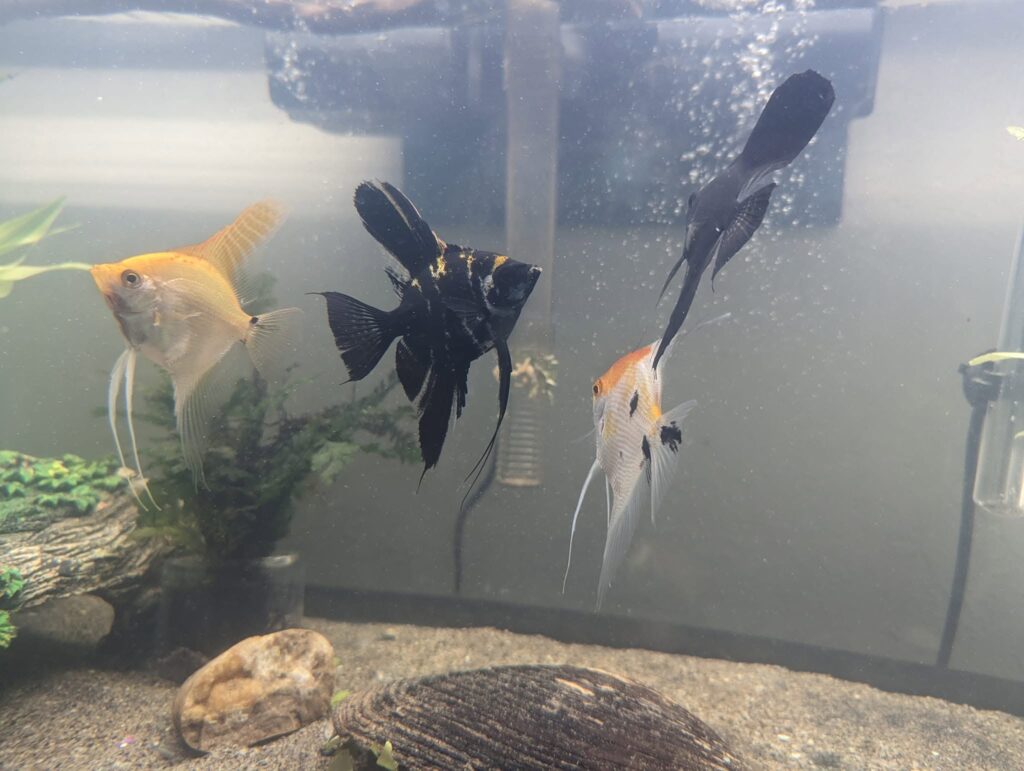
Setting Up the Right Environment Within the Tank
Tank size alone is not enough. The setup inside the tank determines whether your angelfish thrives or just survives.
Filtration
A good filter is non-negotiable. Angelfish prefer gentle water flow — they are not built for strong currents. Use a sponge filter or a canister filter with a spray bar to diffuse the outflow. Aim for a filter rated at 4–6 times the tank volume per hour.
Water Parameters
Angelfish thrive in:
- Temperature: 76–84°F (24–29°C)
- pH: 6.0–7.5 (soft, slightly acidic water is ideal)
- Hardness: 3–10 dGH
Consistency matters more than perfection. Sudden swings in pH or temperature are more damaging than a slightly imperfect reading that stays stable.
Substrate and Décor
Use a fine-grain substrate — sand or small-grain gravel. Tall plants like Amazon swords, vallisneria, and java fern complement the angelfish’s natural environment and provide cover. Driftwood adds tannins that slightly acidify the water and mimic Amazonian conditions.
Avoid sharp decorations. Angelfish fins are delicate, and jagged ornaments cause tears that become infection points.
Lighting
Moderate lighting works best. Angelfish do not have intense lighting preferences, but very bright light without plant cover can stress them. Aim for 8–10 hours of light per day on a timer.
Common Mistakes in Angelfish Tank Sizing
It is worth going through the most common errors, because they appear repeatedly in fish-keeping forums and veterinary consultations:
1. Starting with a 10-gallon tank — This is far too small for even a juvenile angelfish to grow into. The water quality degrades too fast, and the depth is insufficient.
2. Assuming the “inch per gallon” rule applies — This old guideline was never designed for large, territorial, or tall-bodied fish. Angelfish break it entirely.
3. Not accounting for height — A 29-gallon tank that is only 12 inches deep is not appropriate for adult angelfish. Always check dimensions, not just gallon capacity.
4. Overcrowding in a small tank to “see if they get along” — This almost always results in aggression. Space is the primary variable in cichlid conflict management.
5. Upgrading too late — It is far better to start with the right tank than to move fish after they have settled. Frequent relocation causes stress and can trigger disease outbreaks.
What About Breeding Pairs?
If you plan to breed angelfish, tank size becomes even more critical. A breeding pair needs at least 29 gallons, ideally 40 gallons, and should be kept separately from other fish during spawning. Angelfish become highly territorial when breeding — they will defend their eggs and fry aggressively, even against fish they previously tolerated.
A dedicated breeding tank with a flat surface (a piece of slate or a broad leaf) encourages egg-laying and makes care easier.
Suggested For You:
Angelfish Water pH Requirements: The Complete Guide for Healthy Fish
Best Tank Mates for Angelfish: A Complete Community Tank Guide
Angelfish Tank Temperature Range: The Complete Guide for Healthy Fish
Black Veil Angelfish for Sale: What to Know Before You Buy
How to Set Up an Angelfish Breeding Tank: A Complete Guide
Angelfish Stocking: How Many in 75, 55, 29, 25 Gallon Tank
Summary: The Right Tank for Your Angelfish
To put it plainly — if you want healthy, happy angelfish that live a full life, here is what to aim for:
- Minimum for one fish: 20-gallon tall (29-gallon preferred)
- Minimum for a pair: 29 gallons
- Recommended for a pair or small group: 55 gallons
- Community tank: 55–75 gallons
- Water depth: At least 18 inches
- Tank shape: Tall or standard long — not short or cube
Getting the tank size right from the beginning is the single most impactful decision you can make for your angelfish. Everything else — filtration, diet, water chemistry — builds on that foundation.
References
- Fisheries and Aquatic Sciences, University of Florida — IFAS Extension “Ornamental Fish: Freshwater Angelfish” https://edis.ifas.ufl.edu/publication/FA005
- Penn State Extension — Aquaculture and Water Quality “Basic Aquarium Water Quality” https://extension.psu.edu/basic-aquarium-water-quality
- Purdue University Extension — Aquatic Animal Health “Common Diseases of Ornamental Fish” https://www.extension.purdue.edu/aquaculture
- Oregon State University — Aquaculture Program “Recirculating Aquaculture Systems and Water Management” https://extension.oregonstate.edu/aquaculture
- Auburn University — School of Fisheries, Aquaculture and Aquatic Sciences “Principles of Aquarium Fish Husbandry” https://www.ag.auburn.edu/fish/