15 Cat Breeds With Big Ears and Long Face (Details, With Pictures)
The first time I met an Oriental Shorthair, I honestly thought someone had photoshopped a bat’s ears onto a cat’s body. That was not the case. This is simply what an entire family of cat breeds looks like, and once you notice the shape, you cannot unsee it.
This guide covers 15 cat breeds known for their oversized ears and long, wedge-shaped faces. Most trace back to a single ancestor, the Siamese, though a few arrived at the look through entirely separate genetic paths, from spontaneous mutations to wild hybridization.
What Gives These Cats Their Signature Look?
The long face and oversized ears seen in these breeds come from a body type breeders call “foreign” or “oriental” type. It is one of the most recognizable silhouettes in the cat fancy.
This body type traces back largely to the Siamese, one of the oldest documented cat breeds, first brought to the West from Southeast Asia in the late 1800s. Nearly every long-faced breed on this list descends from it, directly or indirectly.
A few breeds reached a similar look independently. The Sphynx and its hairless relatives gained their dramatic ear-to-face ratio through a separate mutation entirely, one identified by researchers at the University of California, Davis (UC Davis VGL, n.d.).
Genetics aside, this face shape carries a few real health considerations. Veterinarians at Cornell University’s College of Veterinary Medicine note that Siamese cats and their close relatives face a higher risk of certain inherited conditions, a pattern we will touch on throughout this guide (Cornell Feline Health Center, n.d.).
One statistic stands out among the rest. UC Davis genetic testing data shows the eye-disease mutation known as CEP290 appears in roughly a third of Siamese cats tested, a remarkably high frequency for a single inherited variant (UC Davis VGL, n.d.).
That number matters because the same mutation also turns up in Balinese, Oriental Shorthair, Colorpoint Shorthair, and several other breeds on this list, all of which share Siamese ancestry somewhere in their pedigree.
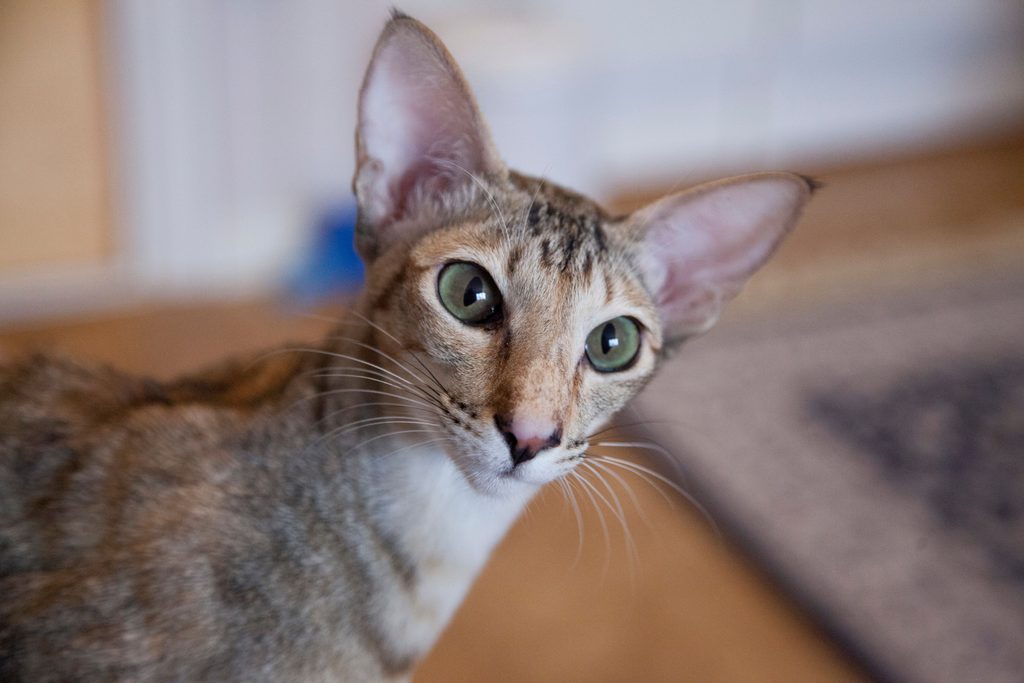
1. Oriental Shorthair
The Oriental Shorthair might be the poster child for this entire list. Its ears sit tall and wide on a slim, wedge-shaped head, giving the breed an almost alien silhouette that is impossible to mistake for anything else once you have seen it.
This breed comes in an enormous range of colors and patterns. According to information from Purina’s breed database, Orientals offer more than 600 recognized color, pattern, and coat combinations, more variety than almost any other cat breed on record. Some fanciers nickname them “Ornamentals” for this reason.
Orientals are talkative, athletic, and deeply attached to their people. They tend to follow owners from room to room and often enjoy playing fetch, a trait more commonly associated with dogs than cats. Many also excel at agility training.
2. Siamese
No breed defines this look quite like the Siamese. Its triangular head, sapphire-blue eyes, and dramatically large ears have made it one of the most recognizable cat breeds in the world for well over a century, and one of the oldest as well.
The Siamese carries some notable, well-documented health risks. Cornell University’s Feline Health Center reports that Siamese cats face roughly twice the risk of mammary cancer compared to other breeds, and tend to develop it earlier in life (Cornell Feline Health Center, n.d.). Regular veterinary checkups matter here.
Siamese cats are famously vocal, often described as having a raspy, almost human-like cry. They bond intensely with their owners and generally do not enjoy being left alone for long stretches, sometimes developing genuine separation anxiety.
3. Abyssinian
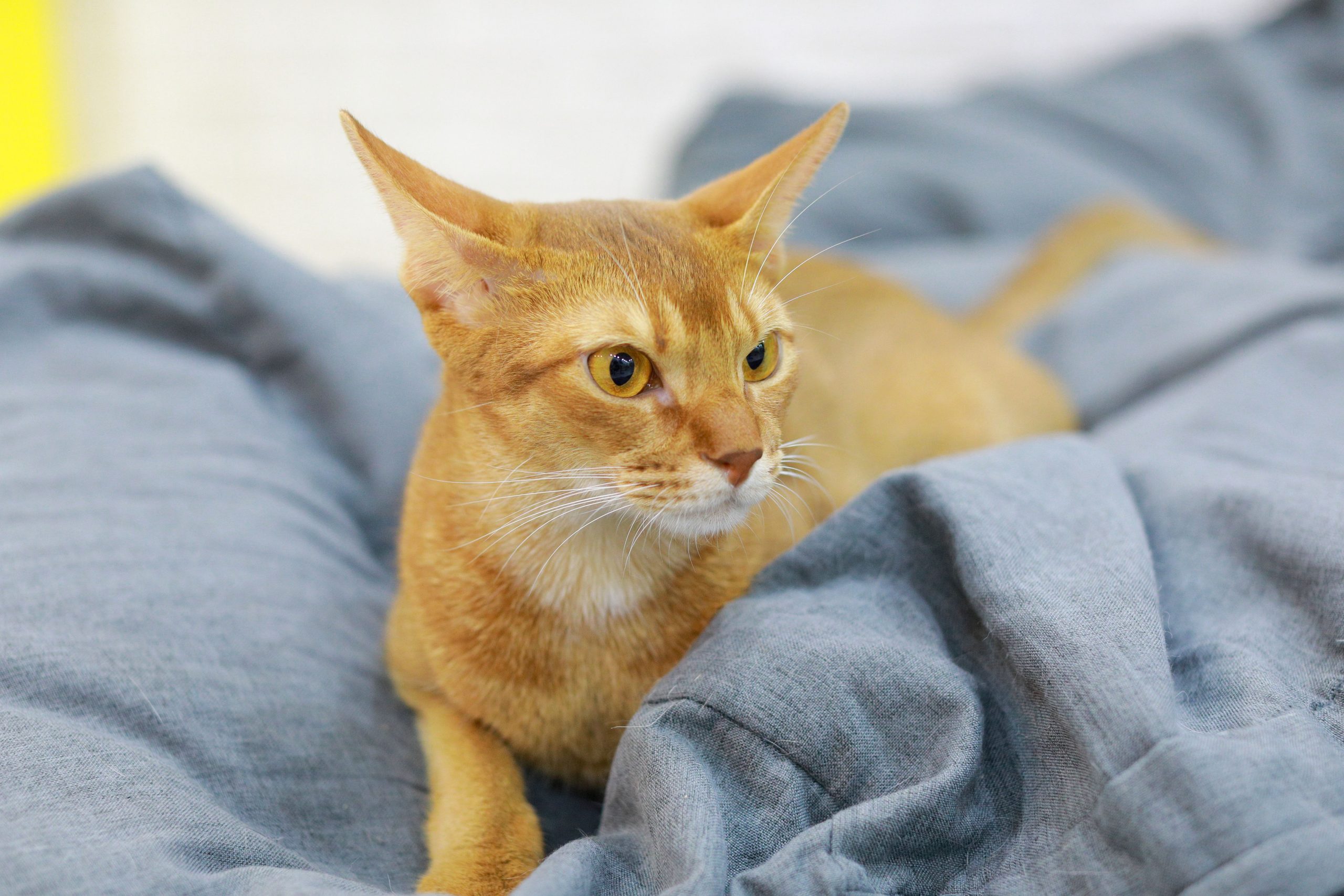
The Abyssinian carries a slightly softer wedge shape than the Siamese, but its large, alert ears and elongated face still place it firmly in this category. Its ticked coat, where each hair carries several bands of color, adds to its wild, almost cougar-like appearance and constant motion.
This breed carries a documented eye health risk. Researchers at UC Davis identified a mutation in the CEP290 gene responsible for a form of progressive retinal atrophy that affects Abyssinians, along with several related breeds (UC Davis VGL, n.d.). A separate, rarer mutation causes earlier-onset blindness.
Abyssinians are energetic, curious, and famously athletic. They tend to climb anything available in the house and do best with plenty of vertical space and interactive toys to keep their sharp minds occupied throughout the day.
4. Sphynx
The Sphynx reaches its long-faced, big-eared look through an entirely different genetic route than the Siamese family. Its nearly hairless skin makes the already prominent ears look even larger, since there is no fur to soften the silhouette.
A specific gene mutation explains this hairlessness. Research from a UC Davis laboratory identified the mutation responsible for the Sphynx’s coat in the KRT71 gene, the same gene involved in the curly coat of the Devon Rex (UC Davis VGL, n.d.).
Because Sphynx cats lack a protective coat, their skin produces extra oil and needs regular bathing. Cornell’s Feline Health Center notes that skin disorders can affect any cat’s coat and comfort, making routine care especially important for hairless breeds (Cornell Feline Health Center, n.d.). Sunburn and temperature sensitivity are also worth watching.
5. Devon Rex
Often called a “pixie cat,” the Devon Rex has enormous, low-set ears on a short, elfin face that somehow still reads as long and angular thanks to its high cheekbones and large eyes.
Its curly coat comes from the same gene family as the Sphynx’s hairlessness. The Devon Rex’s wavy coat is recessive to the Sphynx’s hairless trait but dominant over a normal coat, based on the same KRT71 gene research from UC Davis (UC Davis VGL, n.d.).
This breed is mischievous, people-oriented, and known for perching on shoulders. Owners often describe Devon Rex cats as more dog-like than feline in their eagerness to be involved in daily activities, including cooking, laundry, and even bath time.
6. Cornish Rex
The Cornish Rex shares the Devon Rex’s curly coat concept but carries it through a completely separate gene mutation, resulting in a softer, more uniformly wavy texture across its slender, long-faced body.
This breed’s curl is inherited as a simple recessive trait, according to UC Davis genetics research, meaning it is fixed reliably within the breed once both parent cats carry the gene (UC Davis VGL, n.d.).
Cornish Rex cats are fast, playful, and often seek out warm spots since their thin coat offers less insulation. Many owners find them curled up near heating vents or sunny windowsills, sometimes burrowing into blankets entirely.
7. Balinese
Think of the Balinese as a Siamese in a flowing coat. It shares the same long, wedge-shaped face and oversized ears, but carries a semi-long, silky coat that lacks a dense undercoat.
The breed developed from a spontaneous long-haired mutation that occasionally appeared in Siamese litters, later bred selectively to create a stable, recognized breed with the same striking head shape and vivid blue eyes.
Despite the elegant coat, Balinese cats need surprisingly little grooming, since their coat lacks the thick undercoat that causes matting in many long-haired breeds. Weekly brushing is usually enough to keep it silky and tangle-free.
8. Javanese
The Javanese is closely related to the Balinese and shares its long face, large ears, and semi-long coat, but comes in a wider range of colors and patterns beyond the traditional Siamese points.
Some cat registries classify the Javanese as a color variation of the Balinese rather than a fully separate breed, which explains why the two are frequently confused, even among experienced cat owners.
This breed is playful, vocal, and highly people-oriented, much like its Siamese ancestors. It tends to do best in households where someone is home for much of the day, since boredom can lead to attention-seeking mischief.
9. Peterbald
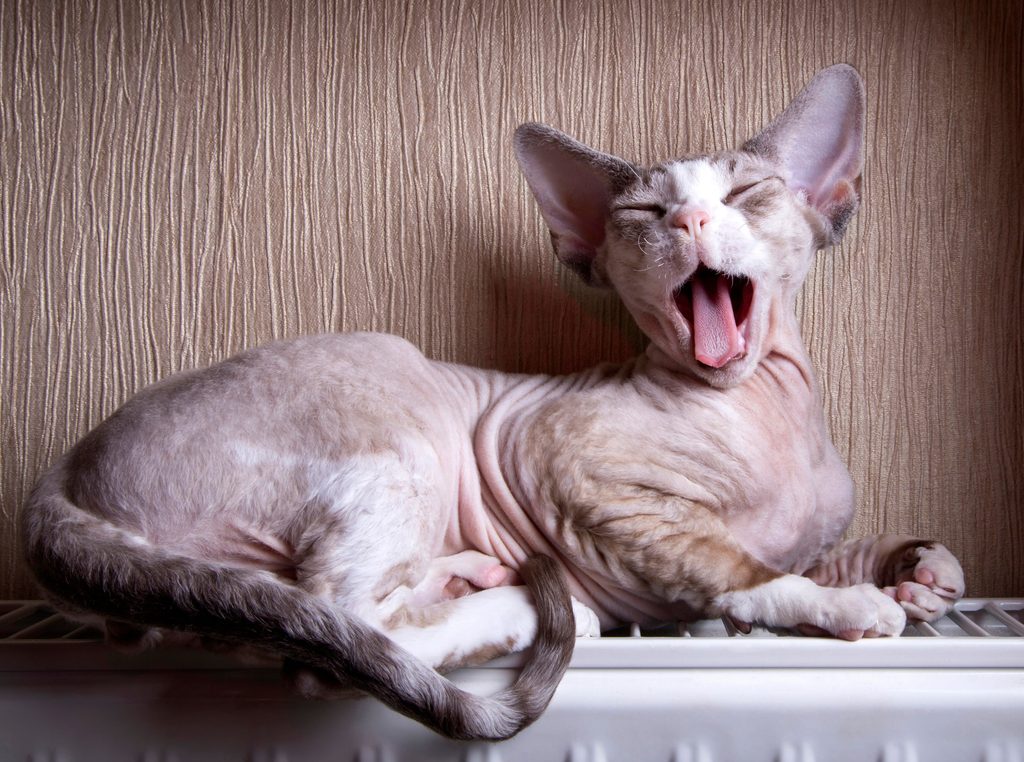
The Peterbald takes the long-faced, big-eared look to an extreme, often paired with a hairless or peach-fuzz coat similar to the Sphynx. This Russian breed emerged in the 1990s from a cross between a Don Sphynx and an Oriental Shorthair.
Its ears are proportionally enormous, even by the standards of this list, sitting atop a narrow, elongated skull that gives the breed an unmistakably sleek, futuristic profile.
Like other hairless and semi-hairless breeds, Peterbalds need regular bathing to manage skin oils. They are affectionate, intelligent, and tend to seek out warm laps and sunny spots, often burrowing under blankets in cooler weather.
10. Savannah
The Savannah brings a different flavor to this list. It is a hybrid breed created by crossing a domestic cat with the African serval, a wild cat known for its dramatically oversized ears relative to head size.
Ownership of Savannah cats is regulated in parts of the United States. The U.S. Department of Agriculture’s Animal and Plant Health Inspection Service oversees breeders producing early-generation hybrids under the Animal Welfare Act, and several states restrict or ban ownership entirely (USDA APHIS, n.d.).
Later-generation Savannahs, typically labeled F4 or F5, are generally treated as domestic cats under most state laws. They are highly active, dog-like in loyalty, and often enjoy water far more than a typical housecat, sometimes joining owners in the shower.
11. Somali
The Somali is essentially a long-haired Abyssinian, sharing the same alert, oversized ears and elongated face beneath a fluffy, fox-like coat. Its ticked fur creates a similarly wild, foxy appearance.
Somalis carry the same eye health considerations as Abyssinians. UC Davis genetics research lists the Somali alongside the Abyssinian as a breed affected by the CEP290 mutation responsible for progressive retinal atrophy (UC Davis VGL, n.d.).
This breed is active, intelligent, and known for a particularly expressive face. Somalis tend to form strong bonds with their families and often follow owners around the house like a shadow, chirping and trilling along the way.
12. Oriental Longhair
The Oriental Longhair is simply the long-coated version of the Oriental Shorthair, carrying the exact same dramatic ears and wedge-shaped face beneath a silky, flowing coat.
This breed shares the extensive color range of its shorthaired counterpart. Like the Oriental Shorthair, it comes in hundreds of possible color and pattern combinations, making no two Oriental Longhairs look quite alike.
Despite the longer coat, grooming needs remain modest since the breed lacks a thick undercoat. A weekly brushing session is usually enough to keep the coat looking healthy and tangle-free.
13. Colorpoint Shorthair
The Colorpoint Shorthair looks almost identical to a Siamese, sharing the same long face and large ears, but comes in point colors beyond the traditional seal, chocolate, blue, and lilac seen in classic Siamese cats.
Genetic testing has confirmed close ties to the Siamese line. UC Davis research on the CEP290 eye mutation lists Colorpoint Shorthairs among the breeds carrying this variant, reflecting their shared ancestry with Siamese cats (UC Davis VGL, n.d.).
This breed is just as vocal and people-focused as its Siamese relatives. Owners should expect a talkative companion that enjoys being part of every household activity, from meal prep to video calls.
14. Chausie
The Chausie is a striking hybrid breed developed by crossing domestic cats with the jungle cat, a wild species native to parts of Asia and North Africa. Its tall, wide-set ears and long face reflect that wild ancestry.
Later-generation Chausies are generally treated as domestic cats, similar to Savannahs, though early-generation hybrids can fall under the same regulatory oversight from state wildlife agencies and, in some cases, USDA licensing requirements (USDA APHIS, n.d.).
This is a large, athletic breed that needs significant exercise and mental stimulation. Chausies often enjoy climbing, water play, and interactive puzzle feeders more than a typical housecat, and many can be leash-trained.
15. Egyptian Mau
The Egyptian Mau rounds out this list with a slightly more moderate wedge face, but its large, alert ears and naturally spotted coat still place it firmly among long-faced, big-eared breeds.
This is one of the few naturally spotted domestic cat breeds, meaning its pattern developed without the intervention of crossbreeding with wild species, unlike the Savannah or Chausie.
Egyptian Maus are known for being among the fastest domestic cats, capable of short bursts of impressive speed and a distinctive, almost worried facial expression. They tend to bond closely with one or two people and can be shy around strangers or unfamiliar visitors.
How to Choose the Right Long-Faced Breed for You
Start by thinking honestly about noise tolerance. Most breeds on this list descend from the Siamese, and that heritage comes with a genuinely vocal personality that some households adore and others find overwhelming.
Coat type matters too. Hairless and semi-hairless breeds like the Sphynx and Peterbald need regular bathing and warm indoor spaces, while longhaired options like the Balinese and Somali need weekly brushing but little else.
Finally, consider energy level and companionship needs. These are not breeds built for a quiet corner. Nearly all of them crave interaction, climbing space, and daily engagement from their humans.
A Few Facts Worth Knowing
Ear size in cats is not just cosmetic. Larger, more mobile ears help cats detect a wider range of sounds and pinpoint their source more precisely, a trait especially pronounced in wild-hybrid breeds like the Savannah and Chausie, both descended from ancestors built for hunting in open grassland.
The wedge-shaped skull common to Siamese-descended breeds also affects vocalization. Veterinary behaviorists note that this head shape, paired with a narrower larynx, contributes to the notably loud, raspy voice many of these cats share throughout their lives, from kittenhood into old age.
Coat and hairlessness aside, nearly every breed on this list shares one more trait: a strong need for companionship. These are not cats that thrive being ignored, regardless of how independent they might look.
Common Health and Care Themes Across These Breeds
Eye health deserves special attention in this group. Several breeds, including the Abyssinian, Somali, Siamese, and Oriental Shorthair, share genetic ties to progressive retinal atrophy, so responsible breeders routinely screen for it before breeding.
Skin and coat care varies enormously depending on which genetic path a breed took. Hairless breeds like the Sphynx and Peterbald need weekly bathing, while longhaired cousins like the Balinese and Somali need only routine brushing.
Hybrid breeds carry their own considerations entirely. Anyone considering a Savannah or Chausie should check local and state regulations first, since ownership rules for early-generation hybrids vary widely across the United States, and even between neighboring counties.
Final Thoughts
The long face and oversized ears found across these breeds tell two very different genetic stories. Most trace directly back to the Siamese, while a handful, like the Sphynx and the wild hybrids, arrived at a similar look through entirely separate paths.
Before choosing one of these breeds, think honestly about your household. Many of these cats are vocal, people-oriented, and need real daily engagement rather than a quiet corner to nap in.
Whichever breed catches your eye, take time to research grooming needs, activity levels, and any breed-specific health screening your veterinarian recommends. A striking face is a wonderful bonus, not a substitute for the right fit.
If you are drawn to the classic look but want lower maintenance, the Oriental Shorthair or Siamese offer that silhouette without the grooming demands of a longhaired or hairless breed. If you want something rarer, the Peterbald or Chausie deliver a genuinely unusual companion.
Whatever you choose, these breeds tend to reward attentive owners with fierce loyalty, near-constant conversation, and a face you will never mistake for any other cat at the vet’s waiting room. Once you have lived with one, an ordinary round-faced cat can almost feel plain by comparison.
References
- Cornell University College of Veterinary Medicine, Cornell Feline Health Center. Feline Glaucoma. https://www.vet.cornell.edu/departments-centers-and-institutes/cornell-feline-health-center/health-information/feline-health-topics/feline-glaucoma
- Cornell University College of Veterinary Medicine, Cornell Feline Health Center. Mammary Tumors. https://www.vet.cornell.edu/departments-centers-and-institutes/cornell-feline-health-center/health-information/feline-health-topics/mammary-tumors
- Cornell University College of Veterinary Medicine, Cornell Feline Health Center. The Challenge of Skin Disorders. https://www.vet.cornell.edu/departments-centers-and-institutes/cornell-feline-health-center/health-information/feline-health-topics/challenge-skin-disorders
- U.S. Department of Agriculture, Animal and Plant Health Inspection Service. Animal Care Public Search Tool. https://www.aphis.usda.gov/awa/public-search
- University of California, Davis, Veterinary Genetics Laboratory. Sphynx and Devon Rex Coats. https://vgl.ucdavis.edu/test/sphynx-and-devon-rex-coats
- University of California, Davis, Veterinary Genetics Laboratory. Progressive Retinal Atrophy (PRA rdAc) (Abyssinian). https://vgl.ucdavis.edu/test/pra-rdac
- The Ohio State University College of Veterinary Medicine, Indoor Pet Initiative. For Cat Owners. https://indoorpet.osu.edu/cats