25 Stunning Dog Breeds With Blue Eyes (With Pictures, and Details)
I still remember the first time a blue-eyed Siberian Husky locked eyes with me at a local park. It felt less like being looked at and more like being studied. That single glance is probably why blue-eyed dogs remain some of the most searched, photographed, and adored companions in the world.
This guide walks through 25 dog breeds that can carry blue eyes, along with the genetics behind that striking color. Some breeds wear blue eyes as a hallmark trait. Others show it only occasionally, through a specific coat pattern or rare gene variant.
Why Do Some Dogs Have Blue Eyes?
Blue eyes in dogs come down to pigment, not paint. A dog’s iris turns blue when very little melanin is present in that part of the eye, letting light scatter in a way that reads as blue to our eyes.
Three main genetic pathways cause this. The first two, merle and piebald, dilute pigment across the coat and can extend into the eyes. Researchers at the University of California, Davis note that merle is governed by a specific DNA insertion in the PMEL17 gene (UC Davis VGL, n.d.).
The third pathway is unique to a handful of breeds. A 2018 study of over 6,000 dogs, published in PLOS Genetics and supported by Cornell University’s College of Veterinary Medicine, identified a DNA duplication near the ALX4 gene that explains blue eyes in Siberian Huskies and some non-merle Australian Shepherds (Deane-Coe et al., 2018).
That same study found the duplication was present in 100 percent of blue-eyed purebred Huskies tested, making it one of the strongest gene-to-trait links ever documented in a companion animal.
Now, let’s meet the breeds.
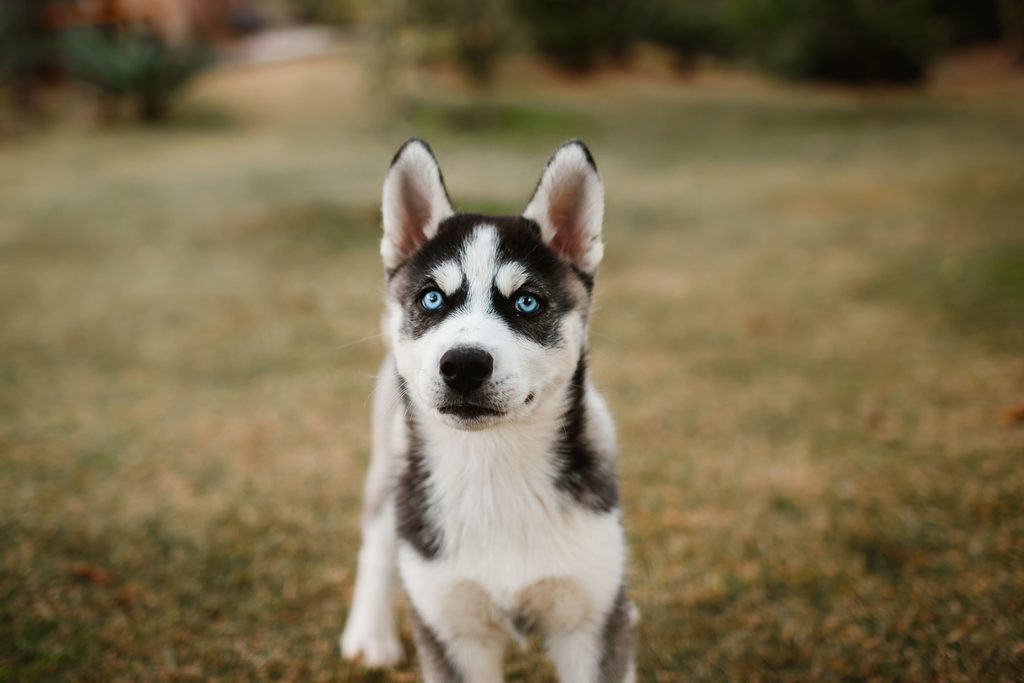
1. Siberian Husky
No breed is more synonymous with blue eyes than the Siberian Husky. Its ice-blue stare, sometimes paired with one brown eye in a striking case of heterochromia, is practically the breed’s signature.
This trait is genetically dominant in Huskies, unlike in most other breeds where blue eyes appear only when two copies of a recessive gene line up. That is part of why blue eyes show up so consistently across Husky litters.
Huskies are energetic, vocal, and bred for endurance rather than obedience. A future owner should plan for serious daily exercise, since this breed was built to run long distances in cold climates.
2. Alaskan Klee Kai
Often mistaken for a miniature Husky, the Alaskan Klee Kai was intentionally bred down in size while keeping the same striking blue or parti-colored eyes. The breed was developed in Alaska during the 1970s.
Its eyes can be blue, brown, or a combination of both, following patterns similar to its larger Husky relatives. The compact size, usually 13 to 17 inches tall, makes it a popular choice for apartment dwellers who still want husky-like looks.
Klee Kais are alert, intelligent, and can be reserved with strangers. Early socialization matters here, since this breed tends to bond tightly with one household and stay wary of outsiders.
3. Australian Shepherd
Australian Shepherds frequently display blue eyes, especially in merle-coated individuals, though the PLOS Genetics study confirmed some tri-colored, non-merle Aussies carry the same duplication found in Huskies.
Heterochromia is common in this breed, with many Aussies sporting one blue eye and one brown, or even split coloring within a single iris. Breeders often prize this look, though it carries no functional advantage or disadvantage on its own.
This is a working breed built for herding livestock. Aussies need a job to do, whether that is agility training, herding trials, or simply structured daily exercise, or they tend to develop destructive habits from boredom.
4. Border Collie
Border Collies occasionally carry blue eyes, most often linked to merle coloring, though the trait can appear in solid-colored dogs as well through recessive inheritance.
This breed is widely regarded as one of the most intelligent in the world, frequently topping working-dog rankings for problem-solving and trainability. That intelligence, paired with striking blue eyes, makes for a dog that is equal parts brilliant and hypnotic to watch work.
Border Collies need serious mental stimulation. A bored Border Collie will often invent its own entertainment, usually at the expense of furniture, shoes, or the family cat.
5. Catahoula Leopard Dog
This Louisiana native carries a merle-like coat pattern and frequently displays blue, green, or amber eyes, sometimes all within the same dog. Its name comes from the mottled, leopard-like spotting across its coat.
Catahoulas have lower rates of merle-related hearing and vision problems compared to some other breeds, according to findings from the UC Davis Veterinary Genetics Laboratory, likely because the breed carries a lower frequency of the piebald spotting gene (UC Davis VGL, n.d.).
Bred originally for hog hunting and cattle work, this breed is intense, independent, and best suited to an experienced owner with space to work off its considerable energy.
6. Dalmatian
The Dalmatian’s spotted coat comes from the piebald gene, and that same gene is responsible for the blue eyes some Dalmatians display. Blue-eyed Dalmatians were first documented as early as 1896.
Blue eyes in this breed carry a real health consideration. Research from Louisiana State University’s School of Veterinary Medicine shows blue-eyed Dalmatians have a statistically higher likelihood of congenital deafness than their brown-eyed littermates (LSU School of Veterinary Medicine, n.d.).
A separate genome-wide study found blue-eyed Dalmatian puppies were 2.7 times more likely to develop congenital sensorineural deafness than brown-eyed puppies (Kluth & Distl, 2013). Prospective owners should ask breeders about BAER hearing tests before bringing a puppy home.
ALSO READ: 25 Types of Dogs With Short Legs (With Care Tips, and Pictures)
7. Great Dane (Merle and Harlequin)
Great Danes carrying the merle or harlequin coat pattern frequently show blue eyes, sometimes as a single blue eye against an otherwise dark gaze. The harlequin pattern results from a complex interaction between the merle and harlequin genes.
Their sheer size makes the trait especially striking. A Great Dane can stand over 30 inches at the shoulder, so a pair of pale blue eyes set into that massive frame tends to draw attention wherever the dog goes.
Despite their imposing build, Danes are famously gentle and are often called “gentle giants.” They need space to stretch out and a diet carefully managed to support healthy joint growth during their rapid puppyhood.
8. Weimaraner
Weimaraners are best known for their pale amber or blue-gray eyes, a shade that sits right at the edge of true blue and often gets grouped with blue-eyed breeds in casual conversation.
The breed’s eye color comes from its dilute coat genetics, the same recessive dilution responsible for its famous silver-gray coat. This is a naturally occurring trait rather than a result of merle or piebald patterning.
Weimaraners were originally bred for big-game hunting in Germany and retain a strong prey drive. They thrive with owners who can commit to vigorous daily exercise and consistent training.
9. Old English Sheepdog
Blue eyes appear occasionally in Old English Sheepdogs, generally as a recessive trait unrelated to merle coloring. National Geographic has noted this breed among those where blue eyes follow simple recessive inheritance rather than coat-pattern genetics.
The eyes are often hidden beneath a thick, shaggy coat, which is part of the breed’s signature look. Many owners trim the hair around the face just to keep the dog’s vision, and those eyes, visible.
This breed needs regular grooming to prevent matting and is known for a bouncy, playful temperament that stays fairly calm indoors once properly exercised.
10. Cardigan Welsh Corgi
The Cardigan Welsh Corgi, distinguished from its Pembroke cousin by a long tail, can carry the merle gene and display blue eyes as a result. This is one of the older Corgi lines, with a history stretching back thousands of years in Wales.
Merle Cardigans require thoughtful breeding practices. Because double-merle pairings can produce serious health issues, responsible breeders avoid pairing two merle-coated Cardigans together.
Despite their short legs, Cardigans are sturdy herding dogs with a surprising amount of stamina. They do well in active households that can offer both physical exercise and mental challenges.
ALSO READ: 20 Small Dog Breeds With Big Ears (Identification, With Pictures)
11. Pyrenean Shepherd
This lesser-known French herding breed occasionally displays blue or partially blue eyes, particularly in merle-coated individuals. It remains rare outside of Europe, which adds to its appeal for owners seeking something unusual.
Pyrenean Shepherds are exceptionally agile and quick, often excelling in agility and herding competitions. Their small size, typically 15 to 21 pounds, belies an enormous amount of energy packed into a compact frame.
This breed bonds intensely with its family and can become wary of strangers without early socialization. It is best suited to owners already familiar with high-drive herding breeds.
12. Beauceron
Beaucerons rarely display blue eyes, but the harlequin coat variety occasionally produces this trait, similar to the mechanism seen in Great Danes. It remains one of the least common blue-eyed variations on this list.
This is a large, powerful French herding and guardian breed, often standing over 25 inches tall. Historically used to herd sheep and guard property, Beaucerons combine intelligence with a naturally protective streak.
Owners should prioritize early, consistent socialization and firm, positive training. This breed does best with experienced handlers who understand working-dog temperaments.
13. Dachshund (Dapple Pattern)
The dapple Dachshund carries a merle-type gene unique to the breed, and this pattern frequently comes paired with one or two blue eyes. The mottled coat resembles a lighter, more delicate version of merle seen in larger breeds.
One published audiometric study found notably elevated hearing issues in merle-patterned Dachshunds compared to solid-colored littermates, reinforcing the same pigment-and-hearing link documented in other merle breeds.
Dachshunds are famously stubborn and food-motivated, which actually makes them fairly easy to train with the right rewards. Their long backs also mean owners should limit jumping to protect spinal health.
14. Australian Cattle Dog (Blue Heeler)
Despite the nickname “Blue Heeler,” this breed’s name refers to coat color rather than eye color, though blue or light amber eyes do appear in some individuals, particularly those with more diluted pigmentation.
Cattle Dogs are built for relentless stamina, historically bred to drive cattle across long distances in the Australian outback. Their eyes, whatever the shade, tend to carry an intensely focused, watchful expression.
This breed needs a job and enough space to work off its considerable drive. Left understimulated, a Cattle Dog will often resort to nipping at heels, a habit rooted in its herding instincts.
ALSO READ: 25 Dog Breeds With Curly Tails (With Pictures, and Care Tips)
15. Chihuahua
Blue eyes are rare in Chihuahuas but do occur, most often in dogs carrying merle coloring, a controversial pattern within the breed since it did not appear in early Chihuahua bloodlines.
Merle Chihuahuas remain a point of debate among breed clubs, with some kennel organizations questioning whether the pattern was introduced through crossbreeding rather than natural variation within the breed.
Regardless of eye color, Chihuahuas are known for big personalities packed into tiny frames. They tend to bond closely with one person and can be wary of unfamiliar dogs or people.
16. Pomeranian
Blue eyes occasionally appear in Pomeranians, most commonly linked to merle coat patterns that have grown more popular, and more controversial, in recent breeding trends.
As with Chihuahuas, merle Pomeranians raise similar breeding concerns. The pattern is not part of the breed’s traditional standard, and responsible breeders avoid pairing two merle Pomeranians to prevent double-merle health complications.
Pomeranians are lively, alert, and often unaware of their small size when it comes to confidence. Their thick double coat requires regular brushing to prevent matting.
17. Shih Tzu
Blue eyes are uncommon in Shih Tzus and typically appear only in dogs carrying merle genetics, a pattern that, like in several small breeds on this list, is not part of the breed’s historical standard.
This breed was developed in Tibet and China as a companion dog, valued for temperament over working ability. Its flowing double coat and round, expressive eyes have made it a popular lap dog for centuries.
Owners of any Shih Tzu, blue-eyed or not, should plan for regular grooming and gentle handling, since this breed’s face shape can make it more sensitive to heat and breathing strain.
18. American Pit Bull Terrier
Blue eyes occasionally appear in Pit Bulls, generally in dogs with diluted “blue” coat coloring, a shade of gray that sometimes carries lighter eye pigmentation alongside it.
This breed is often misunderstood due to media portrayal, despite temperament testing organizations regularly reporting pass rates comparable to, or better than, many other popular breeds.
Pit Bulls are muscular, loyal, and typically very affectionate with their families. They benefit from consistent training and early socialization, much like any strong, high-energy breed.
19. Whippet
Blue eyes in Whippets are rare and usually tied to a specific coat dilution or, less commonly, a merle variant that has stirred debate within some Whippet breed circles.
Whippets are built for speed, capable of reaching close to 35 miles per hour in short sprints, making them one of the fastest breeds relative to their size. Their slender, aerodynamic build reflects generations of selective breeding for coursing and racing.
Despite their athletic build, Whippets are famously calm indoors, often described as couch potatoes once their exercise needs are met for the day.
20. Cocker Spaniel
Blue eyes are uncommon in Cocker Spaniels, but the piebald gene, the same one responsible for extensive white patches in some other breeds, can occasionally produce the trait here as well.
English Cocker Spaniels homozygous for the piebald gene have documented rates of hearing loss, according to veterinary research comparing deafness prevalence across piebald and merle breeds (Strain et al., 2009).
This breed is gentle, eager to please, and generally excellent with families. Regular ear cleaning is essential given the breed’s long, low-hanging ears, which trap moisture easily.
ALSO READ: 30 Small Dog Breeds That Don’t Shed Much (With Pictures, and Care Tips)
21. German Shorthaired Pointer
Blue or blue-gray eyes appear occasionally in German Shorthaired Pointers, often in dogs with lighter overall coat pigmentation. This is a versatile hunting breed developed in Germany during the 19th century.
Pointers were bred to work closely with hunters, tracking, pointing, and retrieving game across varied terrain. That working history shows in their high energy levels and need for consistent physical activity.
This breed does best with owners who can provide substantial daily exercise, whether through hunting, running, or structured dog sports like field trials.
22. Miniature American Shepherd
A smaller cousin of the Australian Shepherd, this breed shares the same merle-linked blue eye potential, including the same heterochromia patterns sometimes seen in its larger relative.
Recognized by the American Kennel Club in 2015, the Miniature American Shepherd was developed specifically to offer Aussie-like looks and intelligence in a smaller package suited to owners with less space.
Despite the smaller frame, this breed retains a strong herding instinct and needs regular mental engagement. Puzzle toys and obedience training help satisfy that working-dog mindset.
23. Panda German Shepherd
The Panda German Shepherd is a genuine German Shepherd carrying a rare, spontaneous white spotting mutation first documented in a single litter in 2000. Some Panda Shepherds display lighter or partially blue eyes as a result.
This is not a separate breed or a designer mix, despite frequent misconceptions online. Genetic testing has confirmed Panda Shepherds are purebred German Shepherds carrying an unusual, naturally occurring pigment gene.
Temperament and health needs mirror standard German Shepherds closely. This breed needs structured training, considerable exercise, and an owner prepared for a large, intelligent working dog.
24. Blue Lacy
Texas’s state dog breed, the Blue Lacy, gets its name from its blue-gray coat, and some individuals display correspondingly light, almost silvery-blue eyes that complement the coat’s dilute coloring.
This breed was developed in the 1800s by Texas ranchers specifically for herding hogs and cattle across rugged terrain, making it a working breed through and through, rarely seen outside ranching communities until recent decades.
Blue Lacys are intelligent, fast, and require significant daily exercise. They are not well suited to sedentary households or small apartments without a serious exercise plan.
25. Mudi
This rare Hungarian herding breed occasionally displays blue or partially blue eyes, particularly in merle-coated individuals, a pattern that exists within the breed’s accepted color range.
Mudis remain uncommon even within their native Hungary, let alone internationally, making a blue-eyed Mudi a genuinely rare sight for most dog enthusiasts outside specialized herding circles.
This breed is agile, vocal, and highly trainable, often excelling in herding trials, agility, and even scent work. Mudis need an active household willing to keep their sharp minds engaged.
Final Thoughts
Blue eyes in dogs tell a genetic story that is far more layered than most people expect. Some breeds inherited the trait through structured, well-documented genes. Others carry it as a rare, almost accidental variation.
A quick reminder before you fall in love with a specific look: if you are considering a merle or piebald breed, ask breeders about hearing and vision testing. Responsible breeding practices protect against the real health risks tied to double-merle pairings.
Whichever breed catches your eye, literally, take the time to research temperament, exercise needs, and grooming demands. A striking gaze is a wonderful bonus, not a substitute for finding the right fit for your lifestyle.
References
- Deane-Coe, P.E., Chu, E.T., Slavney, A., Boyko, A.R., & Sams, A.J. (2018). Direct-to-consumer DNA testing of 6,000 dogs reveals 98.6-kb duplication associated with blue eyes and heterochromia in Siberian Huskies. National Institutes of Health, National Library of Medicine. https://www.ncbi.nlm.nih.gov/pmc/articles/PMC6171790/
- University of California, Davis, Veterinary Genetics Laboratory. Merle. https://vgl.ucdavis.edu/test/merle
- Louisiana State University, School of Veterinary Medicine. Genetics of Deafness in Dogs. https://www.lsu.edu/vetmed/deafness/genetics.php
- Kluth, S., & Distl, O. (2013). Congenital Sensorineural Deafness in Dalmatian Dogs Associated with Quantitative Trait Loci. National Institutes of Health, National Library of Medicine. https://www.ncbi.nlm.nih.gov/pmc/articles/PMC3851758/
- National Institutes of Health, Intramural Research Program. Drs. Elaine Ostrander and Heidi Parker — Unleashing the Dog Genome. https://irp.nih.gov/podcast/2022/01/drs-elaine-ostrander-and-heidi-parker-unleashing-the-dog-genome
- Strain, G.M., Clark, L.A., Wahl, J.M., Turner, A.E., & Murphy, K.E. (2009). Prevalence of Deafness in Dogs Heterozygous or Homozygous for the Merle Allele. National Institutes of Health, National Library of Medicine, PubMed. https://pubmed.ncbi.nlm.nih.gov/19192156/
- Purdue University College of Veterinary Medicine. Information for Consumers, Canine Care Certified Program. https://vet.purdue.edu/ccc/consumers.php