Do Mystery Snails Eat Shrimp? The Truth About Keeping These Two Together
When I first considered adding mystery snails to my shrimp tank, I paused longer than I expected to. The shrimp were thriving — a well-established colony of cherry shrimp that had taken months to build — and I was not about to introduce something that might disrupt that balance.
The question sitting in my mind was simple but important: would the mystery snails go after the shrimp?
The short answer is that mystery snails are not predators of healthy shrimp. But the full picture is more nuanced than that one sentence suggests. There are specific circumstances under which mystery snails will consume shrimp, and understanding those circumstances is what separates a successful community tank from an accidental loss.
This article covers everything you need to know.
What Do Mystery Snails Actually Eat?
To understand whether mystery snails pose a threat to shrimp, you first need to understand what mystery snails are — biologically and behaviourally — as feeders.
Mystery snails (Pomacea bridgesii) are opportunistic omnivores. In the wild and in captivity, their natural diet consists primarily of:
- Algae and biofilm growing on hard surfaces
- Decomposing plant matter
- Decaying organic material in the substrate
- Soft aquatic vegetation
- Fungal growth on submerged wood or leaves
- Uneaten fish food and sinking pellets
Notice what is absent from that list: live, mobile prey. Mystery snails are not hunters. They do not stalk, chase, or ambush other animals. Their feeding mechanism — a radula, which functions like a rasping tongue — is designed for scraping surfaces, not pursuing or subduing living creatures.
This is a fundamental point. A mystery snail cannot catch a healthy, swimming shrimp even if it wanted to. The shrimp is simply too fast, too agile, and too alert.
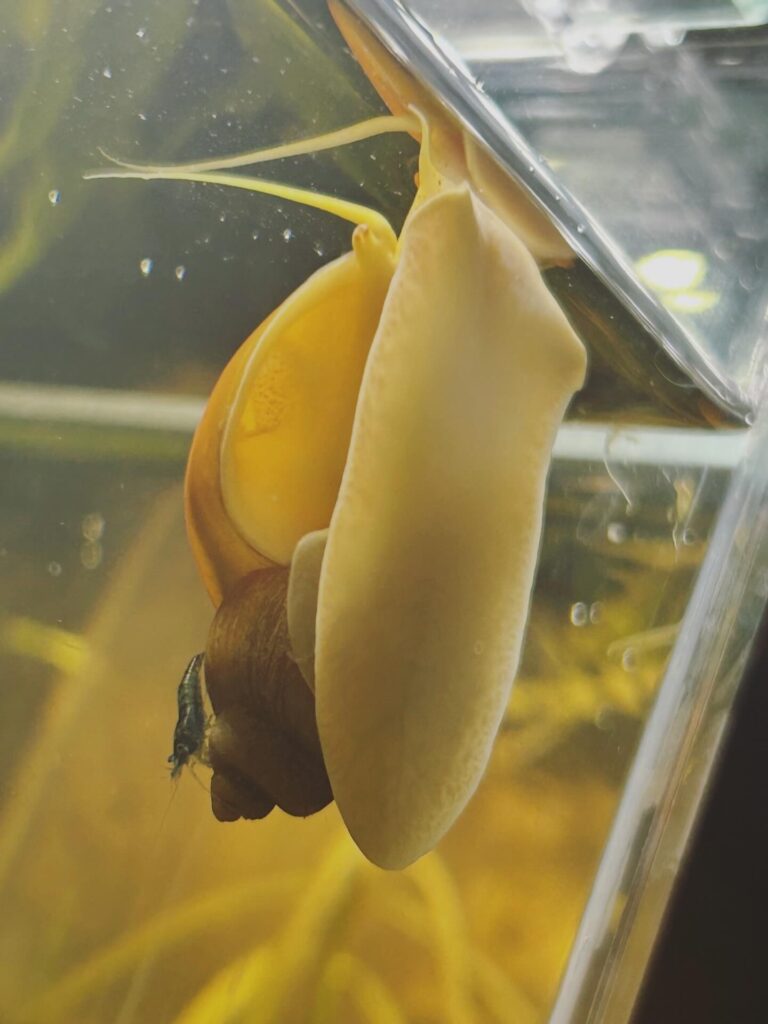
So Do Mystery Snails Ever Eat Shrimp?
Yes — but only under specific conditions, and almost never in the way people fear.
Mystery snails will consume dead or dying shrimp. This is the most important clarification to make. If a shrimp dies in the tank — from old age, disease, failed moulting, or any other cause — a mystery snail will scavenge the body. This is entirely natural behaviour. They are detritivores. Consuming dead organic matter is precisely what they do.
This scavenging behaviour sometimes leads to misunderstandings. An aquarist sees a mystery snail eating a shrimp and assumes the snail killed it. In the vast majority of cases, the shrimp was already dead or fatally compromised before the snail made contact.
The distinction matters because it changes the response entirely. If your mystery snail is eating dead shrimp, the question is not “how do I stop the snail?” — it is “why are my shrimp dying?”
“I have kept cherry shrimp and mystery snails together in the same tank for over six years across multiple setups. I have never once seen a mystery snail pursue or attack a healthy shrimp. What I have seen — regularly — is a mystery snail cleaning up a dead shrimp within hours of it passing. That is not predation. That is the snail doing its job.” — Rachel Simmons, freshwater invertebrate breeder and aquarist educator with 14 years of experience
The One Genuine Risk: Moult Vulnerability
This is the part of the conversation that deserves the most careful attention, because it is where a nuanced risk genuinely exists.
Freshwater shrimp moult periodically — shedding their exoskeleton as they grow. Immediately after moulting, a shrimp is temporarily soft-bodied and highly vulnerable. Its new shell has not yet hardened, its mobility is reduced, and it instinctively hides.
During this brief vulnerability window — which typically lasts several hours to a day — a mystery snail that encounters a freshly moulted shrimp in a confined space could potentially attempt to feed on it, particularly if it is lying still and resembles a piece of soft organic material.
This is not aggressive predation in any conventional sense. The mystery snail is not identifying the shrimp as prey. It is responding to a soft, stationary object that presents like food.
How significant is this risk?
In a well-planted tank with adequate hiding spaces, the risk is low. A freshly moulted shrimp will typically retreat to cover before any other tank inhabitant reaches it. The problem increases in sparse, bare tanks where hiding spots are limited.
“The moult window is the only time I would say there is a credible, if small, risk from mystery snails to shrimp. And even then, it is more accurate to call it opportunistic scavenging than predation. The snail is not hunting — it is responding to an immobile, soft object. Dense planting and plenty of cover eliminate this risk almost entirely.” — Gregory Okafor, freshwater invertebrate forum moderator and invertebrate keeper of 11 years
What About Shrimp Eggs and Baby Shrimp?
This concern comes up frequently, especially among aquarists breeding shrimp. The worry is that mystery snails might consume the tiny eggs or miniature shrimp that are otherwise invisible to larger tank inhabitants.
Shrimp eggs carried by a berried female are generally not at risk from mystery snails. The eggs are attached to the underside of the female’s pleopods (swimming legs) and kept in constant motion by the female’s movement. A mystery snail has no mechanism to access or consume eggs in this position.
Newborn shrimp (shrimplets) are tiny — often 1 to 2 millimetres — and spend their early days hiding deep in plant matter, moss, and substrate crevices. Mystery snails are not capable of pursuing them in any meaningful way. The snail’s slow movement and surface-scraping feeding style is simply not adapted for catching miniature, fast-moving shrimplets.
That said, a very small shrimplet that has died and settled on the substrate will be consumed by a mystery snail as part of normal detritivore activity. Again, this is scavenging, not predation.
The practical conclusion: mystery snails do not pose a meaningful threat to shrimp eggs or healthy juvenile shrimp in a well-maintained tank.
When Mystery Snails and Shrimp Are Ideal Tankmates
Beyond the question of whether mystery snails harm shrimp, there is a positive case for keeping them together — and it is a genuinely compelling one.
They occupy different ecological niches. Shrimp graze primarily on biofilm, aufwuchs, and fine particulate matter. Mystery snails focus on larger algae growth, decomposing plant material, and organic debris. There is minimal competition for food between them.
Mystery snails help maintain water quality. By consuming dead plant matter, leftover food, and decaying organic material — including, yes, dead shrimp — mystery snails reduce the organic load in the tank. This benefits shrimp, which are sensitive to poor water quality.
They do not compete for territory. Shrimp are active throughout the water column and substrate. Mystery snails move slowly across surfaces. There is no territorial behaviour, no dominance hierarchy, and no aggression in either direction.
The combination is visually appealing. A planted tank with active cherry shrimp and slowly gliding mystery snails offers a layered, dynamic visual quality that many aquarists find more engaging than either species alone.
“I actively recommend mystery snails to my shrimp-keeping clients as part of the cleanup crew. They handle the surface algae and decaying matter that shrimp tend to ignore, and they leave the shrimp completely alone. It is one of the cleanest and most effective pairings in the freshwater hobby.” — Tomoko Ibaraki, aquarium designer and freshwater invertebrate enthusiast
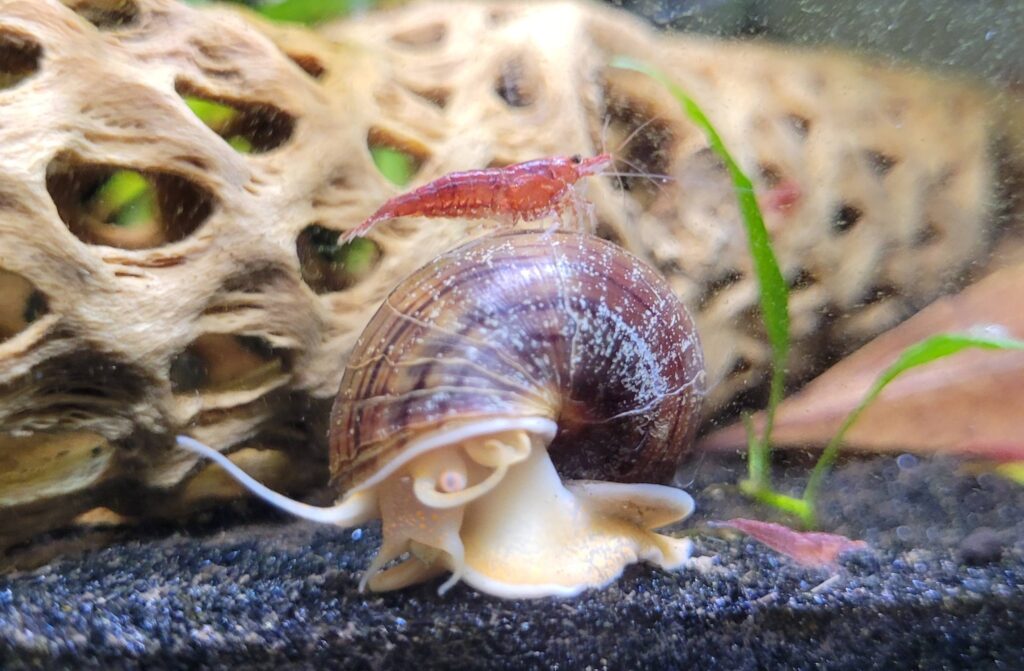
Which Shrimp Species Are Compatible With Mystery Snails?
Not all freshwater shrimp have identical requirements, and compatibility goes both ways — it is worth considering whether the shrimp species you keep are also safe for mystery snails.
Neocaridina shrimp (cherry shrimp, blue velvet, yellow neocaridina): Highly compatible with mystery snails. These small, active shrimp share similar water parameter requirements — pH 7.0 to 7.5, moderate hardness, stable temperature — and are fast enough to avoid any accidental contact with mystery snails. This is arguably the most popular and most successful combination in the hobby.
Caridina shrimp (crystal red, crystal black, Taiwan bee shrimp): Potentially compatible in terms of predation risk — mystery snails will not harm them. However, Caridina shrimp typically prefer softer, more acidic water (pH 6.2 to 6.8) than mystery snails thrive in. Keeping both species in shared water means compromising the ideal parameters for one. Many experienced aquarists prefer to keep Caridina shrimp in species-only tanks for this reason.
Amano shrimp: Fully compatible. Amano shrimp are larger than neocaridina species — adults reach 4 to 5 centimetres — and are entirely capable of moving away from mystery snails without difficulty. The two coexist peacefully and complement each other well in planted community tanks.
Ghost shrimp: Compatible in terms of predation risk. Ghost shrimp are hardy, tolerant of a range of water parameters, and fast-moving. No meaningful threat exists in either direction.
Vampire shrimp (African filter shrimp): Compatible. These large, filter-feeding shrimp occupy a completely different ecological role and have no interaction with mystery snails beyond sharing the same water.
Signs That Something Else Is Harming Your Shrimp
If you are finding dead shrimp in your tank alongside mystery snails, the snails are almost certainly not the cause. Here is what to investigate instead.
Water quality issues: Shrimp are highly sensitive to ammonia, nitrite, and nitrate. Even moderate ammonia levels that most fish tolerate without visible symptoms can be lethal to shrimp over time. Test your water thoroughly before attributing shrimp deaths to any tankmate.
Failed moulting: Moulting failure — where a shrimp becomes trapped in its old exoskeleton — is one of the most common causes of shrimp death in captivity. It is usually linked to mineral deficiency, particularly iodine and calcium. A dead shrimp found still inside its old shell has almost certainly died from failed moulting, not from any tankmate.
pH or parameter instability: Sudden shifts in pH or water chemistry — often caused by inconsistent water changes or the use of untreated tap water — can cause rapid shrimp death. Shrimp are more sensitive to parameter swings than most fish or snails.
Disease or parasites: Shrimp can carry and succumb to a range of pathogens, including bacterial infections and parasites such as Ellobiopsidae (green fungus). These are internal issues unrelated to tankmates.
Aggressive tankmates other than mystery snails: If you have fish in the tank alongside your shrimp and snails, look there first. Many commonly kept fish — bettas, guppies, angelfish, gouramis — will eat small shrimp, particularly juveniles. Mystery snails are not the likely culprit when fish are present.
“Every time I hear someone say their mystery snail killed their shrimp, my first question is: what are your water parameters? Nine times out of ten, the shrimp were already compromised. The snail just got there first after death. It is easy to blame the most visible scavenger.” — David Akin, aquatic hobbyist and author of several freshwater invertebrate care guides
Setting Up a Successful Mystery Snail and Shrimp Tank
If you want both species to coexist comfortably and thrive, a few practical measures make the combination work reliably.
Choose the right water parameters for both species
The sweet spot where mystery snails and neocaridina shrimp both thrive is a pH of 7.0 to 7.5, temperature of 72°F to 78°F (22°C to 26°C), and GH of 8 to 12 dGH. Both species do well in moderately hard water, and this hardness also supports mystery snail shell growth.
Plant the tank densely
Dense planting serves multiple purposes. It provides shrimp with hiding places during moulting. It grows algae and biofilm — food for both species. And it creates a naturalistic, low-stress environment. Java moss, Christmas moss, and dense stands of stem plants are particularly beneficial for shrimp.
Add a layer of leaf litter
Indian almond leaves, catappa leaves, or oak leaves on the substrate create a microhabitat beloved by shrimp. They also feed beneficial bacteria and provide additional biofilm for both shrimp and snails to graze on.
Feed both species adequately
Hungry shrimp and hungry snails can occasionally compete more intensely for the same food sources. Providing varied, regular supplemental feeding — blanched vegetables for both, specialist shrimp food for the shrimp, and algae wafers or sinking pellets for the snails — keeps both well-nourished without creating competition.
Avoid copper in any form
Copper is lethal to both mystery snails and shrimp. Check every medication, plant fertiliser, and water conditioner for copper content before adding it to a tank containing either species. Even trace amounts of copper can be fatal to invertebrates. Use only copper-free products.
Use a sponge filter
Mystery snails and shrimp share the same vulnerability to filter intakes. A sponge filter eliminates the risk of juveniles and small individuals being drawn into the filtration system. It also cultivates biofilm on its surface — a valuable food source for both species.
Avoid overstocking
Overstocking increases waste, elevates nitrates, and creates competition for resources. A balanced, lightly stocked tank keeps conditions stable and reduces stress for both shrimp and snails.
What Mystery Snails Will and Will Not Do Around Shrimp: Summary
It helps to have a direct, consolidated picture of the actual behaviour you can expect.
Mystery snails will:
- Scavenge dead or severely dying shrimp entirely
- Occasionally investigate a very still shrimp closely with their sensory tentacles
- Accidentally make contact with resting shrimp while grazing nearby surfaces
- Clean up moulted exoskeletons left behind by shrimp after a successful moult
Mystery snails will not:
- Chase or pursue healthy, active shrimp
- Attack or bite living shrimp
- Consume shrimp eggs carried by a berried female
- Actively hunt juvenile or baby shrimp
- Demonstrate any territorial or aggressive behaviour toward shrimp
The behaviour you will actually observe in a shared tank is almost entirely peaceful coexistence — mystery snails gliding across surfaces and shrimp darting through plants, each largely indifferent to the other’s presence.
I have watched my own mystery snails pass within millimetres of resting cherry shrimp on multiple occasions. The shrimp occasionally shift slightly. The snail continues on its way, entirely uninterested.
The Reverse Question: Can Shrimp Harm Mystery Snails?
This question comes up less often but is worth addressing.
In most cases, shrimp do not harm mystery snails. However, there are specific situations where shrimp may nibble at a mystery snail.
Large Amano shrimp have been observed occasionally picking at the mantle tissue or foot of a mystery snail that is extended and resting. This is typically opportunistic foraging rather than predation — the shrimp is investigating whether the snail’s soft tissue is edible. In a well-fed tank, this behaviour is rare.
Shrimp may consume a mystery snail’s eggs if the clutch is accessible. Mystery snails lay their eggs above the waterline precisely to prevent this — but if a clutch falls into the water before hatching, it becomes fair game for any scavenging animal in the tank, shrimp included.
A healthy, active mystery snail with a solid operculum can seal itself away from any mild harassment. The primary concern runs in the direction of shrimp safety, not snail safety, in a shared tank.
Common Misconceptions Worth Addressing Directly
“My mystery snail was on top of my shrimp — it must have been attacking it.”
Mystery snails climb over everything in their path — rocks, plants, filter intakes, decorations, and yes, occasionally other tank inhabitants. A mystery snail resting briefly on top of a shrimp is navigating, not attacking. There is no predatory intent in this behaviour.
“My shrimp disappeared, and the snail must have eaten it completely.”
Mystery snails are efficient scavengers. A dead shrimp can be fully consumed within hours, leaving no visible remains. If a shrimp disappears without trace, it is tempting to blame the most conspicuous scavenger — but the shrimp almost certainly died first from another cause.
“Mystery snails are fine with adult shrimp but will eat baby shrimp.”
There is no evidence supporting the idea that mystery snails specifically target shrimplets. The feeding mechanism of a mystery snail — surface rasping — is not adapted for catching small, fast-moving creatures. Shrimplet mortality in shared tanks is overwhelmingly caused by water quality, failed moulting, or predation from fish, not mystery snails.
Suggested For You:
8 Types of Mystery Snails (Based on Shell and Body Colors)
Understanding Mystery Snail Food: What to Feed Pomacea bridgesii
Mystery Snail Tank Setup: Tank Size, Compatible Mates, and Care Tips
Mystery Snail Breeding Tank: Your Complete Guide to Raising Healthy Pomacea diffusa Babies
Why Is My Mystery Snail Floating in The Tank? A Complete Guide for New Aquarium Owners
Final Thoughts
The question of whether mystery snails eat shrimp has a reassuring answer for most aquarists: no, not in any meaningful predatory sense. Mystery snails are peaceful, slow-moving detritivores that lack both the physical capability and the behavioural drive to hunt living shrimp.
What they will do — and what they are excellent at — is cleaning up what the tank produces naturally: algae, biofilm, decaying material, and yes, dead organisms including shrimp that have already passed.
I introduced mystery snails to my cherry shrimp tank three years ago now. The shrimp colony has only grown since then. The mystery snails move around the glass and substrate while the shrimp dart through the plants above them. It is one of the most harmonious combinations I keep.
The key points to carry away:
- Mystery snails do not prey on healthy, living shrimp under any normal circumstances.
- They will scavenge dead or dying shrimp — this is normal detritivore behaviour, not predation.
- The only genuine risk point is a freshly moulted shrimp encountered by a snail in a bare tank with no hiding places — dense planting eliminates this almost entirely.
- Neocaridina shrimp and mystery snails are an excellent, widely recommended pairing that shares compatible water parameters.
- If shrimp are dying in a tank with mystery snails, investigate water quality, moulting health, and other tankmates before blaming the snails.
- Both species are sensitive to copper — always use copper-free products in any tank housing invertebrates.
Provide clean water, adequate food, and a well-planted environment, and mystery snails and shrimp will not just coexist — they will complement each other in a balanced, thriving aquarium.
References
- Cowie, R. H. (2002). Apple snails (Ampullariidae) as agricultural pests: their biology, impacts and management. In G. M. Barker (Ed.), Molluscs as Crop Pests (pp. 145–192). CAB International. University of Hawaii at Manoa, Pacific Biosciences Research Center. https://www.hawaii.edu
- Charmantier, G., & Charmantier-Daures, M. (2001). Ontogeny of osmoregulation in crustaceans: the embryonic phase. American Zoologist, 41(5), 1078–1089. Université Montpellier II, Laboratoire d’Endocrinologie des Crustacés, Institut des Sciences de l’Evolution. https://www.umontpellier.fr
- Darby, P. C., Bennetts, R. E., & Percival, H. F. (2008). Dry season habitat associations of the Florida snail kite: implications for the role of apple snails as prey in freshwater ecosystems. Wetlands, 28(4), 977–985. University of Florida, Department of Wildlife Ecology and Conservation. https://www.ufl.edu
- Lobban, C. S., & Harrison, P. J. (1994). Seaweed ecology and physiology: biofilm, aufwuchs, and the feeding ecology of freshwater invertebrate grazers. Cambridge University Press. University of Guam, Marine Laboratory. https://www.uguam.uog.edu
- Hayes, K. A., Cowie, R. H., Thiengo, S. C., & Strong, E. E. (2012). Comparing apples with apples: clarifying the identities of two highly invasive Neotropical Ampullariidae (Caenogastropoda). Zoological Journal of the Linnean Society, 166(4), 723–753. Smithsonian Institution, National Museum of Natural History & University of Hawaii at Manoa. https://academic.oup.com/zoolinnean