How to Set Up an Angelfish Breeding Tank: A Complete Guide
Angelfish are among the most elegant freshwater fish in the hobby. Their tall, triangular bodies and graceful movements make them a centerpiece in any aquarium. But beyond their beauty, they are surprisingly devoted parents — and watching a pair raise their fry is one of the most rewarding experiences in fishkeeping.
Setting up an angelfish breeding tank is not complicated, but it does require attention to detail. Get the conditions right, and your fish will do most of the work themselves.
This guide walks you through every step, from choosing the right tank to conditioning your breeders and caring for the eggs.
Understanding Angelfish Breeding Behavior
Before setting up any tank, it helps to understand what angelfish need to breed successfully. Pterophyllum scalare, the common freshwater angelfish, is a cichlid. Like most cichlids, angelfish form monogamous pairs, select a spawning site, and guard their eggs and fry aggressively.
In the wild, they spawn on broad leaf surfaces, flat rocks, or submerged roots. In captivity, they will use similar surfaces if provided. The female lays eggs in neat rows, and both parents take turns fanning and guarding them. Under good conditions, a healthy pair can spawn every two to four weeks.
One thing that surprises many beginners — angelfish do not always succeed on their first attempt. First-time parents frequently eat their eggs out of stress or confusion. That is completely normal. With a stable environment and minimal disturbance, most pairs improve with each spawn.
Choosing the Right Tank Size
Tank size is one of the most important decisions you will make. Angelfish are tall fish. A standard 20-gallon tank is too shallow for a breeding pair and will cause stress.
The recommended minimum for a breeding pair is a 29-gallon tank. This provides enough vertical space for the fish to move naturally. However, a 30 to 40-gallon tank is strongly preferred. It offers more stable water parameters, reduces territorial aggression, and gives the pair room to establish their space comfortably.
If you plan to raise fry in the same tank, a 40-gallon setup is ideal. It allows you to keep the parents with the fry for a few weeks without overcrowding.
Avoid very long tanks for breeding purposes. A taller tank with moderate length — sometimes called a “high” aquarium — suits angelfish far better than a wide, shallow one.
Essential Equipment for the Breeding Tank
Getting the right equipment from the start saves a lot of frustration later. Here is what you need:
Filtration
Use a sponge filter. This is not negotiable for a breeding tank. Power filters and hang-on-back filters create strong currents that stress angelfish and can suck up newly hatched fry. A sponge filter provides gentle biological filtration, and the bubbling surface is safe for fry. Use an air pump sized appropriately for your tank volume.
Heater
A reliable, adjustable heater is essential. Angelfish spawn most readily at temperatures between 78°F and 84°F (25.5°C to 28.9°C). Invest in a quality heater with a thermostat — temperature swings disrupt breeding behavior and can kill eggs. A heater guard is a wise addition to prevent fish from burning themselves.
Lighting
Moderate lighting works best. Bright, intense lighting stresses angelfish and discourages spawning. Use a standard LED light on a timer — 10 to 12 hours of light per day mimics natural conditions. If your fish seem nervous under bright light, reduce the intensity or add floating plants.
Spawning Surface
Provide a flat, vertical surface for the fish to lay eggs on. Smooth options include:
- A broad Amazon sword leaf (Echinodorus bleheri)
- A flat piece of slate or smooth tile leaned at a slight angle
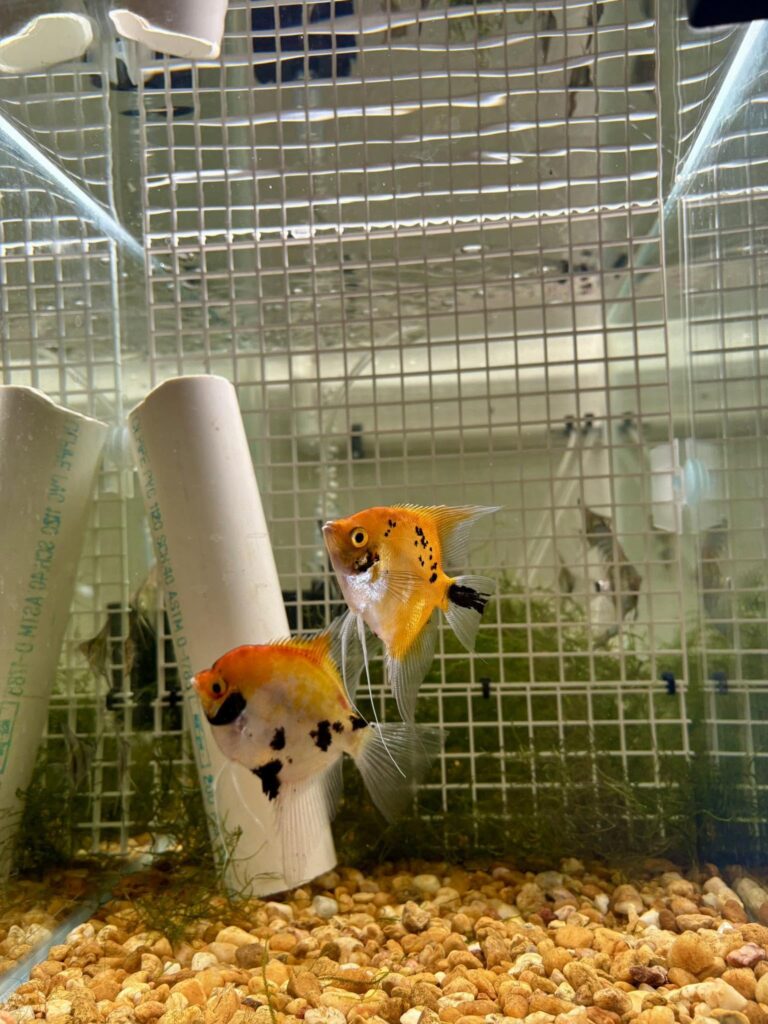
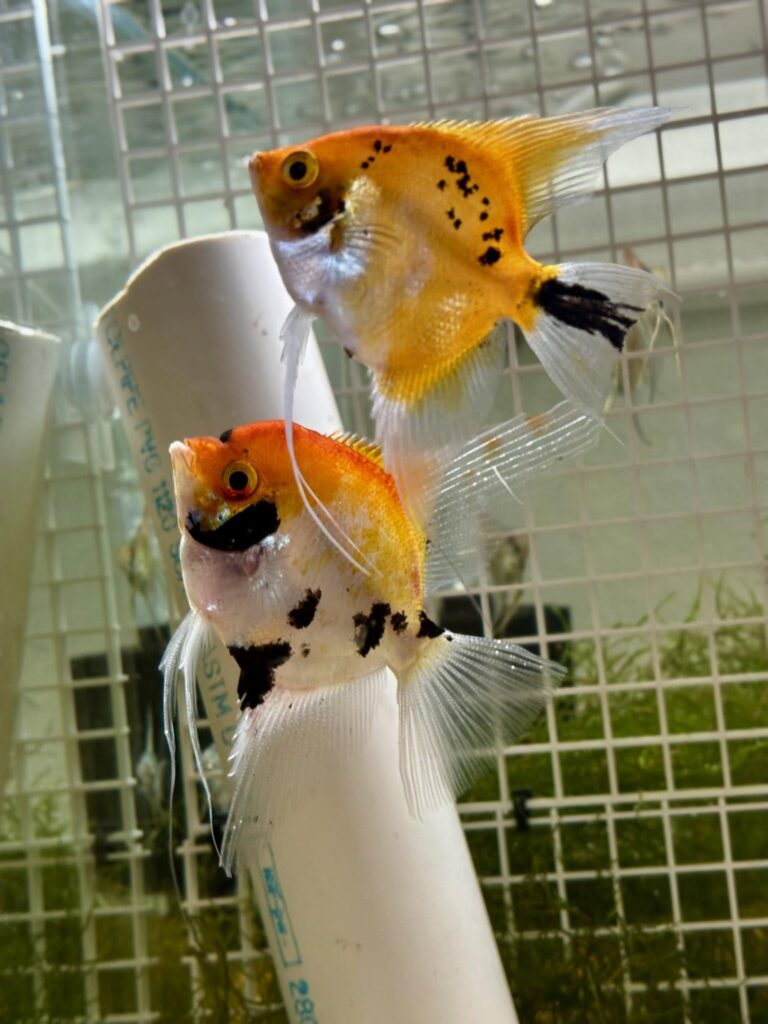
- A PVC pipe section cut lengthwise
- A spawning cone (available at aquarium stores)
Many breeders prefer slate or a spawning cone because they are easy to remove if you want to hatch the eggs separately. Plants are more natural and may encourage shyer pairs to spawn more readily.
Water Parameters and Chemistry
Angelfish are adaptable, but their breeding is more sensitive to water conditions than their day-to-day survival. Matching their natural habitat — the soft, slightly acidic blackwater rivers of the Amazon basin — produces the best results.
Target parameters for angelfish breeding:
| Parameter | Ideal Range |
| Temperature | 78–84°F (25.5–28.9°C) |
| pH | 6.5–7.0 |
| Hardness (GH) | 3–8 dGH |
| Ammonia | 0 ppm |
| Nitrite | 0 ppm |
| Nitrate | Below 20 ppm |
If your tap water is hard or alkaline, consider using RO (reverse osmosis) water blended with tap water to reach the desired hardness and pH. Many angelfish will still spawn in slightly harder or more neutral water, but egg fertility tends to be lower under those conditions.
Perform regular water changes — 25 to 30 percent weekly — using dechlorinated water matched to the tank’s temperature. A sudden drop in temperature during a water change can trigger spawning, which experienced breeders sometimes use deliberately.
Suggested For You:
Angelfish Tank Size: Minimum Gallons and Everything You Need to Know
Angelfish Water pH Requirements: The Complete Guide for Healthy Fish
Best Tank Mates for Angelfish: A Complete Community Tank Guide
Angelfish Tank Temperature Range: The Complete Guide for Healthy Fish
Black Veil Angelfish for Sale: What to Know Before You Buy
Angelfish Stocking: How Many in 75, 55, 29, 25 Gallon Tank
Cycling the Tank Before Adding Fish
Never add fish to an uncycled tank. The nitrogen cycle must be fully established before your angelfish enter the breeding tank. This means beneficial bacteria colonies are present and converting toxic ammonia and nitrite into relatively harmless nitrate.
To cycle your tank:
- Set up all equipment and fill the tank with dechlorinated water.
- Add an ammonia source — pure ammonia drops, fish food, or a small piece of raw shrimp.
- Test water daily with a reliable liquid test kit.
- When ammonia and nitrite both read 0 ppm and nitrate is present, the cycle is complete.
This process typically takes four to six weeks. You can speed it up by seeding the tank with established filter media from an existing aquarium. Once cycled, do a large water change to reduce nitrates before adding your fish.
Selecting and Pairing Your Angelfish
This step can be the most challenging part of the process. Angelfish choose their own mates. Forced pairings rarely work well and often result in aggression or complete indifference.
The natural method is to raise a group of six to eight juvenile angelfish together in a grow-out tank and allow them to pair off naturally. When a pair forms — you will notice them staying close together, cleaning a surface, and defending a territory — remove them to the breeding tank. This method consistently produces the most compatible pairs.
If you are purchasing adults, look for a proven pair from a reputable breeder. Ask if they have spawned together before. If buying individually, choose fish that show no obvious stress signs: erect fins, good coloration, and active behavior.
Signs a pair has formed:
- The two fish stay near each other consistently
- They clean a leaf or flat surface together
- They display to or chase away other tank inhabitants
- The female’s belly appears slightly rounded
Avoid housing other fish in the breeding tank. Even peaceful community fish can disrupt spawning or stress the parents enough to cause egg eating. A dedicated breeding tank with just the pair is always the better approach.
Setting Up the Tank Environment
Decoration in a breeding tank serves a functional purpose. Keep it simple, but thoughtful.
Plants: Include a few broad-leaf plants like Amazon swords. These serve as potential spawning sites and give the fish a sense of security. Java fern attached to driftwood is another good option.
Substrate: A dark, fine substrate — black sand or a dark gravel — makes the fish feel secure and shows off their coloration. Some breeders use a bare-bottom tank for easier cleaning, especially when raising fry. Both approaches work.
Background: Attach a dark background to three sides of the tank. This reduces reflections, minimizes outside disturbances, and lowers the stress level of the breeding pair noticeably.
Driftwood: A small piece of driftwood adds tannins to the water, slightly lowering pH and softening it naturally. It also provides visual structure that helps the pair feel at home.
Conditioning Your Breeders
Well-conditioned fish spawn more readily and produce healthier eggs. Conditioning means feeding a high-quality, varied diet in the weeks before you expect spawning.
Best foods for conditioning angelfish:
- Live or frozen bloodworms
- Live or frozen brine shrimp (especially enriched adult brine shrimp)
- Live blackworms
- Daphnia
- High-quality cichlid flake or pellet as a base diet
Feed two to three times daily in small amounts. Remove uneaten food promptly to keep water quality high. You will often notice that after two to three weeks of conditioning and regular water changes, the female’s belly rounds out and the pair begins cleaning surfaces in preparation for spawning.
The Spawning Process
When spawning is imminent, the pair becomes visibly more focused. They will clean a surface repeatedly and begin displaying to each other with spread fins and lateral shimmering. The female’s ovipositor — a small tube near the ventral fin — becomes visible as spawning approaches.
The female makes several passes over the spawning surface, depositing rows of eggs. The male follows closely behind, fertilizing each row. A healthy spawn produces 100 to 1,000 eggs, though 200 to 400 is common for a productive pair.
After spawning, both parents fan the eggs with their fins to oxygenate them and remove any that go unfertilized (which turn white). Healthy eggs remain clear or slightly amber. The eggs hatch in approximately 48 to 72 hours at 80°F (26.7°C).
Caring for Eggs and Fry
There are two options to go about this:
Option 1 — Parent-raised fry
Leave the eggs with the parents. Many pairs, especially experienced ones, will raise their fry successfully. After hatching, the parents often move the wriggling larvae to a pit in the substrate.
After four to seven days, the fry become free-swimming. At this stage, begin feeding infusoria or commercial fry food, followed by baby brine shrimp (newly hatched Artemia nauplii) within a few days.
Option 2 — Artificially hatching the eggs
If your pair consistently eats their eggs, remove the spawning slate or cone and transfer it to a separate hatching tank. Add a few drops of methylene blue to prevent fungal growth.
Use an airstone positioned near the eggs to mimic the parents’ fanning. Once fry are free-swimming, begin feeding as above.
Perform small, frequent water changes in the fry tank — 10 to 15 percent daily — to maintain pristine water quality. Fry are extremely sensitive to ammonia and nitrite.
Common Problems and How to Solve Them
- Eggs turning white quickly: Unfertilized eggs fungus over fast. This may indicate an incompatible pair, poor water quality, or nutritional deficiency. Improve conditioning and confirm the pair’s compatibility.
- Parents eating eggs: Very common with first-time pairs. Minimize disturbance, cover the tank sides, and reduce lighting during spawning. If the problem persists, switch to artificial hatching.
- Fry dying after becoming free-swimming: Almost always a water quality issue or feeding failure. Ensure infusoria or fry food is available immediately when fry become free-swimming, and maintain pristine water.
- Pair fighting: Incompatibility. Separate the fish and either try a different pairing or allow them to select partners naturally from a group.
Final Thoughts
Setting up an angelfish breeding tank is a rewarding project that pays off in the quiet satisfaction of watching new life develop. The key is patience. Build a stable environment, feed your fish well, and give them privacy. Most pairs will reward that effort with regular, successful spawns.
Start simple. A well-cycled tank, a sponge filter, a heater, a spawning slate, and a compatible pair are genuinely all you need. From there, each spawn teaches you something new about these remarkable fish.
References
- Froese, R. & Pauly, D. (Eds.). FishBase — Pterophyllum scalare species profile. https://www.fishbase.se/summary/Pterophyllum-scalare.html
- Evans, J.P., & Pilastro, A. (2011). Sperm-female coevolution in fishes. Advances in the Study of Behavior, vol. 43. Academic Press. https://www.sciencedirect.com/science/article/pii/B9780123808585000031
- Baensch, H.A., & Riehl, R. (1993). Aquarium Atlas, Vol. 1. Mergus Publishers. https://www.worldcat.org/title/aquarium-atlas/oclc/11814614
- Welcomme, R.L. (1988). International Introductions of Inland Aquatic Species. FAO Fisheries Technical Paper 294. Food and Agriculture Organization of the United Nations. https://www.fao.org/3/t0037e/t0037e.pdf
- Helfman, G.S., Collette, B.B., Facey, D.E., & Bowen, B.W. (2009). The Diversity of Fishes: Biology, Evolution, and Ecology (2nd ed.). Wiley-Blackwell. https://www.wiley.com/en-us/The+Diversity+of+Fishes%3A+Biology%2C+Evolution%2C+and+Ecology%2C+2nd+Edition-p-9781405124942