Angelfish Water pH Requirements: The Complete Guide for Healthy Fish
Angelfish are among the most graceful and widely kept freshwater fish in the aquarium hobby. Their striking fins, calm nature, and impressive size make them a favorite for both beginners and seasoned fishkeepers.
But here is the thing — even the most beautiful angelfish will struggle, and sometimes fail, if the water chemistry is wrong. Of all the water parameters to get right, pH is one of the most critical.
This guide covers everything you need to know about angelfish water pH requirements: what the ideal range is, why it matters, what happens when it drifts off, and how to keep it stable long-term.
What Is pH and Why Does It Matter for Angelfish?
pH measures how acidic or alkaline water is on a scale from 0 to 14. A pH of 7.0 is neutral. Values below 7.0 indicate acidic water, while values above 7.0 indicate alkaline (or basic) water.
For fish, pH directly affects how their bodies function. It influences enzyme activity, gill function, oxygen uptake, and the toxicity of other substances in the water — most notably ammonia. Even a small shift in pH can have large biological consequences.
For angelfish, which evolved in soft, slightly acidic Amazonian waters, the wrong pH is not just uncomfortable. It can be fatal over time.
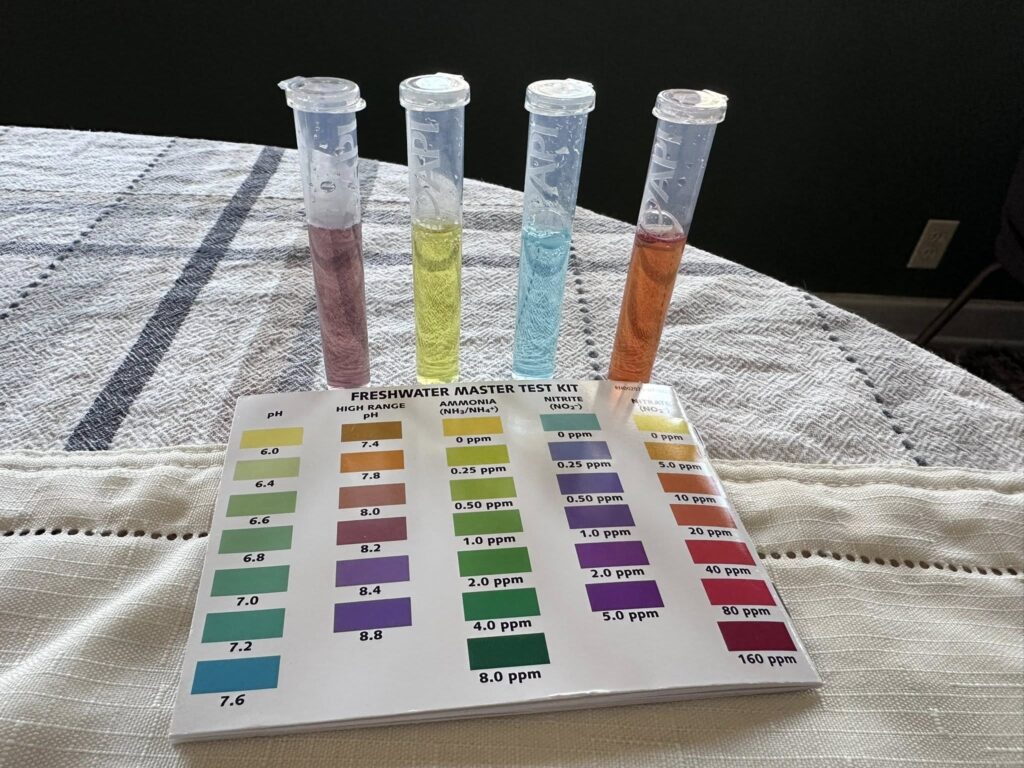
Ideal pH Range for Angelfish
The recommended pH range for angelfish (Pterophyllum scalare and related species) is 6.0 to 7.5, with the sweet spot sitting between 6.5 and 7.0.
This range reflects the natural conditions of the Amazon River basin in South America, where angelfish originate. The waters there are typically warm, soft, and slightly acidic — often tinted brown by decomposing organic matter known as tannins.
While wild angelfish may encounter pH levels as low as 5.0 in some blackwater habitats, captive-bred specimens — which make up the vast majority of aquarium angelfish today — are generally more adaptable and can tolerate a slightly wider range.
That said, adaptability does not mean unlimited tolerance. Keeping angelfish outside the 6.0–7.5 range regularly leads to health problems.
How pH Affects Angelfish Health
Both extremes of a pH can affect your angel fish. Here’s how:
Below pH 6.0 — Too Acidic
At very low pH levels, the water becomes increasingly hostile. The blood chemistry of fish is disrupted, making it harder for their bodies to transport oxygen. You may notice angelfish gasping at the surface, showing pale or faded coloration, or becoming lethargic.
Breeding activity typically stops altogether. Extremely low pH also weakens the immune system, making fish more vulnerable to bacterial and fungal infections.
Additionally, at low pH, nitrification — the biological process that breaks down ammonia — slows down significantly. This can cause toxic compounds to accumulate even in a well-established aquarium.
Above pH 7.8 — Too Alkaline
On the other end, highly alkaline water creates a different set of problems. One of the most important is ammonia toxicity. At higher pH, a greater proportion of ammonia in the water exists in its un-ionized form (NH₃), which is far more toxic to fish than the ionized ammonium form (NH₄⁺).
This means that even moderate ammonia levels that would be tolerable at pH 6.5 can become dangerous at pH 8.0.
Angelfish kept in alkaline water for extended periods often show signs of stress: clamped fins, erratic swimming, loss of appetite, and increased susceptibility to diseases like ich and fin rot.
Sudden pH Swings — The Hidden Danger
Perhaps more dangerous than a consistently wrong pH is a rapidly changing one. Angelfish — like most fish — can adapt gradually to conditions outside their ideal range. But sudden swings of 0.5 or more within a short period cause osmotic shock, which can kill fish quickly.
This is a common cause of death after water changes when the source water has a significantly different pH than the tank water.
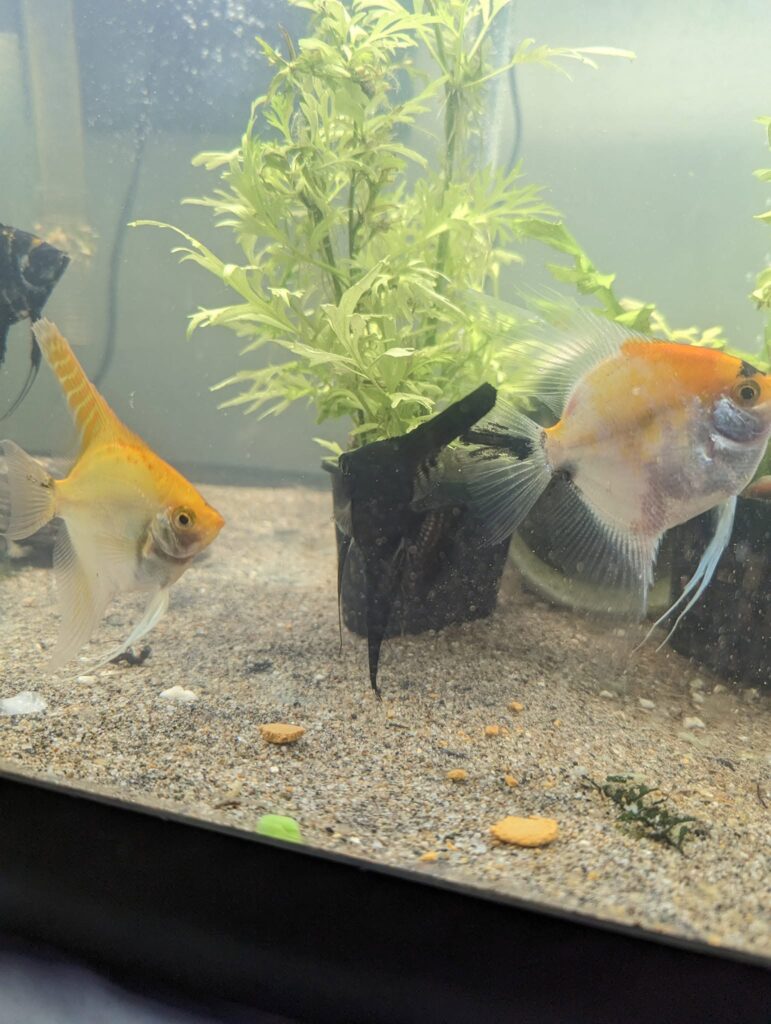
Natural pH in the Angelfish’s Native Habitat
Understanding the wild environment helps explain why pH matters so much for this species.
Angelfish come from the slow-moving floodplains, river tributaries, and flooded forests of the Amazon basin — particularly in countries like Brazil, Peru, and Colombia.
These environments are characterized by warm temperatures (26–30°C / 78–86°F), very soft water with low mineral content, and high concentrations of organic acids from decomposing leaves and wood. The result is water that is naturally acidic, often ranging from pH 4.5 to 6.5 in the wild.
This long evolutionary history in acidic, mineral-poor water is why angelfish thrive best in conditions that replicate, at least partially, those natural parameters.
Testing Your Aquarium’s pH
You cannot manage what you do not measure. Testing pH regularly is essential for any angelfish keeper.
Test kits are available in two main forms. Liquid test kits — such as those made by API — are generally more accurate and cost-effective over time. Test strips are quicker but less reliable, especially at the margins of a range. For a fish as sensitive as the angelfish, a liquid test kit is the better investment.
Test your pH at the same time of day when possible. This matters because pH fluctuates naturally throughout a 24-hour cycle due to photosynthesis and respiration. During daylight hours, aquatic plants consume CO₂ and raise pH.
At night, CO₂ levels build up and pH drops. In heavily planted tanks, this diurnal swing can be as wide as 0.5 to 1.0 pH units.
Test frequency recommendations:
- New tanks: Every day during the nitrogen cycle
- Established tanks: At least once per week
- After water changes: Within an hour of the change
How to Adjust and Maintain pH for Angelfish
Lowering pH (Making Water More Acidic)
If your tap water runs alkaline — which is common in many regions — you will need to reduce the pH before it suits angelfish.
Driftwood and botanicals are the most natural method. Driftwood releases tannins that gradually acidify water. Indian almond leaves, alder cones, and seed pods serve the same purpose and are widely used in Amazonian-style biotope tanks. This approach is gentle, gradual, and closely mimics natural conditions.
Peat moss placed in a filter bag inside the filter is another traditional method. It softens water and lowers pH over time. The water will take on a light tea color, which is not harmful and is actually preferred in blackwater setups.
CO₂ injection lowers pH through carbonic acid formation. It is popular in planted tanks and gives precise control. When CO₂ injection stops at night, pH will rise again — so consistent CO₂ dosing is important if this method is used for pH management.
Commercial pH-down products can work but must be used cautiously. Many contain phosphoric acid, which can cause rapid and hard-to-reverse swings. They are best used for minor adjustments, not major corrections.
Raising pH (Making Water More Alkaline)
If your water is too acidic, raising pH is straightforward.
Crushed coral or aragonite added to the substrate or filter media will steadily buffer the water upward. These materials dissolve slowly and release calcium carbonate, which raises both pH and hardness.
Baking soda (sodium bicarbonate) can be used for short-term adjustments. Add it slowly, in small amounts, and always test before and after. Never add it directly to a tank full of fish without first dissolving it in a separate container of tank water.
Water changes with higher-pH tap water can also raise pH naturally if your tap water is alkaline.
Keeping pH Stable
Stability is the real goal. A consistent pH of 6.8 is far better for angelfish than one that swings between 6.2 and 7.4.
Buffering capacity — also called alkalinity or KH — is what keeps pH stable. Water with low KH is easily destabilized by small inputs of acid or base. For angelfish tanks, a KH of 3–8 dKH (degrees of carbonate hardness) provides reasonable stability without pushing pH too high.
Regular partial water changes (25–30% weekly) also help prevent pH from drifting downward over time, which happens naturally as biological processes produce acids in the tank.
pH and Breeding Angelfish
For hobbyists hoping to breed angelfish, pH management becomes even more important. Spawning is triggered partly by environmental conditions, and water chemistry plays a significant role.
Angelfish tend to breed most reliably at a pH between 6.5 and 7.0. Soft, slightly acidic water with lower conductivity (below 500 µS/cm) improves fertilization rates and egg viability. Eggs laid in water that is too alkaline may have lower hatch rates.
If you are serious about breeding, consider using reverse osmosis (RO) water blended with a small amount of tap water or remineralized with a product designed for Amazonian species. This gives you precise control over both pH and hardness.
Suggested For You:
Angelfish Tank Size: Minimum Gallons and Everything You Need to Know
Best Tank Mates for Angelfish: A Complete Community Tank Guide
Angelfish Tank Temperature Range: The Complete Guide for Healthy Fish
Black Veil Angelfish for Sale: What to Know Before You Buy
How to Set Up an Angelfish Breeding Tank: A Complete Guide
Angelfish Stocking: How Many in 75, 55, 29, 25 Gallon Tank
Common Mistakes Fishkeepers Make with Angelfish pH
- Relying on tap water without testing. Tap water pH varies widely by location and even by season. Never assume it is suitable without testing first.
- Chasing an exact number. Some hobbyists obsessively try to hit pH 6.8 to the decimal, adding chemicals repeatedly. This approach causes more harm than a stable 7.2 ever would.
- Ignoring the relationship between pH and hardness. pH and KH are linked. Trying to maintain low pH in high-KH water is a constant battle. If your tap water is very hard and alkaline, consider RO water blending as a more sustainable long-term solution.
- Not testing after adding new decorations. Some rocks, particularly limestone and marble, will raise pH significantly. Always test new decor in a bucket of water before placing it in an angelfish tank.
Quick Reference: Angelfish pH Parameters
| Parameter | Acceptable Range | Optimal Range |
| pH | 6.0 – 7.5 | 6.5 – 7.0 |
| Temperature | 24–30°C (75–86°F) | 26–28°C (79–82°F) |
| KH (Carbonate Hardness) | 3–8 dKH | 4–6 dKH |
| GH (General Hardness) | 3–10 dGH | 4–8 dGH |
Final Thoughts
Getting the pH right for angelfish is not complicated, but it does require attention. The ideal range is 6.5 to 7.0, though angelfish can tolerate 6.0 to 7.5 with good management. What they cannot tolerate well is instability. A tank that fluctuates wildly between acidic and alkaline extremes is far more dangerous than one that sits at a steady 7.2.
Test regularly, make changes slowly, and prioritize stability over perfection. Do that, and your angelfish will reward you with years of health, color, and — if you are lucky — a spawning pair that fills your tank with tiny wriggling fry.
References
- Helfman, G. S., Collette, B. B., Facey, D. E., & Bowen, B. W. (2009). The Diversity of Fishes: Biology, Evolution, and Ecology (2nd ed.). Wiley-Blackwell. https://www.wiley.com/en-us/The+Diversity+of+Fishes%3A+Biology%2C+Evolution%2C+and+Ecology%2C+2nd+Edition-p-9781405124942
- United States Geological Survey (USGS). (2019). pH and Water. Water Science School. https://www.usgs.gov/special-topics/water-science-school/science/ph-and-water
- Boyd, C. E. (2015). Water Quality: An Introduction (2nd ed.). Springer. https://link.springer.com/book/10.1007/978-3-319-17446-4
- Timmons, M. B., & Ebeling, J. M. (2013). Recirculating Aquaculture (3rd ed.). Ithaca Publishing Company. (Chapter 4 covers water chemistry and pH in fish culture systems.) https://www.ithacapublishing.com/recirculating-aquaculture/
- Kullander, S. O. (2003). Pterophyllum scalare species account. In R. E. Reis, S. O. Kullander & C. J. Ferraris Jr. (Eds.), Check List of the Freshwater Fishes of South and Central America. EDIPUCRS. https://www.fishbase.se/summary/Pterophyllum-scalare.html