Male vs Female Mystery Snail: How to Tell the Difference and Why It Matters
The first time I tried to sex my mystery snails, I spent an embarrassing amount of time staring into the tank with a torch, second-guessing everything I thought I knew. Nobody warns you how genuinely tricky it can be.
Mystery snails do not wear their sex on the outside. There are no dramatic size differences, no colour distinctions, and no behavioural giveaways you can spot from across the room.
And yet, knowing the sex of your mystery snails matters — especially if you are trying to breed them, control their population, or simply understand what is happening in your tank when mating behaviour begins.
This article covers everything you need to know about male vs female mystery snails: how to tell them apart, what the differences mean practically, how reproduction works, and what expert aquarists have learned from years of observation.
Why Sexing Mystery Snails Is Harder Than People Expect
Most aquarium animals offer at least some external clue to their sex. Fish often show colour differences. Shrimp display visible egg sacs. Even some snail species have observable distinctions.
Mystery snails are different. There is only one reliable way to determine the sex of a mystery snail — and it requires a direct look at the snail’s internal anatomy while it is active and extended from its shell.
There is no shortcut. Shell shape, size, and colour do not reliably indicate sex. Behaviour outside of mating context is not a useful indicator either.
This surprises many new keepers. But once you understand what you are looking for and where to look, the process becomes straightforward — just patient.
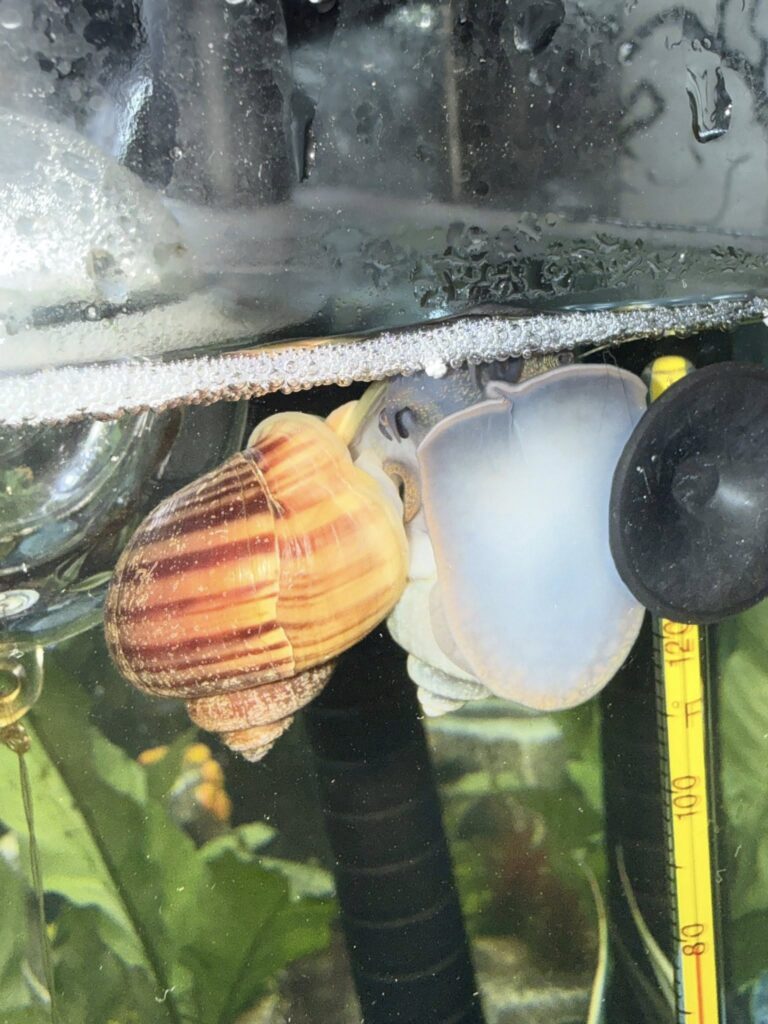
The Only Reliable Method: Examining the Mantle
To sex a mystery snail, you need to look inside the shell opening while the snail is active and its body is extended. Specifically, you are looking at the mantle cavity — the area just inside and beneath the right side of the shell opening.
Here is what you are looking for:
In males: A curved, fleshy, tube-like structure called the penis sheath (or verge) is visible just inside the right side of the shell opening, near the mantle. It is pale, often whitish or cream-coloured, and curves gently. It may appear as a rounded, slightly protruding organ against the inner shell wall.
In females: No such structure is present. The inner right side of the shell opening is smooth and unobstructed.
That is the entire distinction. The presence or absence of the penis sheath is the definitive indicator of sex in mystery snails.
How to Actually Do It: A Step-by-Step Guide
Knowing what to look for is one thing. Getting a clear view is another. Here is a practical method used by experienced aquarists:
Step 1: Wait for the snail to be fully active. A snail partially retreated into its shell will not give you a clear view. Patience is required. Feed the snail or observe it during its most active period — often in the evening or after lights-out.
Step 2: Hold the snail gently with the shell opening facing upward. Lift the snail carefully and tilt it so the opening of the shell faces you. Do this over the tank or a container of tank water in case the snail retreats suddenly.
Step 3: Use a bright light source. A small torch or phone flashlight helps enormously. Direct it into the shell opening to illuminate the mantle cavity.
Step 4: Look to the right side of the opening. The penis sheath, if present, will be visible along the right inner edge of the shell. It may take a moment for your eyes to adjust and locate it.
Step 5: Return the snail to the tank promptly. Do not keep the snail out of water for more than a minute or two during this process. Return it gently and observe for any stress response.
“The first few times you try to sex a mystery snail, you will probably get confused. The key is good lighting and a fully extended snail. Once you have seen the penis sheath clearly in a male, you will never mistake it again. It becomes obvious.” — Rachel Simmons, freshwater invertebrate breeder and online aquarist educator with over 14 years of experience
Recognising the Penis Sheath: A Clearer Description
Because this is the only distinguishing feature, it deserves a more detailed description.
The penis sheath in male mystery snails is:
- Pale in colour — typically cream, white, or very light yellow
- Curved or slightly hooked in shape, curving toward the body of the snail
- Soft and fleshy in texture, distinct from the harder shell interior
- Located on the right side of the mantle cavity, near the base of the head
- Variable in visibility — in some males it is clearly prominent; in others, you may need to look carefully
In younger males, it may be less developed and harder to see. This is why sexing juvenile mystery snails is particularly difficult and often unreliable. Most experienced aquarists recommend waiting until a snail is at least 3 to 4 months old before attempting to determine its sex with confidence.
Can You Sex Mystery Snails Without Handling Them?
This is a common question, and the honest answer is: not reliably.
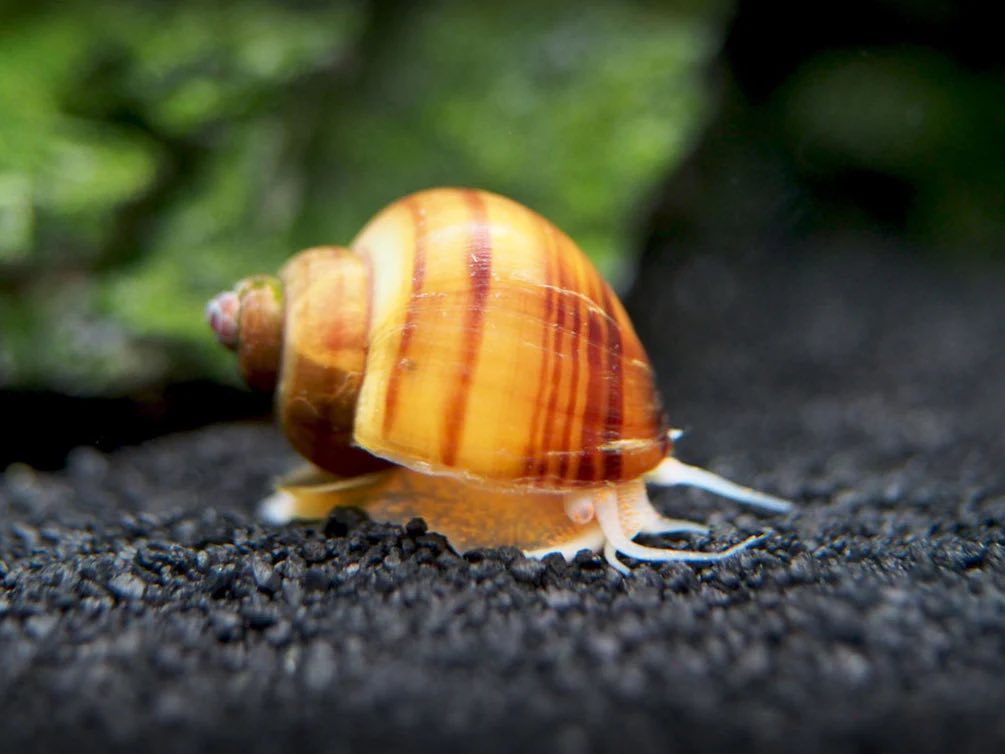
Some aquarists claim to observe the penis sheath while the snail is active on the glass, positioned at the right angle. This is occasionally possible, but it requires ideal positioning and is not something you can count on.
Handling is the most consistent and reliable method. If you find the idea uncomfortable, remember that mystery snails are resilient animals and brief, careful handling does not cause harm.
“I have had people message me saying they can tell the sex from tank observation alone. Sometimes they get lucky. But if you are making breeding decisions based on that method, you will be disappointed eventually. Handle the snail, use good light, and look properly.” — Gregory Okafor, aquarium hobbyist and freshwater invertebrate forum moderator with 11 years of mystery snail keeping
Are There Any Secondary Indicators of Sex?
While the penis sheath is the only definitive indicator, there are a few secondary observations that some experienced keepers use as rough guides. These are not reliable on their own but can supplement direct examination.
Size: In some populations, females tend to grow slightly larger than males. However, this varies significantly based on diet, water quality, and genetics. Size alone should never be used to determine sex — the overlap between male and female size ranges is too great.
Shell shape: Some aquarists report that females occasionally have a slightly rounder, fuller shell profile. Again, this is highly variable and unreliable as a standalone indicator.
Behaviour during mating: During mating, the male will mount the female from behind and slightly above. If you observe your mystery snails mating, you will know with certainty which is which. The snail on top is always male. This is one of the clearest behavioural distinctions available, but it only applies in the context of mating activity.
Egg-laying: If a mystery snail lays an egg clutch, it is unambiguously female. This seems obvious, but it is worth stating for completeness. The female is the only one capable of producing the visible pink or peach egg clusters deposited above the waterline.
Mating Behaviour: What to Expect
Understanding mating behaviour helps you interpret what you are seeing in the tank — and respond appropriately.
Mystery snail mating is generally a slow, unhurried process. The male approaches the female and mounts her shell from behind. This can last anywhere from 30 minutes to several hours. It is normal and not a cause for concern.
Occasionally, the female will attempt to move away or retract into her shell. If this happens persistently, it may simply mean she is not receptive at that moment, or that the male is being overly persistent.
One important welfare note: If a male is continuously and aggressively pursuing a female to the point where she cannot eat, move freely, or rest, consider separating them temporarily. Chronic harassment causes stress and can affect the female’s health and growth.
“Mystery snail mating is fascinating to watch. The male will sometimes spend hours tracking a female before mounting. What I find remarkable is how selective the females can be — they do not always accept a male’s advances, and they are quite clear about it when they do not.” — Amina Diallo, aquatic biology student and freshwater snail keeper from Dakar, Senegal, who documents snail behaviour through an online journal
Female Mystery Snails: The Egg-Laying Process
Once mating has occurred, the female stores sperm and can produce fertilised egg clutches for several months — sometimes without additional mating. This surprises many keepers who assume a single snail cannot produce fertile eggs.
A female mystery snail can produce fertile eggs for up to 4 to 5 months after a single mating event. If you purchase a female from a pet shop that houses mixed-sex populations, there is a real possibility she was already mated before you brought her home.
The egg-laying process follows a predictable pattern:
1. The female emerges partially above the waterline, typically at night or in low light. She deposits a clutch of eggs on the glass, hood, lid, or any surface above the water.
2. The clutch begins as soft and pale pink, then hardens and darkens to a deeper peach or coral colour over 24 to 48 hours.
3. Hatching occurs in 2 to 4 weeks, depending on temperature and humidity. Warmer conditions accelerate development.
4. Hatchlings are tiny — approximately 2 to 3 millimetres — and immediately begin grazing.
A single clutch may contain anywhere from 30 to over 200 eggs, depending on the size and age of the female. Larger, well-nourished females tend to produce bigger clutches.
If you do not want offspring, simply remove the clutch before it hatches. The eggs are deposited above the waterline, making them easy to locate and detach gently with a credit card or similar tool.
Male vs Female: Key Differences at a Glance
| Feature | Male | Female |
| Penis sheath | Present (right inner mantle) | Absent |
| Shell size | Slightly smaller on average | Slightly larger on average |
| Egg-laying | Cannot lay eggs | Lays clutches above waterline |
| Mating position | Mounts female (on top) | Mounted by male (on bottom) |
| Sperm storage | Not applicable | Can store sperm for months |
| Behavioural difference | Initiates mating | May accept or reject mating |
| Reliability of sexing | Requires direct examination | Confirmed by egg-laying |
How Many Males and Females Should You Keep?
This depends entirely on your goal.
If you want to breed mystery snails: A ratio of one male to one or two females is ideal. This prevents any single female from being over-pursued while ensuring mating opportunities. A small group of four to six snails — two males and two to four females — in a 20-gallon or larger tank works very well for a productive breeding setup.
If you want to avoid breeding: Keep only one sex. Since females can store sperm, it is generally safer to keep only males if you want zero chance of reproduction. All-male groups are peaceful and do not show any aggression toward each other.
Alternatively, keeping only females is also an option. Without stored sperm, unfertilised egg clutches will still occasionally be produced, but they will never hatch. These clutches are harmless and easy to remove.
If you are unsure of the sex: Many aquarists simply keep a group of two to four snails without knowing their sex and accept whatever reproduction occurs. Since mystery snail population growth is slow and manageable — unlike pest snails — this is a perfectly reasonable approach for most hobbyists.
Can Mystery Snails Change Sex?
This is a question that comes up occasionally, often because the keeper observed unexpected egg-laying in what they believed was an all-male group.
Mystery snails cannot change sex. They are gonochoric — meaning each individual is either male or female for life, with no capacity for sex change. This distinguishes them from some other gastropod species that are hermaphroditic or capable of sequential sex change.
If egg-laying occurs in what was believed to be an all-male group, the most likely explanations are:
- The sexing was incorrect — the penis sheath was missed or misidentified
- One or more snails were purchased as already-mated females
- The snails were sexed too young, before the penis sheath was clearly developed
Re-examine the snails carefully if unexpected egg-laying occurs. A missed female is almost always the answer.
Sexing Juvenile Mystery Snails
I want to address this directly because it is a source of genuine frustration for many keepers, including myself early on.
Juvenile mystery snails are extremely difficult to sex accurately. In males, the penis sheath begins developing as the snail matures, but it is not reliably visible until the snail reaches approximately 1 to 1.5 centimetres in shell diameter and is around 3 to 4 months of age.
Attempting to sex snails younger than this often produces incorrect results — and the mistake is almost always incorrectly identifying a young male as female, because the sheath is not yet developed enough to see.
The practical advice: Wait. Sex your snails at 3 to 4 months minimum. If you are purchasing snails specifically for breeding, ask the seller whether they have sexed adults available, or purchase a group of six or more juveniles to increase the probability of getting both sexes.
“I cannot tell you how many times someone has messaged me convinced they have all females because they could not find the sheath. Most of the time, the snails are just too young. Give it three months. The anatomy will declare itself.” — Sofia Herrera, biology graduate student and hobbyist aquarist who maintains a dedicated mystery snail breeding programme
Common Mistakes When Sexing Mystery Snails
Even experienced aquarists make these errors occasionally.
Mistake 1: Examining a retreated snail. If the snail is not fully extended, the mantle cavity is not accessible. You will see nothing useful. Wait for full activity before attempting to examine.
Mistake 2: Poor lighting. The mantle cavity is dark. Without a directed light source, you will miss the penis sheath even in a clearly male snail. Always use a bright torch.
Mistake 3: Sexing too young. As discussed, juveniles under 3 months are unreliable to sex. Patience is necessary.
Mistake 4: Confusing the lung siphon for the penis sheath. The siphon — the tube mystery snails use to breathe air at the surface — is located on the left side of the mantle. The penis sheath is on the right. Left versus right is a critical distinction. If you are unsure which side you are examining, reorient the snail.
Mistake 5: Assuming size indicates sex. As noted earlier, size overlap between males and females is too significant to use as a reliable indicator. A large snail is not necessarily female.
Tips for Successful Sexing and Breeding
Tip 1:Photograph what you see. When examining a snail, take a photo with your phone torch illuminating the mantle. Reviewing the image afterward — zoomed in — makes it much easier to confirm what you saw. It also gives you a reference for future comparisons.
Tip 2: Keep records of sexed individuals. If you are managing a breeding group, mark the underside of each snail’s shell with a small, non-toxic marker dot in different colours for males and females. This saves you from re-examining the same snails repeatedly.
Tip 3: Provide a dedicated egg-laying area. Females need accessible surfaces above the waterline to deposit clutches. Keep the water level 2 to 3 centimetres below the rim and ensure the lid or cover provides a dry, accessible surface. Clutches deposited in unsuitable locations have lower hatch rates.
Tip 4: Maintain stable water conditions during breeding. Mating and egg development are energy-intensive processes. During active breeding periods, increase feeding frequency, maintain temperature at the upper comfortable range (76°F to 80°F), and perform consistent water changes. A stressed female will produce smaller clutches with lower fertility.
Tip 5: Incubate clutches carefully if desired. If you want to maximise hatch rates, some breeders remove clutches and place them in a humid, warm container (a small plastic tub with a damp paper towel) rather than leaving them in the tank. This protects clutches from being knocked off by snails and maintains consistent humidity during development.
Suggested For You:
Mystery Snails Stuck Together: What New Aquarium Owners Should Know
Understanding Mystery Snail Shell Growth: Key Indicator of Healthy Snail
Mystery Snail vs Apple Snail: Key Differences Every Aquarist Should Know
Fertile vs Infertile Mystery Snail Eggs: How to Tell the Difference and What to Do Next
Do Mystery Snails Eat Plants? What You Need to Know Before Adding Them to a Planted Tank
Final Thoughts
Sexing mystery snails is not complicated once you know what you are doing — but it takes patience, good light, and a properly extended snail. The penis sheath is the single definitive indicator, and there is no substitute for a direct, well-lit examination.
I remember the quiet satisfaction the first time I correctly sexed an entire group of six snails and later confirmed it through mating observation and egg-laying. There is something genuinely rewarding about understanding your animals at that level of detail.
The key points to carry away:
- The only reliable method of sexing mystery snails is examining the penis sheath in the right mantle cavity.
- Males have the sheath; females do not. There is no other consistent external distinction.
- Do not attempt to sex snails younger than 3 to 4 months — results will be unreliable.
- Females can store sperm for months and may produce fertile eggs long after a single mating event.
- Mystery snails cannot change sex. Unexpected egg-laying almost always means a female was present but undetected.
- For breeding, a 1:1 or 1:2 male-to-female ratio works well. For no breeding, keep single-sex groups.
Understanding the sex of your mystery snails gives you real control over your aquarium — whether your goal is breeding, population management, or simply knowing your animals well. And in this hobby, knowing your animals well is always worth the effort.
References
- Cowie, R. H. (2002). Apple snails (Ampullariidae) as agricultural pests: their biology, impacts and management. In G. M. Barker (Ed.), Molluscs as Crop Pests (pp. 145–192). CAB International. University of Hawaii at Manoa, Pacific Biosciences Research Center. https://www.hawaii.edu
- Yusa, Y. (2007). Sex ratio, sperm storage and sex change in the apple snail Pomacea canaliculata. Journal of Molluscan Studies, 73(3), 241–246. Faculty of Science, Nara Women’s University, Department of Biology. https://academic.oup.com/mollus
- Adema, C. M., Hillier, L. W., Jones, C. S., Loker, E. S., Knight, M., Minx, P., & Wilson, R. K. (2017). Whole genome analysis of a schistosomiasis-transmitting freshwater snail. Nature Communications, 8, 15451. University of New Mexico, Center for Evolutionary and Theoretical Immunology. https://www.unm.edu
- Hayes, K. A., Cowie, R. H., Thiengo, S. C., & Strong, E. E. (2012). Comparing apples with apples: clarifying the identities of two highly invasive Neotropical Ampullariidae. Zoological Journal of the Linnean Society, 166(4), 723–753. Smithsonian Institution & University of Hawaii at Manoa. https://academic.oup.com/zoolinnean
- Estebenet, A. L., & Martín, P. R. (2002). Pomacea canaliculata (Gastropoda: Ampullariidae): life-history traits and their plasticity. Biocell, 26(1), 83–89. Universidad Nacional del Sur, Departamento de Biología, Bahía Blanca, Argentina. https://www.uns.edu.ar