Nerite Snail Eggs: Identification, Pictures, and Everything to Know
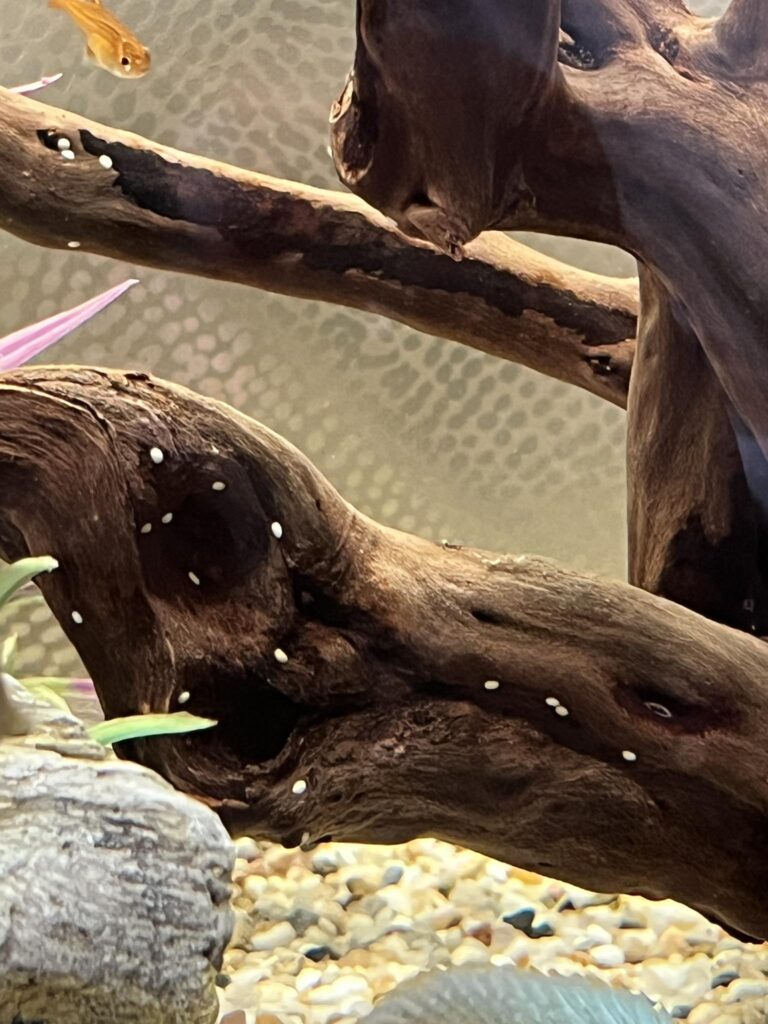
If you are new to keeping nerite snails, there is a good chance you have already spotted them — small, white, sesame-seed-like dots scattered across your aquarium glass, stuck firm on driftwood, or clustered along plant stems.
The first time I noticed them in my own tank, I genuinely did not know what I was looking at. Fungal growth? Mineral deposits? It took some research to confirm the obvious: these were nerite snail eggs, and they were going absolutely nowhere without a fight.
That is perhaps the most commonly reported frustration among nerite snail keepers. The eggs are harmless. They will not hatch in your freshwater tank. But they are stubbornly hard to remove, and a heavily stocked tank can accumulate hundreds of them over time.
This article explains everything about nerite snail eggs — what they look like, why they are laid, whether they can hatch, how to manage or remove them, and what to do if you actually want to try breeding nerite snails intentionally.
| Egg Appearance | Tiny, white to cream-colored, capsule-shaped |
| Egg Size | Approximately 1 mm in diameter |
| Texture | Hard, calcified outer casing |
| Laid On | Glass, rocks, driftwood, plant leaves, decor, substrate |
| Laid By | Females only (males do not lay eggs) |
| Fertilization Required? | No — females lay eggs without a male present |
| Hatch in Freshwater? | No — larvae require brackish or saltwater conditions |
| Hatch in Brackish/Marine Water? | Yes — with the right conditions |
| Egg Removal | Razor blade, credit card scraping, or manual picking |
| Harmful to Tank? | Not directly, but cosmetically undesirable |
| Egg-Laying Trigger | Presence of calcium, stable water, and often a male nearby |
| Egg Laying Frequency | Continuous in mature females with good nutrition |
| Larval Stage | Planktonic — requires specific brackish conditions to survive |
What Do Nerite Snail Eggs Look Like?
Nerite snail eggs are immediately recognizable once you know what to look for. Each egg is a tiny, round-to-oval capsule, roughly 1 millimeter in diameter.
The color ranges from bright white to off-white or cream, and the outer casing has a hard, calcified texture — much like a tiny seed or a grain of white sand pressed firmly onto a surface.
They are not soft or squishy. If you try to wipe them off glass with your finger, they resist. This is because the egg capsule is designed by nature to survive harsh conditions — strong river currents, wave action, fluctuating salinity — long enough for the female to deposit it somewhere stable.
The eggs are usually laid in clusters rather than individually, though the density of the cluster varies. Some females lay eggs in neat, organized rows. Others scatter them more randomly across a wide surface area.
In a tank with multiple females, the sheer number of eggs on hard surfaces can become visually prominent very quickly.
Key identifying features of nerite snail eggs:
- Tiny white or cream capsules, about 1 mm across
- Hard, calcareous outer shell
- Firmly attached to surfaces — difficult to scrape off
- Laid singly or in loose clusters
- Found on glass, rocks, wood, decorations, and occasionally plant leaves
It is worth noting that nerite eggs look different from the eggs of other common aquarium snails. Mystery snail eggs, for example, are laid in large pink or cream-colored clutches above the waterline — impossible to confuse with nerite eggs.
Ramshorn and bladder snail eggs are transparent, gelatinous blobs. Nerite egg capsules are distinct in their hard, white, seed-like form.
Why Do Nerite Snails Lay Eggs?
This sounds like a simple question, but the biology behind it is genuinely interesting.
Female nerite snails will lay eggs regardless of whether a male is present. The eggs produced without fertilization are technically infertile — they contain no viable embryo and will never hatch under any conditions.
However, when a male is present and mating occurs, the eggs are fertilized and contain a developing embryo.
Here is the critical point: even fertilized nerite snail eggs will not hatch in a freshwater aquarium.
The larvae that emerge from the eggs are planktonic — they drift freely in the water column — and they require brackish to marine water conditions (salinity of approximately 15 to 34 parts per thousand) to survive and develop.
In a standard freshwater tank, any larvae that hatched would die within hours.
This is why nerite snails are so popular in the hobby — they lay eggs but never overpopulate a freshwater tank.
Unlike ramshorn snails or bladder snails, which can breed explosively in freshwater, nerite snails offer algae-eating efficiency with zero population control problems.
What Triggers Egg Laying?
Several factors appear to influence how frequently and prolifically a female nerite snail lays eggs:
- Nutritional status — well-fed females with adequate calcium intake lay more eggs
- Water quality — stable, clean water with appropriate hardness encourages egg-laying
- Presence of a male — mating stimulates increased egg production in many species
- Water temperature — warmer water within the appropriate range tends to increase reproductive activity
- Tank maturity — established tanks with abundant biofilm and algae support more active females
In practice, a healthy, well-fed female in a mature tank will lay eggs consistently and frequently. There is no way to stop this entirely without removing the snail.
Where Do Nerite Snails Lay Their Eggs?
Nerite snails are famously non-discriminating about egg placement. They will deposit eggs on virtually any hard, stable surface within reach. The most common locations include:
- Glass panels — particularly the front and side glass at the waterline or along the lower third of the tank. This is where eggs are most visually noticeable and most frustrating for aquarists.
- Rocks and gravel — smooth river stones and larger gravel pieces attract egg deposition. Eggs laid here are often harder to notice but equally difficult to remove.
- Driftwood and bogwood — the rough, porous texture of wood makes it a preferred egg-laying surface for many females. Eggs embedded in wood grain can be nearly impossible to remove completely.
- Live plant leaves — females will sometimes lay eggs on the broad, flat leaves of plants like anubias or java fern. This is cosmetically unfortunate but does not harm the plant.
- Artificial decorations — caves, resin ornaments, and ceramic decorations all attract eggs.
- The filter intake or equipment — females occasionally deposit eggs on heaters, filter pipes, and powerhead casings.
- The underside of tank lids — particularly near the waterline. This is more common in overstocked tanks where females compete for prime horizontal surfaces.
The waterline area of the tank is often a particularly heavy egg-laying zone. Nerite snails in the wild deposit eggs in areas exposed to tidal fluctuations — partially submerged surfaces where the eggs have brief exposure to air. Your tank’s waterline mimics this environment, making it a natural target.
Do Nerite Snail Eggs Hatch? The Full Truth
Let us address this clearly because it causes a lot of confusion.
In a freshwater aquarium: No, the eggs will not hatch. They may remain on surfaces for months or even years before slowly degrading. Some eggs may turn darker or gray over time, indicating they are infertile or have died, but they will not produce live snails.
In brackish water: Possibly, but it is extremely difficult. Fertilized eggs exposed to brackish water of the appropriate salinity may hatch into veliger larvae — the planktonic first stage of the snail’s life cycle.
However, raising these larvae to the juvenile stage requires:
- Very precise salinity management (typically 15 – 25 ppt for the early larval stage)
- An abundant supply of phytoplankton and marine microorganisms for the larvae to feed on
- Specific water temperature and flow conditions
- Equipment capable of maintaining these parameters consistently
In a fully marine tank: Some nerite species with marine origins may successfully complete their larval development. However, this is more relevant to natural reef systems than to the controlled environment of a home aquarium.
The Amphidromous Life Cycle
The reason nerite snails have such complex reproductive requirements is rooted in their amphidromous life cycle — one of the most fascinating reproductive strategies in freshwater invertebrates.
Adult nerite snails spend their lives in freshwater. But when reproduction occurs, the eggs are designed to be swept downstream into estuarine or coastal zones.
The larvae develop in brackish or marine water over several weeks, then — in the wild — juvenile snails migrate back upstream into freshwater rivers and streams.
This life cycle evolved over millions of years and is deeply encoded in the snail’s biology. No amount of manipulation in a home aquarium will override it.
The freshwater tank simply cannot replicate the salinity gradient, phytoplankton communities, and tidal dynamics that larvae need.
Also Read: Mystery Snail Eggs Fell in Water
How to Remove Nerite Snail Eggs: Practical Methods
Since the eggs will not hatch and are primarily a cosmetic issue, most aquarists eventually want to remove them. The challenge is that the calcified capsule adheres firmly to surfaces. Here are the most effective approaches.
Method 1: Razor Blade or Algae Scraper (Glass Only)
A flat razor blade or a dedicated aquarium algae scraper is the most effective tool for removing nerite eggs from glass panels.
Hold the blade at a shallow angle — almost flat against the glass — and apply firm, even pressure. The eggs pop off cleanly in most cases. Work in sections and collect the dislodged eggs with a fine mesh net or allow the filter to catch the debris.
Never use a razor blade on acrylic tanks — it will cause permanent scratches. For acrylic aquariums, use a soft plastic scraper designed for acrylic surfaces.
Method 2: Credit Card or Plastic Scraper
A rigid plastic card — a credit card, library card, or purpose-made plastic aquarium scraper — can remove eggs from glass with less risk of damage than a razor blade. It takes more effort, but it is safer for acrylic surfaces and for less experienced hands.
Method 3: Manual Removal from Decor
For eggs on rocks, decorations, or driftwood, remove the item from the tank and scrub it with a stiff-bristled brush under running water. Do not use soap or cleaning agents — plain water and mechanical scrubbing is sufficient.
Some eggs embedded deeply in wood grain may resist removal. In these cases, you may need to accept that a permanent residue will remain on the wood, which will eventually degrade on its own.
Method 4: Toothbrush Spot Scrubbing
For delicate surfaces or areas difficult to reach with a scraper, a soft-to-medium bristled toothbrush (dedicated for aquarium use only) works well. This is particularly useful for cleaning eggs off plant leaves without damaging the plant tissue.
What Does Not Work
- Chemical treatments — there is no aquarium-safe chemical that will dissolve nerite eggs without harming your livestock
- Leaving it to other tank inhabitants — most fish, shrimp, and other snails will ignore nerite eggs entirely
- Water changes — eggs are not dislodged by water movement
- Waiting — eggs can persist for several months before naturally breaking down
How to Minimize Egg Laying
If the eggs are a persistent problem, you have a few practical options to reduce the number laid — though none will eliminate egg production entirely.
Keep only male nerite snails. Females are the egg layers. Males do not produce eggs. The challenge is that sexing nerite snails is notoriously difficult without close inspection, and even then, the identifying features are subtle.
If you can reliably sex your snails before purchase — some specialty vendors label them — keeping only males solves the problem entirely.
Reduce the number of snails. Fewer females means fewer eggs. If you have 6 snails and 4 of them are female, reducing to 2 or 3 snails will significantly cut egg production.
Maintain lower nutritional input. Heavily fed females produce more eggs. This is not a recommended approach, as underfeeding compromises the snail’s health.
But it is worth noting that a tank with very low algae and no supplemental feeding will see reduced egg production compared to a richly fed tank.
Accept it as part of the deal. Honestly, this is the approach most long-term nerite keepers settle on. The eggs are annoying, but the trade-off — reliable algae control, no overpopulation, and beautiful shell patterns — is well worth it.
A quick scrape of the glass during water changes keeps the tank tidy without much extra effort.
Intentional Nerite Snail Breeding: Is It Possible?
A small but dedicated community of advanced aquarists has successfully bred nerite snails intentionally. It is genuinely possible, but it is one of the more challenging invertebrate breeding projects in the freshwater hobby.
Basic Requirements for Intentional Breeding
Step 1: Establish a breeding group in freshwater. Keep several nerite snails (ideally a mix of males and females) in a well-maintained freshwater tank. Allow mating to occur naturally. Fertilized eggs will be laid on tank surfaces.
Step 2: Harvest the eggs. Carefully remove the egg-bearing surfaces — or carefully scrape the eggs — and transfer them to a brackish water setup. Salinity should be around 15 – 20 ppt (roughly half marine salinity) for initial hatching.
Step 3: Prepare a larval rearing tank. The hatched veliger larvae are microscopic and require live phytoplankton (such as Nannochloropsis or Isochrysis) as their primary food source. The water must be clean, oxygenated, and maintained at appropriate temperature (around 77°F – 82°F / 25°C – 28°C).
Step 4: Manage the salinity transition. As the larvae develop through their planktonic stages and begin to settle as juvenile snails, the salinity must be gradually reduced toward brackish and eventually freshwater levels. This transition takes several weeks and requires careful monitoring.
Step 5: Transfer juveniles to freshwater. Once the young snails have developed a visible shell and are grazing on surfaces, they can be slowly acclimated to freshwater.
The entire process from egg to juvenile typically takes 4 to 8 weeks, depending on species and water conditions. Mortality at the larval stage is very high even under expert care, which is why commercially bred nerite snails are rare and wild-collected individuals dominate the market.
Are Nerite Snail Eggs Harmful?
The short answer is no — nerite snail eggs are not directly harmful to your aquarium.
They do not release toxins. They do not affect water chemistry in any meaningful way. They do not spread disease. They will not hatch and overwhelm your tank.
The concerns are almost entirely cosmetic:
- Aesthetic impact — white dots across glass and decor are not what most aquarists want to see
- Plant leaf coverage — a dense cluster of eggs on plant leaves may theoretically reduce the leaf surface area available for light absorption, but this is rarely significant in practice
- Removal effort — the labor of scraping eggs during maintenance is a genuine inconvenience
If you can tolerate the appearance, there is no biological reason to remove nerite snail eggs. Many experienced aquarists simply scrape them during their regular glass-cleaning routine and think nothing more of it.
Frequently Asked Questions
Why does my nerite snail keep laying eggs even without a male? Female nerite snails will lay eggs regardless of whether a male is present. Unfertilized eggs look identical to fertilized ones but cannot hatch under any conditions.
How long do nerite snail eggs last before they disappear naturally? In a freshwater tank, nerite snail eggs can persist for several months — sometimes longer. They do not dissolve quickly and must usually be removed manually.
Can I move the eggs to saltwater to hatch them? Technically yes, if the eggs are fertilized. However, raising nerite snail larvae is extremely difficult, requiring live phytoplankton and precise salinity management. Most hobbyists who attempt this have limited success.
Will my fish eat the eggs? Most freshwater fish ignore nerite snail eggs entirely. The hard calcified casing is unappealing and difficult to bite through. Some reports suggest certain loaches may nibble at eggs, but complete consumption is rare.
My snails are laying eggs all over my favorite plants. What should I do? Gently remove the eggs with a soft toothbrush. It will not harm the plant. If it is happening repeatedly, consider whether you can reduce the number of female snails in the tank.
Do nerite eggs affect water quality? No. The eggs are inert and do not measurably affect ammonia, nitrite, nitrate, or pH in a normal aquarium.
Final Thoughts
Nerite snail eggs are one of those small inconveniences that come with an otherwise excellent aquarium animal. They are harmless, predictable, and entirely manageable with the right tools and a realistic expectation.
The key takeaway is simple: nerite snails will lay eggs in your freshwater tank, those eggs will not hatch, and with a razor blade and a few minutes during your next water change, the problem is largely solved.
What makes nerite snails worth keeping despite the eggs is everything else they bring to a tank — tireless algae control, beautiful shells, peaceful behavior, and zero risk of overpopulation. That is a combination almost nothing else in the hobby can match.
If the eggs genuinely bother you, try sourcing males only, reduce your snail count, or build a quick scraping routine into your maintenance schedule. In my experience, you adjust quickly — and the benefits far outweigh the inconvenience of a few white dots on the glass.
References
- USGS Nonindigenous Aquatic Species (NAS) Database https://nas.er.usgs.gov
- Smithsonian Ocean Portal, Smithsonian Institution https://ocean.si.edu
- University of Florida IFAS Extension (EDIS) https://edis.ifas.ufl.edu
- U.S. Environmental Protection Agency (EPA) — Aquatic Invasive Species
- Florida Museum of Natural History, University of Florida — Scientific fossil and living specimen collections for Neritidae gastropods, with taxonomic resources useful for understanding the evolutionary context of nerite snail reproduction.