Nerite Snails for Betta Tanks: Can They Live Together?
At some point, almost every betta keeper stares at the algae creeping up the glass and thinks: I need help in here.
Betta fish are stunning and rewarding to keep, but they are also notoriously territorial. Adding any tankmate to a betta aquarium carries a degree of uncertainty. Get it wrong, and the result is a stressed fish, a dead tankmate, or both.
Nerite snails are one of the most frequently recommended tankmates for betta fish — and for good reason. They are peaceful, hardy, excellent algae cleaners, and their hard shells offer meaningful protection against a curious or aggressive betta.
But compatibility is not automatic. A betta’s temperament varies significantly from individual to individual. The tank setup matters. The species of nerite you choose matters. And how you introduce the snail matters more than most people realize.
This guide covers all of it — can nerite snails live in a betta tank?
| Compatibility with Betta | Generally good — with some conditions |
| Risk Level | Low to moderate, depending on betta temperament |
| Best Nerite Species for Betta Tanks | Zebra, Tiger, Olive, Horned Nerite |
| Minimum Tank Size | 5 gallons (10 gallons strongly preferred) |
| Water Temperature Match | ✅ Yes — both prefer 76°F – 82°F (24°C – 28°C) |
| Water pH Match | ✅ Yes — both prefer 7.0 – 8.0 |
| Primary Role in Tank | Algae control and surface cleaning |
| Do Nerites Bother Betta? | Rarely — they are peaceful and slow-moving |
| Will Betta Eat Nerites? | Occasionally nip at antennae; rarely a serious threat |
| Will Nerites Reproduce in Tank? | No — freshwater larvae cannot survive |
| Egg Problem? | Yes — white eggs on surfaces; cosmetic issue only |
| Difficulty Level | Beginner-friendly |
| Recommended Number per Tank | 1–3 snails in a 10-gallon betta tank |
Do Betta Fish and Nerite Snails Actually Get Along?
The short answer is: yes, in most cases, they get along well. But the longer answer requires understanding both animals.
Betta fish are labyrinth fish native to the shallow waters of Southeast Asia. They are famously aggressive toward other bettas and toward fish with long, flowing fins that resemble a rival.
However, their aggression toward non-fish species — snails in particular — is much more variable and generally much less intense.
Most betta fish will investigate a new nerite snail briefly, perhaps nudging or nipping at the soft exposed tissue, and then lose interest. The snail retreats into its shell, the betta moves on, and a peaceful coexistence begins.
The hard, calcareous shell of the nerite snail is a genuine physical advantage. Unlike soft-bodied tankmates, nerites do not present an easy target.
A betta that nips at a shell quickly discovers it gets nothing for the effort. Most bettas conclude that the snail is not worth the trouble.
That said, some betta individuals are significantly more aggressive than average. A highly territorial betta may persistently attack a snail — nipping at the foot, antennae, or operculum whenever the snail extends from its shell.
Chronic harassment like this stresses the snail, prevents normal feeding and movement, and can eventually cause it to decline and die.
The honest truth is this: you cannot know with certainty how your betta will behave until you try. But the odds are strongly in your favor, and there are practical steps to improve them further.
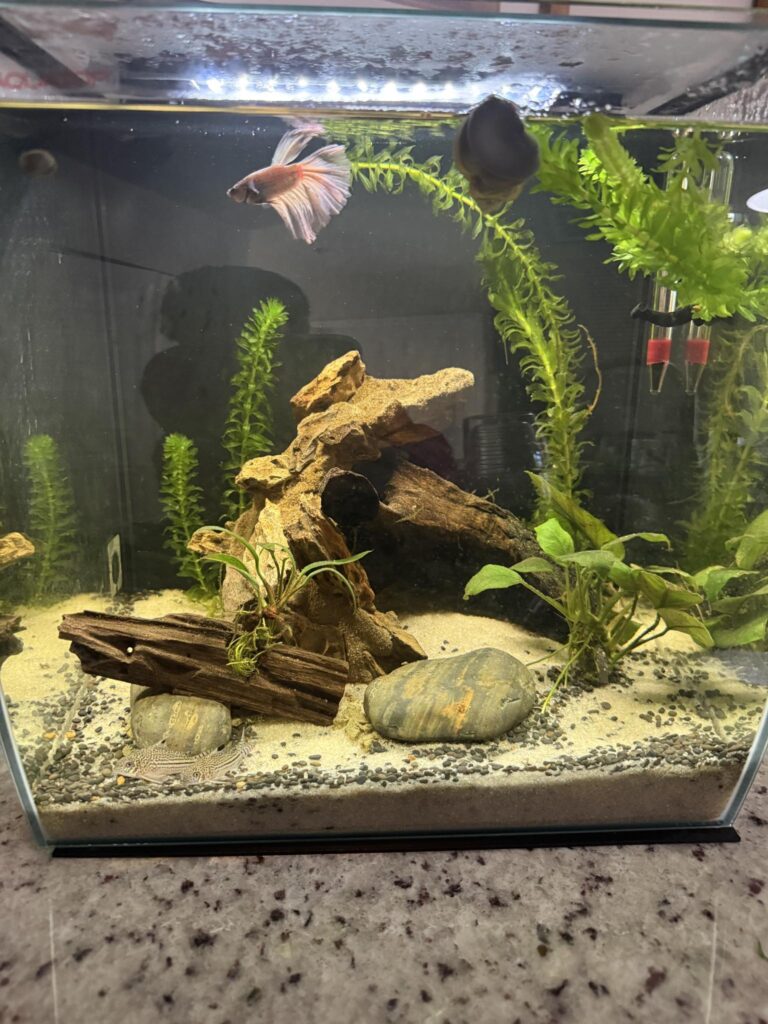
Why Nerite Snails Are an Ideal Choice for Betta Tanks
Among the various snail species available in the aquarium hobby, nerite snails stand out as particularly well-suited to life with a betta. Here is why.
1. The Shell Offers Real Protection
A nerite snail’s shell is thick, hard, and fully enclosed. When threatened, the snail withdraws completely and seals itself with its operculum — the hard plate that covers the shell opening. There is nothing left exposed for a betta to attack.
Compare this to mystery snails, which have a larger, softer body surface that protrudes more visibly, or to bladder snails, whose thin shells offer minimal protection.
2. They Do Not Provoke the Betta
Nerite snails move slowly and methodically along surfaces. They do not dart, splash, swim erratically, or display colors that might trigger a betta’s aggression response. Their quiet, non-threatening presence means bettas often habituate to them within days and begin ignoring them entirely.
3. They Solve the Algae Problem
Betta tanks — particularly heavily planted, well-lit setups — are prone to algae growth on glass and décor. Nerite snails are among the most effective algae grazers in the freshwater hobby. They consume green spot algae, brown diatoms, and soft green algae without touching live plants.
This keeps the tank visually clean and reduces the maintenance burden on the keeper.
4. They Will Not Overpopulate
This point matters enormously in a small betta tank. Many aquarium snails — ramshorn snails, bladder snails, Malaysian trumpet snails — can multiply rapidly, turning a 10-gallon tank into an overcrowded, biologically stressed environment.
Nerite snails cannot breed in freshwater. Their larvae require brackish or saltwater conditions to survive.
You will see white egg capsules on surfaces (more on this below), but no population explosion will follow. The number of nerites in your tank stays exactly where you put it.
5. Shared Water Parameter Requirements
This is a practical but important point that is sometimes overlooked. Bettas and nerite snails have overlapping water parameter preferences, which means you do not need to compromise on tank conditions to accommodate both species.
| Parameter | Betta Preference | Nerite Preference | Compatible? |
| Temperature | 76°F – 82°F | 72°F – 82°F | ✅ Yes |
| pH | 6.8 – 7.5 | 7.0 – 8.5 | ✅ Yes |
| Water Hardness | Soft to moderate | Moderate to hard | ⚠️ Partial |
| Ammonia | 0 ppm | 0 ppm | ✅ Yes |
| Nitrite | 0 ppm | 0 ppm | ✅ Yes |
The one area of mild tension is water hardness. Bettas generally prefer slightly soft to moderately hard water, while nerite snails need moderately hard to hard water for healthy shell development.
In practice, a moderate hardness level of 8 – 12 dGH satisfies both species reasonably well. If your tap water is naturally soft, a small piece of cuttlebone in the tank adds calcium for the snail without significantly altering conditions for the betta.
Which Nerite Snail Species Work Best in a Betta Tank?
Not all nerite species are equally well-suited to a betta tank environment. Here are the best choices and why.
Zebra Nerite Snail (Neritina natalensis)
The zebra nerite is the top recommendation for betta tanks. It is hardy, adaptable, widely available, and its bold yellow-and-black shell pattern makes it visually attractive.
At around 1 inch in size, it is large enough to avoid being seen as prey by all but the most aggressive bettas.
Tiger Nerite Snail (Vittina semiconica)
Tiger nerites are similarly sized to zebra nerites and equally tough. Their dark shell with irregular patterning blends well in most tank setups. They are very active grazers and tend to cover large amounts of tank surface area nightly. A good choice if algae control is your primary concern.
Olive Nerite Snail (Neritina reclivata)
The olive nerite has a smooth, muted shell that looks natural and understated in planted betta tanks. It is slightly less commonly available than zebra or tiger nerites but performs the same algae-cleaning function reliably.
Horned Nerite Snail (Clithon corona)
The horned nerite’s shell spikes serve a dual purpose in a betta tank — they add visual interest and make the snail physically harder for the betta to harass. The pointed projections are not sharp enough to harm the betta but are uncomfortable enough to discourage persistent nipping.
Horned nerites are slightly more sensitive to water quality, so they do best in mature, stable tanks.
Species to Approach with Caution
Smaller nerite species or unusually small individuals may present more risk, simply because a larger betta might attempt to mouth a small snail. Always choose snails that are at least 0.75 inches in size when adding to a betta tank.
Setting Up the Perfect Betta Tank for Nerite Snails
Getting the environment right before adding snails is essential. A well-structured tank improves the odds of compatibility and keeps both the betta and the snail thriving.
Tank Size
A 10-gallon tank is the sweet spot. A 5-gallon tank can work, but it is cramped for a betta and leaves little room for the snail to establish its own territory. In a 10-gallon setup, a single betta with 1 to 2 nerite snails has adequate space.
In larger tanks — 20 gallons or more — you can comfortably keep 3 to 4 nerites with a betta, and the extra space significantly reduces the chance of the betta fixating on the snails.
Do not keep nerites in tanks under 5 gallons. Water quality in nano tanks fluctuates rapidly, which stresses both species.
Plants and Hiding Spots
A densely planted tank benefits both the betta and the snail. Plants serve as visual breaks, reducing the betta’s line of sight to the snails and making it less likely to fixate on them. Hardy, low-maintenance plants like java fern, anubias, and hornwort work especially well.
Add caves, rocks, and driftwood as well. These give the snail multiple grazing surfaces and offer the betta its own defined territory.
Avoid sharp-edged decorations that can damage the betta’s delicate fins. Smooth river stones and soft driftwood are the safest choices.
Filtration
Both bettas and nerite snails require clean, well-oxygenated water. A reliable hang-on-back or sponge filter rated for your tank size is appropriate.
One important note for betta tanks: bettas prefer low to moderate water flow. Strong currents stress them. A sponge filter or a hang-on-back filter with a flow deflector keeps the water clean without creating turbulent conditions.
Ensure the filter intake is covered with a pre-filter sponge. Snails — particularly smaller individuals — can occasionally get drawn against unprotected intakes.
Lid Security
Both bettas and nerite snails are escape risks. Bettas jump, and nerite snails climb. A tight-fitting lid is non-negotiable. Secure any gaps around filter tubes, heater cables, and airline tubing with foam or mesh inserts.
How to Introduce Nerite Snails to a Betta Tank
The introduction process matters more than most keepers appreciate. A poorly managed introduction can set a negative tone between the betta and the snail from the very first minute.
Step 1: Acclimate the Snail Properly
Do not drop the snail directly into the tank. Float the bag for 15 minutes to equalize temperature, then perform a slow drip acclimation over 30 to 45 minutes. This reduces stress on the snail and ensures it is in the best condition when it enters the tank.
Step 2: Rearrange the Decor First
Before adding the snail, rearrange the decorations and plants in the betta tank. This disrupts the betta’s established territorial map and reduces the intensity of its territorial response.
A betta encountering a snail in a freshly rearranged space is less defensive than one encountering an intruder in a space it has mapped for months.
Step 3: Feed the Betta First
A well-fed betta is a calmer betta. Feed your betta a good meal 30 minutes before introducing the snail. A satisfied fish is less inclined to investigate or harass newcomers aggressively.
Step 4: Add the Snail and Observe
Place the snail on a rock or the glass wall and watch what happens. Some observation time — at least 30 minutes at first — is important to gauge the betta’s reaction.
Signs of acceptable curiosity:
- Brief investigation, then moving away
- A single nip followed by disinterest
- Complete indifference
Signs of problematic aggression:
- Persistent flaring and circling the snail
- Repeated biting at the snail’s foot or antennae
- The snail remaining fully retracted for many hours due to constant harassment
If the betta shows dangerous aggression after 24 to 48 hours, remove the snail to a temporary holding tank and give the betta another week to settle. Try the introduction again — sometimes a second attempt goes better than the first.
Managing the Egg Problem in a Betta Tank
One of the most common complaints from betta keepers who add nerite snails is the white egg capsules left all over the tank. Female nerite snails lay eggs continuously — on glass, rocks, driftwood, even plant leaves.
The eggs will not hatch in freshwater and are harmless to the betta. But they are cosmetically disruptive in a display tank built around showcasing a single stunning fish.
The most practical approach is to scrape eggs off the glass during your regular weekly maintenance using a flat razor blade or aquarium scraper. This takes only a couple of minutes and keeps the tank looking clean.
For eggs on driftwood or rocks, a stiff brush under running water during water changes works well.
If the egg volume is genuinely excessive, consider whether you have more females than males in your snail group.
Sourcing male-only nerites from reputable specialty vendors reduces egg production significantly — though it eliminates it entirely only if all snails are male.
Signs That the Combination Is Not Working
Despite the generally positive compatibility between bettas and nerite snails, some combinations simply do not work. Watch for these warning signs:
In the betta:
- Constant flaring at the snail
- Refusing to eat since the snail was introduced
- Repeatedly stalking the snail across the tank
In the snail:
- Remaining sealed in its shell for 24 hours or more
- Visible damage to the soft tissue (foot, antennae)
- Drastic weight loss or inactivity despite good water parameters
- Attempting to escape the tank repeatedly
If you observe two or more of these signs persisting beyond 48 to 72 hours, separate the animals. The snail can be moved to a community tank, a shrimp tank, or a species-only setup where it will thrive without stress.
Not every betta will accept a tankmate. That is simply the nature of the species. Recognizing this early saves the snail from prolonged harm.
Feeding Nerite Snails in a Betta Tank
In a well-established betta tank with regular lighting, nerite snails often find enough algae to sustain themselves. But this is not always guaranteed — especially in newer tanks or heavily cleaned setups.
Supplement their diet if needed with:
- Sinking algae wafers (dropped in after lights out when the betta is less active)
- Blanched zucchini or cucumber, weighted to the substrate
- Spirulina tablets pressed against the glass
Place supplemental food in the evening when the betta is resting. This reduces competition and gives the snails — who are more active at night — uninterrupted feeding time.
Avoid overfeeding. Uneaten food in a small betta tank degrades water quality rapidly. Remove any uneaten vegetable matter after 24 hours.
Common Mistakes Betta Keepers Make with Nerite Snails
Mistake 1: Adding snails to a tank that is too small. A 2.5-gallon or 3-gallon betta tank does not have adequate space or algae production to support a nerite snail comfortably. The snail will starve, and the confined space increases betta aggression.
Mistake 2: Not acclimating the snail. Dropping a snail directly into the tank causes temperature shock and osmotic stress. Always acclimate slowly.
Mistake 3: Assuming all bettas are the same. Some bettas are mellow and curious. Others are relentlessly aggressive. Know your individual betta’s personality before adding any tankmate.
Mistake 4: Ignoring water hardness. Soft, acidic betta water is hard on nerite snail shells. If your betta tank runs at pH 6.5 to 6.8 with very soft water, a nerite snail will develop shell erosion. Either adjust parameters slightly or choose a different algae-control option.
Mistake 5: Panicking about the eggs. The white egg capsules are harmless. New keepers sometimes remove the snail believing the eggs are a disease or pathogen. They are not. Understand the biology first.
Frequently Asked Questions
Can a betta kill a nerite snail? It is possible but uncommon. A chronically aggressive betta that persistently attacks a snail’s soft tissue can cause enough damage to kill it. More often, the hard shell protects the snail adequately. Monitor behavior closely after introduction.
How many nerite snails can I keep with one betta? In a 10-gallon tank, 1 to 2 snails is ideal. In a 20-gallon tank, 2 to 4 is appropriate. Do not overstock — too many snails competing for algae in a small tank leads to nutritional deficiency.
My betta flares at the snail. Is that normal? Initial flaring is normal and usually temporary. If flaring continues beyond 48 hours with no reduction, the betta may not accept the snail.
Will the nerite snail eat my betta’s food? Nerite snails are herbivores and will not compete for protein-based betta pellets or live/frozen foods. They occupy a completely different feeding niche.
Can I keep nerite snails in a betta sorority tank? Yes — in fact, nerite snails tend to do very well in betta sorority setups. Multiple bettas in a large tank are often less focused on any individual snail, reducing harassment.
Do nerite snails need a heater in a betta tank? If your betta tank has a heater maintaining 78°F – 80°F, the nerite snails will be perfectly comfortable. No additional heating is needed.
Final Thoughts
Nerite snails and betta fish are, in the vast majority of cases, a genuinely good pairing. The snails handle algae efficiently, mind their own business, and bring a touch of visual interest to a setup typically built around a single centerpiece fish. The betta, for its part, usually learns to ignore them within days.
I have kept this combination in several tanks over the years, and the results have almost always been positive. The key is choosing the right tank size, understanding your betta’s individual temperament, and introducing the snail thoughtfully.
If you want a cleaner betta tank with minimal effort and minimal risk, a pair of zebra or tiger nerite snails is one of the smartest additions you can make. Just plan for the eggs, keep a razor blade handy, and enjoy one of the hobby’s most satisfying and low-maintenance partnerships.
References
- USGS Nonindigenous Aquatic Species (NAS) Database https://nas.er.usgs.gov
- Smithsonian Tropical Research Institute https://stri.si.edu
- University of Florida IFAS Extension (EDIS) https://edis.ifas.ufl.edu