Nerite Snails vs Mystery Snails: Comparisons + Which One to Choose
When I first started keeping freshwater snails, choosing between nerite snails and mystery snails felt oddly difficult. Both are popular. Both are widely available. And both come with enthusiastic recommendations from seasoned aquarists. So which one is actually better — and better for whom?
The honest answer is that neither is universally superior. They are different animals with different strengths, different care requirements, and different roles in an aquarium. Understanding those differences is what helps you make the right choice — or decide, as many aquarists do, to keep both.
In this guide, I am going to break down every meaningful comparison between nerite snails and mystery snails: size, temperament, care, breeding, tank compatibility, lifespan, and more. By the end, you will have a clear picture of where each snail excels and where it falls short.
A Brief Introduction to Each Species
Nerite snails belong to the family Neritidae and encompass several species commonly kept in aquariums, including Neritina natalensis (zebra nerite), Vittina semiconica (red racer nerite), and Clithon corona (horned nerite), among others. They originate from freshwater and brackish environments across Africa, Southeast Asia, and the Indo-Pacific region.
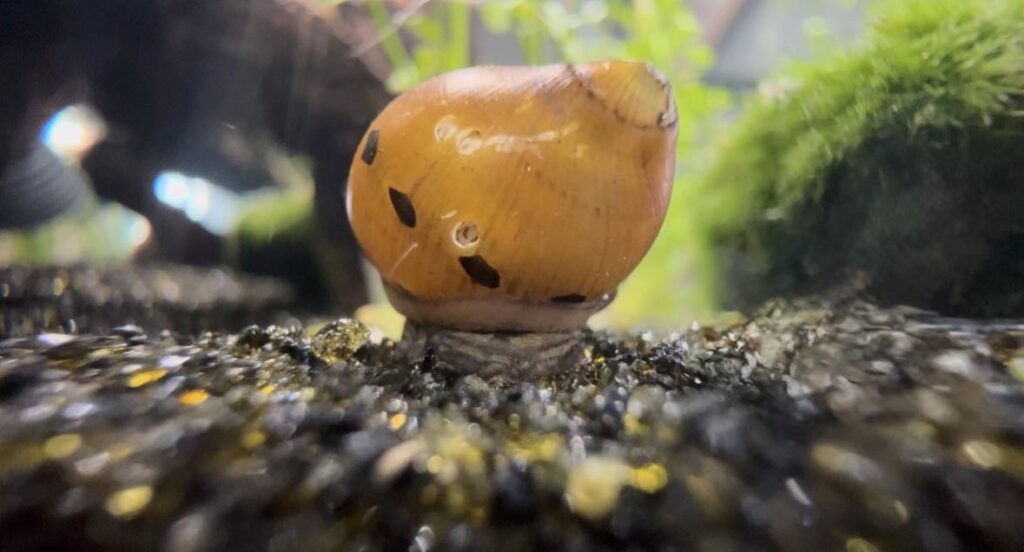
Mystery snails (Pomacea bridgesii) belong to the family Ampullariidae and are native to South America — primarily Bolivia, Brazil, and Paraguay. They are a type of apple snail, though considerably smaller and less destructive than their larger cousins.
Both species are gastropod molluscs. Both are peaceful. Both are kept for their algae-eating habits and visual appeal. But their biology, behaviour, and care requirements diverge in important ways.
Size Comparison
This is usually the first thing aquarists notice.
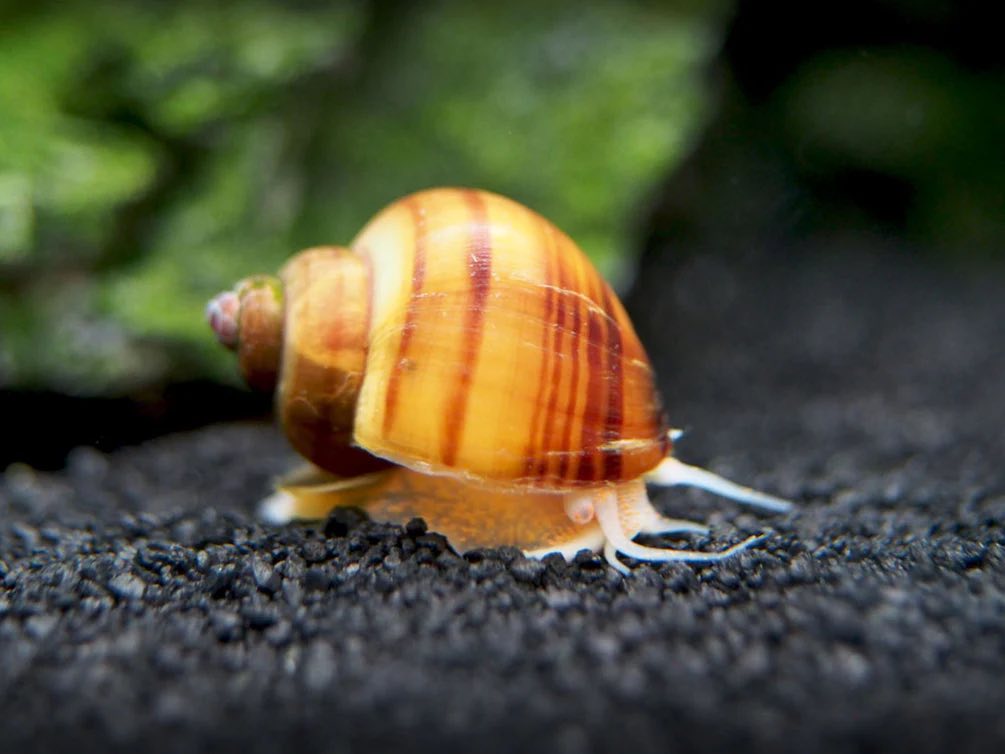
Nerite snails are small. Most species reach between 0.5 and 1 inch (1.3 to 2.5 centimetres) in shell diameter. A few species, such as the red racer nerite, can approach 1.25 inches, but this is on the larger end.
Mystery snails are considerably larger. Healthy adults typically measure 1.5 to 2 inches (3.8 to 5 centimetres) in diameter, with well-kept individuals occasionally reaching 2.5 inches.
What this means practically:
In a small tank — say, 5 to 10 gallons — nerite snails are often the better fit simply due to their compact size. They produce less waste and take up less space. In a medium to large aquarium, the mystery snail’s size becomes an asset: it is more visible, more engaging to watch, and makes a bolder visual statement.
Appearance and Variety
Both snails are visually striking, but in very different ways.
Nerite snails are celebrated for their shell patterns. The zebra nerite has bold black-and-gold stripes. The olive nerite has a smooth, dark green shell. The tiger nerite displays intricate dark markings on a lighter base. The horned nerite has small spiky protrusions along the shell. The sheer variety of patterns makes nerites a popular choice for aquarists who want visual diversity without keeping multiple species.
Mystery snails are admired for their colour morphs and overall presence. Common colour varieties include gold, ivory, blue, brown, purple, and jade. The body colour (the soft tissue visible when the snail is active) also varies and often contrasts beautifully with the shell. A blue mystery snail with a dark body, for instance, is a genuinely striking animal.
I personally find mystery snails more captivating to watch in motion — there is something almost deliberate about the way they move, like a slow, curious explorer. Nerites, by contrast, are efficient and almost businesslike. Both have their charm.
Algae-Eating Ability
This is one of the most common reasons aquarists add snails to a tank — and it is where the two species differ most noticeably.
Nerite snails are widely regarded as superior algae eaters. They consume a broad range of algae types, including:
- Green spot algae (which few other animals will eat)
- Green dust algae
- Brown algae (diatoms)
- Hair algae (to a lesser extent)
- Biofilm and film algae on glass and hardscape
Their rasping feeding behaviour is thorough and efficient. Aquarists frequently describe finding perfectly clean glass trails left behind by nerites — methodical, overlapping paths that leave no algae untouched.
“If I had to choose one snail purely for algae control, it would be nerites every single time. They are relentless. I have seen them clean green spot algae off glass that scraper blades barely touched.” — Sandra Howell, planted tank specialist and aquarium maintenance professional with 20 years of experience
Mystery snails are good algae eaters but not great ones. They consume soft algae, biofilm, and decaying plant matter readily. However, they will not tackle green spot algae effectively, and they can be selective. Their primary contribution is as general detritivores — cleaning up waste, uneaten food, and decomposing organic matter — rather than as dedicated algae eliminators.
For algae control specifically: nerite snails win clearly.
Plant Safety
This is a significant concern in planted aquariums.
Nerite snails are fully plant-safe. They do not consume healthy plant tissue. They graze on algae and biofilm growing on plant leaves without damaging the leaves themselves. This makes them ideal for heavily planted tanks where plant health is a priority.
Mystery snails have a more complicated relationship with plants. In most cases, they leave healthy plants alone. However, they will consume plants that are already dying, damaged, or soft-leaved. Delicate species such as Cabomba, Egeria densa, and Vallisneria can sometimes be nibbled by mystery snails, especially if other food is scarce.
The general consensus is that mystery snails are safe in planted tanks as long as they are well-fed and the plants are robust. Aquarists keeping delicate or expensive plant species sometimes prefer nerites as the safer option.
“I kept mystery snails in my Dutch aquascape for two years without any plant damage. But I was feeding them blanched vegetables consistently. The moment I neglected feeding for a week, I found bite marks on my Bacopa. They are opportunists when hungry.” — Pieter van den Berg, Dutch aquascape enthusiast and freshwater plant cultivator
Breeding in Captivity
Here is one of the most important practical differences between the two species.
Nerite snails cannot breed in freshwater. Their larvae require brackish or marine conditions to develop. This means that nerite snails will not reproduce in a standard freshwater aquarium. They will lay eggs — small, white, sesame-seed-sized capsules that adhere stubbornly to hard surfaces — but those eggs will not hatch in freshwater.
For aquarists who do not want population explosions, this is a genuine advantage. You control the population entirely.
The downside? Those egg capsules are difficult to remove and can be visually unappealing on driftwood, rocks, or decorations. Some aquarists find them mildly frustrating. It is a trade-off.
Mystery snails can breed in freshwater, but the process is manageable. Females lay clutches of pink-to-peach eggs above the waterline, in a visible cluster that is easy to spot and remove if you do not want offspring. If you leave the clutches, they will hatch — typically within 2 to 4 weeks.
Unlike many snails, mystery snails are not hermaphroditic. They have separate sexes, and you need both a male and a female for reproduction. A single mystery snail in a tank will not reproduce alone.
For population control: nerites offer more predictability. For breeders: mystery snails are more accessible and rewarding.
Water Parameter Requirements
Both species are hardy, but they have different tolerances.
Nerite snails:
- Temperature: 65°F to 85°F (18°C to 29°C)
- pH: 7.0 to 8.5 — they tolerate and even prefer slightly alkaline water
- GH: 6 to 12 dGH
- Salinity: Tolerant of low levels; some species thrive briefly in brackish conditions
- Sensitivity: Moderately sensitive to copper (toxic to all snails)
Mystery snails:
- Temperature: 68°F to 82°F (20°C to 28°C)
- pH: 7.0 to 7.5 — slightly alkaline
- GH: 8 to 18 dGH — they benefit from harder water for shell development
- Salinity: Strictly freshwater; cannot tolerate salt
- Sensitivity: Sensitive to copper and low calcium; require calcium supplementation in soft water
Both species share important sensitivities:
- Copper is lethal to both species. Many fish medications contain copper. Always check medication labels before treating a tank that contains snails — or remove snails to a separate tank before treating.
- Ammonia and nitrite spikes are harmful to both. Stable, cycled tanks are non-negotiable.
- Both benefit from calcium supplementation, especially in soft water.
The mystery snail has slightly narrower water parameter requirements overall and a stronger dependence on calcium. Nerite snails are arguably more forgiving of parameter fluctuations.
Tank Size Requirements
Nerite snails are excellent for small tanks. A single nerite can thrive in as little as 5 gallons, and a pair does well in 10 gallons. Their small size and low bioload make them one of the best options for nano aquariums.
Mystery snails require more space. The recommended minimum is 5 gallons per snail, but 10 gallons or more is better for a single adult. In smaller tanks, their waste production can cause noticeable nitrate accumulation.
If you are working with a nano tank, nerites are the practical choice. If you have a medium to large aquarium, mystery snails have room to roam and grow.
Temperament and Behaviour
Both species are peaceful and non-aggressive. Neither will harm fish, shrimp, or other invertebrates.
Nerite snails are active and persistent grazers. They move methodically across surfaces — glass, rocks, driftwood, substrate — in search of algae. They are not particularly social and do not interact much with tankmates beyond their grazing activity.
Mystery snails are more animated and, frankly, more entertaining to observe. They explore actively, often climbing to the surface for air, investigating food sources with their sensory tentacles, and occasionally venturing out of the water entirely. Their siphon-breathing behaviour — extending a tube above the waterline to breathe air — is one of the most distinctive things about them.
Mystery snails also have a more expressive quality to their movement. Watching one extend fully from its shell and glide along the glass has a certain appeal that nerites, with their compact build, do not quite match.
“I keep both species in most of my community tanks. Nerites are workers — they clean. Mystery snails are personalities — they entertain. They serve completely different functions in the same aquarium.” — Tomoko Ibaraki, aquarium designer and freshwater invertebrate enthusiast based in Osaka
Lifespan
Nerite snails live for approximately 1 to 3 years in captivity, with many living closer to 2 years under good conditions. Some aquarists report individuals surviving 4 or even 5 years, though this is less common.
Mystery snails have a similar lifespan of 1 to 3 years, with the average falling around 1 to 2 years in most home aquariums. Cooler water temperatures tend to extend lifespan by slowing metabolism, while warmer water accelerates growth but shortens life expectancy.
Neither species is particularly long-lived compared to some aquarium fish. This is worth knowing before you become too attached — or before you invest in costly specimens.
Compatibility With Tankmates
Both species are vulnerable to the same predators and aggressors.
Avoid keeping either species with:
- Pea puffers (Carinotetraodon travancoricus) — they target and eat snails with precision
- Goldfish — they will pick at and harass both species
- Cichlids — most species will attack snails
- Loaches (especially clown and yoyo loaches) — they are natural snail predators
- Bettas — some individuals are harmless; others will bite the antennae of mystery snails relentlessly
Safe companions for both species include:
- Tetras (cardinal, neon, ember, rummy nose)
- Rasboras (harlequin, chili, lambchop)
- Corydoras catfish
- Freshwater shrimp (cherry, amano, ghost)
- Other peaceful snails
- Guppies and platies
One species-specific note: Mystery snails have long, prominent antennae that some fish find irresistible to nip. Even fish that are generally considered peaceful — such as some bettas — may repeatedly bite the antennae of mystery snails. Antenna damage does not usually kill the snail, but it causes chronic stress and the antennae may not fully regenerate.
Ease of Care: Side by Side
| Factor | Nerite Snails | Mystery Snails |
| Minimum tank size | 5 gallons | 10 gallons |
| Algae eating | Excellent | Good |
| Plant safety | Fully safe | Generally safe |
| Breeding control | Very easy (no freshwater breeding) | Manageable (remove egg clutches) |
| Calcium needs | Moderate | High |
| Water hardness needs | Moderate | High |
| Beginner-friendliness | High | High |
| Visual impact | Moderate (patterned shells) | High (large, colourful) |
| Behavioural interest | Moderate | High |
| Egg appearance | Unsightly white capsules | Visible pink clutches above waterline |
| Compatibility concerns | Copper, predatory fish | Copper, fin-nippers, calcium deficiency |
Which Should You Choose?
The right choice depends on what you need from your snail.
Choose nerite snails if:
- You have a small or nano tank
- Algae control is your primary goal, especially green spot algae
- You have a delicate planted aquascape and want zero risk to plants
- You do not want to manage a breeding population
- You want a low-maintenance, hard-working snail
Choose mystery snails if:
- You have a medium to large tank with space for exploration
- You want a visually impressive, behaviourally engaging snail
- You are interested in breeding or raising juveniles
- You enjoy feeding and interacting with your invertebrates
- You want a snail that doubles as a cleanup crew for waste and detritus
Choose both if:
- You have a tank of 20 gallons or more
- You want comprehensive algae control and visual interest
- You enjoy a diverse invertebrate community
I will be direct: in a well-established community tank of 20 gallons or more, keeping both species together is arguably the best approach. The nerites handle the algae; the mystery snails handle the detritus; and together, they cover more of the tank maintenance than either could alone.
Expert Summary
“The question is not which snail is better — it is which snail is better for your tank. For a 10-gallon planted nano, a nerite. For a 40-gallon community display, a mystery snail, or honestly, both.” — Carlos Ferreira, aquarium educator and freshwater biology instructor at a community college in Lisbon
“I would never set up a tank without at least one nerite for green spot algae duty. But mystery snails are the ones visitors always ask about. They have personality in a way that smaller snails simply do not.” — Amara Osei, aquarist and tropical fish shop owner with 12 years in the freshwater hobby
The consensus among experienced keepers is consistent: nerites for function, mystery snails for character — and ideally, both for a balanced tank.
Suggested For You:
How Big Can Mystery Snails Get? Size Guide, Growth Factors, and Expert Insights
Do Mystery Snails Eat Shrimp? The Truth About Keeping These Two Together
Mystery Snail vs Apple Snail: Key Differences Every Aquarist Should Know
Can Mystery Snails Live Out of Water? What Every Aquarist Needs to Know
Do Assassin Snails Kill and Eat Mystery Snails?
Final Thoughts
Nerite snails and mystery snails are both excellent choices. They are peaceful, useful, and genuinely fascinating to observe. The comparison between them is less about which is superior and more about which is right for your specific situation.
To summarise the key points:
- Nerites are smaller, better at algae control, and will not breed in freshwater.
- Mystery snails are larger, more behaviorally engaging, and have higher calcium needs.
- Both are sensitive to copper, need stable water chemistry, and are vulnerable to the same predators.
- In tanks of sufficient size, keeping both together is a practical and rewarding strategy.
Whichever you choose, give them the right conditions — clean water, adequate calcium, peaceful tankmates, and consistent food — and they will reward you with a healthier, more balanced aquarium for years to come.
References
- Cowie, R. H., & Hayes, K. A. (2012). Apple snails of the family Ampullariidae: biological invasions, ecology, and the impact of Pomacea species on freshwater ecosystems. University of Hawaii at Manoa, Pacific Biosciences Research Center. https://www.hawaii.edu
- Pointier, J. P., David, P., & Jarne, P. (2005). Biological invasions: the case of planorbid snails and freshwater gastropod colonisation. Journal of Helminthology, 79(3), 249–256. Université de Perpignan, Laboratory of Parasitology. https://www.cambridge.org/core
- Aditya, G., & Saha, G. K. (2006). Predation of the backswimmer, Notonecta sp. on the larvae and pupae of Culex quinquefasciatus — snail community interactions in freshwater ecosystems. Department of Zoology, University of Calcutta. Limnology Publication Series. https://www.caluniv.ac.in
- Rawlings, T. A., Hayes, K. A., Cowie, R. H., & Collins, T. M. (2007). The identity, distribution, and impacts of non-native apple snails in the continental United States. BMC Evolutionary Biology, 7(1), 97. Florida International University, Department of Biological Sciences. https://bmcevolbiol.biomedcentral.com
- Yusa, Y., Sugiura, N., & Wada, T. (2006). Predatory potential of freshwater animals on the invasive apple snail Pomacea canaliculata (Gastropoda: Ampullariidae) in Southern Japan. Biological Invasions, 8(2), 137–147. Nara Women’s University, Faculty of Science, Department of Biology. https://link.springer.com