35 Animals Native to Hawaii (Identification, With Pictures)
Hawaii sits about 2,400 miles from the nearest continent. That isolation shaped some of the most unusual wildlife on Earth. Few animals could cross such a wide ocean, so those that did slowly evolved into new species.
This guide covers 35 animals native to Hawaii. Some are endemic, meaning they live nowhere else on the planet. Others are indigenous, meaning they arrived naturally but also live elsewhere. Both groups belong to Hawaii’s natural heritage.
Native Hawaiian Mammals and Marine Mammals
Hawaii has very few native mammals. Most of its famous land animals, such as mongooses and pigs, were brought by people. The mammals below arrived on their own.
1. Hawaiian Monk Seal (ʻIlio-holo-i-ka-uaua)
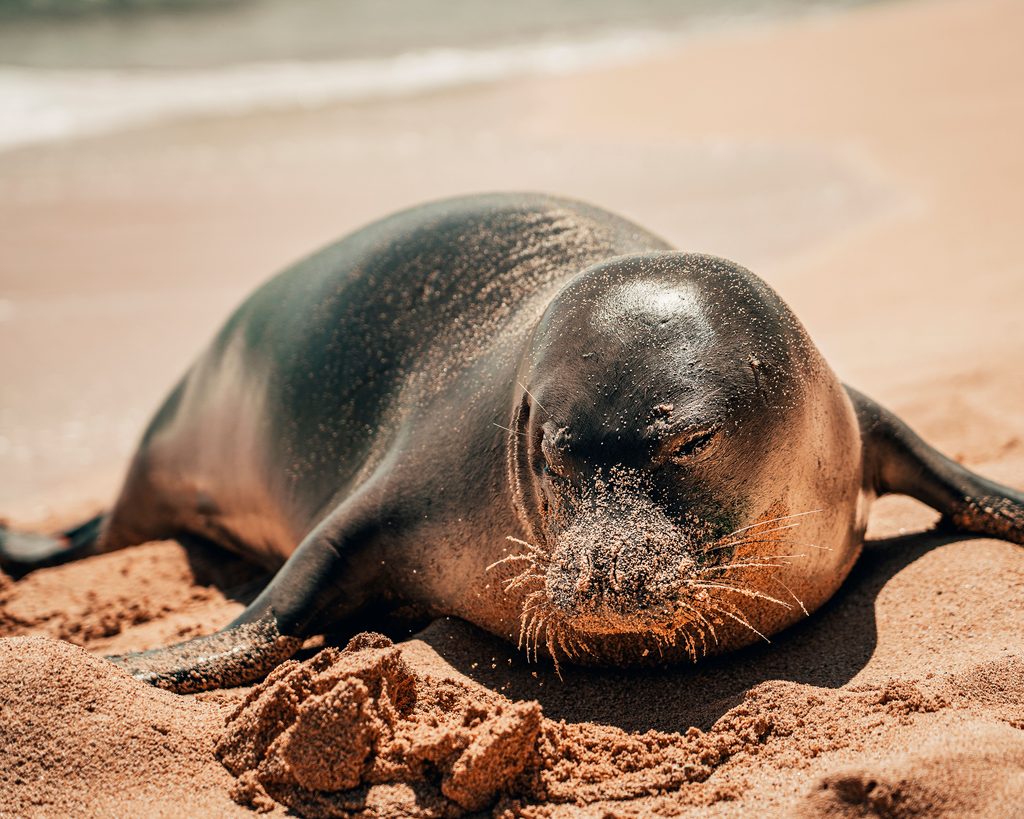
The Hawaiian monk seal is found nowhere else on Earth. NOAA calls it one of the most endangered seals in the world. Most live in the remote Northwestern Hawaiian Islands, but more are now seen on the main islands.
Seal hunting in the mid-19th century nearly wiped them out. Today, about 1,400 seals remain in the wild, according to NOAA estimates. Recovery efforts have helped, but the number must roughly triple before the species can leave the endangered list.
If you see a seal on a beach, give it plenty of space. Resting on the sand is normal behavior, not a sign of distress. Never touch it or let dogs approach.
2. Hawaiian Hoary Bat (ʻŌpeʻapeʻa)
The ʻōpeʻapeʻa is Hawaii’s only native land mammal. It was named the official state land mammal in 2015. It lives on all the major islands, including Kauaʻi, Maui, and Hawaiʻi Island.
It is a small bat. The U.S. Fish and Wildlife Service reports it weighs only 20 to 38 grams. Its frosted, “hoary” fur and yellowish collar make it easy to recognize.
It hunts moths, beetles, and other insects at dusk. Scientists still know surprisingly little about it. Habitat loss and wind turbines remain concerns.
3. Humpback Whale (Koholā)
Humpback whales are seasonal visitors, not residents. Still, Hawaii is one of their most important homes. NOAA states that roughly half of the North Pacific humpback population visits Hawaiian waters each year.
They arrive to mate, give birth, and nurse their calves in warm, shallow water. The season runs from November through April, with a peak from January to March. They do not feed while they are here.
The Hawaiian Islands Humpback Whale National Marine Sanctuary protects these waters. If you go whale watching, choose an operator that respects legal approach distances.
4. Spinner Dolphin (Naiʻa)
Spinner dolphins are famous for leaping and spinning in the air. Hawaii has resident groups that stay close to the islands. They are a common sight in places like the Kona coast.
They hunt offshore at night and return to calm bays during the day to rest. This daytime rest is vital. Dolphins that are repeatedly disturbed can lose important sleep.
Please keep your distance in the water and from boats. NOAA’s guidance asks people to stay at least 50 yards away.
5. Bottlenose Dolphin (Naiʻa)
Bottlenose dolphins are also part of Hawaii’s natural marine life. NOAA notes that 23 other whale and dolphin species have been recorded in Hawaiian waters besides humpbacks. Bottlenose dolphins are among the best known.
Some live in groups near the islands, while others travel in open water. They are curious, social, and intelligent. Their echolocation helps them find fish in murky water.
Wild dolphins should not be fed or chased. Feeding teaches them to depend on people, which can put them in danger.
6. False Killer Whale (Paʻaʻaua)
The false killer whale is a large dolphin, not a true whale. Despite the name, it is not a killer whale. It has a slender black body and a rounded head.
Hawaii has a small insular population that lives around the main islands. This group is listed as endangered, with fewer than 200 animals estimated. Fishing gear entanglement is a major threat.
Sightings are rare, so seeing one is special. These animals are strong swimmers and often travel in tight, social groups.
Native Hawaiian Reptiles
Hawaii has no native land reptiles. Its only native reptiles are sea turtles, and both nest on Hawaiian beaches.
7. Green Sea Turtle (Honu)
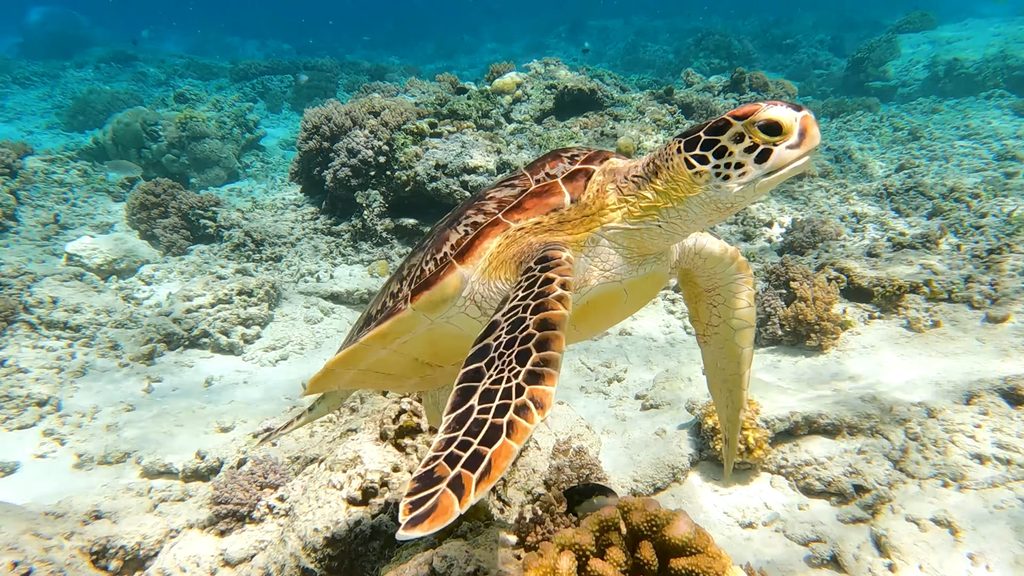
The honu is perhaps Hawaii’s best-loved animal. Adults can reach four feet long and 400 pounds, making them the largest hard-shelled sea turtles. They graze on algae along nearshore reefs.
Here is a fact that surprised me: about 96% of Hawaii’s honu nest at Lalo (French Frigate Shoals), in the remote Northwestern Hawaiian Islands. Some adults swim more than 1,200 miles round trip to get there.
Honu are protected by federal and state law. NOAA advises viewing them from at least 10 feet away. Never touch or ride a turtle.
8. Hawksbill Sea Turtle (Honuʻea)
The honuʻea is much rarer than the honu. It is smaller, with a pointed beak and an overlapping, patterned shell. Globally, hawksbills are critically endangered.
In Hawaii, they nest mostly on Hawaiʻi Island, Maui, and Molokaʻi. Biologists work closely with volunteers to protect their nests. Their numbers are tiny, so every nest matters.
If you see tracks leading from the sea into beach vegetation, report them. NOAA runs a Marine Wildlife Hotline for this purpose: 1-888-256-9840.
Native Hawaiian Birds
Birds are where Hawaii’s evolution shines. A single ancestor species gave rise to dozens of unique forms. Sadly, birds are also where the extinction crisis hits hardest.
ALSO READ: 25 Birds That Sing at Night (Species Names, With Pictures)
9. Nēnē (Hawaiian Goose)
The nēnē is Hawaii’s state bird and the world’s rarest goose. The National Park Service calls it the largest native land animal in Hawaii. It lives only in the islands.
By 1952, only about 30 birds remained statewide. Captive breeding and release programs changed that. Today, nearly 3,500 nēnē live in Hawaii, according to the National Park Service.
Drivers are the biggest danger. Slow down near nēnē crossing signs. Never feed them, and stay about 60 feet away.
10. ʻIʻiwi (Scarlet Honeycreeper)
The ʻiʻiwi is a showstopper. It has bright red feathers and a long, curved, salmon-colored bill made for sipping nectar. Hawaiians once used its feathers in royal cloaks.
It was once one of the most common native birds. Now it survives mostly in high-elevation forests. A USGS-linked study warned that it could go extinct by 2100 without action against avian disease.
Mosquitoes spread avian malaria, which kills it. Controlling mosquitoes is now seen as one of the best ways to save it.
11. ʻApapane
The ʻapapane is a crimson bird with white under its tail. It is one of the most widespread native honeycreepers. Its busy flight between ʻōhiʻa blossoms is a joy to watch.
Like the ʻiʻiwi, it feeds mainly on nectar. In doing so, it helps pollinate native trees. That makes it important to the whole forest.
Visit places like Hawaiʻi Volcanoes National Park for good chances to spot one. Early morning is best, when the birds are most active.
12. ʻAkikiki (Kauaʻi Creeper)
The ʻakikiki is a small gray-and-white bird of Kauaʻi’s mountain forests. It creeps along trunks like a nuthatch, searching for insects. It has no relatives outside Hawaii.
A 2022 report named it as one of four honeycreeper species on the brink of extinction. The others are the ʻakeke’e, kiwikiu, and ʻākohekohe. Avian malaria is the main cause.
Conservation groups have moved some birds into protective care. Their story shows how fast an entire species can slip away.
13. Kiwikiu (Maui Parrotbill)
The kiwikiu lives only on the windward slopes of Haleakalā on Maui. It has a thick, parrot-like bill. It uses it to split branches and pull out insect larvae.
Its habitat has shrunk. Mosquitoes now reach higher into the mountains as temperatures rise. That puts this bird in serious danger.
Researchers describe it as one of Hawaii’s most urgent conservation cases. Your best view is through a conservation-led tour, not casual hiking.
14. Palila
The palila is a stout, yellow-headed honeycreeper. It lives on the slopes of Mauna Kea on Hawaiʻi Island. It depends almost entirely on the māmane tree.
It eats the tree’s seeds, which are toxic to most animals. This tight link makes it vulnerable. When māmane forests decline, so does the palila.
Protecting the dry forest helps the bird survive. Removing grazing animals has been one key step.
15. ʻIo (Hawaiian Hawk)
The ʻio is a hawk found only on Hawaiʻi Island. It comes in two color forms, light and dark. Native Hawaiians saw it as a symbol of royalty.
It hunts rodents, insects, and small birds. It is a rare conservation success. It recovered enough to be taken off the federal endangered species list.
Watch the skies over open forest and ranchland. It often soars in wide circles, calling with a sharp scream.
16. Pueo (Hawaiian Short-eared Owl)
The pueo is an owl that hunts in daylight, which sets it apart from most owls. It lives in open grasslands and shrublands. Many Hawaiian families regard it as a protective spirit, or ʻaumākua.
It is a native subspecies of the short-eared owl. On Oʻahu, its numbers are especially low. Rats, cats, and traffic all pose risks.
Seeing one gliding low over a field is memorable. Sightings are most likely at dawn and dusk.
17. ʻAlalā (Hawaiian Crow)
The ʻalalā is a crow found only in Hawaii. It was declared extinct in the wild in 2002. Only a few birds survived in captive care.
Conservation groups have since bred them and begun releases into the forest of Hawaiʻi Island. The work is slow and difficult. Predators and disease remain real challenges.
This bird is a hopeful but fragile story. It proves that a species can return from the edge, though never without effort.
18. Hawaiian Coot (ʻAlae Keʻokeʻo)
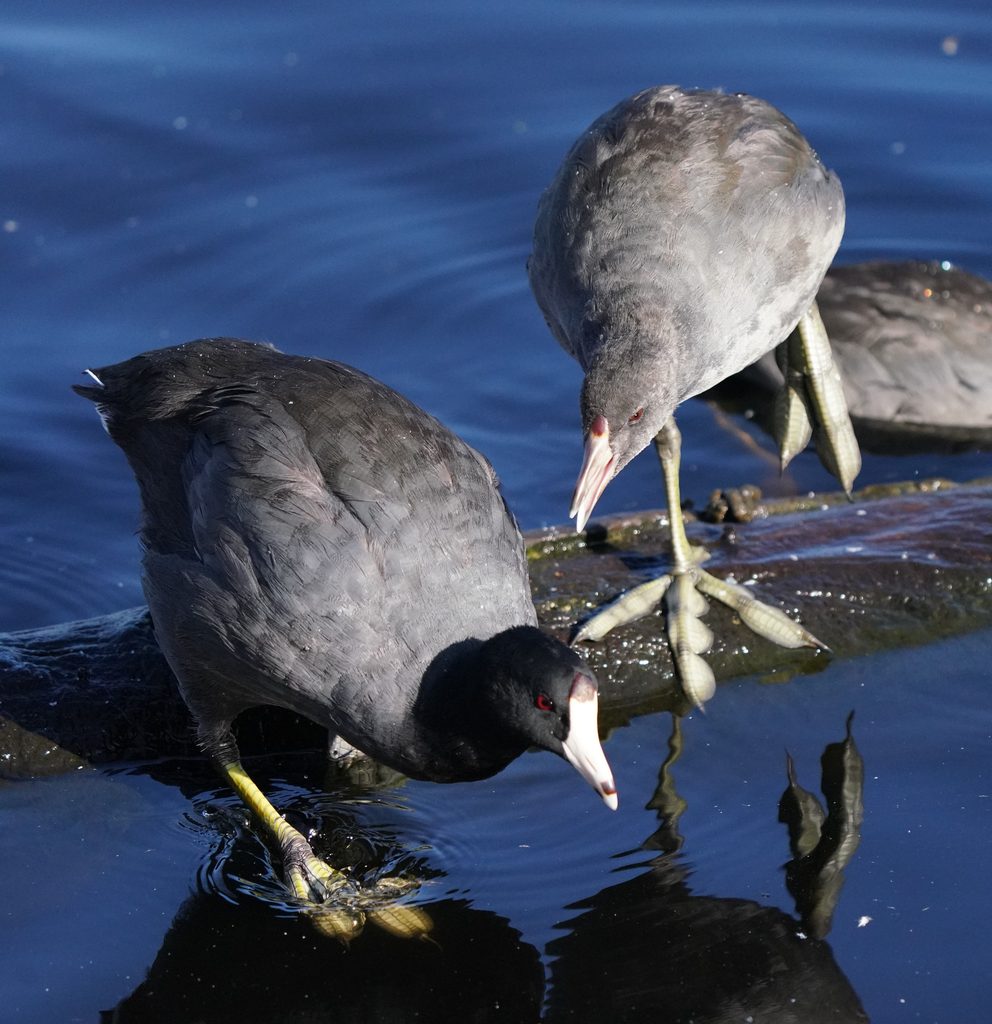
The ʻalae keʻokeʻo is a dark waterbird with a bright white forehead shield. It lives in freshwater and brackish wetlands on most main islands. It swims, dives, and walks on land.
Hawaiian stories say that it carried fire to people. It is a native subspecies of a bird found elsewhere. It remains endangered.
Wetland loss is the biggest threat. Preserving ponds and marshes helps this bird and many others.
ALSO READ: 25 Birds With Colorful Beaks (Identification, With Pictures)
19. Hawaiian Stilt (Aeʻo)
The aeʻo is an elegant wader. It has long pink legs, a black back, and a white belly. It probes shallow water for insects, crustaceans, and small fish.
It nests in wetlands, salt ponds, and even some wastewater ponds. Predators and habitat loss have reduced its numbers. Wetland protection has helped it hold on.
Look for it at wildlife refuges. Its sharp, barking call carries far across open water.
20. Hawaiian Duck (Koloa Maoli)
The koloa maoli is a brownish duck found mainly on Kauaʻi. It is endemic to Hawaii. It looks a lot like a female mallard, which is part of its problem.
Mallards, brought by people, breed with koloa. Over time, this hybridization can erase the native duck’s genes. It is a quiet but serious threat.
Keeping feral mallards out of wetlands helps protect the koloa. It is one of many reasons not to release domestic ducks.
21. Laysan Albatross (Moli)
The moli is a large seabird with a wingspan of about six to seven feet. It spends most of its life at sea. It returns to land only to breed.
It nests in large numbers on remote islands and also on places like Kauaʻi and Oʻahu. One famous female, nicknamed Wisdom, has been tracked for more than 70 years. That makes her the oldest known wild bird.
Watch the birds’ elaborate courtship dances in winter. Keep a respectful distance from nesting adults.
22. Hawaiian Petrel (ʻUaʻu)
The ʻuaʻu is a seabird that nests in burrows high on mountain slopes, such as on Haleakalā. It spends months at sea, then returns to land at night. Its eerie calls echo over the volcano.
It is endangered. Cats, rats, and mongooses prey on its nests. Bright lights can also confuse young birds, which then crash to the ground.
Turning off unnecessary outdoor lights during fledgling season is a simple way to help.
23. ʻElepaio
The ʻelepaio is a small, lively forest bird. It belongs to the monarch flycatcher family. Different species live on Hawaiʻi Island, Oʻahu, and Kauaʻi.
It is famously bold and curious. It often hops close to hikers. Early Hawaiians connected it with canoe building.
Some populations have declined sharply. The Oʻahu ʻelepaio is endangered. Its survival depends on protecting native forest.
24. ʻAmakihi
The ʻamakihi is a small, greenish-yellow honeycreeper. It is one of the most adaptable native forest birds. It feeds on nectar, insects, and fruit.
Here is some rare good news. Some ʻamakihi at low elevations appear to be developing tolerance to avian malaria. Scientists study them closely for clues that could help other species.
You may spot one in gardens and forests across several islands. It reminds us that nature sometimes finds a way.
Native Hawaiian Fish and Marine Life
Hawaii’s reefs are astonishing. NOAA-linked research found that about 21% of reef fish species in the Northwestern Hawaiian Islands are endemic. Deeper reefs show even higher rates.
25. Reef Triggerfish (Humuhumunukunukuapuaʻa)
This fish has the longest and most loved name in Hawaii. It is the state fish. The name is often translated as “triggerfish with a snout like a pig.”
It has a bold, patterned body and a rounded face. It can make a grunting sound. It lives on shallow reefs, where it grazes on algae and small animals.
It is easy to find while snorkeling. Look for it near rocky coral areas.
26. Yellow Tang (Lauʻīpala)
The yellow tang is a bright, flat-bodied fish. Its color is so vivid it almost looks painted. It forms large schools on healthy reefs.
It grazes on algae, which keeps coral from being smothered. That makes it a quiet reef protector. It is also popular in the aquarium trade, so collecting is regulated.
When you snorkel, look for sudden flashes of yellow. A thriving school is a sign of a healthy reef.
27. Reef Manta Ray (Hā)
The reef manta ray glides through Hawaii’s waters with a wingspan that can exceed ten feet. It is gentle and filters plankton from the water. It has no stinger.
Along the Kona coast, lights attract plankton at night, and mantas follow. This has made manta night snorkeling a signature experience.
Each ray has a unique spot pattern, so researchers can identify individuals. Never touch a manta. Its skin has a protective mucus layer.
28. ʻOʻopu (Hawaiian Freshwater Goby)
Hawaii’s streams hold some remarkable fish. The ʻoʻopu are gobies. Most species are found nowhere else.
They live a double life. Young fish drift to sea, then return to climb waterfalls. They use a fused, suction-cup-like fin to scale steep rock.
They are a powerful sign of healthy streams. Stream diversion and pollution threaten them.
ALSO READ: 50 Types of Birds With Long Legs (Species Identification, With Pictures)
Native Hawaiian Insects, Spiders, and Invertebrates
Small animals make up much of Hawaii’s endemic wildlife. Many were unknown until recently. They show evolution at its most inventive.
29. Kamehameha Butterfly (Pulelehua)
The pulelehua is Hawaii’s state insect. It is one of only two native butterflies in the islands. Its wings are orange-brown with delicate dark patterns.
Its caterpillars feed on the māmaki plant. Look for them in moist upland forests. The butterfly appears mostly in the daytime.
Loss of forest and competition from invasive insects have affected it. Planting native māmaki can help it thrive.
30. Hawaiian Happy-Face Spider
This spider is real, and its name fits. Its abdomen can carry a pattern that looks like a smiling face. The markings vary from yellow to red and white.
It lives on the undersides of leaves in wet forests. It is endemic to Hawaii. It builds little webs but often hunts without relying on them.
Not every spider has a “face.” The patterns appear in some forms and not others. It is a favorite subject of evolutionary scientists.
31. Oʻahu Tree Snail (Kāhuli)
Tree snails are among Hawaii’s most beautiful animals. Their shells show bold stripes and spirals. The genus Achatinella once included dozens of species.
Many have gone extinct. Introduced predators, especially the rosy wolfsnail, are largely to blame. Habitat loss and collecting also hurt them.
Today, the survivors are protected. Hawaiian oral traditions describe kāhuli as singing in the forest, which makes their loss even sadder.
32. Hawaiian Picture-Wing Fly
Hawaii has around 100 species of picture-wing fruit flies. Their wings are marked with intricate patterns. They look like tiny works of art.
Each species tends to live on a single island and often depends on a single host plant. That is a sign of how finely evolution can sort life.
Scientists study them to understand how new species form. They are small, but they teach big lessons.
33. Hawaiian Bobtail Squid (ʻAkahi?)
The Hawaiian bobtail squid is a tiny, soft-bodied animal found in shallow sandy waters. It is only a couple of inches long. It hunts at night.
It has a famous partnership with glowing bacteria. The bacteria live in a special organ. Their light helps hide the squid’s shadow from predators below.
University researchers use it as a model for how animals and microbes cooperate. It is a small animal with a large scientific legacy.
34. ʻŌpaeʻula (Hawaiian Red Shrimp)
The ʻōpaeʻula is a tiny red shrimp. It lives in anchialine pools, which are brackish ponds along the coast. They connect underground to the sea.
These pools are rare and fragile. Introduced fish, such as guppies, can wipe out the shrimp. Pollution and development add to the pressure.
The shrimp has deep cultural meaning in Hawaii. Protecting these pools protects an entire hidden ecosystem.
35. Hawaiian Damselfly (Pinao ʻula)
Hawaii’s native damselflies belong to the genus Megalagrion. They are found nowhere else in the world. Their colors range from orange to blue to green.
They lay eggs in streams, ponds, and even small leaf pockets. Their young live in the water before becoming flying adults. Some are rare today.
Invasive fish and insects have caused serious losses. Clean, protected waterways give these delicate insects a chance.
Why Protecting Hawaii’s Native Animals Matters
Hawaii’s wildlife is more than beautiful. It carries culture, science, and identity. Many species appear in Hawaiian legends, names, and traditions.
The numbers are sobering. Once there were more than 50 honeycreeper species, but today only 17 remain, according to USGS. Disease, invasive predators, and habitat loss drive most of this decline.
But there is hope. The nēnē rose from about 30 birds to nearly 3,500. Monk seal numbers are trending upward. Real progress is possible when people act.
How You Can Help Native Hawaiian Wildlife
Small choices make a real difference. Here are simple steps visitors and residents can take:
- Keep your distance from seals, turtles, dolphins, and nesting birds.
- Never feed wildlife. It changes their behavior and can harm them.
- Drive slowly in nēnē and wildlife areas.
- Reduce outdoor lighting during seabird fledgling season.
- Use reef-safe sunscreen and avoid touching coral.
- Report injured animals to local wildlife hotlines.
Final Thoughts
Hawaii’s native animals evolved in isolation, and that makes them both special and fragile. Every animal on this list plays a part in a living, connected system.
I hope this guide leaves you with more than a checklist. If you visit, look closely, move gently, and leave the habitat as you found it. These animals have survived against the odds, and they still need our care.
References
- NOAA Fisheries. Hawaiian Monk Seal. https://www.fisheries.noaa.gov/species/hawaiian-monk-seal
- U.S. Fish and Wildlife Service. Hawaiian Hoary Bat (ʻŌpeʻapeʻa). https://www.fws.gov/species/hawaiian-hoary-bat-lasiurus-cinereus-semotus
- National Park Service. Voices of Science: The Rarest Goose in the World (Nēnē). https://www.nps.gov/articles/nene.htm
- U.S. Geological Survey. Scientists Evaluate Ways to Save Hawaiian Honeycreeper. https://www.usgs.gov/news/scientists-evaluate-ways-save-hawaiian-honeycreeper
- NOAA Hawaiian Islands Humpback Whale National Marine Sanctuary. About the Sanctuary. https://hawaiihumpbackwhale.noaa.gov/about/about.html
- NOAA Fisheries. Honu Count: Help Us Find Numbered Sea Turtles in Hawaiʻi. https://www.fisheries.noaa.gov/pacific-islands/honu-count-help-us-find-numbered-sea-turtles-hawaii
- Hawaiʻi Department of Land and Natural Resources / University of Hawaiʻi Institute of Marine Biology (Friedlander et al., 2020). Dominance of Endemics in the Reef Fish Assemblages of the Hawaiian Archipelago. https://dlnr.hawaii.gov/holomua/files/2023/09/Friedlander-et-al.-2020-Dominance-of-endemics-in-the-reef-fish-assemblages-of-the-Hawaiian-Archipelago.pdf