50 Types of Birds With Long Legs (Species Identification, With Pictures)
I once watched a black-necked stilt wade through a shallow pond on legs so long they looked borrowed from a much bigger bird. It stopped me in my tracks. That single image is why this guide exists.
Long legs are not an accident of design. They solve a problem: how does a bird reach food, water, or safety that shorter-legged animals cannot access?
This article covers 50 types of birds with long legs, drawn from wetlands, grasslands, and open plains around the world. Each entry explains why that bird needs its legs the way it does.
Why Do Some Birds Evolve Long Legs?
Long legs generally serve one of three purposes: wading into deeper water, running faster across open ground, or reaching food that shorter birds cannot.
Wading birds use height to access deeper water without swimming. This lets them hunt fish and invertebrates that would otherwise stay out of reach.
The U.S. Fish and Wildlife Service notes that the black-necked stilt is described by researchers as having “the second longest legs in proportion to its body, exceeded only by flamingos.” That single comparison tells you how competitive leg length is in the bird world.
Ground-dwelling birds like ostriches use long legs differently. Their legs exist for speed and defense rather than wading.
The Smithsonian’s National Zoo confirms that ostriches are incredibly swift runners due to their long, strong legs, making them the fastest two-legged animals on Earth.
Now, here are the 50 species that best represent this adaptation.
Wading Birds of Wetlands and Marshes
1. American Flamingo
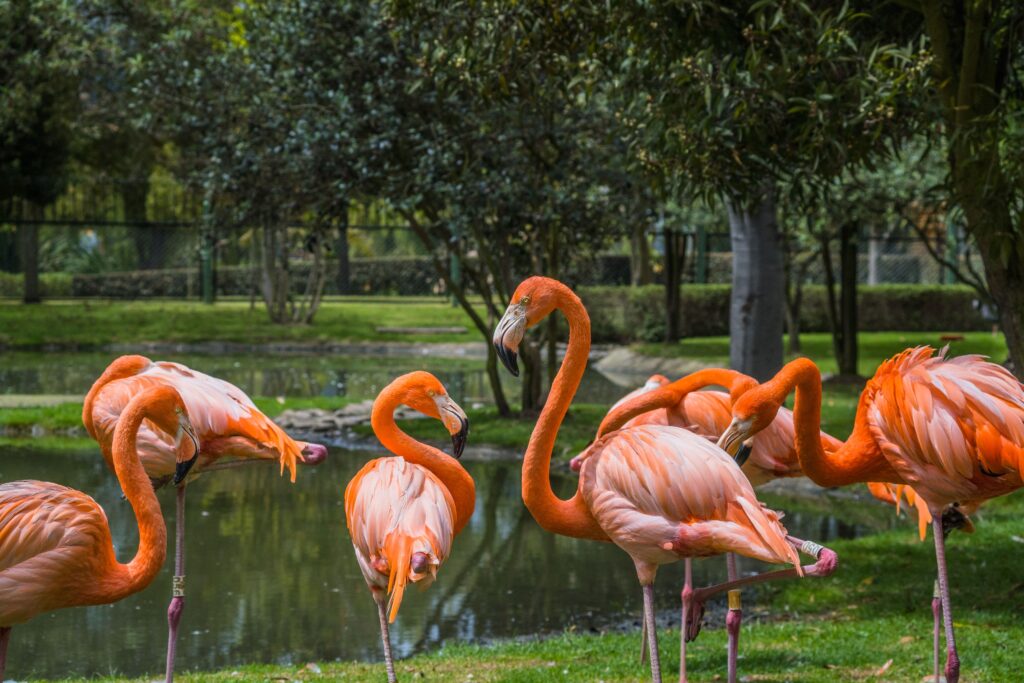
This bird might be the most recognizable long-legged species on the planet. Its pink legs can make up more than half its total height.
The U.S. Fish and Wildlife Service describes American flamingos as three to five feet tall with long, slender pink legs and webbed feet with three toes.
Fun fact: What looks like a backward-bending knee is actually the ankle. The Smithsonian notes the actual knee sits higher up the leg, hidden by the body and feathers, meaning the bird is essentially standing on tiptoe.
Flamingos often sleep standing on one leg, tucking the other close to their body. Researchers believe this posture helps conserve body heat, since a folded leg loses far less warmth than one left extended in cold water.
Their pink color, oddly enough, has nothing to do with their legs directly. It comes from pigments in the shrimp and algae they eat, and the same pigments tint both feathers and bare skin over time.
2. Greater Flamingo
The largest of all flamingo species, this bird stands even taller than its American cousin in some populations. It uses the same filter-feeding method, tipping its head upside down in shallow water.
Range: Found across Africa, southern Europe, and parts of Asia, often in massive breeding colonies.
Breeding colonies of greater flamingos can number in the tens of thousands, and their long legs let entire flocks wade shoulder to shoulder without disturbing each other’s feeding zones.
Chicks hatch with straight bills and grayish legs, only developing the adult curved bill and rosy leg tone after several months of steady growth.
3. Chilean Flamingo
Slightly smaller than the greater flamingo, this South American species has gray-green legs with pink joints, a distinctive feature among flamingos.
It thrives in high-altitude lakes across the Andes, where its long legs allow it to wade in cold, mineral-rich waters other birds avoid.
These lakes often sit above 12,000 feet, and temperatures can drop sharply overnight. The bird’s leg structure helps it stand for hours in near-freezing shallows without losing mobility.
Chilean flamingos are also strong fliers despite their wading lifestyle, sometimes migrating hundreds of miles between breeding and feeding lakes as water levels shift with the seasons.
4. Lesser Flamingo
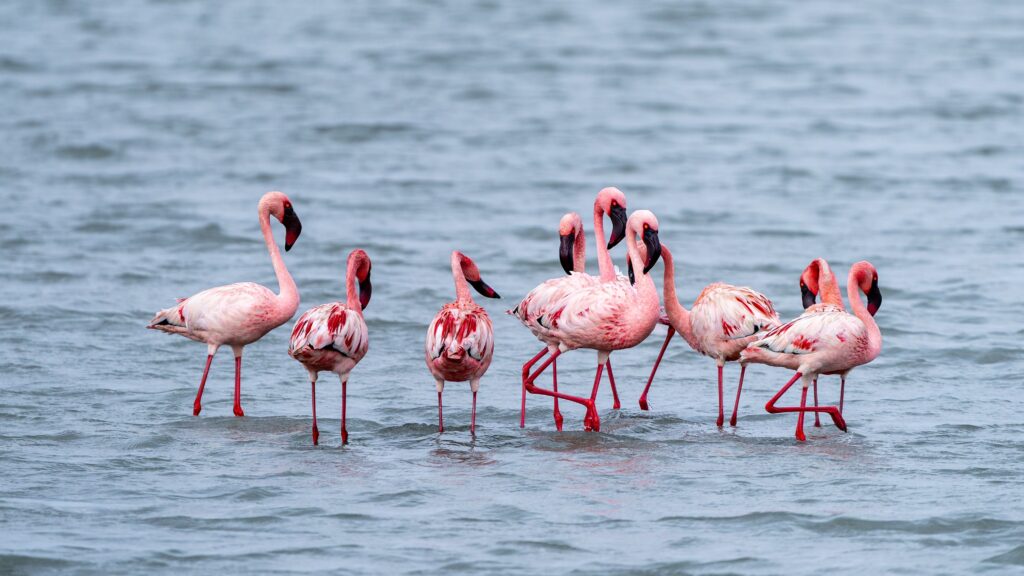
The smallest flamingo species still carries proportionally long legs for its size. It feeds almost exclusively on blue-green algae in East Africa’s soda lakes.
These lakes are so caustic that few other animals can tolerate them, making the flamingo’s leg adaptation a genuine survival advantage.
Lesser flamingos gather in some of the largest bird flocks on the planet, with certain East African lakes hosting well over a million individuals during peak feeding season.
Their legs also carry tough, scaly skin that resists the corrosive salts in the water, a trait shared with other soda-lake flamingo populations.
5. Black-Necked Stilt
Few birds wear their name as literally as this one. Its legs are a bright, unmistakable pink-red, and they dominate the bird’s silhouette.
The Smithsonian’s National Zoo states that in relation to body size, black-necked stilts have the longest legs compared to any other bird aside from flamingos.
I find the math on this genuinely surprising. One naturalist calculated that stilts are roughly one-quarter body and three-quarters legs, like a five-foot person walking on twenty-foot stilts.
These birds are fiercely protective parents. When a predator nears the nest, stilts perform a “popcorn display,” hopping and flopping in a group to confuse and drive the threat away.
Despite their delicate appearance, black-necked stilts can live around 20 years in the wild, a fairly long lifespan for a bird of their size and habitat exposure.
6. Hawaiian Stilt (Aeʻo)
This endangered subspecies lives only in Hawaii’s wetlands. It shares the same leg proportions as the mainland black-necked stilt but has slightly longer legs and bill.
The U.S. Fish and Wildlife Service confirms this bird has some of the longest legs relative to body size in the bird world, and it remains federally protected due to habitat loss.
Wetland drainage across the Hawaiian Islands has shrunk this bird’s available habitat considerably, making managed refuges a critical part of its ongoing survival.
Conservationists closely track nesting pairs each season, since the aeʻo’s population remains small enough that localized threats, like introduced predators, can have an outsized impact.
7. American Avocet
This elegant shorebird pairs long bluish legs with an upturned bill. The Smithsonian notes adults measure 17 to 18.5 inches long with a wingspan of 28.4 inches, and those legs let it wade comfortably in open, muddy wetlands.
Behavior tip: Avocets often sweep their heads side to side while wading, using their bill and leg height together to stir up prey.
Their legs also support an unusual nesting habit called brood parasitism, where a female sometimes lays eggs in another avocet’s nest, letting the host pair raise the extra chicks.
During breeding season, the head and neck turn a warm rust color, a shift that fades to grayish white once nesting duties end for the year.
8. Great Blue Heron
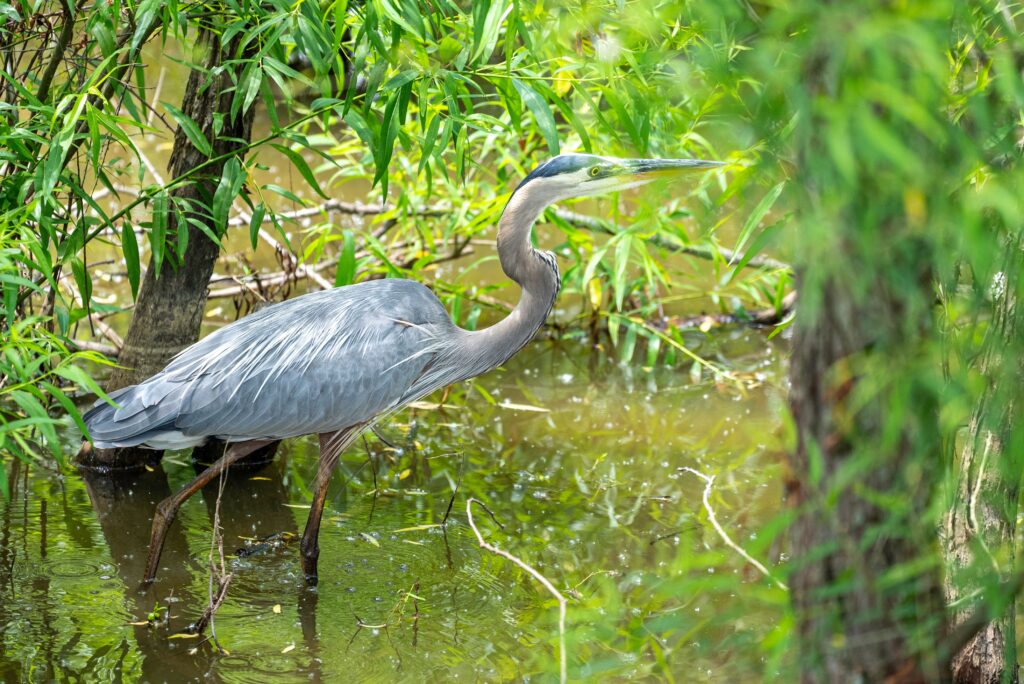
Standing motionless in shallow water, this heron relies on long, stilt-like legs to stay dry while hunting fish below the surface. It is one of the tallest wading birds in North America.
Its legs let it move slowly and silently, a critical advantage when hunting fish that startle at the slightest ripple.
Beyond fish, this heron will eat frogs, small mammals, and even other birds, using its long neck and legs together to strike prey it can barely see through murky water.
Great blue herons often nest in large colonies called heronries, sometimes building dozens of stick nests high in the same stand of trees, well away from ground predators.
9. Great Egret
This all-white heron relative shares the same long-legged hunting style. Its legs are black and noticeably longer than its body length when fully extended.
Historical note: Great egret plumes were hunted heavily in the early 1900s, a practice that helped trigger some of the first American bird protection laws.
That plume trade nearly wiped out breeding colonies across the southeastern United States, and the great egret later became the symbol of the National Audubon Society as a reminder of that recovery.
Today, this bird has rebounded strongly and is one of the most widespread wading birds in North America, often seen standing motionless in golf course ponds and roadside ditches alike.
10. Snowy Egret
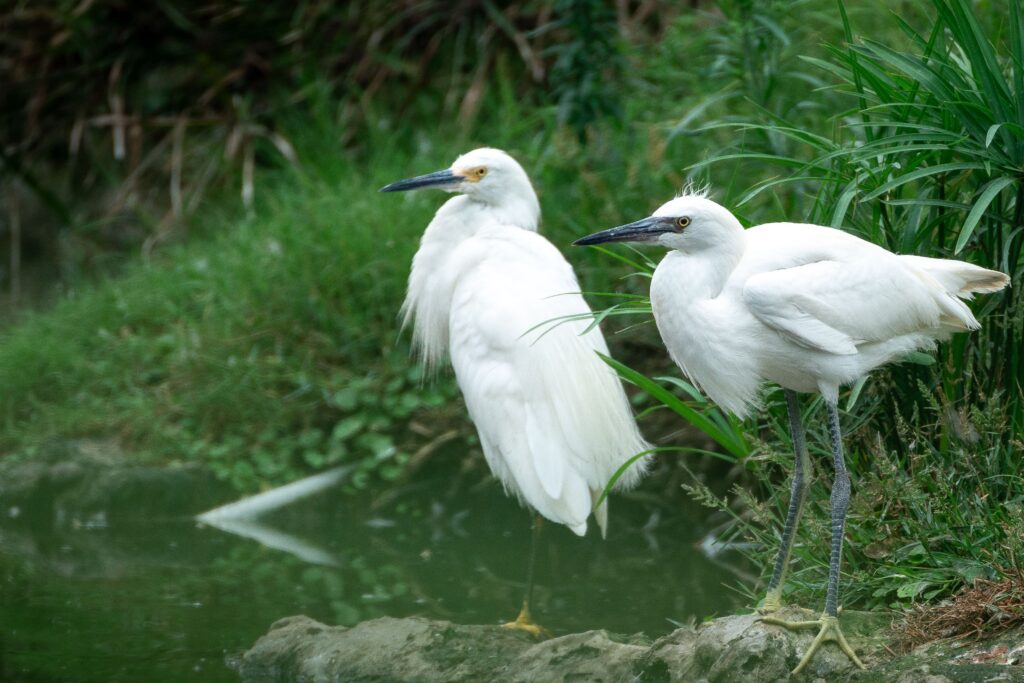
Smaller than the great egret, this bird has bright yellow feet at the end of black legs, a striking color contrast. It often stirs mud with its feet to flush out prey while wading.
Birders sometimes call this the “golden slippers” bird, a nickname earned entirely from that vivid foot coloring against otherwise dark legs.
Snowy egrets are active hunters compared to some herons, running through shallow water and even shuffling their feet rapidly to scare small fish into motion before striking.
11. Little Blue Heron
This heron’s legs are a muted greenish-gray, matching its slate-blue body. It hunts in shallower water than the great blue heron, using its shorter but still elongated legs to stalk prey patiently.
Juveniles are almost entirely white, a color that shifts gradually to blue-gray over their first year, often creating a patchy, mottled look during the transition.
This species tends to forage alone rather than in flocks, moving slowly through marsh edges and using its legs to test footing on soft, uneven mud before each step.
ALSO READ: 25 Birds With Colorful Beaks (Identification, With Pictures)
12. Tricolored Heron
Slim and long-legged, this heron is known for active hunting rather than standing still. It runs, hops, and even spreads its wings to shade the water while chasing fish.
That wing-shading behavior, sometimes called canopy feeding, reduces glare on the water’s surface, letting the heron spot fish more easily as it dashes forward on its long legs.
Compared to other herons on this list, the tricolored heron is noticeably slimmer, giving it a distinctive silhouette even from a distance.
13. Black-Crowned Night Heron
Shorter-legged than most herons on this list, it still qualifies as long-legged relative to its stocky body. It hunts mainly at dusk and night, relying on stealth over speed.
Its eyes are proportionally larger than those of day-hunting herons, an adaptation that helps it spot prey in low light while standing motionless at the water’s edge.
During the day, this heron often roosts quietly in dense trees, making it far less visible to casual observers than its daytime relatives.
14. Yellow-Crowned Night Heron
This heron specializes in crustaceans, especially crabs. Its long legs let it wade into tidal marshes at low tide, reaching prey buried just beneath the surface.
Its thick, sturdy bill is built specifically for crushing crab shells, a trait that sets its diet apart from most other wading birds on this list.
This species is more active at dawn and dusk than in full daylight, timing its hunts around the tidal patterns that expose crab burrows.
15. Reddish Egret
Known for its unpredictable, almost comedic hunting style, this egret runs, spins, and staggers through shallow water. Its long legs give it the reach needed for these erratic movements.
Two color forms exist within the species, a reddish-brown morph and a rarer all-white morph, both sharing the same energetic hunting technique.
This bird is considered one of the rarest herons in North America, and its populations remain closely tied to healthy coastal lagoon habitat along the Gulf Coast.
16. Roseate Spoonbill
This bright pink wader has long red legs that match its unusual spoon-shaped bill. It wades through shallow lagoons, sweeping its bill side to side while its legs keep its body elevated above the water.
Like flamingos, its pink coloring comes from pigments in the crustaceans it eats, meaning diet directly shapes both its legs and feathers over time.
Spoonbills often forage in mixed flocks alongside herons and ibises, their long legs allowing them to work slightly deeper water than their smaller wading companions.
17. White Ibis
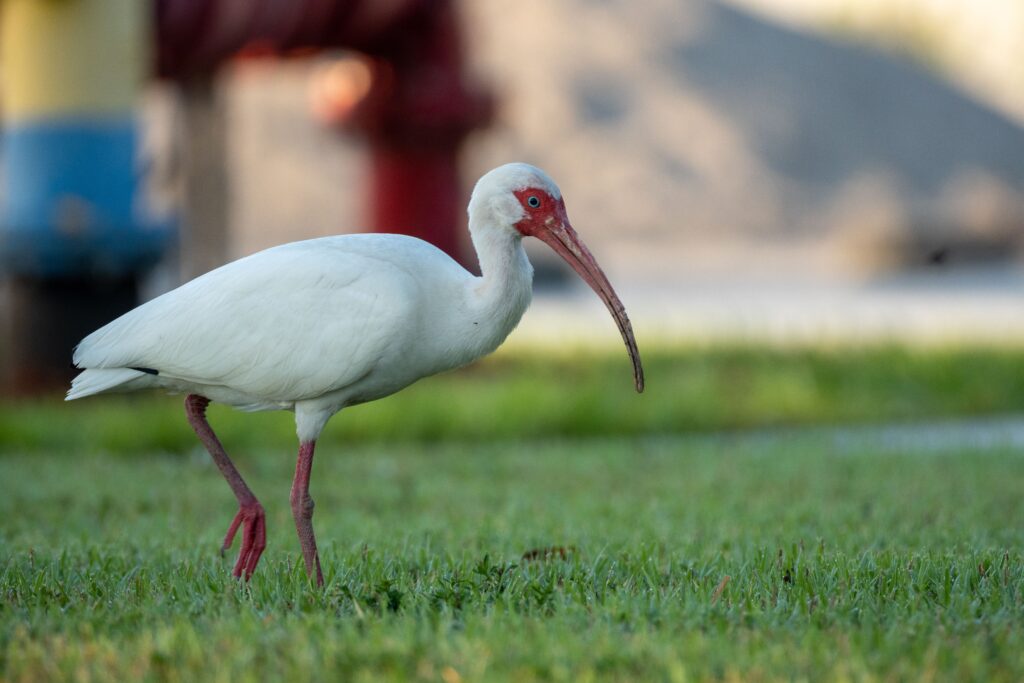
This wading bird has long, reddish-pink legs suited to probing soft mud. It often forages in large flocks, each bird’s long legs letting it access water at a slightly different depth.
Unlike herons, which hunt mostly by sight, the white ibis relies heavily on touch, using its curved bill to feel for crayfish and insects hidden below the surface.
Its legs turn a deeper, brighter pink during breeding season, matching similar seasonal color shifts seen in several other wading birds on this list.
18. Scarlet Ibis
A close relative of the white ibis, this bird shares the same long-legged wading posture but wears vivid red plumage across its entire body, legs included.
Its striking color comes from a diet rich in red crustaceans, making this one of the clearest examples of diet-driven coloration in the bird world.
Large scarlet ibis colonies in South America create a dramatic visual effect, with hundreds of bright red birds wading together across tidal mudflats at once.
19. Glossy Ibis
This dark, iridescent ibis has long grayish legs and a thin, curved bill. It favors freshwater marshes and rice fields, wading confidently through soft mud most birds would avoid.
Its plumage shifts color depending on the light, flashing bronze, green, and purple tones that make it look almost black from a distance.
This species has expanded its range significantly over the past century, now breeding in areas of North America where it was once considered a rare visitor.
20. Wood Stork
North America’s only native stork stands on long, dark legs with distinctive pink feet. It hunts by touch, sweeping its beak through water while its legs keep it stable in murky conditions.
Its feeding reflex is remarkably fast, snapping shut in a fraction of a second once prey touches its bill, one of the quickest reaction times recorded in any bird.
Wood storks depend heavily on shrinking water levels during the dry season, which concentrate fish into small pools their legs can wade through efficiently.
21. Jabiru Stork
One of the largest flying birds in the Americas, the jabiru has thick, long black legs built to support its considerable body weight while wading through deep wetlands.
Its bald black head and red neck pouch make it instantly recognizable, even from a considerable distance across open marshland.
Jabirus build enormous stick nests high in trees, often reusing and expanding the same nest site for many years in a row.
22. Marabou Stork
This African scavenger has long, stick-thin legs that often appear a chalky white. Researchers believe the color comes from the bird deliberately excreting waste onto its own legs to cool down, a process called urohidrosis.
This same cooling method is used by several stork and vulture species, letting evaporation draw heat away from the legs in intense African heat.
Marabou storks often gather at carcasses alongside vultures, using their long legs to stride confidently through crowded, competitive feeding scenes other birds would avoid.
23. Saddle-Billed Stork
With some of the longest legs of any African wading bird, this species can stand over five feet tall. Its dramatic red, black, and yellow bill draws attention, but the legs do the real work in deep swamps.
Males and females look similar but can be told apart by eye color, with females showing yellow irises and males dark brown ones.
This stork tends to be solitary or seen in pairs rather than large flocks, patrolling long stretches of river and wetland territory on its towering legs.
ALSO READ: 30 Stunning Birds With Long Beaks (Species Identification, With Pictures)
24. Whooping Crane
North America’s tallest bird stands on long, dark legs that let it wade into wetlands for crabs, clams, and insects. Its population has recovered significantly in recent decades thanks to sustained conservation work.
Recent survey data shows the wild population reaching several hundred individuals, a dramatic recovery from the mere handful that survived in the mid-twentieth century.
Whooping cranes mate for life and perform elaborate courtship dances, leaping and bowing on their long legs in displays that strengthen the pair bond each breeding season.
Young cranes, called colts, can walk and even swim within hours of hatching, though their legs take months to reach full adult length and strength.
25. Sandhill Crane
Slightly shorter than the whooping crane, the sandhill crane still carries long, sturdy legs suited to both wetland wading and dry grassland foraging.
Behavior tip: These cranes often gather by the thousands during migration, a spectacle visible at wildlife refuges across the central United States.
Their diet is unusually varied for a long-legged bird, ranging from seeds and grains to insects, snails, and even small rodents caught with a quick strike.
Sandhill cranes are also known for their loud, rolling calls, which can carry for more than a mile across open wetland, often heard before the bird itself is spotted.
26. Blue Crane
South Africa’s national bird has long, pale legs and a graceful, almost dancer-like walk. It favors grasslands over deep wetlands, using its legs mainly for covering long distances on foot.
Unlike many cranes, this species rarely wades in deep water, relying instead on its legs to forage across dry pastures and cultivated farmland.
Its population has faced pressure from habitat conversion, making protected grassland reserves an important part of its ongoing conservation.
27. Demoiselle Crane
The smallest crane species still has proportionally long legs. It migrates over the Himalayas, one of the most demanding bird migrations on the planet, relying on strong legs for extended ground foraging on both ends of the journey.
Before crossing the mountains, flocks build up fat reserves by foraging heavily on the ground, since their legs must support long stretches of walking and feeding beforehand.
Once across the Himalayas, these cranes winter across the Indian subcontinent, often sharing farmland with local communities that have coexisted with the species for centuries.
28. Grey Crowned Crane
This striking African crane has long gray legs and a golden crest. It forages in both wetlands and open grassland, giving it more habitat flexibility than many other crane species.
Its courtship dance is one of the most elaborate in the bird world, involving jumping, bowing, and wing-flapping performed on those long, flexible legs.
Unlike most cranes, this species readily perches in trees at night, a habit made possible by strong, grasping toes at the end of its long legs.
29. Limpkin
Named for its limping gait, this wading bird has long yellowish-green legs adapted for walking on floating vegetation and soft mud while hunting apple snails.
Its diet is so tied to apple snails that the bird’s range often shifts based on where healthy snail populations are found in a given wetland.
The limpkin’s eerie, wailing call is a familiar night sound in Florida wetlands, often described by longtime residents as one of the most haunting bird calls in North America.
30. Purple Gallinule
This colorful marsh bird has unusually long yellow legs and toes, letting it walk across lily pads and floating vegetation without sinking.
Its brilliant purple-blue body and bright red bill make it one of the most visually striking marsh birds on this entire list.
Young purple gallinules are much duller in color, gradually developing their vivid adult plumage over roughly a year of growth.
31. Common Moorhen
Slightly shorter-legged than the purple gallinule, this bird still relies on elongated toes and legs to move across marsh vegetation with confidence.
Its bright red bill with a yellow tip makes it easy to distinguish from similar-looking marsh birds sharing the same wetland habitat.
Moorhens are surprisingly good swimmers despite their long legs, often paddling across open water between patches of floating vegetation.
32. American Coot
While it swims often, the American coot also walks across mudflats on long, lobed toes attached to legs built for both wading and paddling.
Unlike ducks, coots lack webbed feet, relying instead on these unusual lobed toes to push through water and walk across soft mud with equal ease.
Large coot flocks often gather on open lakes in winter, using their sturdy legs to clamber onto shoreline vegetation when resting between feeding bouts.
33. Black-Winged Stilt
The Old World counterpart to the black-necked stilt, this bird shares the same extreme leg-to-body ratio. It is found across Europe, Asia, and Africa in shallow wetlands.
Its legs are so long relative to its body that, in flight, they trail well past the tail, giving the bird an unmistakable silhouette overhead.
Black-winged stilts are highly social during breeding season, nesting in loose colonies where multiple pairs defend a shared stretch of shoreline together.
34. Pied Avocet
Europe and Asia’s version of the American avocet, this bird has long blue-gray legs and the same upturned bill, used for the same side-to-side sweeping feeding style.
Its bold black-and-white plumage makes it a popular subject for birdwatchers, and it has even become a conservation symbol in parts of the United Kingdom.
Pied avocets nest on bare, open ground near water, relying on their long legs to quickly reposition themselves if a predator approaches the exposed nest site.
35. Long-Legged Buzzard
Not every long-legged bird is a wader. This raptor’s legs are noticeably longer than those of related buzzard species, an adaptation that helps it hunt ground squirrels and other burrowing prey in open terrain.
Its extended legs let it reach directly into burrow entrances, a hunting technique less effective for buzzards with shorter, stockier legs.
This species favors dry, open steppe and semi-desert habitat across parts of Europe, Asia, and North Africa, where burrowing rodents make up a large share of its diet.
ALSO READ: 15 Breeds of Chicken With No Feathers on the Neck (With Pictures, and Care Tips)
36. Secretary Bird
This African raptor hunts on foot rather than from the air. Its long, crane-like legs let it stomp venomous snakes to death, a hunting method almost unique among birds of prey.
Its legs are covered in thick, armored scales, protecting them from snake bites during these high-risk ground attacks.
Secretary birds can walk many miles a day across open savanna while hunting, making their long legs essential to covering the large territories they patrol.
37. Kori Bustard
One of the heaviest flying birds in the world, the kori bustard has long, powerful legs suited to walking long distances across African savannas in search of insects, seeds, and small reptiles.
Because of its considerable weight, this bird prefers walking to flying whenever possible, saving flight for emergencies or long migratory movements.
Male kori bustards perform elaborate ground displays during breeding season, inflating their throat and raising tail feathers while standing tall on their long legs.
38. Great Bustard
Europe and Asia’s heaviest flying bird shares a similar body plan to the kori bustard. Its long legs support a large frame while it forages across open steppe and farmland.
Males can weigh significantly more than females, and their long legs must carry that extra bulk across wide open grasslands during both feeding and courtship.
This species has faced sharp population declines in parts of Western Europe, making protected steppe reserves increasingly important for its long-term survival.
39. Emu
Australia’s largest bird cannot fly, but its long, muscular legs make it an efficient long-distance walker. The Smithsonian’s National Zoo notes emus can reach speeds of up to 31 miles per hour, with their long legs enabling them to walk considerable distances or outrun danger.
Unusually, male emus take on full incubation and chick-rearing duties, using their strong legs to guard the nest for weeks without eating or drinking much at all.
Emus are also capable swimmers, and their long legs give them a powerful kick that helps them cross rivers and flooded ground during seasonal movements.
40. Common Ostrich
The tallest and heaviest bird alive relies entirely on its legs for survival, since it cannot fly. The Smithsonian’s National Zoo reports ostriches have been clocked running continuously at 30 to 37 miles per hour, with sprints reaching up to 43 miles per hour.
Why it matters: These are officially recognized as the fastest two-legged animals on Earth, a title earned entirely through leg design.
A single ostrich stride can cover an impressive distance, and its legs are strong enough to deliver a forward kick capable of seriously injuring a predator like a lion.
Unlike most birds, the ostrich has only two toes on each foot, a streamlined adaptation that reduces weight and improves running efficiency at high speed.
41. Rhea
South America’s largest bird resembles a smaller ostrich in build. Its long legs allow fast sprints across open grassland, its main defense against predators on the pampas.
Rheas often run in a zigzag pattern when fleeing danger, using quick directional changes that their long, flexible legs make possible at full speed.
Like emus, male rheas typically handle incubation and chick-rearing alone, relying on their legs to defend a shared nest containing eggs from multiple females.
42. Southern Cassowary
This powerful, flightless bird from Australia and New Guinea has thick, muscular legs ending in sharp claws. Unlike most birds on this list, its legs double as a serious weapon when threatened.
Each foot carries a dagger-like inner claw capable of delivering a serious injury, making the cassowary one of the few birds considered genuinely dangerous to approach.
Despite this reputation, cassowaries are shy by nature and rely on dense rainforest cover, using their long legs mainly to move quickly through thick undergrowth.
43. Northern Jacana
Known for walking across lily pads, this tropical wetland bird has extraordinarily long toes attached to long legs, distributing its weight so evenly it appears to walk on water.
This trick has earned jacanas the nickname “lily trotters” among birdwatchers across Central America and the Caribbean.
In an unusual role reversal, female jacanas mate with multiple males, while each male uses his long legs to incubate eggs and raise chicks independently.
ALSO READ: 15 Breeds of Chicken With Feathers on Feet: (With Pictures, and Care Tips)
44. African Jacana
Similar in build to its northern relative, this bird uses the same long-legged, long-toed strategy to move across floating vegetation in African wetlands without sinking.
Its toes are proportionally even longer than those of the northern jacana, an adaptation suited to the dense floating plants common across African lake systems.
Chicks can walk and forage almost immediately after hatching, their oversized feet already functional enough to support their weight on soft vegetation.
45. Curlew Sandpiper
This smaller shorebird has long, dark legs suited to probing soft mud during its lengthy Arctic-to-Africa migration each year.
Its breeding range sits deep in the Siberian Arctic, meaning its legs must carry it thousands of miles each year between breeding and wintering grounds.
During breeding season, its plumage turns a rich brick red, a striking contrast to the plain gray tones it wears the rest of the year.
46. Bar-Tailed Godwit
Famous for extremely long nonstop migratory flights, this shorebird’s long legs let it wade into deep tidal mudflats where competitors cannot reach.
Some populations of this species complete one of the longest nonstop migratory flights recorded in any bird, crossing entire ocean basins without landing.
Before departure, godwits build up substantial fat reserves, since their long legs and flight muscles must sustain days of continuous travel.
47. Marbled Godwit
A close cousin of the bar-tailed godwit, this bird shares the same leg length advantage, using it to forage in slightly deeper coastal waters than most sandpipers.
Its long, slightly upturned bill works alongside its legs, letting it probe deep into sand and mud for buried marine worms and shellfish.
This species breeds on North American prairie grasslands, a habitat quite different from the coastal mudflats where it spends most of the winter.
48. Willet
This plain-looking shorebird transforms in flight, revealing bold black-and-white wing patterns. Its long grayish legs let it wade confidently across rocky and sandy shorelines alike.
Willets are known for their loud, persistent alarm calls, often the first warning other shorebirds receive when a predator approaches a shared beach or marsh.
Two distinct populations exist, one favoring eastern coastal marshes and another breeding on inland western wetlands, each slightly different in size and leg proportion.
49. Spotted Redshank
This Eurasian shorebird has some of the longest, most vividly red legs of any sandpiper relative. It wades into deeper water than most similar species, giving it access to prey others miss.
During breeding season, its plumage turns almost entirely black, making the bright red legs stand out even more sharply against the dark body.
This bird will sometimes swim briefly while foraging, an unusual behavior among shorebirds that mostly rely on wading rather than swimming to find food.
50. Greater Yellowlegs
As the name suggests, this shorebird’s defining feature is its long, bright yellow legs. It often wades in deeper pools than smaller sandpipers, using its height advantage to hunt small fish and aquatic insects.
Its loud, three-note call is often the first sound birders notice at a wetland, since this species tends to react vocally to any disturbance nearby.
Compared to the similar lesser yellowlegs, this bird is noticeably larger, with a longer bill and legs that make side-by-side identification fairly straightforward.
Quick Comparison Table
| Bird | Leg Color | Primary Advantage |
| American Flamingo | Pink | Deep-water filter feeding |
| Black-Necked Stilt | Pink-red | Longest leg-to-body ratio (with flamingos) |
| Common Ostrich | Gray-brown | Speed and defense |
| Secretary Bird | Gray-pink | Stomping prey while hunting |
| Whooping Crane | Dark gray | Wetland wading and foraging |
| Northern Jacana | Yellow-green | Walking on floating vegetation |
How Leg Length Relates to Habitat
Birds that wade in deep water tend to have the longest legs relative to body size. Flamingos and stilts sit at the top of this category.
Birds that run across open, dry ground trade some leg length for raw muscle power instead. Ostriches and rheas fit this pattern.
A smaller third group, like jacanas, uses long legs paired with long toes. This spreads weight across soft or floating surfaces rather than adding height.
My own takeaway: Watching where a bird stands often tells you more about its legs than watching how it walks. Habitat shapes leg design more than almost any other factor.
Frequently Asked Questions
Which bird has the longest legs relative to its body size? The flamingo and the black-necked stilt are widely cited as the top two, according to wildlife researchers cited by the U.S. Fish and Wildlife Service.
Why do flamingo legs bend backward? They do not. What looks like a backward knee is actually the ankle joint. The true knee sits higher up, hidden by the bird’s feathers.
Are long-legged birds always waders? No. Ostriches, emus, and secretary birds use long legs for running and hunting on dry land rather than wading in water.
Do long legs affect a bird’s speed? Yes, significantly. Ostriches use their long, powerful legs to reach sprinting speeds of up to 43 miles per hour, making them the fastest birds on land.
Final Thoughts
Fifty birds, and not one of them grew long legs by chance. Every stride, wade, and sprint on this list ties back to a specific survival need.
I hope this guide gives you a better eye the next time you spot a heron standing still or a stilt darting across a shoreline. There is real engineering behind that stance.
References
- U.S. Fish & Wildlife Service. “Black-necked Stilt.” https://www.fws.gov/story/2022-07/black-necked-stilt
- U.S. Fish & Wildlife Service. “March 2024, Bird of the Month: American Flamingo.” https://www.fws.gov/story/2024-03/march-2024-bird-month-american-flamingo
- U.S. Fish & Wildlife Service. “Hawaiian Stilt Aeriels.” https://www.fws.gov/media/hawaiian-stilt-aeriels
- U.S. Fish & Wildlife Service. “Whooping Crane (Grus americana) Species Profile.” https://www.fws.gov/species/whooping-crane-grus-americana
- Smithsonian’s National Zoo and Conservation Biology Institute. “Ostrich.” https://nationalzoo.si.edu/animals/ostrich
- Smithsonian’s National Zoo and Conservation Biology Institute. “Black-necked Stilt.” https://nationalzoo.si.edu/animals/black-necked-stilt
- Smithsonian’s National Zoo and Conservation Biology Institute. “Why Are Flamingos Pink? And Other Flamingo Facts.” https://nationalzoo.si.edu/animals/news/why-are-flamingos-pink-and-other-flamingo-facts