45 Birds With Colorful Feathers (Species Identification, With Pictures)
I once sat on a bench near a bird feeder in Florida and watched a painted bunting land less than twenty feet away. My jaw genuinely dropped. No photo had prepared me for how bright that bird actually was in person.
This guide walks through 45 birds with colorful feathers, chosen for how vivid, well-documented, and identifiable each species is. Some of these colors come from diet. Others come from something far stranger: microscopic physics happening inside the feather itself.
Why Do Some Birds Have Such Colorful Feathers?
Bird color comes from two very different sources: pigment and structure. Understanding the difference changes how you see every bright feather afterward.
Pigment-based color comes from compounds the bird either eats or produces internally. Flamingos and cardinals fall into this category, their color shifting with diet quality over time.
Structural color works differently. Harvard researchers explain that a peacock’s bright teal and blue feathers are not the result of pigments at all, but rather nanoscale networks that reflect specific wavelengths of light.
A study published through the National Center for Biotechnology Information confirms this further, noting that peacock feathers appear vividly colored because of a photonic-crystal structure inside the feather’s cortex, not because of any blue or green pigment present in the tissue.
This explains something strange. Smithsonian researchers note that peacock feathers are actually pigmented brown underneath, and it is only the nanoscale structure layered over that brown base that produces the vivid blues and greens we see.
Now, let’s look at 45 species that showcase both of these color strategies at their most extreme.
Structural Color Champions
1. Indian Peafowl (Peacock)
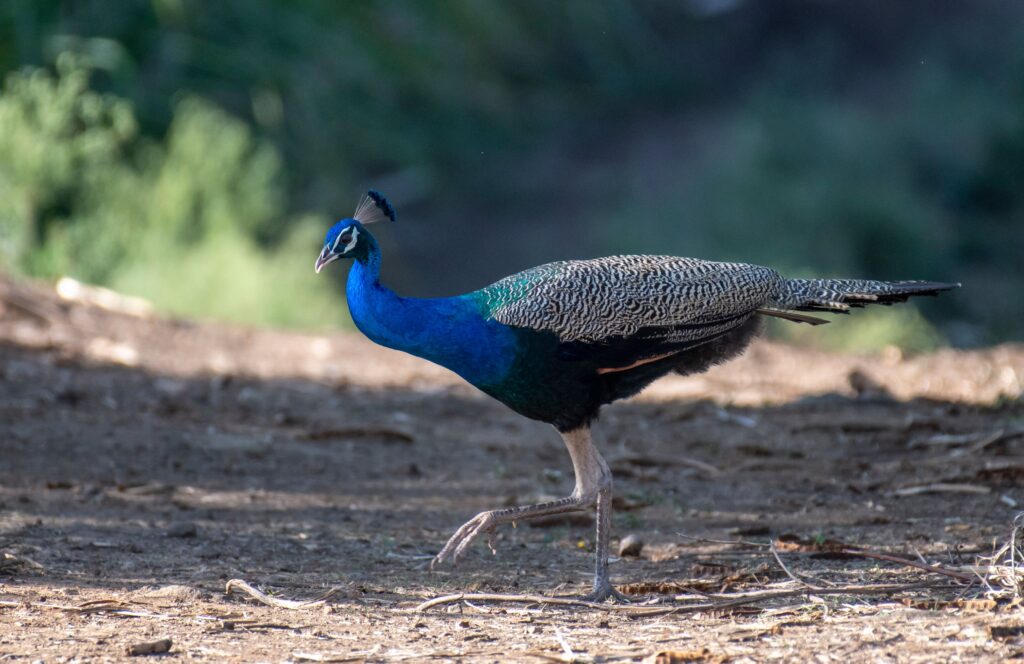
This is the bird most people picture when they hear “colorful feathers.” The Smithsonian’s National Zoo describes the male’s elongated upper tail feathers as forming a five-foot train, decorated with iridescent eyespots called ocelli.
According to the Smithsonian, a single male peacock may carry between 100 and 175 ocelli across his full train, each ringed in blue and bronze.
I find it almost unbelievable that none of that blue-green shimmer comes from pigment. Research published through the National Center for Biotechnology Information confirms the color comes entirely from a periodic melanin structure inside the feather, not from any dye-like compound.
Females, called peahens, look almost like a different species entirely. Their plumage stays a muted brown, since evolutionary pressure for bright display feathers falls almost entirely on the males.
ALSO READ: 25 Birds That Sing at Night (Species Names, With Pictures)
2. Green Peafowl
A close relative of the Indian peafowl, this species carries the same structural coloring but with a noticeably more metallic green body, rather than the deep blue neck of its cousin.
Unlike the Indian peafowl, both sexes of the green peafowl show fairly vivid coloring, a rare exception among birds where males typically dominate the color spectrum.
This species has faced serious population decline across Southeast Asia, making it considerably harder to spot in the wild than the widely domesticated Indian peafowl.
3. Resplendent Quetzal
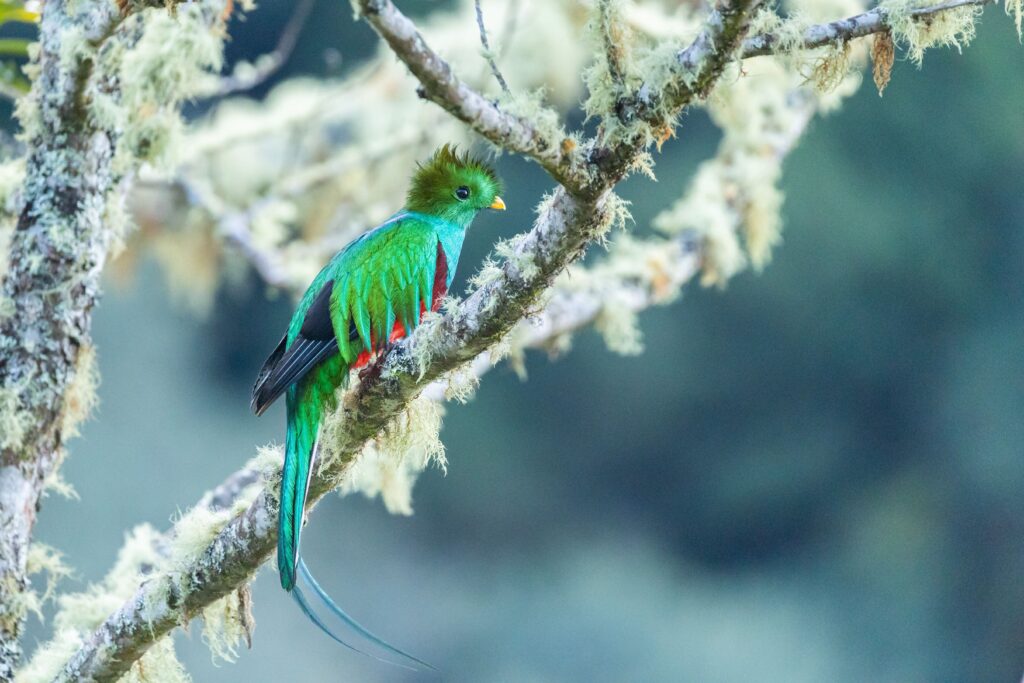
Considered one of the most beautiful birds in Central America, this quetzal carries iridescent emerald-green feathers that shift toward blue or gold depending on the angle of light.
Males grow extraordinarily long tail coverts during breeding season, sometimes trailing well beyond the body length, a feature tied directly to courtship display success.
Ancient Mesoamerican cultures considered this bird sacred, and its feathers were historically reserved for royalty, a reflection of just how highly its color was valued centuries before modern ornithology existed.
4. Anna’s Hummingbird
This small hummingbird carries an iridescent rose-pink throat patch, called a gorget, that can look nearly black in dim light and blindingly bright in direct sun.
That shifting effect comes from structural color layered over melanin, the same basic mechanism responsible for a peacock’s shimmer, just scaled down to a feather barely visible to the naked eye.
Males use this gorget in dramatic dive displays, flashing the color directly at females during courtship flights that can exceed 50 feet in a single dive.
5. Ruby-Throated Hummingbird
Eastern North America’s most familiar hummingbird carries a similar iridescent throat patch, this time in a deep ruby red rather than pink.
Females lack this bright throat coloring entirely, showing a plain white or lightly speckled throat instead, a common pattern among hummingbird species.
Because the red comes from feather structure rather than pigment, the same bird can appear to have a black throat one moment and a brilliant ruby one the next, depending entirely on viewing angle.
6. Violet-Crowned Woodnymph
This tropical hummingbird carries a violet-blue crown that practically glows under sunlight, paired with a deep emerald body. It favors forest edges and gardens across Central and South America.
Like other hummingbirds on this list, its brightest colors are concentrated on the head and throat, areas most visible during courtship display flights.
Its name reflects exactly what makes it stand out, that crown color shifting dramatically depending on whether the bird is angled toward or away from the light source.
ALSO READ: 50 Types of Birds With Long Legs (Species Identification, With Pictures)
Pigment-Based Color Champions
7. American Flamingo
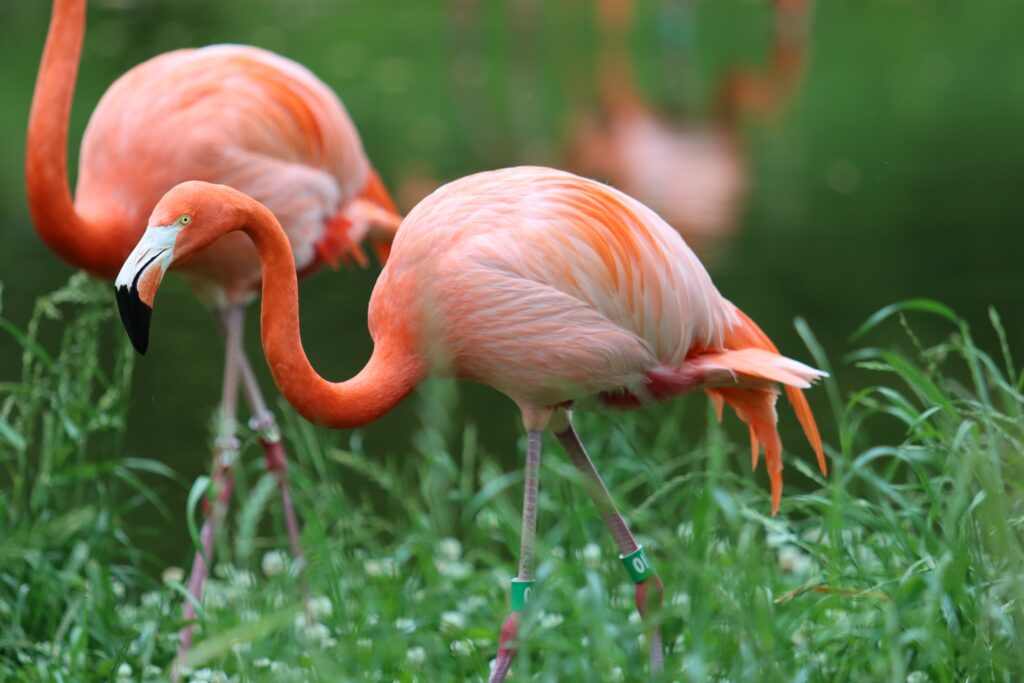
This wading bird’s pink feathers come directly from carotenoid pigments found in the shrimp and algae it filters from shallow water.
Chicks hatch gray and only develop their signature pink coloring gradually, as their diet shifts toward pigment-rich food sources over their first year or two.
Interesting note: Flamingos kept in captivity on a low-carotenoid diet can actually fade toward white over time, proof of just how directly diet controls this bird’s color.
8. Scarlet Ibis
Few birds wear red as boldly as this South American wading bird. Its entire body, legs included, takes on a vivid red tone drawn from the red crustaceans that make up much of its diet.
Large colonies of scarlet ibises create a striking visual effect, with hundreds of birds roosting together and turning entire mangrove stands a deep crimson at dusk.
Juveniles hatch gray and mottled, slowly gaining their full red coloring as they mature and their diet becomes more consistent.
9. Northern Cardinal
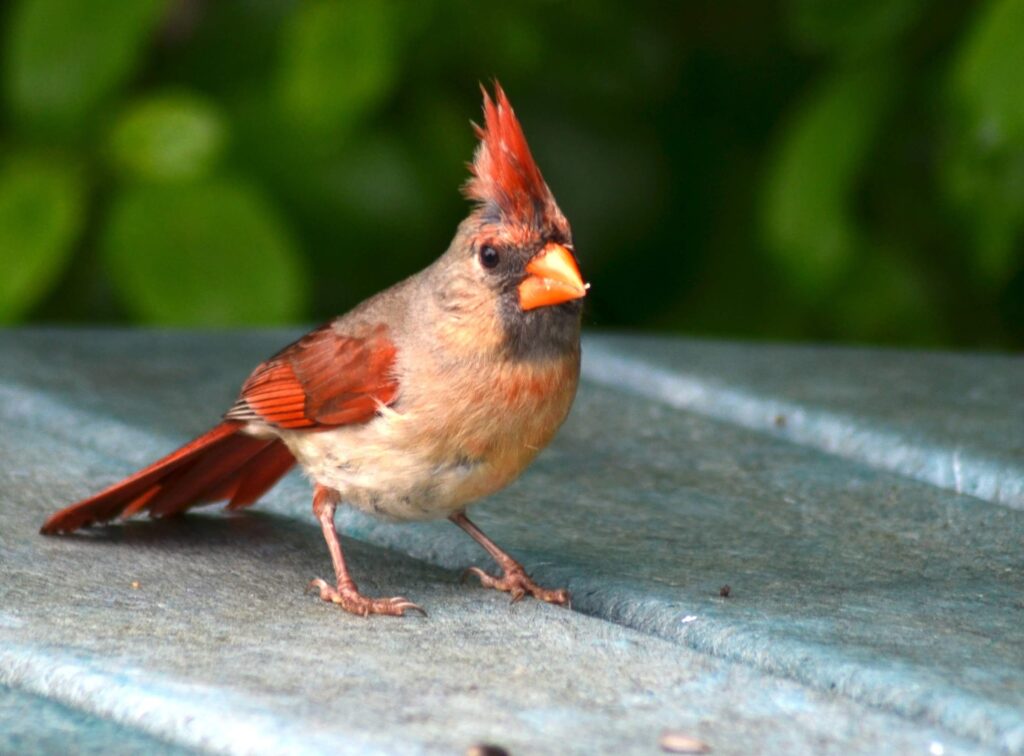
This familiar backyard bird owes its bright red plumage to carotenoid pigments absorbed through seeds, berries, and fruit.
Brighter red males are generally considered healthier by potential mates, since achieving that vivid color requires consistently strong nutrition over time.
Females carry a much more subdued reddish-brown tone, a common pattern that helps them stay camouflaged while incubating eggs on the nest.
10. Scarlet Tanager
This forest songbird carries brilliant red body plumage contrasted sharply against jet-black wings, one of the boldest color combinations in any North American forest bird.
That red fades entirely outside breeding season, with males molting into a duller olive-yellow plumage that closely resembles the female’s year-round coloring.
This seasonal shift conserves energy, since maintaining bright breeding plumage year-round would demand pigment resources the bird does not need once mating season ends.
ALSO READ: 25 Birds With Colorful Beaks (Identification, With Pictures)
11. Painted Bunting
Often called North America’s most colorful bird, this species pairs a deep blue head with a bright red chest and lime-green back. Missouri’s Department of Conservation describes the male as unmistakable, with no other native bird sharing that exact color combination.
Texas A&M University’s breeding bird research notes males do not reach full adult coloring until their second breeding season, sometimes 15 to 18 months after hatching.
Sadly, that same bright color has made this bird a target for illegal capture in parts of its wintering range, where it is sometimes sold as a caged bird.
Females and young males wear a soft lime-green instead, providing camouflage while the species’ more famous coloring stays reserved for mature adult males.
12. Indigo Bunting
A close relative of the painted bunting, this small songbird appears deep blue in good light, though that color is entirely structural rather than pigment-based.
In poor lighting, the same bird can look almost black, since the blue effect depends on how sunlight interacts with the feather’s internal structure.
Indigo buntings migrate at night, using star patterns to navigate, a behavior first confirmed through planetarium-based research decades ago.
13. Lazuli Bunting
This western counterpart to the indigo bunting carries a lighter, more turquoise-toned blue head and back, paired with a warm orange-brown chest band.
Like other buntings, its blue coloring comes from feather structure, not pigment, meaning its appearance can shift noticeably depending on the angle of observation.
This species favors brushy hillsides and streamside thickets, often overlapping with indigo bunting territory where the two species occasionally interbreed.
14. Mandarin Duck
Native to East Asia, this duck carries one of the most elaborate color patterns of any waterfowl species, mixing orange, green, purple, and white across a single body.
Males display an unusual raised orange “sail” feather on each wing, a feature used almost exclusively during courtship posturing rather than flight.
Unlike many colorful birds, the mandarin duck’s pattern includes both structural and pigment-based elements working together across different feather regions.
15. Wood Duck
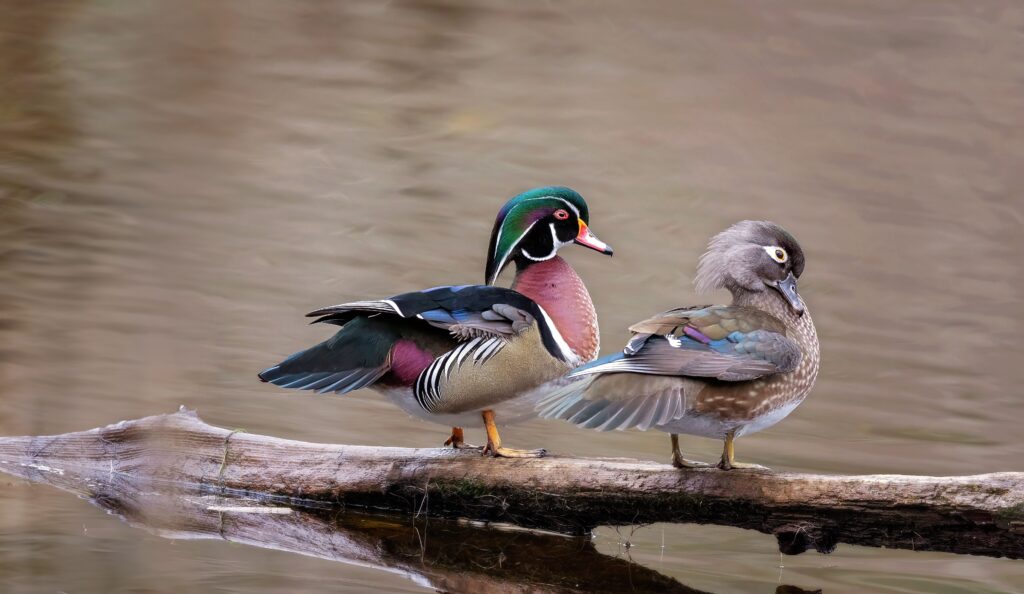
North America’s answer to the mandarin duck, this species carries a similarly elaborate mix of iridescent green, purple, white, and chestnut feathers.
Males use their crested head and bold eye markings during elaborate head-bobbing courtship displays performed on calm woodland ponds.
Females, by contrast, show a much plainer gray-brown coloring with a distinctive white eye-ring, prioritizing camouflage over display.
ALSO READ: 30 Stunning Birds With Long Beaks (Species Identification, With Pictures)
Tropical and Rainforest Standouts
16. Scarlet Macaw
This large parrot combines brilliant red, yellow, and blue feathers in bold, clearly defined bands across its wings and back.
Its coloring likely serves multiple purposes, including mate recognition and flock cohesion, since scarlet macaws travel in pairs or small family groups through dense forest canopy.
This species can live several decades in the wild, meaning its bright plumage remains a lifelong feature rather than a temporary breeding display.
17. Hyacinth Macaw
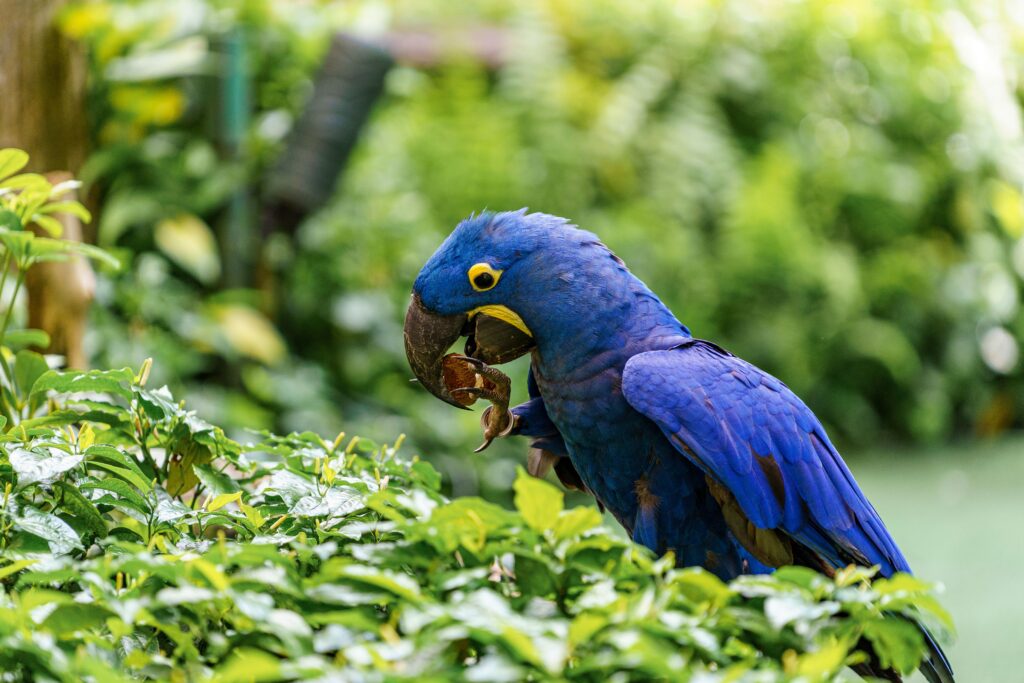
The largest flying parrot species carries deep cobalt-blue feathers across its entire body, offset only by a patch of bright yellow skin near the eye and bill.
That blue coloring comes from a combination of feather structure and pigment, producing a shade so deep it can appear almost black in low light.
Habitat loss and the illegal pet trade have placed serious pressure on wild populations, making this one of the more vulnerable birds on this list.
18. Blue-and-Yellow Macaw
This widely recognized parrot pairs a vivid blue back and wings with a bright yellow chest and underside, one of the most photographed color combinations in the parrot family.
Its loud, repetitive calls often announce its presence before the bird is visually spotted moving through the forest canopy.
Blue-and-yellow macaws mate for life, and paired birds are frequently seen flying and perching together throughout the year.
19. Rainbow Lorikeet
This small Australian parrot carries an almost impossible mix of blue, green, yellow, orange, and red feathers packed into a single small body.
Its brush-tipped tongue reflects its nectar-based diet, a feeding style shared with several other brightly colored lorikeet species across the Pacific region.
Rainbow lorikeets often gather in large, noisy flocks at flowering trees, their combined colors creating a shifting, kaleidoscope-like effect as they move between branches.
20. Gouldian Finch
This small Australian finch displays an extraordinary range of colors, including purple chests, yellow bellies, and heads that come in red, black, or yellow depending on genetic variation.
Researchers have studied this species extensively because all three head-color variants occur within the same population, an unusually direct example of visible genetic diversity.
Wild populations have declined sharply due to habitat changes, making this finch far more common in aviculture today than in its native Australian range.
21. Superb Bird-of-Paradise
Native to New Guinea, males of this species display an extraordinary transformation during courtship, spreading a jet-black cape and turquoise breast shield into a shape resembling a smiling alien face.
That transformation is almost entirely feather-based, with specialized plumes reshaping the bird’s silhouette temporarily during the display itself.
Females observe from nearby branches, and only the most precisely performed displays typically result in successful mating.
22. Wilson’s Bird-of-Paradise
This small, spectacularly marked bird carries a bright red back, yellow cape, and a turquoise crown of bare skin rather than feathers on top of the head.
Males clear a small patch of forest floor for courtship displays, using the surrounding leaf litter to make their bright colors stand out even further by contrast.
Females, as with most birds-of-paradise, remain far duller in color, reflecting the same pattern seen throughout many strongly sexually dimorphic species.
23. Toco Toucan
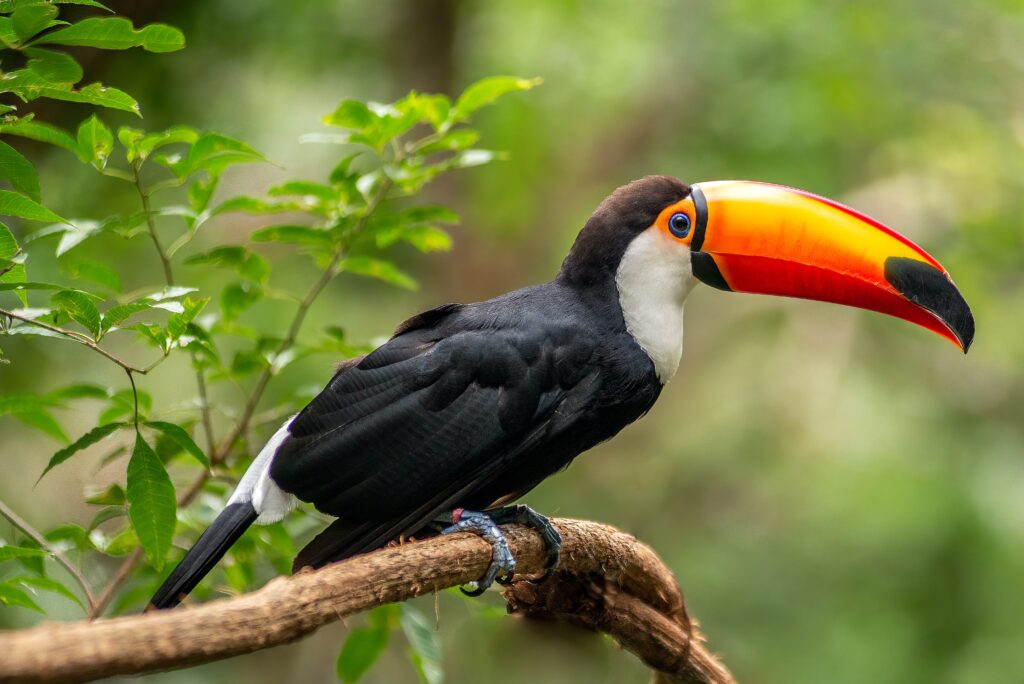
While best known for its enormous orange bill, this bird’s body carries bold black feathers set against a crisp white throat and chest, creating a striking overall silhouette.
That stark contrast makes the toucan easy to spot even at a distance, despite the surrounding green of its rainforest habitat.
Its feathers, unlike its bill, rely on standard pigment-based coloring rather than the structural effects seen in peacocks or hummingbirds.
24. Keel-Billed Toucan
Much like its toco relative, this bird pairs a rainbow-colored bill with mostly black body feathers, a bright yellow throat, and red undertail feathers.
This color combination likely aids in species recognition among the many toucan and aracari species sharing overlapping rainforest territory.
Its social, flock-based lifestyle means color-based recognition between individuals may play a larger role than in more solitary bird species.
25. Violet Turaco
This large African forest bird carries deep violet-blue body feathers alongside a bright crimson crest and red wing patches.
Unusually, researchers have found turacos produce their red and green pigments through unique copper-based compounds, a coloring method found in almost no other bird family on Earth.
This bird moves through tree canopy with quick, agile hops, using strong legs rather than sustained flight to travel between feeding sites.
26. Lilac-Breasted Roller
One of Africa’s most photographed birds, this species combines lilac, turquoise, green, and cinnamon feathers across a body barely larger than a robin.
Its name comes from its dramatic courtship flight, where the bird rolls and tumbles through the air, flashing its colorful wings during the display.
This bird often perches prominently on open branches, making it one of the easier colorful species to photograph across the African savanna.
27. Rainbow Bee-Eater
This Australian bird carries a striking mix of green, blue, orange, and black feathers, with a distinctive black eye stripe running through its face.
True to its name, it specializes in catching bees and wasps mid-flight, removing the stinger by repeatedly striking the insect against a branch before eating it.
Its colors likely help with camouflage against dappled sunlight while perched, despite how vivid the bird appears in a clear, direct photograph.
28. Southern Cassowary
This large, flightless bird carries deep black body feathers combined with a vividly blue and red neck and head, colors that come from bare skin rather than plumage.
That colorful neck skin can shift in intensity depending on the bird’s mood, becoming notably brighter during territorial or courtship displays.
Despite lacking colorful feathers across most of its body, the cassowary’s head and neck alone make it one of the most visually striking large birds in the world.
29. Golden Pheasant
Native to mountain forests in China, this pheasant carries a golden-yellow crest, deep red body, and blue-green wing patches, one of the most dramatically layered color patterns in any pheasant species.
Males use their long, golden tail feathers during courtship displays, fanning them out while circling slowly around a nearby female.
This species has also become popular in aviculture worldwide, meaning captive populations now likely outnumber wild individuals across its native range.
30. Lady Amherst’s Pheasant
A close relative of the golden pheasant, this species carries a striking black-and-white barred tail alongside a red crest and blue-green back feathers.
Its long, elegant tail can extend well beyond the rest of the body, adding to the dramatic visual effect during both flight and display.
Like the golden pheasant, this species has established small feral populations outside its native range due to historical releases from private collections.
Familiar Backyard and Garden Birds
31. Blue Jay
This common North American bird appears bright blue, though that color is entirely structural, produced by light scattering off microscopic feather structures rather than any blue pigment.
If a blue jay feather is crushed, the blue color disappears entirely, leaving only a dull brown, direct proof that the color exists in feather structure rather than pigment.
Blue jays are also known for mimicking hawk calls, a behavior sometimes used to scare off other birds from a shared feeding area.
32. Eastern Bluebird
This small thrush relative carries a soft blue back and rusty orange chest, a combination that makes it a favorite among backyard birdwatchers across the eastern United States.
Like the blue jay, its blue coloring comes from feather structure rather than pigment, meaning the exact shade can shift slightly depending on lighting conditions.
Bluebird populations declined sharply in the mid-20th century due to competition for nesting cavities, prompting widespread nest box conservation programs that remain active today.
33. American Goldfinch
Males of this small finch turn a bright lemon-yellow during breeding season, a striking contrast against black wings and cap.
That yellow fades to a duller olive tone after breeding season ends, conserving the pigment resources needed to maintain such a vivid color.
Goldfinches are strict vegetarians among North American finches, relying almost entirely on seeds, a diet directly tied to their pigment-based coloring.
34. Baltimore Oriole
This songbird carries a bold combination of black and bright orange feathers, a pattern so recognizable it inspired the name of a Major League Baseball team.
Orange intensity can vary noticeably between individual males, with brighter birds generally considered more successful in attracting mates during breeding season.
Orioles build unusual hanging, sock-like nests woven from plant fibers, often suspended from the tips of high outer tree branches.
35. Rose-Breasted Grosbeak
This songbird pairs a black-and-white body with a strikingly bright rose-red patch across the chest, almost like a splash of paint.
That red patch varies in size and intensity between individual males, and some research suggests females may use its exact shape as one factor in mate selection.
Females look completely different, carrying a streaky brown pattern that closely resembles a large sparrow rather than their more colorful mates.
36. Vermilion Flycatcher
This small flycatcher displays an almost impossibly bright red head and chest, contrasted against dark brown wings and back.
Males use this bright coloring during fluttering display flights, hovering conspicuously above open perches to catch a female’s attention.
Its diet consists mainly of flying insects, caught in short bursts from an exposed perch before returning to the same spot.
37. Cedar Waxwing
This social songbird carries a soft, blended plumage of tan, gray, and yellow, accented by a bright red waxy tip on select wing feathers.
Those red tips are not typical feather coloring at all, but rather a waxy secretion that gives the species its name and appears more prominently in older, more experienced birds.
Cedar waxwings travel in tight flocks, often stripping berry bushes bare in a matter of minutes before moving on together.
38. Yellow Warbler
This small warbler carries an almost uniform bright yellow body, with males showing faint reddish streaking across the chest during breeding season.
Its coloring helps it blend into sunlit leaves and willow thickets, offering surprising camouflage despite how vivid the bird looks in direct comparison photos.
Yellow warblers are frequent targets of cowbird nest parasitism, and some individuals have been observed building an entirely new nest layer over parasitized eggs rather than abandoning the site.
39. Western Tanager
This bright yellow-bodied songbird carries a strikingly orange-red head, a color that, unlike most pigment-based coloring, actually comes from a pigment obtained through its insect diet rather than produced internally.
Researchers have noted this is unusual, since most red bird coloring comes from plant-based carotenoids rather than insect-derived pigments.
This species breeds in coniferous forests across western North America, often staying high in the canopy where its colors can be difficult to spot despite their brightness.
40. Purple Finch
Often confused with the more common house finch, this bird carries a richer, more raspberry-toned red across its head and chest rather than a simple orange-red.
Color intensity in males can vary by region and diet, making precise identification alongside similar finch species a genuine challenge even for experienced birders.
Females lack any red coloring entirely, showing a heavily streaked brown-and-white pattern instead.
Waterbirds and Coastal Standouts
41. Roseate Spoonbill
This wading bird’s bright pink feathers come from the same carotenoid-rich crustacean diet responsible for flamingo coloring, despite the two species belonging to entirely different families.
Color intensity often signals overall health, with the brightest pink individuals typically representing well-fed, successful adult breeders.
Juveniles hatch with pale, whitish feathers, gradually gaining their signature pink tone as their diet stabilizes over the following year.
42. Purple Gallinule
This marsh bird carries a deep purple-blue body accented by a bright yellow-tipped red bill and long yellow legs.
Its coloring stays vivid year-round, unlike many songbirds that shift into duller tones outside breeding season.
Purple gallinules use their unusually long toes to walk confidently across lily pads and floating vegetation, a habitat few other brightly colored waterbirds can access as easily.
43. Green-Winged Teal
This small dabbling duck carries a striking green facial patch against a rich chestnut-brown head, one of the more understated but genuinely vivid color patterns among waterfowl.
That green patch is entirely structural, shifting toward blue or even black depending on the viewing angle, much like the blue seen in jays and bluebirds.
This species is among the fastest-flying ducks in North America, a trait that has made it a frequently studied subject in waterfowl research.
44. Harlequin Duck
Named for its bold, patchwork-style plumage, this sea duck combines slate blue, chestnut, black, and white in a pattern unlike any other North American waterfowl species.
It favors turbulent coastal waters and fast-moving mountain streams, habitats where its broken color pattern may help break up its outline against churning water.
Females carry a much plainer brown coloring, again reflecting the broader pattern of male-dominated display coloring seen throughout much of this list.
45. Atlantic Puffin
While best known for its colorful beak, this seabird’s black-and-white body feathers create the sharp visual contrast that makes its bright bill stand out even further.
That stark black-and-white pattern likely serves a camouflage purpose at sea, breaking up the bird’s silhouette from both above and below while swimming.
Chicks hatch covered in soft gray-black down, only developing the adult’s crisp black-and-white feather pattern after their first full molt at sea.
Quick Comparison Table
| Bird | Color Type | Main Source |
| Indian Peafowl | Structural | Photonic-crystal feather structure |
| American Flamingo | Pigment | Carotenoids from diet |
| Painted Bunting | Pigment and structural | Diet plus feather structure |
| Blue Jay | Structural | Light-scattering feather structure |
| Scarlet Macaw | Pigment | Carotenoid-based plumage |
| Mandarin Duck | Structural and pigment | Combined coloring mechanisms |
Structural vs. Pigment Color: A Quick Breakdown
Pigment color comes from actual colored compounds inside the feather, absorbed through diet or produced by the bird’s own body chemistry.
Structural color comes from the physical shape of the feather itself, bending and reflecting light at a microscopic scale rather than relying on any pigment at all.
Some birds, like the mandarin duck, use both systems at once, layering pigment-based patches alongside structurally colored iridescent feathers.
My own takeaway: The next time a blue feather catches your eye, remember it might not be blue at all in any chemical sense. It may simply be reflecting blue light back at you.
Frequently Asked Questions
What is the most colorful bird in the world? The Indian peacock is widely regarded as one of the most colorful birds, though tropical species like the resplendent quetzal and scarlet macaw are frequently cited as close contenders.
Why do peacock feathers look blue and green if peacocks are actually brown underneath? Research from the National Center for Biotechnology Information confirms the color comes from a photonic-crystal structure in the feather’s cortex, which reflects specific wavelengths of light regardless of the brown pigment beneath.
Do all colorful birds get their color from food? No. Structural color, seen in peacocks, blue jays, and hummingbirds, comes from feather architecture rather than diet. Pigment color, seen in flamingos and cardinals, does depend directly on diet.
Why are male birds usually more colorful than females? In most species, males use bright color to attract mates, while females benefit more from camouflage while nesting and incubating eggs.
Final Thoughts
Forty-five birds, and every single one earns its color through either careful diet or remarkable feather engineering. Neither path is simple, and neither is an accident.
I hope this guide changes how you look at the next bright feather you spot, whether it is a peacock at a zoo or a goldfinch at your own backyard feeder. There is real science behind every shade.
References
- Harvard John A. Paulson School of Engineering and Applied Sciences. “A New Technique for Structural Color, Inspired by Birds.” https://seas.harvard.edu/news/new-technique-structural-color-inspired-birds
- National Center for Biotechnology Information, U.S. National Library of Medicine (PubMed). “Coloration Strategies in Peacock Feathers.” https://pubmed.ncbi.nlm.nih.gov/14557541/
- National Center for Biotechnology Information (PMC). “Progress in Polydopamine-Based Melanin Mimetic Materials for Structural Color Generation.” https://www.ncbi.nlm.nih.gov/pmc/articles/PMC7832497/
- Smithsonian’s National Zoo and Conservation Biology Institute. “Common Peafowl.” https://nationalzoo.si.edu/animals/common-peafowl
- The University of Akron. “Bird Feathers Inspire Research on Structural Colors.” https://www.uakron.edu/im/news/bird-feathers-inspire-research-on-structural-colors
- Texas A&M University, Texas Breeding Bird Atlas. “Painted Bunting.” https://txtbba.tamu.edu/species-accounts/painted-bunting/
- Missouri Department of Conservation. “Painted Bunting.” https://mdc.mo.gov/discover-nature/field-guide/painted-bunting