25 Types of Penguins (Different Species, With Pictures Explained)
Penguins do not fly, yet somehow they still steal the show wherever they turn up. I have never met anyone who watches a penguin waddle across ice and stays unimpressed.
Most scientific bodies recognize between 18 and 19 living penguin species, according to BirdLife International and the World Wildlife Fund. This guide covers 25 distinct types of penguin species, plus their details and pictures.
What Makes a Penguin a Penguin?
Every penguin belongs to the order Sphenisciformes and the family Spheniscidae. All of them live in the Southern Hemisphere, with one exception living right on the equator.
Penguins cannot fly. Their wings evolved into stiff, paddle-like flippers built for speed underwater rather than lift in the air.
They share a few other traits too. Countershaded black-and-white plumage, short legs set far back on the body, and a waddling walk on land are common across nearly every species.
Scientists group penguins into six genera based on shared ancestry and appearance. We will walk through each genus, then look at the additional subspecies and forms that round out our list of 25.
Part 1. Great Penguins: Genus Aptenodytes (2 Species)
The great penguins are the largest members of the entire family. Both species breed on remote, often brutally cold subantarctic islands and the Antarctic continent itself.
1. Emperor Penguin
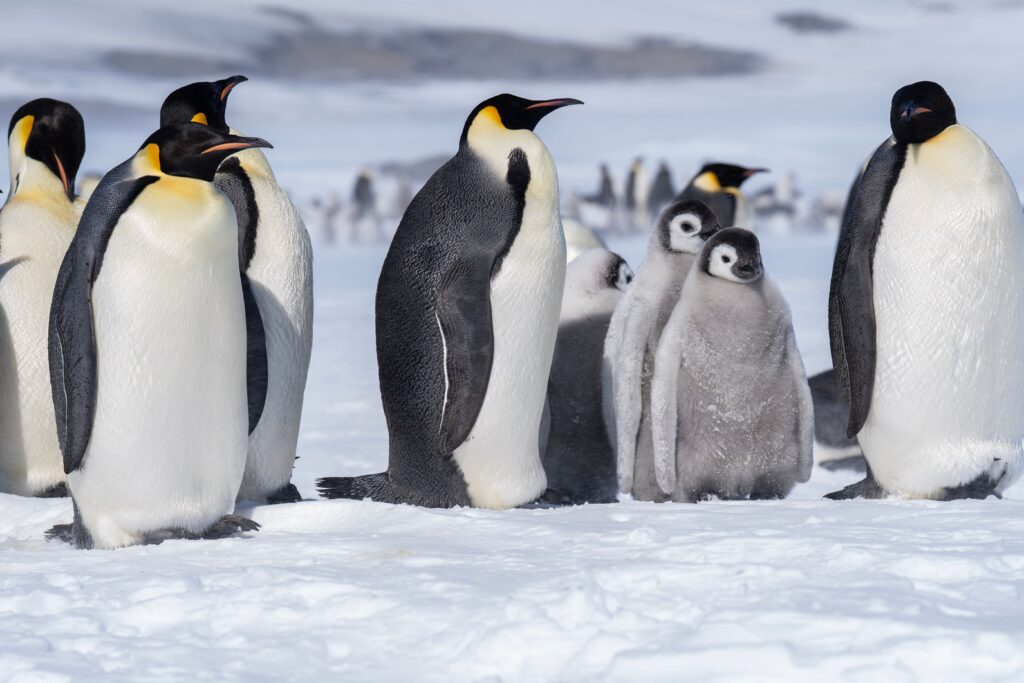
The emperor penguin is the tallest and heaviest of all penguin species, standing about 115 centimeters (45 inches) tall. It is the only penguin that breeds during the harsh Antarctic winter, enduring temperatures that can drop below minus 60 degrees Celsius.
Males incubate a single egg on their feet for roughly two months without eating, huddling together in massive groups for warmth. This extreme parenting strategy is unmatched by any other bird species on Earth.
Emperor penguins are also the deepest diving birds known to science, with recorded dives exceeding 500 meters (1,640 feet). That kind of depth lets them reach prey no other penguin can access.
2. King Penguin
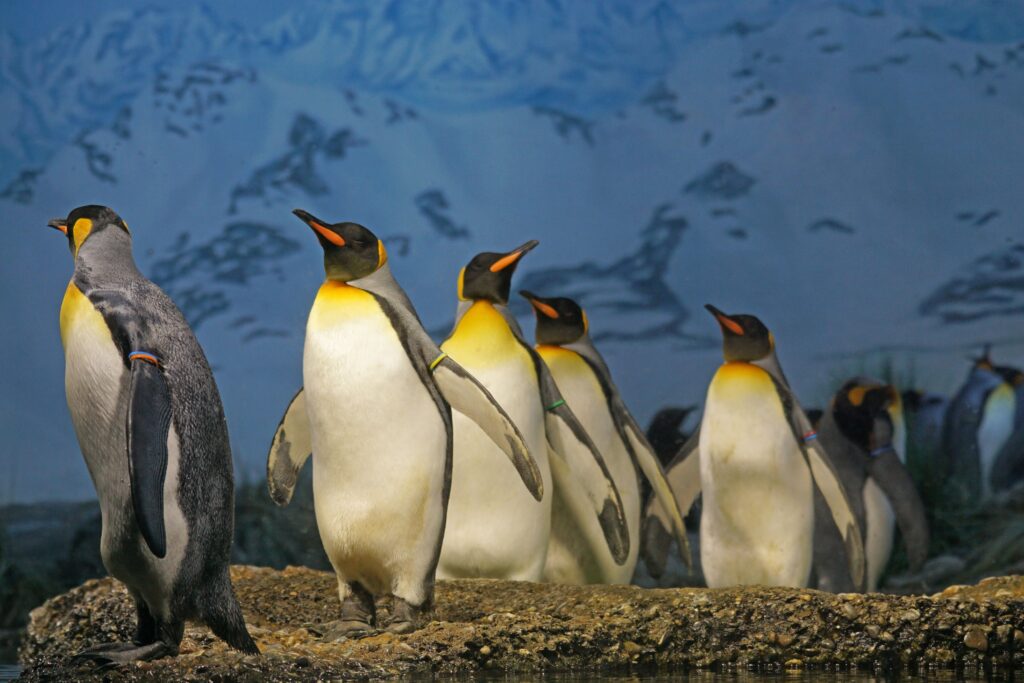
The king penguin is the second largest species, easily recognized by bright orange patches on its neck and ears. It breeds on subantarctic islands such as South Georgia, the Falklands, and the Crozet and Kerguelen archipelagos.
Unlike the emperor, the king penguin has such a long breeding cycle that chicks often overwinter on the colony, covered in thick brown down that once led sailors to mistake them for an entirely different species. Colonies can hold hundreds of thousands of breeding pairs at some sites.
King penguins dive frequently but not nearly as deep as emperors, usually feeding within the top 100 to 300 meters of the water column.
ALSO READ: 45 Birds With Colorful Feathers (Species Identification, With Pictures)
Part 2. Brush-Tailed Penguins: Genus Pygoscelis (3 Species)
Brush-tailed penguins are named for their stiff tail feathers, which drag slightly behind them and help with balance while walking on ice. This genus includes some of the most familiar Antarctic species.
3. Adélie Penguin
The Adélie penguin is one of the most widely studied species on the entire continent, thanks to decades of long-term monitoring by international research teams. It shows a simple black head and white eye-ring against a tuxedo-like body.
A recent NSF-supported drone survey recorded roughly 300,000 nesting pairs at a single colony on Cape Crozier, one of the largest Adélie colonies known. That survey alone covered an area comparable in size to the small country of Monaco.
Adélie penguins depend heavily on sea ice for both feeding and breeding, which makes them one of the clearest indicators scientists use to track changes in the Antarctic environment.
4. Gentoo Penguin
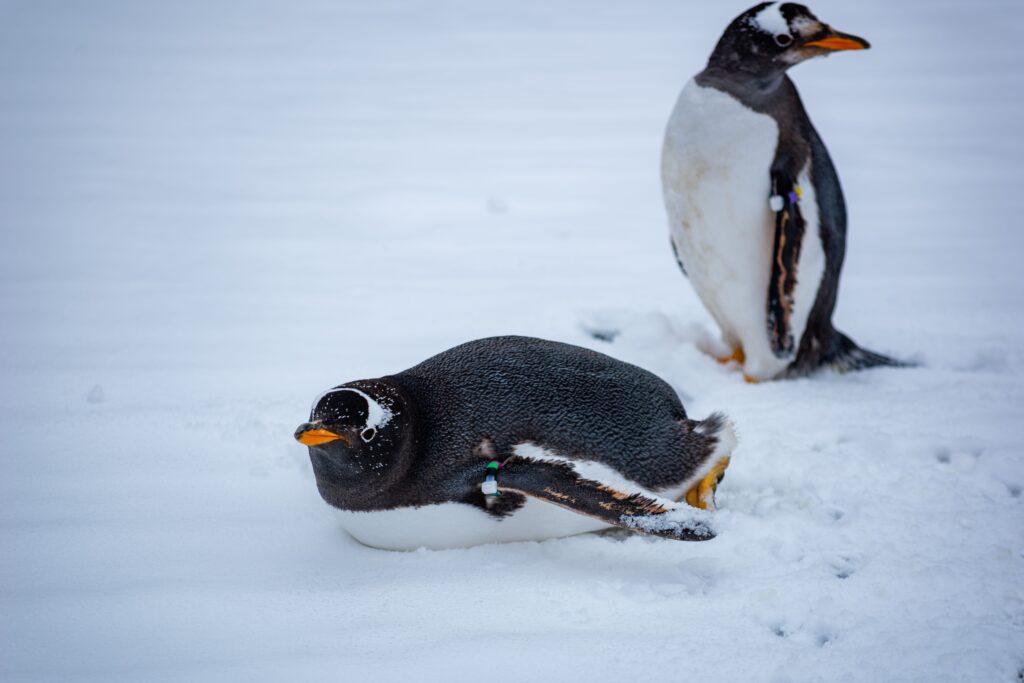
The gentoo penguin is easy to spot thanks to a wide white patch stretching across the top of its head like a cap. It also carries the fastest recorded swimming speed of any penguin, reaching bursts of over 35 kilometers per hour underwater.
Gentoos build nests from stones, grass, and feathers, and pairs often squabble loudly over stolen pebbles from a neighbor’s nest. This behavior has made them one of the more entertaining species to observe at breeding colonies.
Their range stretches from the Antarctic Peninsula up through subantarctic islands, giving them one of the broadest distributions among ice-associated penguins.
5. Chinstrap Penguin
The chinstrap penguin gets its name from the narrow black band running under its chin, giving the impression of a tiny helmet strap. It is one of the most numerous penguin species by total population.
Large colonies gather on the South Sandwich Islands and South Shetland Islands, often numbering in the hundreds of thousands of breeding pairs at a single site. Chinstraps are known for a loud, harsh call that carries easily across crowded colonies.
Researchers with NOAA Fisheries have used chemical signatures in chinstrap feathers to track how far individual birds travel to feed, offering new insight into their movement patterns across the Southern Ocean.
ALSO READ: 25 Birds That Sing at Night (Species Names, With Pictures)
Part 3. Little Penguins: Genus Eudyptula (1 Species)
This genus contains the smallest living penguin species, found only along the coastlines of Australia and New Zealand.
6. Little Penguin
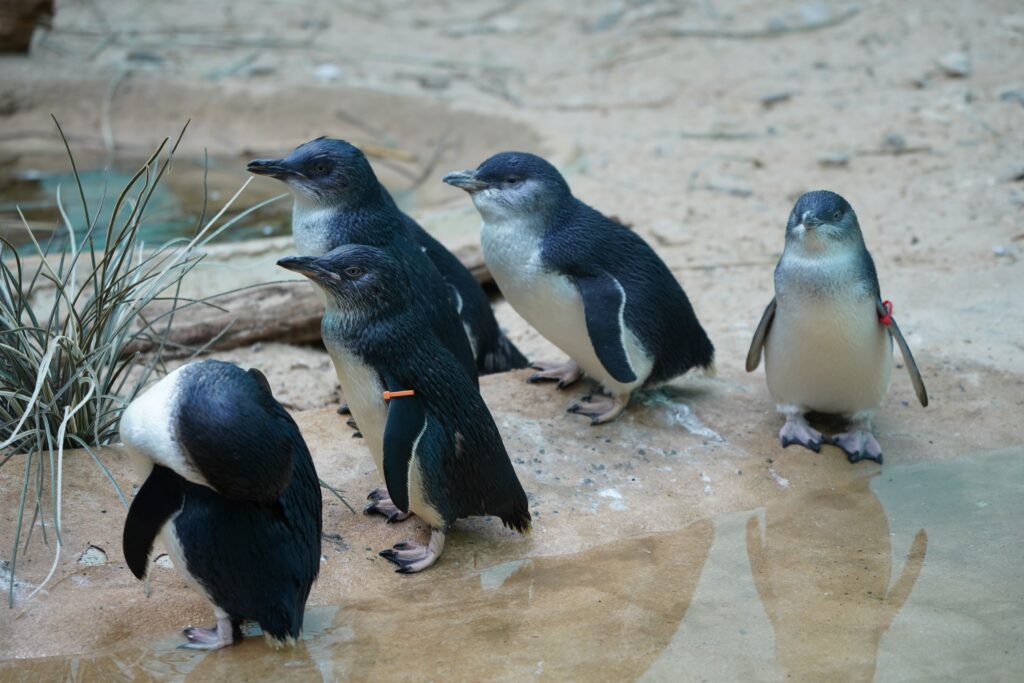
Standing barely 30 centimeters (about 12 inches) tall, the little penguin is the smallest species alive today. It is also called the fairy penguin or blue penguin, named for its soft slate-blue plumage rather than the typical black.
Unlike most penguins, it nests in burrows or under coastal vegetation and comes ashore almost exclusively after dark to avoid predators. Wild populations are estimated between 350,000 and 600,000 individuals, though numbers are gradually declining in parts of its range.
Little penguins are a major tourism draw in places like Phillip Island, Australia, where nightly “penguin parades” let visitors watch colonies return from the sea.
ALSO READ: 50 Types of Birds With Long Legs (Species Identification, With Pictures)
Part 4. Yellow-Eyed Penguin: Genus Megadyptes (1 Species)
This genus contains a single species, found nowhere else on Earth but New Zealand.
7. Yellow-Eyed Penguin
The yellow-eyed penguin, known locally as hoiho, carries a distinctive pale yellow band running from its eyes around the back of its head. It is considered one of the rarest penguin species alive today.
Unlike colonial nesters, yellow-eyed penguins prefer solitary, hidden nest sites within coastal forest and scrub, often out of sight of neighboring pairs. This solitary nature makes them harder to monitor than most other species.
Habitat loss, introduced predators, and disease outbreaks have pushed this species toward endangered status, prompting significant conservation investment across mainland New Zealand and its outlying islands.
Part 5. Banded Penguins: Genus Spheniscus (4 Species)
Banded penguins share a black band running across the chest and are generally found in warmer climates than their Antarctic relatives.
8. African Penguin
The African penguin, also called the jackass penguin for its donkey-like bray, is the only penguin species native to the African continent. It breeds along the coasts of South Africa and Namibia.
Its population has collapsed dramatically over the past century, from roughly a million breeding pairs in the early 1900s to a small fraction of that number today. It is currently classified as endangered, with continued declines recorded at major colonies.
Distinctive pink patches of bare skin above each eye help the bird release excess body heat in warmer coastal conditions.
9. Humboldt Penguin
Named after the cold Humboldt Current that runs along the Pacific coast of South America, this species breeds primarily in Chile and Peru. It shares a similar banded chest pattern with its African relative but tends to be slightly larger.
Humboldt penguins burrow into guano deposits or rocky crevices to nest, sheltering their eggs from intense coastal sun. Historical harvesting of guano for fertilizer destroyed much of this natural nesting material, contributing to population declines.
It is currently listed as vulnerable, with overfishing and El Niño events continuing to affect food availability along its range.
10. Magellanic Penguin
The Magellanic penguin breeds along the coasts of Argentina, Chile, and the Falkland Islands, forming some of the largest colonies of any banded penguin species. The University of Washington’s Magellanic Penguin Project, led by researcher Dee Boersma, has studied one colony at Punta Tombo continuously since 1982.
This decades-long study has tracked how individual penguins respond to shifting ocean conditions, oil spills, and extreme heat events. A 2019 heat wave recorded at the site caused a documented mass mortality event among adults and chicks.
Two black bands across the chest, rather than one, help separate this species from its close relatives.
11. Galápagos Penguin
The Galápagos penguin holds a genuinely unique distinction: it is the only penguin species found north of the equator, with parts of its range crossing into the Northern Hemisphere. Cool water currents around the islands make this tropical location surprisingly livable for a cold-adapted bird.
It is also one of the smallest banded penguins and among the rarest species overall, with a total population estimated at only a few thousand individuals. El Niño events, which warm surrounding waters and reduce food supply, can cause sharp population crashes within a single season.
Its limited range makes it especially vulnerable to any single environmental disturbance in the region.
ALSO READ: 25 Birds With Colorful Beaks (Identification, With Pictures)
Part 6. Crested Penguins: Genus Eudyptes (7 Species)
Crested penguins are named for the bold, often bright yellow feather plumes that sprout above their eyes. This is the largest genus in the entire penguin family.
12. Macaroni Penguin
The macaroni penguin carries some of the most dramatic head plumage of any penguin, with orange-yellow feathers sprouting from the center of the forehead. It is believed to be the most numerous penguin species by total population, with millions of breeding pairs across the Southern Ocean.
Despite huge numbers, the species is currently classified as vulnerable, since several major colonies have shown significant declines linked to changing krill availability. Colonies often share breeding grounds with rockhopper penguins on the same rocky slopes.
Its name reportedly comes from eighteenth-century English sailors, who compared its extravagant crest to the flamboyant “macaroni” fashion trend of the time.
13. Royal Penguin
The royal penguin is closely related to the macaroni penguin and, for years, was considered simply a color form of the same species. It breeds almost exclusively on Macquarie Island, located between New Zealand and Antarctica.
Its pale white face contrasts with the macaroni’s darker cheeks, offering the clearest way to separate the two species in the field. Nearly the entire world population nests on this single remote island.
Because its breeding range is so limited, any disturbance at Macquarie Island carries outsized risk for the species as a whole.
14. Fiordland Crested Penguin
Known locally as tawaki, the Fiordland crested penguin is endemic to New Zealand’s South Island. A thick stripe of pale yellow plumes runs from the bill back over each eye, distinguishing it from other crested species.
It nests in an unusual habitat for a penguin, choosing dense temperate coastal forest among tree roots and rocks rather than open, exposed ground. This forest-dwelling behavior is almost unheard of elsewhere in the penguin family.
Only around 2,500 breeding pairs remain, making it one of the rarer mainland-nesting penguins anywhere in the world.
15. Snares Penguin
The Snares penguin is endemic to the Snares Islands, a small, uninhabited group south of New Zealand. It closely resembles the Fiordland crested penguin but has a slightly thicker bill and lacks bare pink skin at its base.
Nesting takes place under dense coastal forest canopy, much like its Fiordland relative, offering protection from wind and sun. The entire global population is restricted to this single island group.
Its extremely limited range makes ongoing population monitoring especially important for conservation planning.
16. Erect-Crested Penguin
The erect-crested penguin is named for its stiff, upright yellow crest feathers, which stand straight up rather than drooping like those of related species. It breeds on a small number of remote subantarctic islands south of New Zealand.
Population numbers have declined sharply over recent decades, and the species is currently classified as endangered. Researchers have struggled to pinpoint an exact cause, though changing ocean conditions are considered a likely factor.
Because its breeding sites are so remote and difficult to access, this remains one of the least studied penguin species overall.
17. Southern Rockhopper Penguin
The southern rockhopper penguin is a compact, energetic bird named for its habit of hopping between rocks rather than waddling like most other species. Spiky yellow crest feathers and piercing red eyes give it a distinctly punk-rock appearance.
It breeds across a wide range of subantarctic islands, including the Falklands, and is currently classified as vulnerable due to ongoing population declines at several major colonies. Changing sea surface temperatures are thought to be affecting prey availability.
Its energetic hopping style, often straight up steep rocky cliffs, sets it apart from every other penguin on this list.
18. Northern Rockhopper Penguin
Slightly larger than its southern relative, the northern rockhopper penguin carries longer crest feathers and breeds on a smaller number of remote South Atlantic and Indian Ocean islands. It has suffered one of the steepest declines of any penguin species.
Estimates suggest the population has fallen by as much as 90 percent since the 1950s, largely due to changing ocean conditions and historical overharvesting for oil. It is currently classified as endangered.
Its dramatic population collapse makes it one of the most urgent conservation priorities within the entire crested penguin group.
19. Eastern Rockhopper Penguin
The eastern rockhopper penguin is recognized as a separate species by some authorities, including the Integrated Taxonomic Information System, though others still classify it as part of the southern rockhopper. It breeds on islands in the far southern Indian Ocean, including the Prince Edward and Crozet groups.
Genetic studies suggest measurable differences between eastern populations and their southern relatives, supporting the case for separate species status. Physically, the two are difficult to tell apart without close study.
This ongoing taxonomic debate is a good example of how penguin classification continues to shift as new genetic research becomes available.
ALSO READ: 30 Stunning Birds With Long Beaks (Species Identification, With Pictures)
Beyond the Core Species: 6 Additional Recognized Subspecies and Forms
Taxonomists agree on at least 18 or 19 full penguin species, but several closely related populations are distinct enough that field guides and researchers increasingly treat them as their own “types.” Here are six worth knowing.
20. White-Flippered Penguin
The white-flippered penguin is a subspecies of the little penguin, found only around New Zealand’s Banks Peninsula and nearby islands. A broader white edge along the flipper separates it from other little penguin populations.
Some researchers have argued for full species status, given its restricted range and consistent physical differences. For now, most authorities still classify it as a distinct subspecies rather than a separate species.
Its tiny range makes it especially sensitive to local threats like introduced predators and coastal development.
21. Falkland Islands Gentoo Penguin
Genetic research published in recent years has identified measurable differences between gentoo penguin populations across their range, with birds from the Falkland Islands forming one distinct lineage. This population tends to be slightly larger than gentoos found further south.
Falkland gentoos breed in some of the largest colonies anywhere in the species’ range, supported by rich surrounding fishing grounds. Local conservation groups conduct regular censuses to track colony health here.
Researchers increasingly treat this as a genetically distinct population worth tracking separately from other gentoo groups.
22. Antarctic Peninsula Gentoo Penguin
A second genetically distinct gentoo lineage breeds along the Antarctic Peninsula itself, adapted to a colder, more ice-dominated environment than the Falklands population. NOAA Fisheries researchers monitor several colonies of this group at field stations on King George Island.
This population faces different pressures than its northern relatives, particularly around krill availability and rapidly warming local sea temperatures. Long-term monitoring here has produced some of the most detailed gentoo population data available anywhere.
Its close ties to a warming, fast-changing environment make it a particularly important population for climate research.
23. South Georgia Gentoo Penguin
A third recognized gentoo lineage breeds specifically around the remote island of South Georgia, sitting between the Falklands and Antarctic Peninsula populations both geographically and genetically. Colonies here benefit from exceptionally rich surrounding waters.
South Georgia hosts some of the highest concentrations of breeding seabirds anywhere in the Southern Ocean, making it a globally significant site for gentoo research. Multiple international research teams maintain a long-term presence on the island.
This population’s intermediate genetic position has made it especially useful for understanding how gentoo lineages diverged over time.
24. Patagonian King Penguin
The Patagonian king penguin refers to the widespread subspecies found across South Georgia, the Falklands, and other South Atlantic breeding sites. It represents the vast majority of the world’s king penguin population.
Colonies at sites like South Georgia’s St. Andrews Bay can hold well over 100,000 breeding pairs, forming some of the densest seabird gatherings on the planet. Chicks here endure a long overwintering period on the colony before finally fledging.
Its large, accessible colonies have made this subspecies one of the most studied and photographed forms of king penguin anywhere.
25. Blonde African Penguin
The blonde African penguin is a rare, naturally occurring color form caused by a genetic condition that reduces melanin production, giving the bird pale, sandy-colored feathers instead of the usual black and white pattern. It remains fully identifiable as an African penguin in every other respect.
Rehabilitation centers along the South African coast have documented and cared for several of these unusually colored individuals over the years, drawing considerable public attention each time one appears. Their pale coloring can make them more visible to predators in the wild.
This striking color variation offers a vivid, real-world example of how much natural variation can exist within a single well-known species.
ALSO READ: 25 Birds That Swim Underwater to Catch Fish (With Pictures, and Info)
How to Identify Penguins in the Field
Size is often the fastest clue. Emperor and king penguins tower over every other species, while little penguins barely reach a person’s shin.
Head markings narrow things down quickly after that. Crested species show bold yellow plumes, banded species show a chest stripe, and brush-tailed species rely on subtler facial patterns instead.
Range matters just as much as appearance. A banded penguin seen in South America is almost certainly Humboldt or Magellanic, while one on the Galápagos Islands has only one possible answer.
Behavior offers a final layer of confirmation. Rockhoppers hop rather than waddle, little penguins come ashore only after dark, and yellow-eyed penguins nest alone rather than in crowded colonies.
Where Penguins Live Around the World
Penguins are often assumed to live only in snow and ice, but that picture is only partly true. Just five species live permanently on or around the Antarctic continent itself.
Antarctica and the Southern Ocean host the emperor, Adélie, chinstrap, and gentoo penguins, along with visiting king penguins on nearby subantarctic islands. These species depend heavily on sea ice for breeding and feeding.
Subantarctic islands such as South Georgia, the Falklands, Macquarie, and the Crozet archipelago support king, macaroni, royal, and rockhopper populations, often in colonies numbering in the hundreds of thousands.
Temperate coastlines across South America, southern Africa, and Australasia are home to Humboldt, Magellanic, African, little, and yellow-eyed penguins, none of which ever encounter snow in their natural range.
The Galápagos Islands, sitting directly on the equator, host the only penguin species living in genuinely tropical waters anywhere on Earth.
Conservation Status Snapshot
Penguins are under more pressure than most people realize. According to BirdLife International, 11 of the 18 formally recognized species are currently classified as globally threatened.
The erect-crested penguin, yellow-eyed penguin, northern rockhopper penguin, and Galápagos penguin all carry endangered status, with populations still trending downward. The African penguin has fared even worse, with numbers a small fraction of what they were a century ago.
By contrast, species like the gentoo penguin and little penguin remain relatively stable across much of their range, aided by protected breeding sites and reduced human disturbance in key colonies.
Climate change, shifting krill populations, and commercial fishing pressure sit behind most of these declines. NOAA Fisheries research has directly linked concentrated krill fishing near the Antarctic Peninsula to reduced breeding success in several penguin colonies.
A Quick Word From Me
Writing this list changed how I think about penguins. I expected mostly black-and-white variations on the same theme.
Instead, I found a species that nests in forests, one that lives on the equator, and one with a genuine yellow mohawk. Penguins turned out to be far stranger and more varied than their cartoon reputation suggests.
Frequently Asked Questions
How many types of penguins are there? Most authorities recognize 18 to 19 full species, though the exact number depends on how certain closely related populations, like the rockhoppers, are classified.
What is the largest penguin species? The emperor penguin is the largest, standing around 115 centimeters tall and weighing up to 40 kilograms.
What is the smallest penguin species? The little penguin holds that title, standing roughly 30 centimeters tall as an adult.
Do any penguins live outside Antarctica? Yes. In fact, most penguin species never set foot on Antarctica at all, living instead along temperate coastlines in South America, Africa, Australia, and New Zealand.
Is there a penguin that lives near the equator? Yes, the Galápagos penguin is the only species found north of the equator, thanks to cool ocean currents surrounding the islands.
Final Thoughts
Twenty-five types barely covers the full range of shapes, colors, and habitats found across the penguin family, yet they capture almost everything that makes these birds so remarkable.
Next time a penguin documentary comes on, take a closer look at which species is on screen. There is a good chance it is one of the 25 covered right here.
References
- National Science Foundation — Autonomous Multi-Drone Aerial Surveys of Antarctic Penguin Colonies: https://www.nsf.gov/news/autonomous-multi-drone-aerial-surveys-antarctic
- NOAA Fisheries — Seabird Research in the Antarctic: https://www.fisheries.noaa.gov/international/science-data/seabird-research-antarctic
- NOAA Fisheries — Antarctic Ecosystem Research Program, Southwest Fisheries Science Center: https://www.fisheries.noaa.gov/about/antarctic-ecosystem-research-program-southwest-fisheries-science-center
- NOAA Fisheries — Scientists Track Antarctic Penguins Using Chemical Signatures: https://www.fisheries.noaa.gov/news/scientists-track-antarctic-penguins-using-chemical-signatures
- University of Washington News — How Natural Selection Acted on One Penguin Species Over the Past Quarter Century: https://www.washington.edu/news/2016/09/23/how-natural-selection-acted-on-one-penguin-species-over-the-past-quarter-century/
- Woods Hole Oceanographic Institution, FLEDGE Lab — Facts on Penguins: https://www2.whoi.edu/site/jenouvrier/research/facts-on-penguins/
- Scripps Institution of Oceanography, UC San Diego — Diving Into Seabird Science: https://scripps.ucsd.edu/news/diving-seabird-science