25 Birds That Swim Underwater to Catch Fish (With Pictures, and Info)
I still remember the first time I watched a cormorant vanish under a lake and pop up thirty feet away with a wriggling fish. It felt like a magic trick. Birds are supposed to fly, not swim like otters. Yet nature built dozens of species that do exactly that.
These birds have traded some flying skill for something rarer: the ability to chase fish through open water. Some use their feet as paddles. Others fold their wings into flippers. A few even walk along riverbeds like tiny divers in rubber boots.
This guide covers 25 birds that swim underwater to catch fish, with verified depth records, speeds, and dive times from wildlife agencies and research institutions. Let’s go beneath the surface.
How Do Birds Swim Underwater in the First Place?
Before the list, it helps to know what makes underwater swimming possible for a creature built to fly. Three main adaptations show up again and again.
Dense bones reduce buoyancy. Most flying birds have hollow, air-filled bones to stay light. Diving birds like loons and cormorants have solid bones instead, which helps them sink and stay down.
Reduced heart rate conserves oxygen. This is called the diving reflex. Blood flow shifts away from muscles and toward the heart and brain during a dive.
Wing or foot propulsion drives movement. Penguins and puffins “fly” through water using their wings. Cormorants, loons, and grebes kick with large webbed feet instead.
Researchers at Colby College note that a loon compresses its body and forces air out of its feathers just before diving, since trapped air would otherwise make the bird too buoyant to submerge easily.
Now, here are the 25 birds that put these adaptations to work.
1. Emperor Penguin
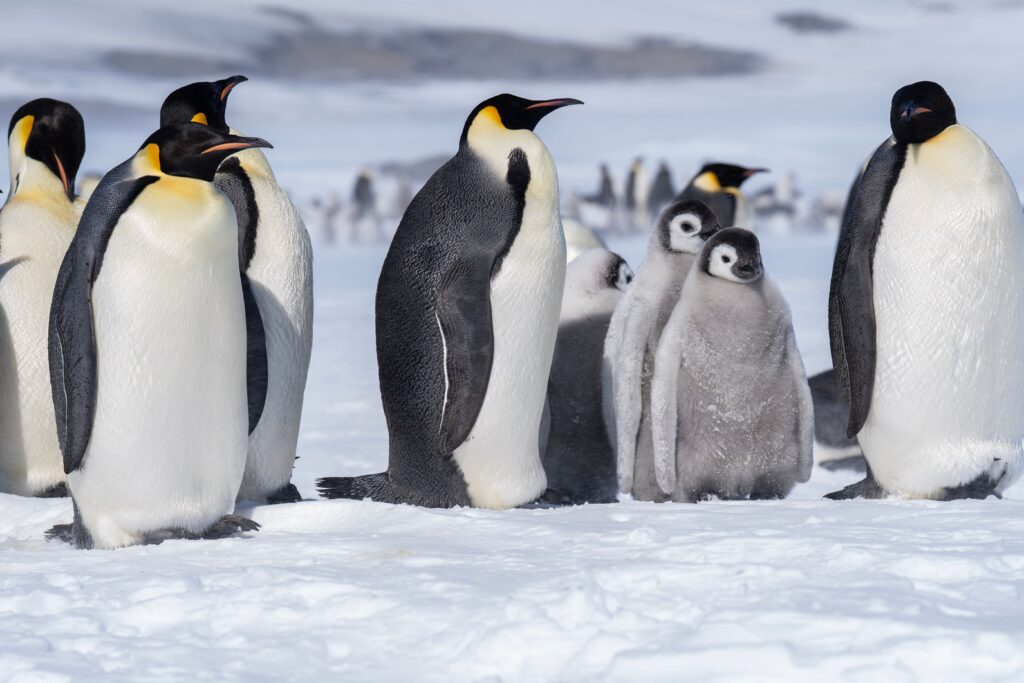
The emperor penguin is the undisputed champion of avian diving. A three-year study tracking 93 penguins recorded a dive of 564 metres (1,850 feet), the deepest ever measured for any bird.
Most of its hunting dives are far shallower, typically between 100 and 200 metres. Even so, one individual has stayed submerged for 32.2 minutes, according to a study in Marine Ecology Progress Series.
This depth comes from more than just lung capacity. Emperor penguins hold elevated myoglobin levels in their muscles, which stores extra oxygen for long dives.
Interestingly, of the 264 dives beyond 400 metres recorded in that study, a full 12 dives beyond 500 metres were all performed by a single individual bird. That suggests extreme depth isn’t a routine hunting strategy for the species as a whole; it’s closer to a rare, exceptional feat performed by a few standout divers pushing their limits.
Physically, this bird is built for pressure most animals never encounter. Its bones are solid rather than hollow, and its rib cage can flex slightly under compression instead of cracking. That flexibility, paired with air sacs that partially collapse during descent, keeps the emperor penguin safe at depths that would injure most vertebrates.
Breeding adds another layer of difficulty to this story. Emperor penguins fast for months during the Antarctic winter while incubating a single egg, so every deep dive once the ice breaks up matters enormously for feeding a hungry chick. A parent that can’t locate fish quickly risks losing the entire breeding season, which is part of why this species pushes its diving limits so hard.
2. Gentoo Penguin
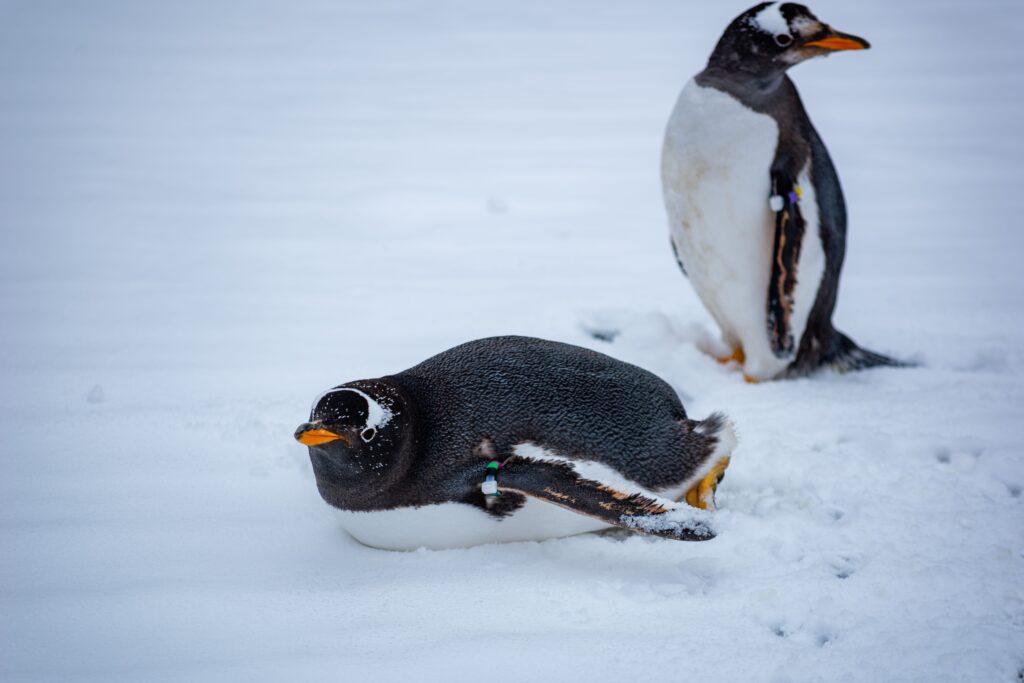
If emperors win on depth, the gentoo penguin wins on speed. It reaches bursts of 36 km/h (22 mph) underwater, making it the fastest-swimming bird documented anywhere.
Gentoos can also dive to around 200 metres in pursuit of fish and krill. Scientists studying their swimming motion found that a wing-tilting technique called “feathering” gives them this speed advantage.
I find this one genuinely astonishing. A bird the size of a toddler can out-swim most competitive human swimmers several times over.
Gentoo penguins also porpoise while swimming, leaping clear of the surface between strokes the way dolphins do. This isn’t just showing off. Breaking the surface reduces drag at high speed, since air resistance is far lower than water resistance, and it lets the bird grab a quick breath without slowing down.
Their colonies stretch across the Antarctic Peninsula and several sub-Antarctic islands, and gentoos tend to forage closer to shore than emperors or kings. Shorter, shallower trips mean gentoo parents can return to the nest more often, which may explain why this species has expanded its range even as some neighboring penguins have declined.
3. Adélie Penguin
The Adélie penguin hunts krill and small fish in the icy waters around Antarctica. It typically dives to depths of 50 to 170 metres, though shallower dives are far more common during daily feeding trips.
Adélies often hunt in groups, which may help them corral schools of fish more efficiently than a lone bird could manage.
Most Adélie dives stay well under 100 metres, with the deepest confirmed record sitting around 240 metres. Diving pattern shifts through the day, with birds generally hunting closer to the surface at dawn and dusk, when their prey rises higher in the water column.
This species is also one of only two penguins that breed exclusively on the Antarctic continent itself, rather than on warmer sub-Antarctic islands. That means Adélies must time their entire breeding cycle around the seasonal retreat of sea ice, since the colony’s access to open water for fishing depends entirely on when the ice breaks apart each spring.
4. King Penguin
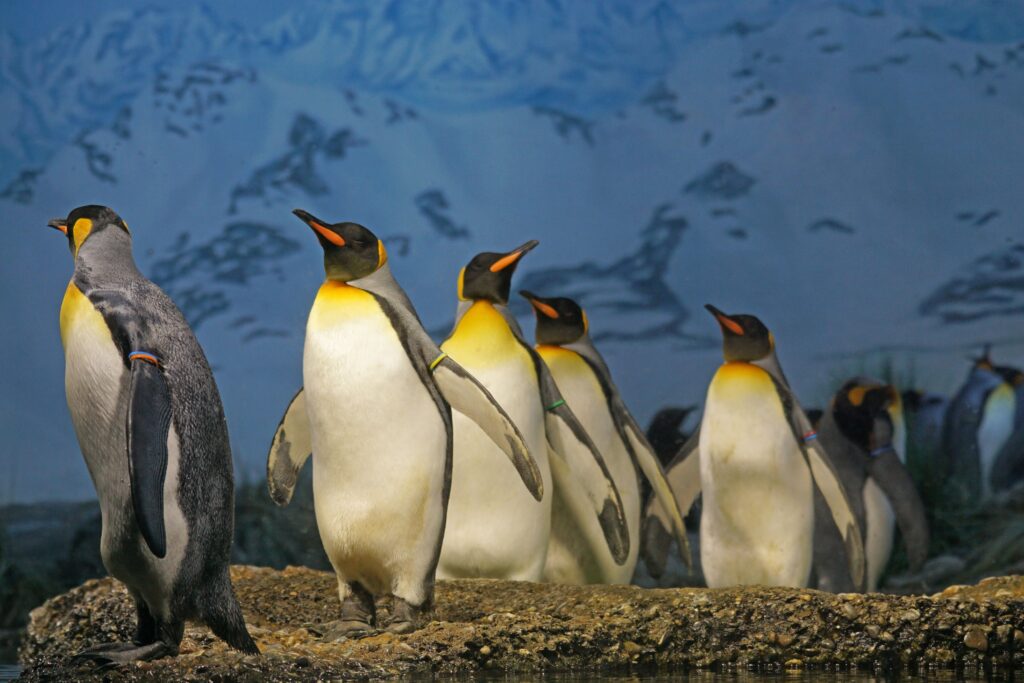
King penguins dive deeper than most people expect for a bird that isn’t the emperor. Recorded dives reach roughly 300 metres, aimed mainly at catching lanternfish and squid in open ocean water far from shore.
Their dives can last several minutes, and king penguins often travel hundreds of kilometres from their colonies just to reach productive feeding grounds.
King penguins time their hunting around their prey’s own daily migration. Lanternfish rise closer to the surface at night and sink into darker water during the day, so king penguins dive far deeper in daylight hours and stay within 30 metres of the surface after dark, adjusting their strategy to match where the fish actually are.
Raising a chick is a slow, demanding process for this species, often stretching to 14 or 16 months before the young bird is ready to fend for itself. That long dependency means adults must repeatedly leave the colony on multi-week foraging trips, diving hundreds of times per journey just to keep a single chick fed through an entire winter.
5. Rockhopper Penguin
Rockhopper penguins are smaller and shallower divers, generally reaching around 100 metres or less. What they lack in depth, they make up for in energy and persistence, hopping between rocks on land and chasing krill and small fish just offshore.
Despite their small size, rockhoppers swim at surprisingly quick speeds underwater, reaching close to 7 km/h (4 mph) during a chase. They’re also the only penguin species known to enter the water by jumping in feet-first rather than the belly-flop dive used by most other penguins.
Rockhoppers typically head out to sea in coordinated groups each morning and may stay away from the colony for up to 12 hours at a stretch. Night dives tend to run shallower than daytime dives, and birds breeding in colder sub-Antarctic waters generally forage deeper and longer than those living in milder, food-rich regions further north.
6. Little Penguin (Blue Penguin)
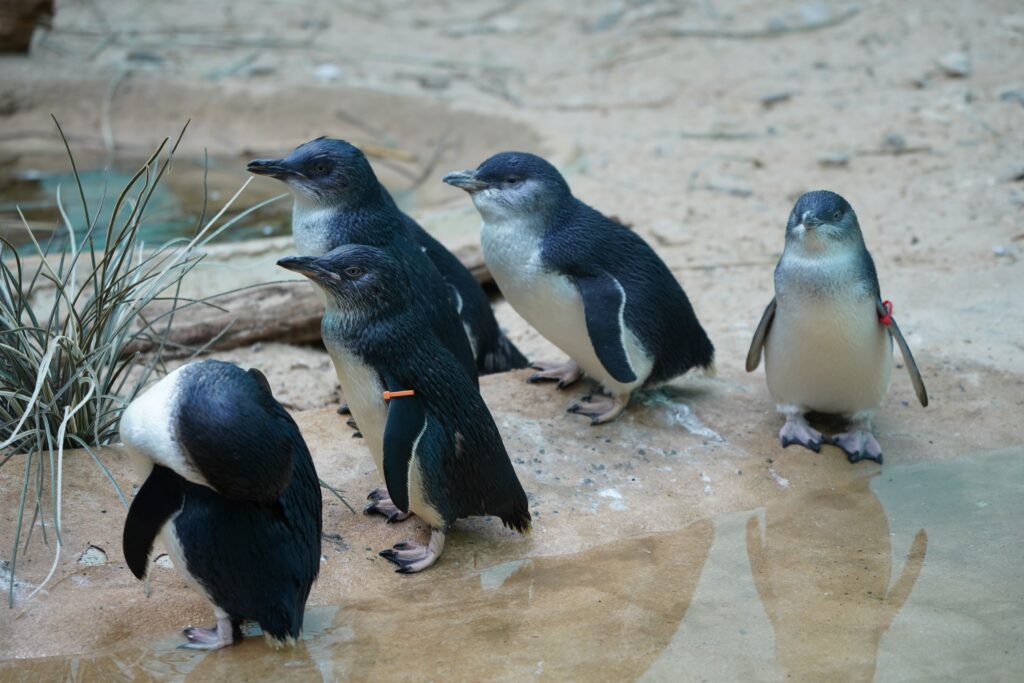
The little penguin, found along Australian and New Zealand coasts, is the smallest penguin species alive. It dives to modest depths of around 60 feet on average but does so dozens of times a day to catch small schooling fish.
Standing barely a foot tall, the little penguin is the smallest of all penguin species, weighing only around 2 to 3 pounds. Despite this, telemetry studies have recorded individuals reaching depths of roughly 69 metres, far beyond what its tiny frame might suggest.
Little penguins are also unusual for being strictly nocturnal on land. They wait until after dusk to return from the sea, waddling ashore in groups toward burrows tucked into sand dunes or rocky crevices, likely as protection against daytime predators that hunt by sight along the coast.
ALSO READ: 25 Types of Penguins (Different Species, With Pictures Explained)
7. Great Cormorant
The great cormorant dives using powerful webbed feet rather than its wings. Recorded dives have reached depths approaching 60 metres, though most foraging happens much shallower, around 14 metres on average.
Cormorants have less preen oil than most waterbirds, so their feathers get waterlogged on purpose. That reduces buoyancy and makes deep, fast pursuit dives easier.
That trade-off comes at a cost, though. Once a great cormorant finishes fishing, it can’t simply fly off dry. Wet feathers mean it has to perch and stretch its wings out wide for several minutes, a familiar sight along riverbanks and harbor walls around the world.
Great cormorants have one of the widest distributions of any waterbird, found across Europe, Asia, Africa, and North America. This adaptability is part of why humans in China and Japan have used trained cormorants for traditional fishing for centuries, exploiting the bird’s natural hunting instincts while a ring around its throat prevents it from swallowing the largest catches.

8. Double-crested Cormorant
North America’s double-crested cormorant typically dives over 100 feet and stays submerged for two to three minutes at a stretch. It relies entirely on foot propulsion, chasing fish with sharp, agile turns underwater.
Once it surfaces, you’ll usually see it standing with wings spread wide, drying its soaked feathers in the sun.
This species is common across nearly the entire North American continent, from Alaska down to Mexico, and it adapts easily to lakes, rivers, and coastal bays alike. Excellent underwater vision lets it hunt effectively even in murky water, and a sharply hooked bill tip keeps slippery fish from wriggling free once caught.
Double-crested cormorants were once heavily persecuted by fishery operators who saw them as competitors, and populations crashed in parts of North America during the mid-20th century from pesticide contamination. Protections since then have allowed numbers to recover substantially, though the species still draws conflict at fish farms and stocked trout streams.
9. Imperial Cormorant
An imperial cormorant fitted with a small camera by researchers in Argentina was filmed diving 150 feet (46 metres) straight to the seafloor to catch a single fish, a depth that surprised the scientific team studying it.
The footage, released through National Geographic and the Wildlife Conservation Society, showed the bird hunting far deeper than earlier estimates suggested cormorants could manage.
The full dive sequence was tracked closely: roughly 40 seconds to descend, 80 seconds hunting near the bottom, then 40 seconds back to the surface. That’s over two and a half minutes on a single breath, spent almost entirely in near-total darkness.
Also called the king cormorant, this large seabird nests along the rocky coastlines of Argentina and the Falkland Islands. Its colonies can be enormous, with thousands of pairs crowding onto cliffside ledges, and it often shares nesting grounds with rockhopper penguins and other seabirds competing for the same fish stocks nearby.
Unlike many cormorants that forage in shallow bays, the imperial cormorant regularly targets bottom-dwelling species living directly on the seafloor. That habit places real physical demands on the bird, since navigating total darkness under pressure requires strong spatial memory and a willingness to hunt largely by touch and sound rather than sight.
10. Common Loon
The common loon is a symbol of quiet northern lakes, but underwater it becomes a serious predator. Loons typically dive 4 to 10 metres, though tagged individuals have reached depths of 60 metres or more.
A loon’s heart rate can drop from 250 beats per minute at the surface to just 20 beats per minute during a deep dive, a dramatic adjustment that stretches its oxygen supply.
Government dive-tracking data collected on wintering loons in the Gulf of Mexico recorded dives as deep as 50 metres, most aimed at bottom-dwelling prey.
Loons are almost helpless on land, since their legs sit so far back on the body that walking becomes an awkward shuffle. This same leg placement is what makes them such strong underwater swimmers, delivering powerful thrust with every kick as they chase fish through open water.
Beyond depth and speed, loons carry real symbolic weight in the regions where they breed. Their haunting, wavering calls across quiet northern lakes have become one of the defining sounds of the wilderness in Canada and the northern United States, and the species remains a closely watched indicator of clean, healthy lake ecosystems.
ALSO READ: 45 Birds With Colorful Feathers (Species Identification, With Pictures)
11. Red-throated Loon
Smaller than the common loon, the red-throated loon hunts in shallower coastal and freshwater areas. It still swims with the same foot-powered pursuit style, chasing small fish with sudden bursts of speed.
Unlike the common loon, which needs a long running start across water to take flight, the red-throated loon can launch almost directly from the surface. This makes it more flexible about using smaller ponds and tundra pools for nesting, since it doesn’t need the long open runway that larger loon species require.
Breeding across the high Arctic, this species often nests on tiny pools too small to hold fish at all, then commutes to nearby larger lakes or the open sea to hunt. That commuting habit sets it apart from most other loons, which typically nest directly on the same body of water where they feed.
12. Atlantic Puffin
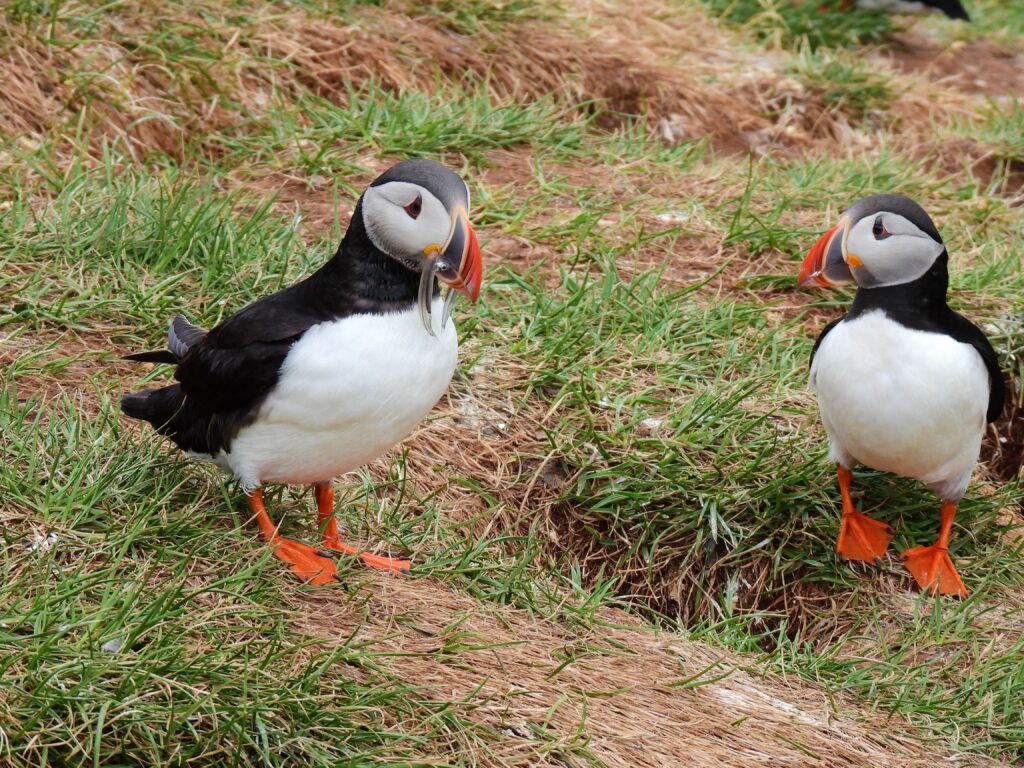
The Atlantic puffin is one of the few birds that genuinely “flies” underwater, using its short, powerful wings as paddles and its feet as a rudder. Puffins have been recorded diving to depths of up to 60 metres (200 feet).
Most dives last only 20 to 30 seconds, but a puffin can carry an impressive number of fish crosswise in its bill afterward. The record catch documented in Britain was 62 fish in a single beak-load.
Small backward-facing spines on the roof of a puffin’s mouth hold each fish in place, which is exactly what allows it to keep catching more without dropping the ones it’s already holding. This clever adaptation turns a single dive into a multi-fish haul, maximizing the payoff for chicks waiting back at the burrow.
Puffins spend the overwhelming majority of the year far out at sea, only returning to land each spring and summer to breed. Iceland alone hosts an estimated 60 percent of the world’s Atlantic puffins, nesting in earthen burrows dug into clifftop turf, often the very same burrow used year after year by the same breeding pair.
13. Common Murre
Among all auks, the common murre is one of the deepest divers, with records showing dives past 100 metres. It hunts fish and small invertebrates far below the surface, propelled entirely by its wings.
Murres nest in dense cliffside colonies, which means thousands of birds may be diving in the same patch of ocean during a feeding frenzy.
Common murres have some of the most tightly packed nesting arrangements of any bird species anywhere, with incubating adults often standing shoulder to shoulder on bare cliff ledges. They lay a single pear-shaped egg directly on the rock, a shape that helps it spin in a tight circle rather than roll off the ledge if bumped.
Chicks leave the nest ledge long before they can fly, jumping or fluttering down toward the sea at just a few weeks old while still covered in down. A parent, usually the male, accompanies the chick on this dramatic plunge and continues caring for it at sea for several more weeks until it’s strong enough to fend for itself.
ALSO READ: 50 Types of Birds With Long Legs (Species Identification, With Pictures)
14. Razorbill

The razorbill is a close relative of the puffin and shares its wing-powered swimming style. It dives to depths of around 25 metres on typical feeding trips, chasing small schooling fish like sand eels and sprats.
Researchers tracking razorbills have occasionally recorded far deeper excursions, with one bird documented swimming at 140 metres, well beyond what typical feeding trips would suggest. Most of its hunting, though, happens in the upper 20 metres of open water, close enough to the surface for daylight to still reach.
Roughly 60 to 70 percent of the world’s razorbills breed around the coasts of Iceland, often nesting alongside common murres and Atlantic puffins on the same stretches of cliff. Interestingly, razorbills are known to steal fish directly from puffins by chasing and torpedoing them from below, a rare example of one diving seabird actively hunting another underwater.
15. Black Guillemot
The black guillemot favors shallower coastal waters, generally diving less than 50 metres. It hunts along rocky seabeds, picking off small fish and invertebrates hiding among stones and kelp.
Unlike murres and razorbills, which nest in enormous crowded colonies, the black guillemot tends to breed in smaller, more scattered groups, often tucking a nest into a rock crevice or an old building along the shoreline. Its bright red feet and mouth lining make it one of the easiest auks to identify at a glance, standing out sharply against otherwise black-and-white plumage.
Black guillemots are also unusual among auks for staying close to home year-round rather than wintering far out at sea. Many individuals remain within sight of their breeding cliffs even in the coldest months, foraging in shallow inshore waters as long as the sea stays free of thick ice.
16. Anhinga (Snakebird)
The anhinga hunts by stealth rather than speed. It swims with its entire body submerged, leaving only its snake-like head and neck visible above the water, a habit that earned it the nickname “snakebird.”
Rather than chasing fish, it stalks slowly and then spears prey sideways with a sudden thrust of its sharp bill. Unlike most waterbirds, anhingas lack waterproof feathers, so their plumage gets soaked, which actually helps them stay submerged.
The U.S. National Park Service notes that anhingas swim slowly underwater around vegetation, spearing fish through the side with a rapid stab of the partly opened bill.
Once a fish is impaled, the anhinga faces an unusual problem: the bill can’t open wide enough to swallow prey while it’s still stuck sideways on the tip. It solves this by tossing the fish into the air with a flick of the neck, catching it again, and swallowing it headfirst in one smooth motion.
University of Miami researchers studying Florida’s waterbirds found that anhingas and double-crested cormorants, despite looking and behaving similarly, actually differ noticeably in physiology and hunting style. Anhingas favor a slower, stalking approach around dense vegetation, while cormorants tend to chase larger fish more actively, often in deeper and more open water.
17. Great Cormorant’s Cousin: The European Shag
The European shag dives to some of the greatest depths recorded in the cormorant family, approaching 60 metres in some tracked individuals. It favors rocky coastlines and hunts sand eels and other small fish near the seabed.
Slightly smaller and slimmer-necked than the great cormorant, the shag is easy to mistake for its larger relative at a distance. A thinner bill and a distinct breeding-season crest are the clearest giveaways, along with a metallic green sheen across its feathers that gives rise to its alternate name, the green cormorant.
Because it feeds almost entirely close to shore, the European shag is especially vulnerable to prolonged storms. Extended stretches of rough seas can prevent birds from diving effectively for days at a time, and populations along parts of the British and Irish coastline have suffered noticeable declines during unusually stormy breeding seasons.
18. Long-tailed Duck
The long-tailed duck is arguably the most impressive diver among ducks. Tracked individuals have reached depths of 60 metres (200 feet), and this species spends three to four times longer underwater than it does resting on the surface during feeding bouts.
Unusually for a duck, it swims using its partly folded wings rather than its feet, a technique closer to what penguins and puffins use.
This wing-powered swimming style sets the long-tailed duck apart from nearly every other duck species. Its ascent and descent are also unusually fast, moving through the water column at roughly one to one and a half metres per second, whether it’s diving in fresh water or out at sea.
Long-tailed ducks breed on Arctic tundra pools and spend the winter far offshore, often well beyond sight of land. Sadly, this species has suffered steep population declines in recent decades, partly from entanglement in fishing nets, and it’s now classified as vulnerable on international conservation assessments.
ALSO READ: 25 Birds With Colorful Beaks (Identification, With Pictures)
19. Common Eider
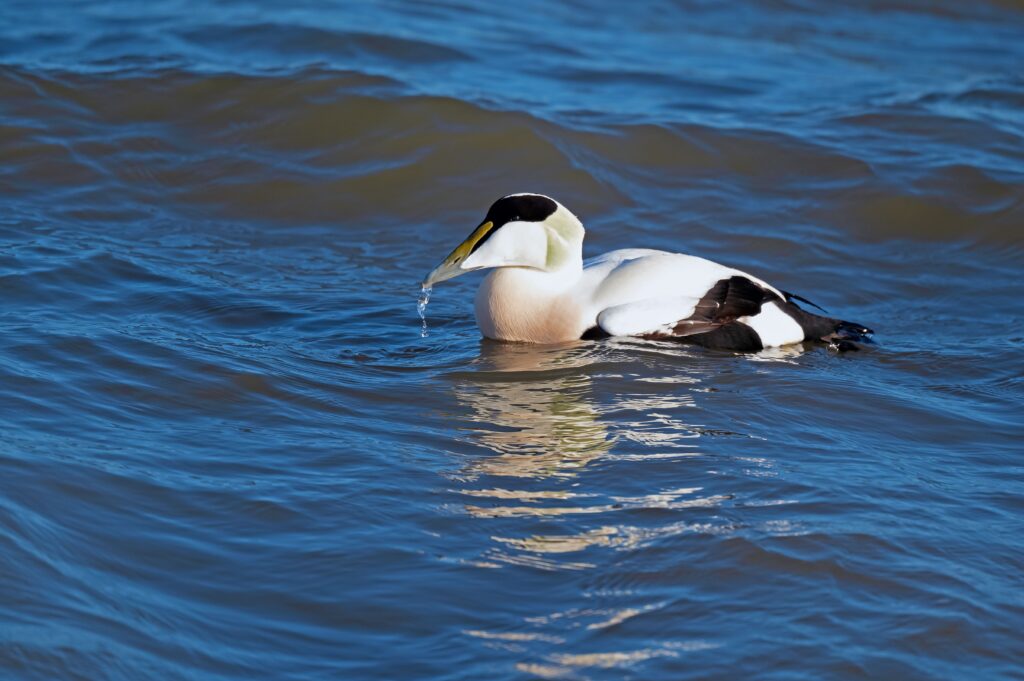
The common eider holds the title of deepest-diving true duck, reaching depths of around 20 metres (65 feet). It feeds mainly on mussels and other shellfish, though it will also take small fish when the opportunity arises.
Common eiders are famous for another reason entirely: the soft, insulating down feathers females pluck from their own breast to line the nest. This same down has been harvested by coastal communities for centuries, prized as one of the warmest natural insulating materials available anywhere.
Eiders dive using their feet rather than their wings, kicking hard to reach mussel beds along rocky coastlines. Their strong, thick bills are well suited to crushing shellfish, and large flocks often gather at productive feeding grounds during the colder months, sometimes numbering in the thousands.
20. Red-breasted Merganser
The red-breasted merganser has a long, thin, serrated bill built specifically for gripping slippery fish. It dives to depths of roughly 9 to 12 metres, chasing prey underwater with quick, agile turns.
This species sometimes hunts cooperatively, working together in small groups to herd schools of fish into shallow water where they become easy to snatch without even needing to dive. It’s also remarkably fast in flight, with recorded speeds reaching up to 81 mph, among the quickest of any duck species anywhere.
Red-breasted mergansers breed across the tundra and boreal forest zones of the Northern Hemisphere and are the only mergansers regularly found far out on open salt water. Their legs sit unusually far back on the body, which helps enormously with underwater propulsion but makes them clumsy and slow when trying to walk on land.
21. Common Merganser
Similar in build to its red-breasted cousin, the common merganser hunts in both rivers and lakes. It dives and swims underwater for around 30 seconds at a time, using its feet to pursue trout, minnows, and other freshwater fish.
Common mergansers hunt almost entirely by sight, which means they favor clear, unpolluted lakes and rivers where visibility underwater stays good. Murky or heavily silted water makes it far harder for this species to spot fish, which is one reason it’s often considered an indicator of water quality.
Flocks of common mergansers sometimes cooperate during winter, working together to push fish into shallower areas where they’re easier to catch. Because they compete directly with anglers for trout and salmon in some regions, the species has occasionally been targeted by fisheries as a perceived threat to stocked game fish.
ALSO READ: 30 Stunning Birds With Long Beaks (Species Identification, With Pictures)
22. Western Grebe
The western grebe is known for its striking courtship dance across the water’s surface, but its underwater hunting is just as specialized. It dives smoothly with barely a ripple, using lobed toes rather than fully webbed feet to chase small fish.
The western grebe’s courtship display, sometimes called “rushing,” involves both birds sprinting side by side across the water’s surface with their necks curved into a matching S-shape. This synchronized performance is considered one of the most elaborate courtship rituals in the entire bird world, and it plays a direct role in choosing a mate.
Because their legs sit so far back on the body, western grebes are almost entirely helpless on land and rarely come ashore except when storms force them down during migration. They typically migrate at night and spend virtually their entire lives on open water, only briefly interrupting that routine to nest along reed-lined lake edges.
23. Great Crested Grebe
The great crested grebe dives frequently while foraging, often staying under for 20 to 30 seconds. Its slender, dagger-like bill is well suited to grabbing fish rather than crushing shellfish.
Chicks of this species are remarkably precocious, capable of swimming and diving within hours of hatching. Parents often carry the striped, zebra-patterned chicks on their backs, even diving underwater with a chick still clinging to their feathers, a habit that offers protection from fish and other predators lurking below.
Great crested grebes were once hunted heavily in the 19th century for their ornamental head feathers, which were used in fashion, and populations crashed sharply as a result. Conservation protections introduced since then have allowed the species to recover strongly, and it’s now a familiar and common sight on lakes and reservoirs across much of Europe.
24. Northern Gannet
The northern gannet doesn’t linger underwater the way a penguin does, but its entry into the water is one of the most dramatic hunting moves in the bird world. Gannets plunge from heights of up to 30 metres and hit the water at speeds of roughly 60 mph (97 km/h).
After entry, they continue swimming underwater using both wings and feet, sometimes reaching depths of around 15 to 20 metres before surfacing with a fish. Special air sacs beneath the skin cushion the impact of each dive.
Gannets actually use two distinct dive shapes. A quick V-shaped dive lasts only a few seconds, while a longer U-shaped dive keeps the bird swimming underwater for up to 20 seconds. Research suggests the U-shaped version is roughly 50% more successful at catching prey, since it gives the gannet more time to chase a fish that dodges the first strike.
Surviving repeated high-speed water entries takes some remarkable engineering. Air sacs beneath the skin of the neck and chest inflate like built-in airbags, absorbing the shock of impact, while fused nostrils and a reinforced skull keep water from being forced into sensitive tissue during the strike.
Northern gannets nest in some of the largest and noisiest seabird colonies in the North Atlantic, with sites like Bonaventure Island in Canada and Bass Rock in Scotland hosting tens of thousands of breeding pairs. Juveniles eventually migrate remarkable distances, sometimes traveling thousands of kilometres south toward the coast of West Africa before returning north to breed.
25. American Dipper
The American dipper closes this list with the strangest method of them all. It’s the only truly aquatic songbird in North America, and instead of swimming freely, it walks along the streambed underwater, gripping stones with its unwebbed claws.
It typically stays submerged for 5 to 15 seconds at a time, foraging for aquatic insect larvae, fish eggs, and the occasional small fish. Cornell Lab of Ornithology researchers describe it entering the water head-first from a rock, propelled briefly by partly opened wings before it settles onto the bottom.
A translucent third eyelid lets it see clearly underwater, and a flap over its nostrils keeps water out while it forages against the current.
Dippers are fiercely territorial, defending a stretch of stream year-round against rival pairs. Their bodies carry an unusually thick layer of down and oil-rich feathers, along with blood that carries more oxygen than most songbirds of similar size, all of which helps them keep hunting even in near-freezing winter currents.
Because this species depends entirely on fast, clean, well-oxygenated streams, it’s often treated as a living gauge of watershed health. A stream that loses its dippers has usually lost something else first, whether that’s water clarity, insect abundance, or the steady flow that this small, remarkable bird depends on to survive.
A Quick Comparison of Depth and Speed
| Bird | Max Recorded Depth | Notable Trait |
| Emperor Penguin | 564 m | Deepest-diving bird ever recorded |
| Gentoo Penguin | ~200 m | Fastest swimming bird (36 km/h) |
| King Penguin | ~300 m | Long-distance open-ocean forager |
| Common Loon | ~60 m | Heart rate drops to 20 bpm while diving |
| Long-tailed Duck | ~60 m | Deepest-diving true duck species |
| Atlantic Puffin | ~60 m | Carries up to 62 fish per trip |
| Northern Gannet | ~20 m (post-plunge) | Enters water at 60 mph |
| American Dipper | Shallow (walks bottom) | Only aquatic songbird in North America |
Where to Spot Diving Birds Yourself
If this list has you curious to see one in person, timing and location matter more than luck. Coastal cliffs and offshore islands in the North Atlantic, such as those around Newfoundland, Scotland, and Iceland, host large colonies of puffins, gannets, and murres during the breeding season, roughly May through August.
Quiet northern lakes in Canada, the northern United States, and Scandinavia are reliable spots for common loons, especially at dawn when the water is calm and their calls carry furthest.
Fast, rocky mountain streams in western North America are the place to look for the American dipper. Watch a boulder near a rapid for a few minutes, and you may see one bob, then simply vanish into the current.
Florida’s freshwater marshes and mangrove edges, particularly in the Everglades, are dependable territory for anhingas, often visible drying their wings on a low branch after a dive.
Frequently Asked Questions
Which bird dives the deepest to catch fish? The emperor penguin holds the record, with a confirmed dive of 564 metres recorded by researchers using time-depth recorders in East Antarctica.
Can ducks really swim underwater like penguins? Some can. The long-tailed duck and common eider are strong underwater swimmers, though neither matches a penguin’s depth or speed.
What is the only songbird that swims underwater? The American dipper is the only truly aquatic songbird in North America, and it forages by walking along streambeds rather than swimming freely.
Do all diving birds use their feet to swim? No. Penguins, puffins, auks, and long-tailed ducks use their wings for propulsion, while cormorants, loons, grebes, and most ducks rely on their feet.
References
- Australian Antarctic Program (Australian Government) — Emperor penguins diving and travelling
- U.S. National Park Service — American Dipper
- U.S. National Park Service — Birds of Dinosaur National Monument (Anhinga profile)
- Data.gov (U.S. Geological Survey dataset) — Common Loon Winter Dive Data
- Alaska Department of Fish and Game — American Dipper Species Profile
- Colby College (Maine Birds) — Common Loon Adaptations
- University of Miami News — New Insights About Florida’s Most Common Diving Birds