25 Common Types of Parrots (Species Traits, With Pictures Explained )
Parrots are some of the most colorful, intelligent, and talkative birds on our planet. I have always found them fascinating, not just for their looks but for how much personality they pack into one small body.
There are roughly 400 recognized parrot species worldwide, according to World Parrot Trust data. That number keeps shifting slightly as researchers reclassify a few subspecies. But one thing stays constant: parrots exist on every continent except Antarctica.
This guide covers 25 types of parrots you are most likely to encounter, whether in the wild, in a zoo, or as a household companion. This includes their natural range, size, temperament, and a few facts you probably have not heard before.
Let’s get into it.
Why Parrots Deserve Special Attention
Parrots are not just pretty birds. Their brain-to-body size ratio rivals that of primates, according to BirdLife International. Some species solve problems at a level comparable to a five-year-old child.
Sadly, this same intelligence and beauty make them targets. Of the world’s known parrot species, roughly 28 percent are already threatened with extinction, based on Audubon-cited research published in Biodiversity and Conservation. Habitat loss and the pet trade are the two biggest drivers.
Keeping that context in mind makes the list below more than just a fun read. It is also a small window into which species need our attention most.
1. African Grey Parrot
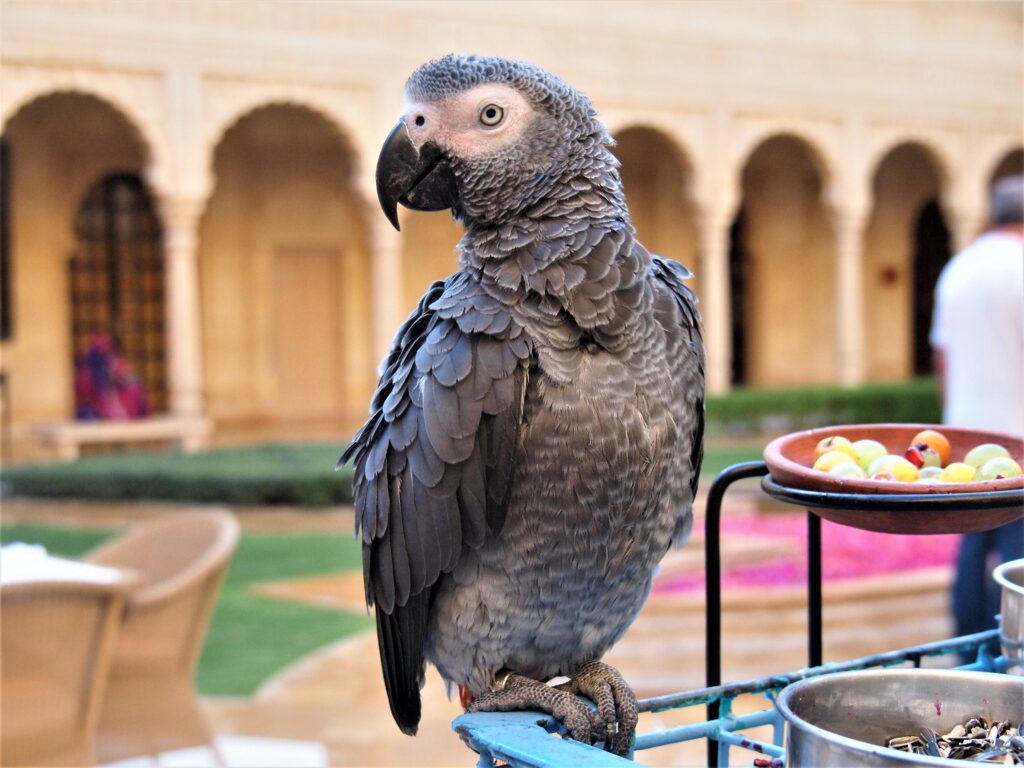
The African Grey is widely considered the most intelligent parrot species in the world. Researchers at Harvard studied a Grey named Griffin and found he could outperform some children on logic tasks.
These birds are native to the rainforests of West and Central Africa. They typically live 40 to 60 years in captivity, which is a serious commitment for any owner.
Wild populations have dropped sharply due to trapping for the pet trade. This decline pushed the species onto CITES Appendix I, banning international commercial trade.
2. Scarlet Macaw
Few birds turn heads like the Scarlet Macaw. Its blazing red, yellow, and blue feathers make it one of the most photographed parrots on Earth.
Native to Central and South America, this macaw can grow up to 33 inches long, tail included. Scarlet Macaws mate for life and often stay bonded to a single partner for decades.
Conservation groups have helped release captive-bred Scarlet Macaws back into places like the Los Tuxtlas Biosphere Reserve in Mexico. Between 2014 and 2018, 189 birds were released there, forming the region’s second-largest wild population.
ALSO READ: 25 Best Birds to Have as Pets (Species Identification, With Pictures)
3. Blue-and-Gold Macaw
This species is a favorite in zoos because of its calm temperament compared to other large macaws. Its blue back and golden-yellow chest make identification easy.
Blue-and-Gold Macaws are found across South America, especially in swampy forests and palm groves. They can live more than 60 years with proper care.
They are strong flyers and can cover several miles a day searching for fruit and seeds in the wild.
4. Hyacinth Macaw
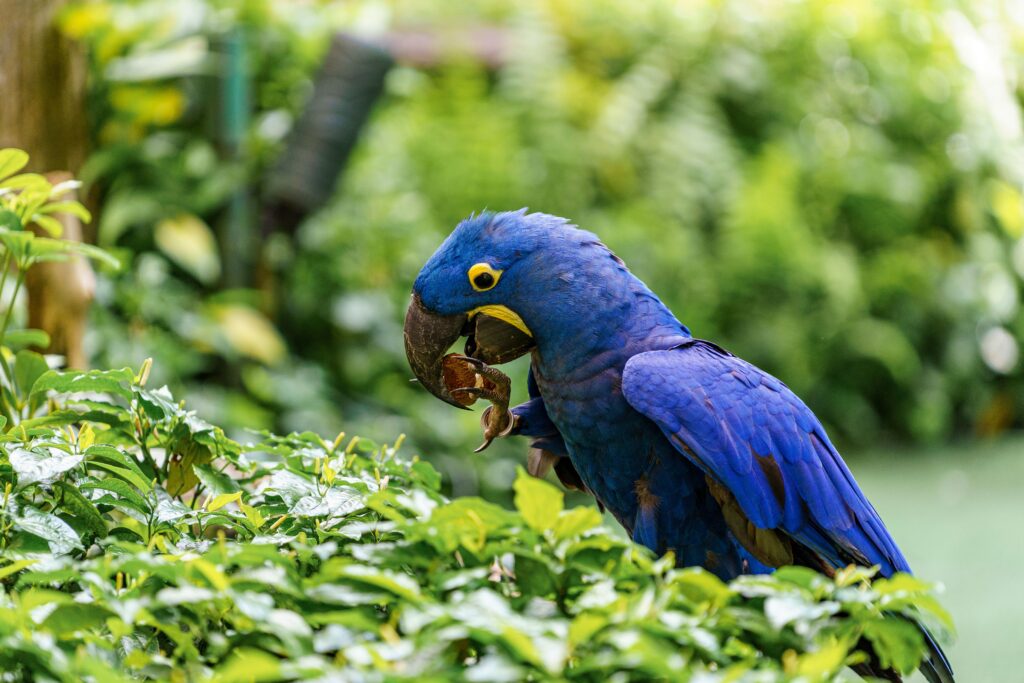
The Hyacinth Macaw holds the title of the world’s largest parrot species, reaching about 40 inches in length. Its deep cobalt-blue plumage is unmistakable.
This bird has a bite force strong enough to crack Brazil nuts and even metal cage bars. Despite that power, Hyacinth Macaws are known to be gentle with trusted humans.
Habitat destruction in Brazil’s Pantanal and Cerrado regions has made this species vulnerable. Conservation programs there now closely monitor nesting sites.
5. Green-winged Macaw
Also called the Red-and-Green Macaw, this bird is the second-largest macaw species, according to the Smithsonian’s National Zoo. It has a mostly red body with green wing feathers and a blue rump.
Green-winged Macaws often gather with other macaw species at clay licks. They eat the mineral-rich clay to neutralize toxins found in unripe seeds and nuts.
Breeding pairs lay one to three eggs, and incubation lasts about 28 days. Chicks stay in the nest for roughly three months before fledging.
6. Blue-fronted Amazon
Known also as the Turquoise-fronted Amazon, this parrot is prized for its talking ability and strong social bonds. It lives in family groups across South America.
Blue-fronted Amazons are cavity nesters, meaning they rely on old-growth trees for breeding. Deforestation has made suitable nesting spots harder to find in some regions.
Their loud, expressive calls make them popular pets, though they demand significant daily attention and mental stimulation.
ALSO READ: 25 Types of Penguins (Different Species, With Pictures Explained)
7. Yellow-naped Amazon
This Amazon parrot lives along the Pacific coast of Mexico and Central America. Sadly, it is now classified as Endangered by the IUCN.
Yellow-naped Amazons favor semi-arid woodland and pine savanna habitats. They often form large, noisy flocks that roost together at night.
Illegal poaching for the pet trade remains the primary threat to this species, alongside continued habitat clearing.
8. Sulphur-crested Cockatoo
This large white cockatoo, topped with a bright yellow crest, is native to Australia and New Guinea. Its piercing call can be heard from a long distance.
Sulphur-crested Cockatoos are highly social and often gather in flocks of dozens, sometimes hundreds, in the wild. They are also famously destructive chewers, a trait that surprises many first-time owners.
In captivity, they can live more than 70 years, meaning they frequently outlive their original owners.
9. Umbrella Cockatoo
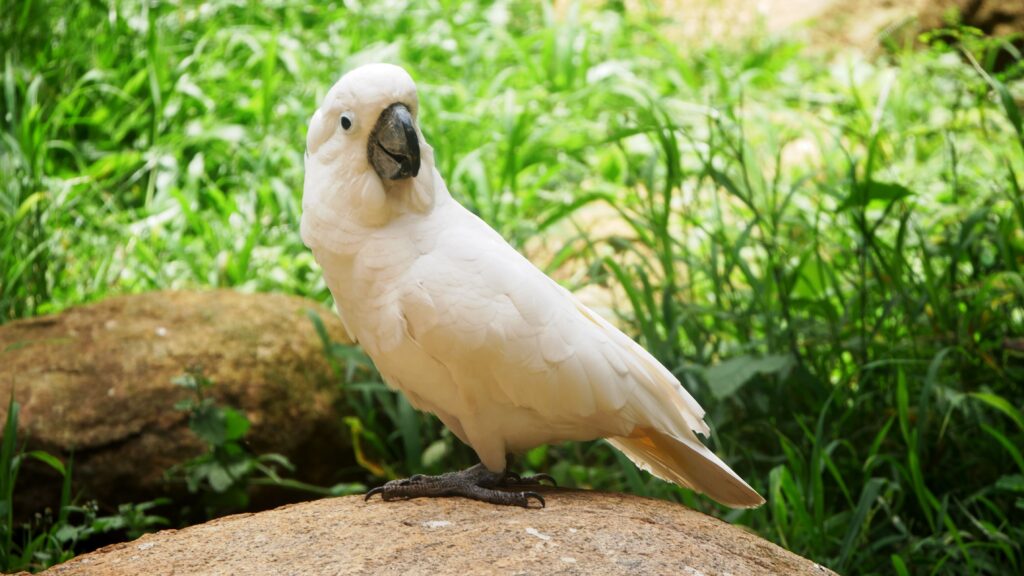
Named for the way its crest fans out like an umbrella when raised, this cockatoo hails from Indonesia’s Maluku Islands. It is almost entirely white, with a soft yellow tinge under the wings.
Umbrella Cockatoos bond intensely with their human caregivers. That devotion can turn into problematic clinginess if the bird is not given enough independence early on.
Habitat loss in Indonesia has pushed this species toward vulnerable status in the wild.
10. Moluccan Cockatoo
The Moluccan Cockatoo is known for its soft salmon-pink plumage and dramatic personality. It is one of the loudest parrot species commonly kept as a pet.
Native to the Seram archipelago in Indonesia, this bird requires enormous amounts of social interaction. Without it, Moluccan Cockatoos are prone to feather-plucking and stress behaviors.
Because of this intensity, many bird experts discourage first-time owners from choosing this species.
ALSO READ: 15 Breeds of Chicken With Feathers on Feet: (With Pictures, and Care Tips)
11. Galah (Rose-breasted Cockatoo)
The Galah is one of Australia’s most common cockatoos, easily spotted by its rose-pink chest and grey wings. Farmers sometimes see them in large flocks feeding on grain fields.
Unlike many rarer parrots, the Galah’s population is stable and even expanding in parts of Australia. Its adaptability to human-altered landscapes has helped it thrive.
Galahs are playful and often seen hanging upside down from branches, seemingly just for fun.
12. Palm Cockatoo
This is one of the most unusual parrots on the planet. Palm Cockatoos are the only known non-human species that manufacture a tool specifically to make sound, according to BirdLife International.
Males snap branches to create drumsticks, which they use to tap rhythmic beats on tree trunks. This behavior is thought to attract mates.
Found in northern Australia and New Guinea, the Palm Cockatoo has jet-black feathers and a striking red facial patch that flushes brighter when the bird is excited.
13. Cockatiel
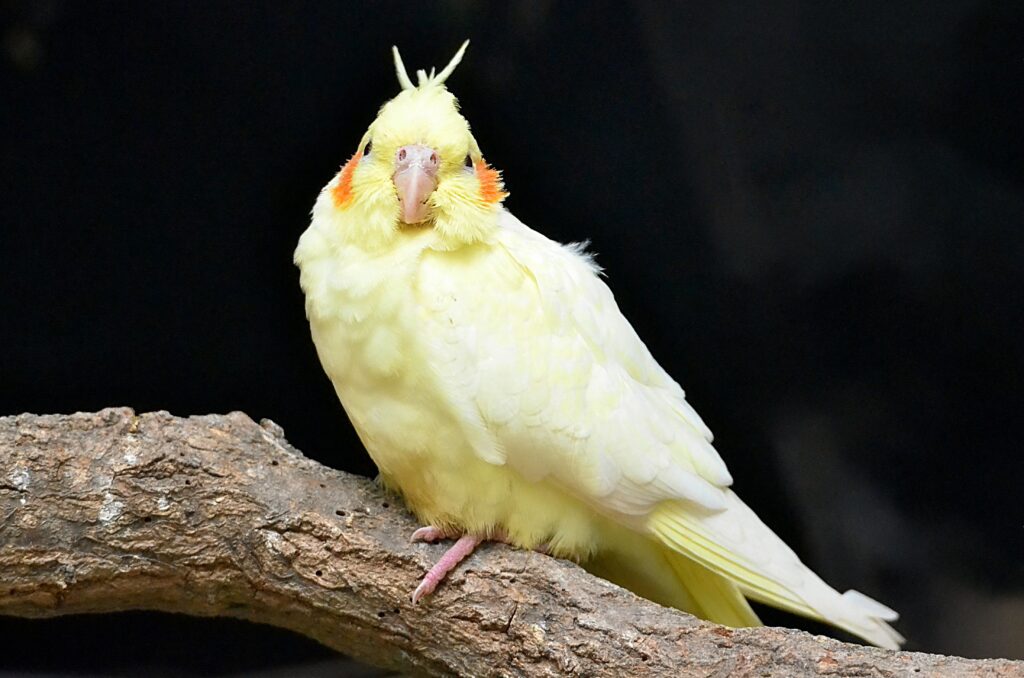
The Cockatiel is likely the most popular pet parrot in the world, thanks to its small size and gentle nature. It is native to the Australian outback.
Male Cockatiels are known for whistling entire tunes, sometimes learned directly from their owners. Their crest position also reveals mood, standing tall when curious and flattening when scared.
With proper care, Cockatiels typically live 16 to 25 years, making them a long-term but manageable commitment.
14. Budgerigar (Budgie)
Budgies are the most kept pet bird species globally, according to multiple avian welfare organizations. In the wild, they form massive nomadic flocks across the arid interior of Australia.
Wild Budgies are green and yellow, but selective breeding has produced blue, white, and violet color variants for the pet trade. They are excellent talkers for such a tiny bird.
A wild Budgie’s flock can number in the thousands, moving quickly to follow seasonal rains and seed availability.

15. Peach-faced Lovebird
Lovebirds are named for their tendency to sit closely together, often preening one another for hours. The Peach-faced Lovebird, native to southwestern Africa, is the most common lovebird species kept as a pet.
Despite their small size, these birds have big personalities and can be territorial. They typically live 10 to 15 years.
Peach-faced Lovebirds are cavity nesters and, interestingly, the females carry nesting material tucked into their rump feathers rather than in their beaks.
16. Sun Conure

The Sun Conure is instantly recognizable thanks to its vivid orange and yellow plumage. It is native to northeastern South America, including parts of Venezuela and Brazil.
This species is classified as Endangered due to heavy trapping for the pet trade combined with habitat loss. Wild populations have declined substantially over the past few decades.
Sun Conures are loud, affectionate, and require significant social interaction to remain emotionally healthy in captivity.
ALSO READ: 15 Breeds of Chicken With No Feathers on the Neck (With Pictures, and Care Tips)
17. Green-cheeked Conure
Smaller and quieter than its Sun Conure cousin, the Green-cheeked Conure has become a favorite among apartment dwellers. It is native to the forests of South America.
This bird has a mostly green body with maroon tail feathers and a grey chest. It typically lives 10 to 15 years with proper diet and care.
Green-cheeked Conures are playful and enjoy hanging upside down, similar to small clowns of the parrot world.
18. Eclectus Parrot
The Eclectus Parrot is one of the few bird species where males and females look completely different. Males are bright green, while females are red and purple.
This striking difference, called sexual dimorphism, once led scientists to classify the two sexes as separate species. Eclectus Parrots are native to New Guinea, the Solomon Islands, and northern Australia.
Unlike most parrots, Eclectus females may control nesting cavities for extended periods, sometimes mating with multiple males who help provide food.
19. Kakapo
The Kakapo is unlike any other parrot on this list. It is flightless, nocturnal, and can weigh up to 6.6 pounds, making it the heaviest parrot species, as confirmed by San Diego Zoo data.
Native only to New Zealand, the Kakapo is critically endangered, with a wild population numbering in the low hundreds. Conservation teams monitor nearly every individual bird by name.
Its mating system is called a lek. Males dig bowl-shaped depressions in the ground and produce deep booming calls to attract females from long distances.
20. Kea

The Kea is New Zealand’s alpine parrot, found nowhere else on Earth. It thrives in cold mountain environments, often seen playing in snow near ski resorts.
This species is famous for its curiosity and problem-solving skills. Keas have been observed working together to open latches, unzip backpacks, and even move objects for hidden food rewards.
Their intelligence sometimes gets them labeled as mischievous, since they are known to damage car windshield wipers and rubber seals out of sheer curiosity.
21. Rainbow Lorikeet
True to its name, the Rainbow Lorikeet displays an explosion of blue, green, orange, and yellow feathers. It is native to Australia and eastern Indonesia.
Unlike seed-eating parrots, Lorikeets feed mainly on nectar and pollen using a specialized brush-tipped tongue. This diet shapes both their digestive system and their nomadic movement patterns.
They travel in large, noisy flocks, often descending on flowering trees in numbers that can startle first-time observers.
ALSO READ: 45 Birds With Colorful Feathers (Species Identification, With Pictures)
22. Indian Ringneck Parakeet
Also called the Rose-ringed Parakeet, this species is native to parts of Africa and South Asia. It has adapted remarkably well to urban environments across the world.
Feral populations now thrive in cities like London, Los Angeles, and Amsterdam, likely descended from escaped or released pets. Males develop a distinctive pink-and-black neck ring once they mature, usually around two to three years old.
Indian Ringnecks are known for clear speech and can build vocabularies of dozens of words.
23. Senegal Parrot
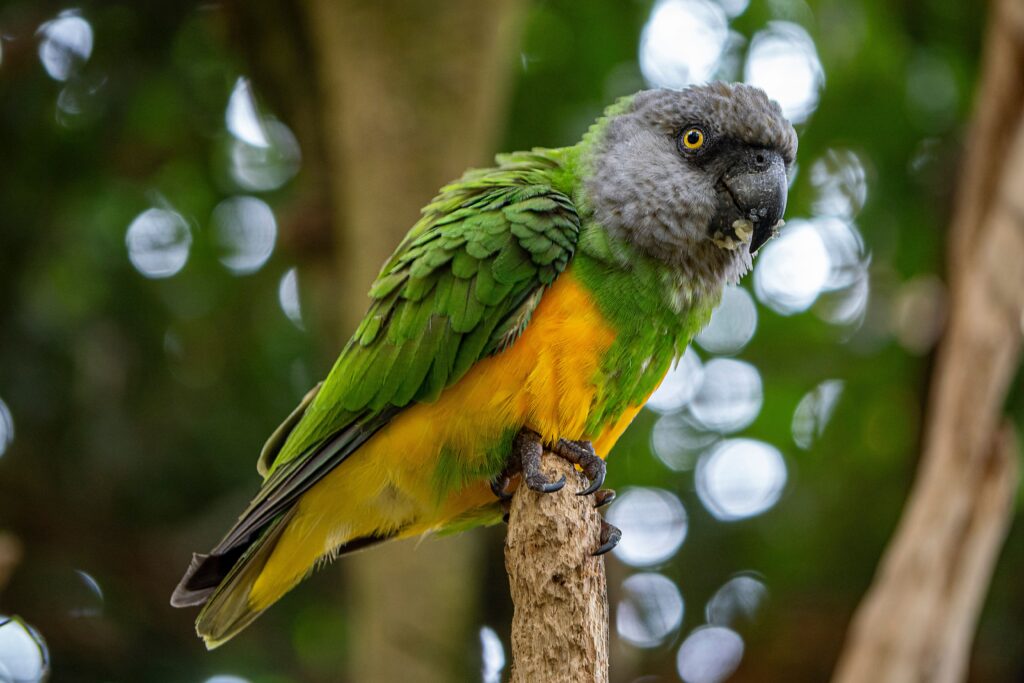
The Senegal Parrot comes from the savannas and woodlands of West Africa. It is smaller than an African Grey but shares a similarly quiet, thoughtful demeanor.
This species is a favorite among apartment owners because of its moderate noise level. Senegal Parrots have green bodies, grey heads, and a yellow-to-orange underside.
They can be nippy during adolescence, but most mellow considerably as they mature into adulthood.
24. Hawk-headed Parrot
Also known as the Red-fan Parrot, this bird has a unique defensive display. When startled, it raises its neck feathers into a fan-like ruff around its head, resembling a hawk.
Native to South American rainforests in Brazil, Colombia, Peru, and Venezuela, this species is protected by Brazilian law and cannot be legally caught or traded there.
Researchers at the Smithsonian’s National Zoo note that Hawk-headed Parrots may lose 24 to 31 percent of their current habitat to deforestation by 2040, a serious long-term concern.
25. Quaker Parrot (Monk Parakeet)
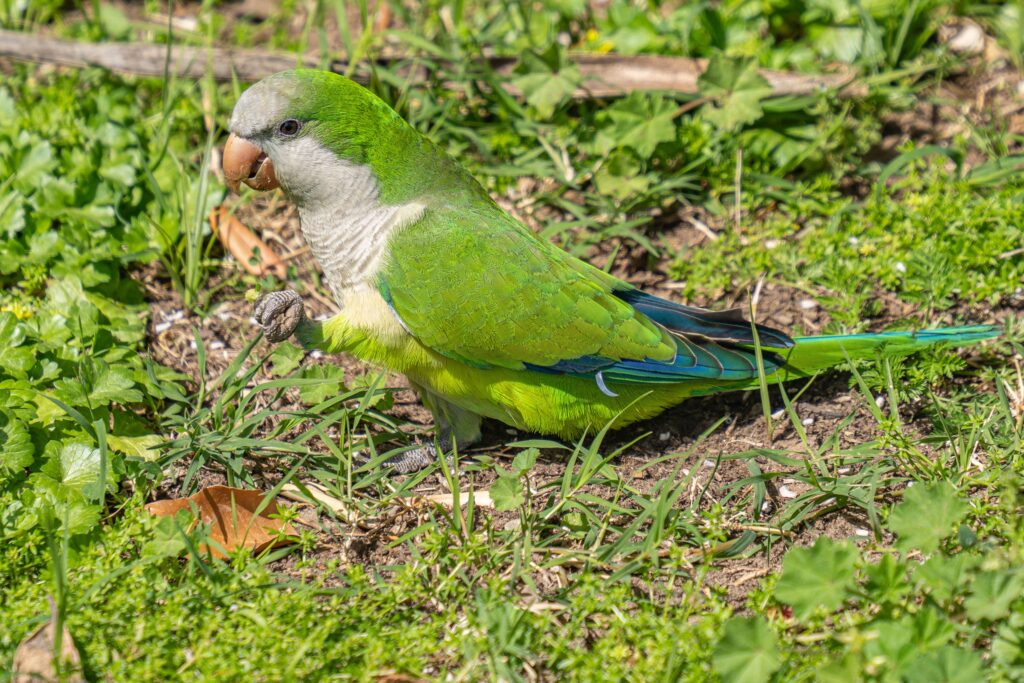
The Quaker Parrot, native to temperate South America, is the only parrot species known to build stick nests rather than nesting in tree cavities. Some nests grow large enough to house multiple breeding pairs.
This adaptability has allowed Quaker Parrots to establish wild feral colonies in parts of the United States and Europe, despite originating from a much warmer climate.
They are excellent talkers and tend to bond strongly with a single person, sometimes becoming possessive of their favorite human.
Quick Comparison of Key Traits
A few patterns emerge once you look at these 25 species side by side.
- Largest species: Hyacinth Macaw, at around 40 inches long.
- Smallest common pet species: Budgerigar, typically under 8 inches.
- Longest-lived: African Grey and Sulphur-crested Cockatoo, both capable of surpassing 60 years.
- Only flightless species: Kakapo.
- Most endangered on this list: Yellow-naped Amazon and Sun Conure, both facing serious population declines.
What Threatens Parrots Worldwide
It would be incomplete to list these birds without mentioning the pressures they face. According to a 2021 study cited by Mongabay, 18 parrot species are critically endangered, 39 are endangered, and 55 are vulnerable on the IUCN Red List.
The pet trade remains a leading cause. Defenders of Wildlife reports that roughly 75 percent of trapped parrots die before ever reaching a buyer, a devastating statistic that rarely gets discussed openly.
Habitat destruction compounds the problem. Logging, agriculture, and urban expansion continue to shrink the tropical forests most parrot species depend on for nesting and food.
How Parrots Are Classified
Scientists group parrots under the order Psittaciformes, which splits into three main families. Knowing these families helps explain why some parrots look and behave so differently from others.
Psittacidae is the largest family, covering true parrots like Amazons, African Greys, macaws, and conures. Cacatuidae covers cockatoos, easily identified by their movable head crest. Strigopidae is a small, ancient family limited to New Zealand, home to the Kakapo, Kea, and Kaka.
This three-way split is not just academic trivia. It reflects millions of years of separate evolution, which is why New Zealand’s parrots behave so differently from their tropical cousins.
Parrot Lifespan and Size at a Glance
People often underestimate how long parrots actually live. Smaller species like Budgies and Lovebirds usually live 5 to 15 years, while mid-sized birds like conures and Senegal Parrots reach 15 to 30 years.
Large parrots are the real long-term commitment. African Greys, Amazons, and cockatoos frequently live 50 years or longer, meaning a bird purchased by a young adult could easily outlive them.
Size varies just as dramatically. Pygmy parrots measure under 4 inches, while the Hyacinth Macaw stretches to roughly 40 inches from beak to tail tip. That is a tenfold difference within the same bird order.
Frequently Asked Questions
What is the smartest parrot species? The African Grey Parrot is generally considered the smartest, based on decades of research from Harvard and Boston University. Griffin, a Grey studied by researcher Irene Pepperberg, demonstrated reasoning skills comparable to a young child.
Which parrot is the best talker? African Greys, Indian Ringnecks, and Amazon parrots are typically ranked as the clearest talkers. Budgies, despite their small size, can also build surprisingly large vocabularies.
What is the rarest parrot in the world? The Kakapo is among the rarest, with only a few hundred individuals remaining, all tracked individually by New Zealand conservation teams. The Spix’s Macaw is another extremely rare species, having been extinct in the wild before recent reintroduction efforts began.
Do all parrots learn to talk? No. Talking ability varies by species and by individual bird. Some parrots, like certain lorikeets, rarely mimic speech at all, while others pick up dozens of words within months.
Are parrots good pets for beginners? Smaller species like Budgies, Cockatiels, and Green-cheeked Conures tend to suit beginners better than large macaws or cockatoos, which demand more space, noise tolerance, and daily interaction.
Final Thoughts
Parrots are more than colorful companions or backyard visitors. They are complex, intelligent animals whose survival often hinges on decisions made far outside their forest homes.
I hope this list gave you a clearer picture of just how varied the parrot family really is, from the tool-making Palm Cockatoo to the flightless, ground-dwelling Kakapo. Each species carries its own story, and many of those stories are still being written by conservationists today.
If you are considering a pet parrot, please research the specific species thoroughly first. Their long lifespans and emotional needs make them a serious, decades-long commitment rather than a casual purchase.
References
- U.S. Fish & Wildlife Service. Parrots (Psittaciformes). https://www.fws.gov/species/parrots-psittaciformes
- U.S. Fish & Wildlife Service. Endangered and Threatened Wildlife and Plants; Four Foreign Parrot Species. https://www.fws.gov/species-publication-action/endangered-and-threatened-wildlife-and-plants-four-foreign-parrot
- Smithsonian’s National Zoo and Conservation Biology Institute. Hawk-headed Parrot. https://nationalzoo.si.edu/animals/hawk-headed-parrot
- Smithsonian’s National Zoo and Conservation Biology Institute. Green-winged Macaw. https://nationalzoo.si.edu/animals/green-winged-macaw
- Harvard Gazette, Harvard University. Harvard study shows parrots can pass classic test of intelligence. https://news.harvard.edu/gazette/story/2019/02/harvard-study-shows-parrots-can-pass-classic-test-of-intelligence/
- North Carolina State University, College of Veterinary Medicine. NC State CVM Parrot Cognition and Behavior Symposium. https://cvm.ncsu.edu/nc-state-cvm-parrot-cognition-and-behavior-symposium/
- Brigham Young University, ScholarsArchive. Testing Cognition in Amazona spp., Journal of Undergraduate Research. https://scholarsarchive.byu.edu/jur/vol2013/iss1/1001