50 Different Types of Doves (With Pictures, and Species Info)
Doves have followed humans through history as symbols of peace, love, and quiet mornings. I have spent many hours watching them on fence posts and telephone wires, and I still find their soft cooing calming.
There are roughly 344 recognized species within the pigeon and dove family, Columbidae, based on current global taxonomy. This guide focuses on 50 of the most notable, widespread, and fascinating types.
You will find backyard visitors, tropical rainforest dwellers, desert specialists, and even a few tragic stories of extinction. Let’s walk through them together.
What Makes a Dove a Dove?
Doves and pigeons belong to the same family. There is no strict scientific line separating the two names.
In English, smaller Columbidae are usually called doves, while larger ones are called pigeons. Other languages split the same birds differently.
The word “pigeon” traces back to a Latin term for a peeping chick. The word “dove” comes from an old Germanic root tied to the bird’s flight pattern.
For this guide, we follow common English naming conventions used by ornithologists.
Quick Facts About Doves
Before we get to the list, a few numbers help set the stage.
- The mourning dove population in the United States was estimated at about 249 million birds as of September 2018, according to the U.S. Fish and Wildlife Service.
- Mourning doves are the most frequently hunted bird species in North America, per Cornell Lab of Ornithology.
- Seeds make up 99 percent of a mourning dove’s diet.
- The oldest known mourning dove on record lived at least 30 years and 4 months.
- Texas alone accounts for about 30 percent of the total U.S. mourning dove harvest and 87 percent of the white-winged dove harvest each year.
- The passenger pigeon once numbered between 3 and 5 billion birds before going extinct in 1914.
Now, let’s explore the types.
North American Doves
1. Mourning Dove (Zenaida macroura)
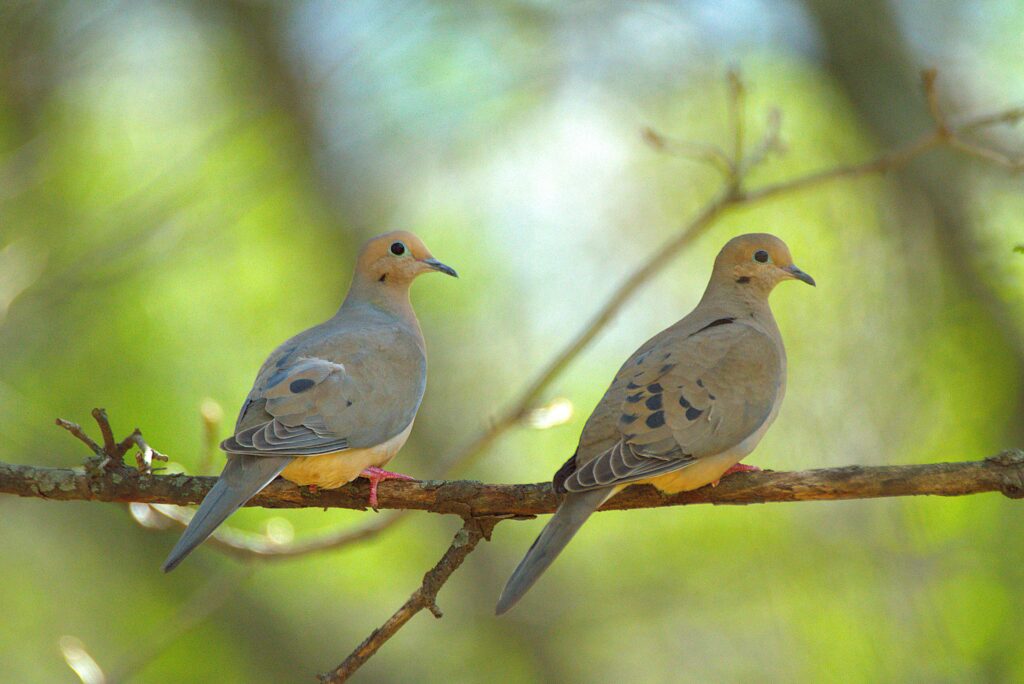
This is the dove most Americans know best. It has a slender tail, small head, and a soft, sad-sounding call.
Its flight is fast and direct. You will often see it perched alone on wires.
Beyond looks, this species shows remarkable breeding output. In warm climates, a single pair may raise up to six broods in one season, which helps explain how the population stays high despite heavy hunting pressure.
Mourning doves nest almost anywhere, from evergreen branches to gutters and abandoned farm equipment. The nest itself is a flimsy platform of twigs, built when the male passes material to the female while standing on her back.
2. White-Winged Dove (Zenaida asiatica)
Named for the bold white stripe on its wing, this species thrives in the American Southwest. It has adapted well to city life in places like Phoenix and Tucson.
Its call is a rhythmic, rolling coo that some describe as sounding like “who cooks for you.” Desert dwellers often use this call as a seasonal marker, since the birds arrive to breed as cactus fruit begins to ripen.
In Texas, the species carries real economic weight. It accounts for the vast majority of the state’s annual dove harvest, supporting a hunting tradition that generates hundreds of millions of dollars each year.
Unlike many desert birds, white-winged doves can drink brackish or slightly salty water without harm, an adaptation that helps them survive in arid landscapes where clean freshwater is scarce.
ALSO READ: 25 Common Types of Parrots (Species Traits, With Pictures Explained )
3. Eurasian Collared-Dove (Streptopelia decaocto)
This chunky bird carries a black half-collar on its neck. It arrived in the Bahamas in the 1970s and reached Florida within a decade.
From there, it spread across almost the entire continent. I find its steady three-note coo distinct from the mourning dove’s call.
Its rapid spread ranks among the fastest range expansions recorded for any introduced bird in North America. Backyard feeders and ornamental trees in suburban neighborhoods gave the species an easy foothold as it moved inland from the coasts.
The name “decaocto” comes from Greek mythology, referencing a servant girl transformed into a dove to escape mistreatment. Birders sometimes use that legend to help remember the species’ mournful, repetitive call.
4. Inca Dove (Columbina inca)
Small and scaly-looking, this dove has a soft, pale, textured plumage pattern. It is common across the southern United States and Mexico.
Despite its delicate appearance, the Inca dove tolerates surprisingly hot conditions. During peak daytime heat, small groups will stack on top of one another in a tight pyramid formation to conserve body heat during cooler nights.
Its call is a short, two-note phrase often described as sounding like “no hope.” Once you learn it, you will notice it in almost any warm, dry neighborhood within its range.
5. Common Ground Dove (Columbina passerina)
One of the smallest doves in North America. It forages quietly on bare soil and rarely draws attention to itself.
Adults measure barely 6 to 7 inches long, roughly the size of a sparrow, making this one of the tiniest members of the entire Columbidae family found north of Mexico.
Despite its small size, the common ground dove has a surprisingly loud, repetitive call for its stature. Males repeat a short “woo-woo” note for extended periods while defending a territory.
6. Band-Tailed Pigeon (Patagioenas fasciata)
Found along the West Coast and in mountain forests, this larger species has a pale band across its tail. It often travels in flocks through oak and pine woodlands.
Acorns form a major part of its diet in many regions, and flocks will travel considerable distances to reach productive oak stands during autumn mast years.
Historically, this species faced heavy hunting pressure similar to the passenger pigeon, though it never suffered the same catastrophic decline. Modern populations remain stable across much of the Pacific coast and Rocky Mountain range.
ALSO READ: 25 Best Birds to Have as Pets (Species Identification, With Pictures)
7. White-Tipped Dove (Leptotila verreauxi)
This tropical species reaches into southern Texas. It has grey plumage with a distinctive eye-ring, either red or blue depending on the subspecies.
Its call is a low, resonant, owl-like hoot, delivered from a hidden perch deep in brush or woodland. Many birders hear it long before they ever spot the bird itself.
This species belongs to a genus of 11 total species found only in the Americas. Its wide range, stretching from southern Texas to southern South America, has allowed several closely related species to split off over time.
8. Rock Pigeon / Rock Dove (Columba livia)
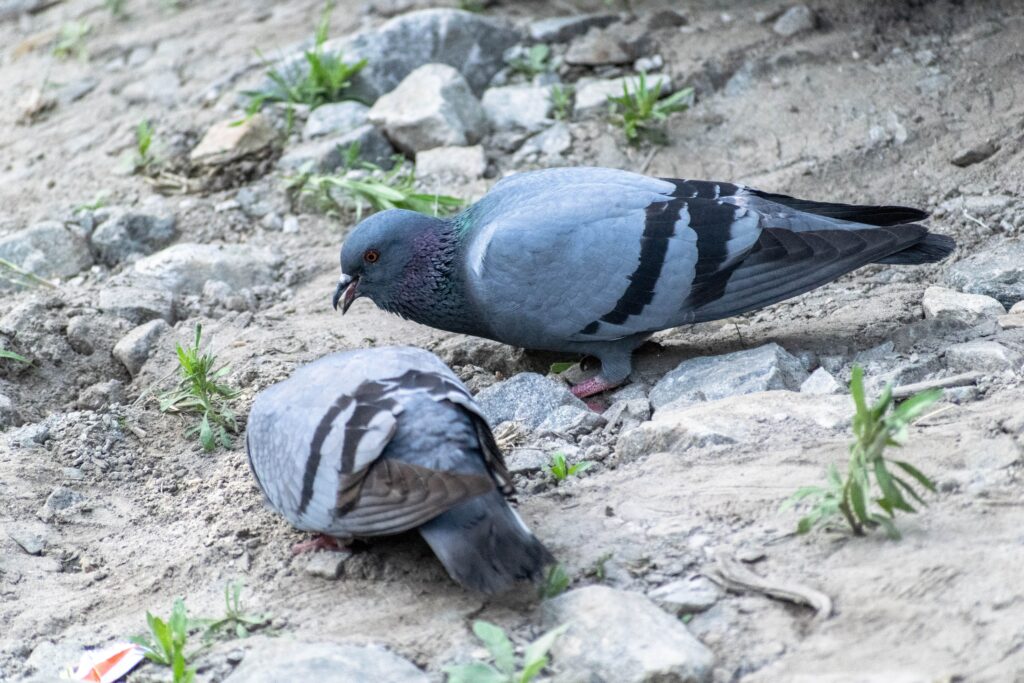
The familiar city pigeon seen worldwide. Every domestic and feral pigeon descends from this wild ancestor, originally from cliffs in Europe, Asia, and North Africa.
Wild rock doves nest on sheer cliff faces, which explains why urban pigeons feel just as comfortable on window ledges and bridge girders. Buildings essentially mimic the cliffs their ancestors depended on for centuries.
Humans have bred this single species into hundreds of distinct fancy pigeon breeds, ranging from racing homers to ornamental fantails, making it one of the most artificially diversified birds on the planet.
9. Ruddy Ground Dove (Columbina talpacoti)
This small reddish-brown dove has expanded its range northward into the southern United States in recent decades. Males show a warm rust color across the back.
Pairs often forage together in open fields and along roadsides, picking through fallen seeds. Their tolerance for disturbed and agricultural land has helped the species spread well beyond its original tropical range.
10. Western Peruvian Dove (Zenaida meloda)
Found along the arid Pacific coast of Peru and Ecuador, this species tolerates dry, sparse habitats better than most doves.
It often gathers near human settlements, farms, and irrigated fields, where scattered grain and consistent water sources make survival easier in an otherwise harsh coastal desert environment.
European and Asian Doves
11. European Turtle-Dove (Streptopelia turtur)
This migratory species breeds in Europe and winters in sub-Saharan Africa. Sadly, its population has fallen sharply due to hunting pressure and habitat loss along migration routes.
Its soft, purring call gave rise to the term “turtle dove,” a name unrelated to reptiles and instead derived from the sound of the bird’s own song.
Conservation groups across Europe have pushed for hunting restrictions along Mediterranean flyways, since millions of birds historically passed through countries where spring hunting remained legal for decades.
12. Oriental Turtle-Dove (Streptopelia orientalis)
One of the larger members of its genus, measuring up to 35 centimeters. It breeds across much of Asia and undertakes long-distance migration.
Its plumage shows a scaled, patterned back that helps it blend into forest leaf litter. This camouflage, paired with a cautious nature, makes the species harder to observe than many of its open-country relatives.
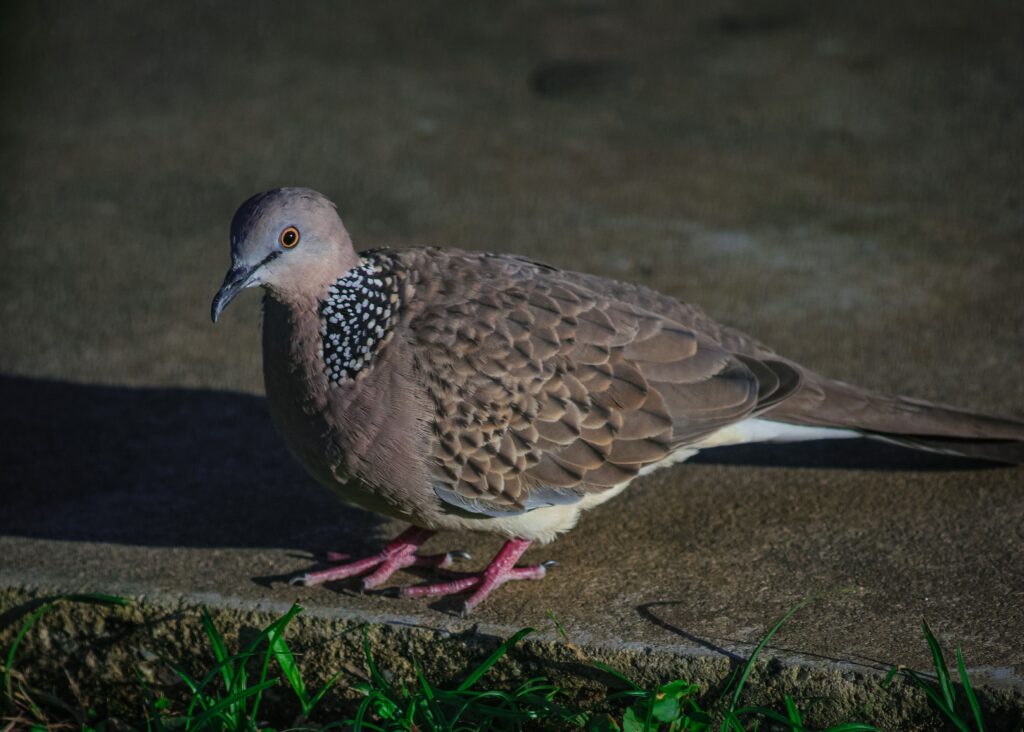
13. Rock Pigeon (Streptopelia chinensis)
Recognizable by the black-and-white spotted patch on its neck. Native to South Asia, it has also established populations in Australia and parts of the United States.
Introduced populations in California and Hawaii have persisted for decades, showing how well this adaptable species handles urban parks, gardens, and agricultural edges far from its native range.
ALSO READ: 55 Different Types of Duck Species (With Pictures, and Info)
14. Laughing Dove (Spilopelia senegalensis)
Named for its bubbling, chuckling call, this small dove is common across Africa, the Middle East, and South Asia. It adapts well to gardens and farmland.
Pairs often stay bonded year-round rather than only during breeding season, and both birds share incubation duties, taking turns sitting on the nest throughout the day and night.
15. Red Collared-Dove (Streptopelia tranquebarica)
At just 20 to 23 centimeters, this is one of the smallest species in the Streptopelia genus. Males display a rich reddish-brown body with a black neck band.
Females look noticeably duller than males, a pattern known as sexual dimorphism that helps females stay camouflaged while incubating eggs on exposed nests.
16. Barbary Dove (Streptopelia risoria)
A domesticated form kept for centuries as a pet and food source. Because it was bred for tameness, it cannot survive if released into the wild.
Its soft, pale coloring and gentle temperament made it a favorite in aviaries and magic acts for generations. Genetic studies suggest it descends from the African collared dove, selectively bred over centuries of captivity.
17. Hill Pigeon (Columba rupestris)
This species lives at high elevations across Central Asia. It resembles the rock pigeon but favors cliffs and rocky terrain in colder climates.
It often nests in loose colonies inside caves, rock crevices, and even abandoned buildings, gathering in larger flocks outside the breeding season to forage across open steppe and farmland.
18. Snow Pigeon (Columba leuconota)
Found in the Himalayas, this hardy bird tolerates extreme cold and altitude. Its pale plumage helps it blend into snowy, rocky landscapes.
Flocks have been observed foraging at elevations exceeding 5,000 meters, making this one of the highest-altitude members of the entire pigeon family anywhere in the world.
19. Stock Dove (Columba oenas)
Smaller than the wood pigeon, this species nests in tree cavities across Europe and parts of Asia. It served as the type species for the entire Columba genus.
Because it depends on natural cavities or old woodpecker holes, it favors mature woodland over young forest, making habitat age just as important as habitat type for successful breeding.
20. Yellow-Eyed Dove (Columba eversmanni)
A globally threatened species native to Central Asia. Habitat loss and pesticide exposure along the Amu Darya and Syr Darya rivers have driven steep declines.
Researchers consider it one of the least-studied Columba species, with much of its wintering range in South Asia still poorly documented, complicating conservation planning efforts.
African Doves
21. Namaqua Dove (Oena capensis)
This slim, long-tailed dove lives across Africa’s drier regions. Males have a striking black face and throat patch.
Its long, pointed tail and rapid, low flight make it look almost swallow-like when startled from the ground, a useful field mark for separating it from other African doves.
22. Emerald-Spotted Wood Dove (Turtur chalcospilos)
A small, plump bird with metallic green patches on its folded wings. It favors dry, deciduous woodland across eastern and southern Africa and avoids dense rainforest.
Its descending, mournful call is one of the most familiar sounds of the African bush at dawn, often compared to someone slowly running down a musical scale.
23. Speckled Pigeon (Columba guinea)
Common across sub-Saharan Africa, this large pigeon has reddish, bare skin around the eyes and speckled wing patterns.
It readily nests on buildings, cliffs, and rocky outcrops, and has become a familiar sight in African cities and towns, much like the rock pigeon has in urban centers elsewhere.
24. Tambourine Dove (Turtur tympanistria)
A forest-floor specialist found in African woodlands. Its call resembles a soft, repeated drumbeat, which gives the species its name.
Males display bright white underparts against a dark back, a contrast that becomes especially visible during short, low display flights through the forest understory.
25. Blue-Spotted Wood Dove (Turtur afer)
Similar to the emerald-spotted wood dove but with blue, rather than green, wing markings. It inhabits savanna and woodland edges across West and Central Africa.
It usually forages alone or in pairs rather than large flocks, walking steadily across open ground while bobbing its head in the manner typical of many ground-feeding doves.
26. African Mourning Dove (Streptopelia decipiens)
Not to be confused with the American mourning dove, this species lives near rivers and wetlands across sub-Saharan Africa. Its call carries a mournful, drawn-out tone.
Pale eye-rings and a bluish base to the bill help distinguish it from similar African doves, especially where its range overlaps with the more common Cape turtle-dove.
27. Lemon Dove (Columba larvata)

A shy forest dweller found in African highland forests. It forages quietly on the forest floor and rarely perches in the open.
Its rounded shape and short tail give it a distinctly different silhouette from open-country doves, an adaptation suited to moving quickly through dense undergrowth.
28. Cape Turtle-Dove (Streptopelia capicola)
Also called the ring-necked dove, this is one of the most common and vocal doves across southern and eastern Africa. Its repetitive call is a familiar sound of the African bush.
Local folklore across several African cultures has assigned phonetic phrases to its call, with many describing it as saying “work harder, work harder” on a continuous loop through the heat of the day.
Australian and Pacific Doves
29. Crested Pigeon (Ocyphaps lophotes)
Instantly recognizable by its upright, thin crest. Native to Australia, it produces a distinct whistling sound in flight caused by modified wing feathers.
That whistling noise doubles as an alarm signal. When one bird takes off in a hurry, the sound alerts the rest of the flock to possible danger nearby.
30. Zebra Dove (Geopelia striata)
Named for the fine, dark barring across its neck and chest. Native to Southeast Asia, it has also been introduced to Hawaii, where it thrives in urban parks.
In parts of Southeast Asia, this species is prized for its soft cooing and is kept in decorative cages during traditional singing competitions, a cultural practice that continues in several countries today.
31. Asian Emerald Dove (Chalcophaps indica)
This forest dove has iridescent green wings that shimmer in filtered sunlight. It forages on forest floors across South and Southeast Asia and northern Australia.
It tends to fly low and fast through dense forest, weaving between trunks in a manner that can startle hikers walking quiet trails at dawn or dusk.
32. Diamond Dove (Geopelia cuneata)
One of Australia’s smallest doves, known for the white spots dotting its wings. It is a popular species in the pet trade due to its calm nature.
Wild populations concentrate near water sources in Australia’s arid interior, and flock sizes often swell dramatically around remaining waterholes during extended dry seasons.
33. Victoria Crowned Pigeon (Goura victoria)
Among the largest pigeons alive, this striking bird from New Guinea carries a lace-like blue crest. It can weigh over 2 kilograms.
Despite its size, it remains a strong flier when needed, though it prefers walking across the forest floor while foraging for fallen fruit, seeds, and small invertebrates.
ALSO READ: 45 Birds With Colorful Feathers (Species Identification, With Pictures)
34. Wonga Pigeon (Leucosarcia melanoleuca)
A ground-dwelling species native to eastern Australian rainforests. It has a heavy build and prefers walking to flying when disturbed.
Its call, a repetitive, monotonous “wonk-wonk,” can carry through dense rainforest for long periods, often continuing for hours during the breeding season.
35. New Zealand Pigeon (Hemiphaga novaeseelandiae)
Known locally as the kereru, this large native pigeon plays a critical role in dispersing seeds of native New Zealand trees, some of which depend entirely on this bird for reproduction.
Its wide gape allows it to swallow large native fruits whole, including species like the karaka and taraire, seeds that most other native birds are simply too small to disperse.
Caribbean and Central American Doves
36. Zenaida Dove (Zenaida aurita)
Common throughout the Caribbean islands, this species resembles the mourning dove but has a shorter, more rounded tail.
Charles Darwin actually collected specimens of this species during his voyage on the Beagle, and it later lent its genus name, Zenaida, to several related dove species across the Americas.
37. Grenada Dove (Leptotila wellsi)
Critically endangered and found only on the island of Grenada. It is the national bird of Grenada and one of the rarest doves on Earth.
Recent surveys place the total population at roughly 136 to 190 mature individuals, confined almost entirely to two fragments of dry forest habitat in the southwest and west of the island.
Hurricanes pose an outsized threat to such a small population. Hurricane Ivan in 2004 alone triggered an estimated 25 percent population decline, according to long-term monitoring by regional ornithologists.
Introduced predators compound the problem. Small Indian mongooses, brought to the Caribbean generations ago, actively hunt ground-nesting doves like this one, making predator control a central part of ongoing recovery efforts.
38. Galápagos Dove (Zenaida galapagoensis)
Endemic to the Galápagos Islands, this dove has evolved a longer, curved bill compared to its mainland relatives, an adaptation for feeding on cactus flowers.
Having evolved with few natural predators, it shows little fear of humans, often approaching visitors closely, a trait shared by many endemic Galápagos species observed since Darwin’s original visit.
39. Caribbean Dove (Leptotila jamaicensis)
The type species for the Leptotila genus, native to Jamaica, the Yucatán Peninsula, and nearby islands. It has bright white underparts and a soft grey crown.
It favors dry scrub and forest edge habitat, foraging quietly on the ground for fallen seeds and small fruit, much like other members of its genus across the Americas.
40. Plain-Breasted Ground Dove (Columbina minuta)
A tiny, understated dove found from Mexico through much of South America. Its plumage is uniformly plain, matching its name.
It often associates with other small ground doves in mixed foraging flocks, making careful attention to size and subtle color tone necessary for accurate field identification.
South American Doves
41. Eared Dove (Zenaida auriculata)
One of the most abundant birds in South America, found in massive flocks across open country and farmland. Its population has actually benefited from agricultural expansion.
In parts of Argentina and Brazil, flocks numbering in the tens of thousands have historically gathered around grain fields, occasionally prompting agricultural authorities to manage the species as a crop pest.
42. Picui Ground Dove (Columbina picui)
A small, pale dove common across grasslands and scrublands in Argentina, Paraguay, and neighboring countries.
Its pale grey plumage and small size make it easy to overlook, but its persistent, soft cooing during the breeding season often gives its presence away long before it is seen.
43. Blue Ground Dove (Claravis pretiosa)
Males show a soft blue-grey plumage, while females are a warm brown. It inhabits forest edges and clearings from Mexico to South America.
This striking color difference between sexes is more pronounced than in most New World doves, making males and females look almost like two entirely different species at first glance.
44. Scaled Dove (Columbina squammata)
Named for the scale-like pattern on its chest feathers. It ranges across open and semi-open habitats in South America.
It adapts readily to disturbed and agricultural landscapes, often seen foraging along roadsides and field margins where native vegetation has given way to farmland.
45. Plumbeous Pigeon (Patagioenas plumbea)
A forest-dwelling pigeon found in South American rainforests, identifiable by its deep, slow, resonant cooing that can travel far through dense canopy.
Because it stays high in the forest canopy, it is heard far more often than it is seen, making its distinctive call the most reliable way to confirm its presence in the field.
Extinct and Endangered Doves
46. Passenger Pigeon (Ectopistes migratorius)
Once the most abundant bird in North America, with a population estimated between 3 and 5 billion. Massive flocks reportedly darkened the sky for hours as they passed overhead.
Commercial hunting, aided by telegraph communication that tracked flock locations, decimated the species within decades. The last confirmed wild sighting came in 1900.
The final individual, a female named Martha, died at the Cincinnati Zoo on September 1, 1914, at 29 years old. Her body is preserved at the Smithsonian’s National Museum of Natural History.
Martha’s story remains one of the fastest, most complete extinctions ever documented and caused directly by human activity. Her death is widely credited with helping spark the modern American conservation movement, decades before most wildlife protection laws existed.
47. Pink Pigeon (Nesoenas mayeri)
Native to Mauritius, this species came close to extinction in the 1970s, when fewer than 20 birds remained in the wild. Intensive conservation breeding has since helped the population recover into the hundreds.
Captive breeding programs, combined with predator control targeting introduced rats and cats, allowed reintroduced populations to establish across several protected sites on the island.
The species remains listed as Vulnerable rather than fully secure, since its entire wild population still depends on continued habitat management and ongoing protection from introduced predators.
48. Socorro Dove (Zenaida graysoni)
Extinct in the wild since the 1970s due to introduced predators on Socorro Island, Mexico. A captive breeding population survives, and reintroduction efforts are ongoing.
Feral cats introduced to the island are widely blamed for the species’ disappearance from the wild, since the dove had evolved without any natural mammalian predators for thousands of years.
Zoos and conservation organizations worldwide maintain a coordinated captive population, and plans for eventual reintroduction depend heavily on successfully removing invasive predators from Socorro Island first.
49. Cloven-Feathered Dove (Drepanoptila holosericea)
Found only on New Caledonia, this fruit-eating dove has an unusual, split-appearing tail feather structure. It depends heavily on intact native forest.
Its diet centers almost entirely on forest fruit, making it an important seed disperser for native trees, similar to the ecological role played by fruit doves elsewhere in the Pacific.
50. Yellow-Legged Pigeon (Columba pallidiceps)
A poorly studied and rare species from the Solomon Islands and Papua New Guinea. Limited data makes its exact population status difficult to confirm, though habitat loss is considered the primary threat.
Its pale head and legs help separate it from similar regional pigeons, though its secretive forest habits mean that sightings and field data remain scarce even among experienced regional researchers.
How to Identify Doves in the Wild
Telling one dove species from another gets easier once you know what to look for. I always start with three things: size, tail shape, and call.
Size separates the small ground doves, like the Inca dove and common ground dove, from larger species such as the band-tailed pigeon or Victoria crowned pigeon.
Tail shape matters too. A long, pointed tail usually points to a Zenaida species, such as the mourning dove. A short, squared tail suggests a Streptopelia or Columbina species instead.
Call patterns offer the clearest clue for many birders. The mourning dove’s call has a soft, falling rhythm, while the Eurasian collared-dove gives a steady, three-part coo repeated in sequence.
Neck markings help too. Collared doves carry a black half-ring at the nape, while spotted doves show a checkered black-and-white patch instead.
Feeding behavior can also help. Ground doves peck quietly at bare soil, while fruit doves like the cloven-feathered dove stay high in the forest canopy, feeding on ripe fruit.
Habitat Range and Migration Patterns
Doves occupy nearly every terrestrial habitat on Earth, apart from the polar regions and the deepest ocean. This adaptability explains why the family has grown to include hundreds of species.
Desert specialists, such as the Inca dove and Namaqua dove, survive on minimal water by drawing moisture from seeds. Forest specialists, like the lemon dove, rarely leave dense cover.
Migration varies widely across the family. Most tropical doves stay put year-round, since food remains available in every season.
Temperate species behave differently. The European turtle-dove and oriental turtle-dove migrate long distances, breeding in cooler regions and wintering in warmer climates.
Mourning doves show a mixed pattern. Northern populations migrate south for winter, while southern populations often stay in place throughout the year.
Doves as Symbols and Their Role in Ecosystems
Doves carry meaning far beyond biology. Cultures across the world associate them with peace, love, and renewal.
Beyond symbolism, doves matter ecologically. Many species disperse seeds across forests and grasslands, helping plants regenerate over wide areas.
Some island species, like the New Zealand pigeon, are the only remaining animals large enough to swallow and spread the seeds of certain native trees. Losing these doves would threaten entire plant populations.
Conservation Status at a Glance
Most dove species carry a Least Concern rating from the IUCN Red List. However, several face serious threats.
- Habitat loss remains the leading driver of decline for forest and island species.
- Overhunting historically caused the extinction of the passenger pigeon and pushed the pink pigeon to near-collapse.
- Introduced predators, such as cats and rats on islands, threaten ground-nesting species like the Socorro dove and Grenada dove.
- Agricultural change has helped some open-country species, like the eared dove, expand their numbers.
Mourning dove populations, meanwhile, show mixed trends. Breeding Bird Survey data covering 1966 to 2019 recorded a cumulative decline of about 20 percent, even while the species remains one of the most abundant birds in North America.
Frequently Asked Questions
How many types of doves exist in total? Current taxonomy recognizes around 344 species across the Columbidae family, which includes both doves and pigeons.
What is the difference between a dove and a pigeon? There is no formal scientific distinction. English speakers generally call smaller Columbidae species doves and larger ones pigeons, but usage varies.
Which dove is the most common in the United States? The mourning dove holds that title, with an estimated population of roughly 249 million birds as of 2018.
Are doves and pigeons good parents? Yes. Both parents produce a nutrient-rich secretion called crop milk to feed their chicks during the first days of life, a trait unique among most bird families.
Can doves breed multiple times a year? Many species can. Mourning doves, for example, may raise up to six broods in a single warm season, which helps explain their large overall population despite heavy hunting pressure.
Final Thoughts
Fifty types of doves barely scratch the surface of this diverse family, yet they show just how adaptable these birds are. From city sidewalks to remote Pacific islands, doves have found a way to survive almost everywhere.
I hope this guide gives you a new appreciation the next time you hear that familiar, soft coo outside your window.
References
- U.S. Fish and Wildlife Service. Mourning Dove Population Status, 2019. https://www.fws.gov/sites/default/files/documents/MourningDovePopulationStatus19.pdf
- U.S. Fish and Wildlife Service. Mourning Dove Population Status, 2022. https://www.fws.gov/sites/default/files/documents/mourning-dove-population-status-report-2022.pdf
- U.S. Geological Survey. Mourning Dove Population Trend Estimates from Call-Count and North American Breeding Bird Surveys. https://www.usgs.gov/publications/mourning-dove-population-trend-estimates-call-count-and-north-american-breeding-bird
- Cornell Lab of Ornithology, Cornell University. Mourning Dove Life History, All About Birds. https://www.allaboutbirds.org/guide/Mourning_Dove/lifehistory
- Cornell Lab of Ornithology, Cornell University. Eurasian Collared-Dove Overview, All About Birds. https://www.allaboutbirds.org/guide/Eurasian_Collared-Dove/
- Smithsonian Institution. Martha, a Passenger Pigeon. https://www.si.edu/object/martha-passenger-pigeon:siris_sic_11640
- Texas Parks and Wildlife Department. Dove Population Status – 2023. https://tpwd.texas.gov/documents/344/DoveStatusReport-2023.pdf