55 Different Types of Duck Species (With Pictures, and Info)
Ducks are everywhere. You’ll find them paddling in city ponds, diving off rocky coastlines, and nesting in tree hollows deep in the forest. I have watched them for years, and I am still surprised by how different one duck can be from the next.
There are 174 recognized species in the waterfowl family Anatidae, which covers ducks, geese, and swans, according to the International Ornithological Committee. Ducks make up the majority of that number.
This guide covers 55 of the most notable duck species from around the world. I have grouped them by family, since that is how scientists tell them apart, and it also makes them far easier for you to remember.
Before we count ducks, let’s answer the question most people search for first: what actually makes a duck a duck?
What Makes a Duck a Duck?
Every duck belongs to the family Anatidae, along with geese and swans. Ducks are the smallest members of this group.
They share a few traits. Ducks have webbed feet, flattened bills, and short necks compared to geese and swans. Most are strong swimmers and even stronger fliers.
Scientists split ducks into main groups based on how they feed. Dabbling ducks tip forward at the surface. Diving ducks plunge completely underwater. Sea ducks live along coastlines. Whistling ducks, stiff-tails, and perching ducks round out the family tree.
Let’s walk through all 55, group by group.
Part 1: Dabbling Ducks (20 Species)
Dabbling ducks are the ducks most people picture first. They feed at or near the surface, tipping their tails up while their heads dip below the waterline.
They rarely dive fully. Instead, they filter seeds, plants, and small invertebrates from shallow water and mud. This feeding style keeps them close to ponds, marshes, and flooded fields.
Dabblers can launch straight up off the water. This sets them apart from divers, which need a running start before takeoff.
1. Mallard
The mallard is the most recognizable duck on the planet, and probably the one you picture the moment someone says “duck.” Males show a glossy, iridescent green head, a bright yellow bill, and a thin white ring around the neck. Females wear mottled brown feathers with a bold orange-and-black bill.
This species adapts to almost any wetland, from city parks to remote lakes, which explains why it thrives on every continent except Antarctica. Mallards will happily nest near people, often raising ducklings in surprisingly urban settings.
Most domestic duck breeds trace their ancestry back to this one wild bird. That single fact says a lot about how flexible and hardy the mallard truly is.
2. American Black Duck
Found across eastern North America, the American black duck looks similar to a female mallard at first glance. Look closer, though, and you will notice a darker, almost chocolate-brown body with a paler, contrasting head.
Males carry a yellow-green bill, while females show a duller olive one. In flight, a flash of white underwing feathers helps separate this species from its mallard cousins.
Hybridization with mallards has become a real concern for this bird. Wildlife biologists now track interbreeding closely, since it threatens the genetic distinctiveness of the black duck over time.
3. Mottled Duck
The mottled duck is a close mallard relative found along the U.S. Gulf Coast and much of Florida. It shares the mallard’s general shape but wears a warmer, uniformly brown plumage without the drake’s flashy green head.
Unlike mallards, mottled ducks do not migrate far from their home range. Most spend their entire lives within the same coastal marshes where they hatched.
This loyalty to one region makes habitat loss especially risky for the species. Coastal wetland drainage in Texas and Louisiana has already reduced suitable nesting ground in several areas.
4. Northern Pintail
The northern pintail is one of the most elegant ducks in flight, known for its long, pointed tail feathers, especially striking in breeding males. Its slender neck and streamlined body give it a graceful, almost aristocratic silhouette on the water.
Pintails are fast fliers and among the most widespread ducks in the Northern Hemisphere, breeding from the Arctic tundra down through temperate grasslands. They favor shallow wetlands, flooded fields, and open prairie potholes.
Numbers have declined in parts of North America due to the loss of prairie nesting habitat. Conservation groups list the pintail as a priority species for wetland restoration work.
5. Northern Shoveler
You can identify the northern shoveler from a distance just by its bill. It carries an oversized, spoon-shaped bill that looks almost too big for its head.
That bill is not just for show. Fine comb-like edges inside it let the shoveler filter tiny food particles, seeds, and invertebrates straight from the water’s surface as it swims with its head partly submerged.
Shovelers often feed in tight, spinning groups, stirring up food together in shallow water. Watching a group work in unison is one of the more entertaining sights on any wetland.
6. Blue-winged Teal
The blue-winged teal is a small, quick duck named for the pale blue shoulder patch visible in flight. Males also show a distinctive white crescent on the face during breeding season.
This species is one of the earliest ducks to migrate south each autumn, often departing North America weeks before other dabblers. Some individuals travel as far as South America to spend the winter.
Because it breeds in prairie pothole wetlands, its population tends to rise and fall with rainfall patterns across the northern plains. Wet years generally mean strong breeding success.
7. Green-winged Teal
North America’s smallest dabbling duck, the green-winged teal, packs a lot of personality into a compact frame. Males show a chestnut head with a striking green eye patch, while both sexes flash an iridescent green wing patch in flight.
Despite its size, this teal flies in tight, fast flocks and often surprises hunters and birders alike with sudden, sharp direction changes. Its agility in the air rivals birds twice its size.
It tends to favor shallow, muddy wetlands over open lakes, since that habitat suits its preference for small seeds and invertebrates.
ALSO READ: 25 Birds That Swim Underwater to Catch Fish (With Pictures, and Info)
8. Cinnamon Teal
The cinnamon teal earns its name from the deep reddish-brown plumage covering the male’s head, chest, and body. Females are duller brown, closely resembling other female teal species, which can make identification tricky in mixed flocks.
This duck favors shallow wetlands across the western United States, Mexico, and much of South America. It rarely strays far from marshes with dense emergent vegetation.
Cinnamon teal pairs form quickly each spring, and males can be surprisingly aggressive when defending a mate or nesting territory.
9. Gadwall
The gadwall is often overlooked because of its plain grey-brown appearance from a distance. Up close, however, males show a fine, intricate pattern of scales across the chest that rewards a closer look.
A black rear end and a white wing patch, visible mostly in flight, help separate gadwalls from similar-looking ducks. Females resemble mallard hens but have a thinner, more orange-edged bill.
Gadwalls have expanded their range considerably over recent decades, becoming increasingly common across reservoirs, city ponds, and managed wetlands.
10. American Wigeon
Nicknamed the “baldpate” for the creamy white crown on the male’s head, the American wigeon stands out in any mixed flock of dabbling ducks. A dark green eye patch runs backward from each eye, adding to its distinctive look.
Wigeons often graze on land, unlike most other dabblers, plucking grasses and shoots from fields and shorelines. They will also steal food from diving ducks as they surface with vegetation.
This grazing habit occasionally puts them in conflict with farmers, particularly where wigeons gather in large numbers on winter grain fields.
11. Eurasian Wigeon
The Eurasian wigeon is the Old World counterpart to the American wigeon, sharing a similar body shape but a very different head pattern. Males show a rich chestnut head topped with a cream-colored crown stripe.
It breeds across northern Europe and Asia, then winters as far south as North Africa and India. Small numbers regularly cross the Atlantic and turn up among American wigeon flocks each winter.
Birders often scan large wigeon flocks specifically hoping to spot this rarer visitor mixed in with its American relative.
12. Garganey
The garganey is a small, migratory duck found across Europe and Asia, rarely seen in the Americas. Breeding males show a bold white eyebrow stripe that curves dramatically down the side of the neck, unlike any other dabbling duck.
It is one of the few ducks that migrates entirely out of Europe for winter, traveling as far as sub-Saharan Africa and southern Asia. This long-distance movement makes it a true global traveler among dabblers.
Outside the breeding season, males lose their striking head pattern and become far harder to distinguish from females.
13. Baikal Teal
Native to eastern Siberia and East Asia, the Baikal teal carries one of the most striking face patterns of any duck alive. A swirl of cream, green, and black feathers wraps around the head, almost resembling hand-painted brushstrokes.
Large flocks gather at a handful of key wintering sites in South Korea, where hundreds of thousands can appear together at dusk. These mass flights have become a genuine tourist draw in some regions.
Population numbers dropped sharply through the twentieth century before recovering thanks to protected wintering wetlands.
14. Hawaiian Duck
Found only in Hawaii, mainly on the island of Kauai, the Hawaiian duck is closely related to the mallard and shows a similarly mottled brown plumage. Males lack the mallard’s bright green head, likely an adaptation to island life without the same predators.
It is currently listed as endangered, with wild populations reduced by habitat loss and interbreeding with introduced mallards. Conservation programs now work to protect remaining pure populations on Kauai.
Efforts to remove feral mallards from other islands aim to slow this genetic dilution before it spreads further.
15. Laysan Duck
The Laysan duck is one of the rarest ducks alive, restricted almost entirely to Laysan Island in the remote Northwestern Hawaiian Islands. It is notably smaller than most dabbling ducks and shows a dark, almost chocolate-brown body with a white eye-ring.
Fewer than a thousand individuals exist in the wild today, making this species one of the most endangered waterfowl on Earth. A translocated population on Midway Atoll now serves as a safeguard against a single catastrophic event wiping out the species.
Its survival depends almost entirely on continued predator control and habitat management on these small, isolated islands.
16. Philippine Duck
The Philippine duck is the only entirely native duck species found in the Philippines, absent from any other country. It has a distinctive rusty-brown head with pale cheek patches that contrast against a darker body.
This species inhabits freshwater marshes, rice paddies, and coastal lagoons throughout the archipelago. Its reliance on wetland rice farming ties its survival closely to how these landscapes are managed.
Hunting pressure and wetland conversion for agriculture have reduced numbers in several regions, prompting local conservation attention.
17. Pacific Black Duck
Common across Australia, New Zealand, and nearby Pacific islands, the Pacific black duck resembles a mallard hen at a glance. A darker overall body and a glossy green-black speculum, the colorful wing patch, help separate the two species.
It adapts readily to a wide range of wetlands, from remote billabongs to suburban lakes. This flexibility has made it one of the most successful native waterfowl across the region.
Interbreeding with introduced mallards in New Zealand has become a genuine conservation concern, echoing the same issue faced by the Hawaiian duck.
18. Yellow-billed Duck
Native to sub-Saharan Africa, the yellow-billed duck stands out thanks to its bright yellow bill, which contrasts sharply against dark grey-brown plumage. Both sexes look nearly identical, which is unusual among dabbling ducks.
It favors permanent wetlands, dams, and slow-moving rivers across much of the African continent. Unlike many northern dabblers, it does not undertake long migrations, since its habitat rarely freezes.
This species readily mixes with domestic and feral mallards in some urban areas, raising similar hybridization concerns seen elsewhere.
19. African Black Duck
The African black duck is a shy, river-dwelling species found in fast-flowing streams across sub-Saharan Africa. Its dark, near-black plumage with fine white speckling helps it blend into shadowed, rocky riverbanks.
It strongly prefers rocky, forested waterways over open lakes or marshes, a habitat choice that sets it apart from most dabbling ducks. Pairs often defend long stretches of river as a territory.
Because it depends on clean, fast-moving water, this duck serves as a useful indicator of river health in the regions where it lives.
20. Spot-billed Duck
Widespread across South and East Asia, the spot-billed duck carries a black bill tipped with yellow and a small orange spot near the base, the feature that gives it its name. Its body plumage is a warm, scaled brown similar to a mallard hen.
It occupies a huge range, from Indian wetlands to Japanese rice paddies, adapting well to both natural marshes and farmed landscapes. Some populations migrate short distances, while others remain resident year-round.
In parts of its range, this species hybridizes with domestic mallards, a pattern conservationists continue to monitor closely.
ALSO READ: 25 Types of Penguins (Different Species, With Pictures Explained)
Part 2: Diving Ducks or Pochards (9 Species)
Diving ducks, also called pochards, submerge completely to reach food. Their legs sit further back on the body, which helps them swim underwater but makes walking on land clumsy.
Most diving ducks need a running start across the water before they can take flight. Their diet leans heavily on aquatic plants, mollusks, and small fish.
21. Canvasback
The canvasback is the largest diving duck in North America, instantly recognizable by its sloped forehead that runs in a straight line from the bill to the crown. Males show a rich chestnut head against a pale, almost white body.
It favors large lakes, bays, and coastal estuaries, often diving to considerable depths for roots and tubers of aquatic plants. Its powerful, rapid wingbeat makes it one of the fastest ducks in level flight.
Chesapeake Bay has historically served as one of its most important wintering grounds, though habitat degradation there has affected numbers over the decades.
22. Redhead
Often confused with the canvasback, the redhead has a rounder head and a shorter, blue-grey bill tipped with black, quite different from the canvasback’s long, sloping profile. Males show a similarly rich rust-red head.
Redheads frequently lay eggs in the nests of other duck species, a behavior called brood parasitism. This strategy lets them boost reproductive success without always raising their own young.
They favor prairie marshes for breeding and large open lakes for wintering, moving between these habitats each year in sizable flocks.
23. Ring-necked Duck
The ring-necked duck is named for a faint chestnut ring around the neck that is rarely visible in the field, even at close range. The white ring around the base of its bill offers a far more reliable way to identify it.
Unlike many diving ducks, this species prefers smaller ponds, marshes, and wooded wetlands over large open lakes. That preference makes it one of the more frequently seen divers on inland waters.
Its peaked head shape, rising to a point at the back, gives it a distinctive silhouette even in poor light.
24. Greater Scaup
The greater scaup is a coastal diving duck with a rounded head and a greenish sheen visible in good light. Its body shows a pale grey back sandwiched between a dark chest and dark rear.
It often winters in large rafts of hundreds or even thousands of birds on open coastal water. These dense flocks provide safety in numbers against predators during the colder months.
Because it depends heavily on coastal habitat, pollution and shellfish declines in estuaries directly affect its food supply.
25. Lesser Scaup
Nearly identical to the greater scaup, the lesser scaup is slightly smaller and shows a purplish, rather than greenish, head sheen in good light. The two species are notoriously difficult to separate without close observation.
Wing pattern offers the surest way to tell them apart. On the greater scaup, the white wing stripe extends further toward the wingtip, while on the lesser scaup it fades to grey partway along.
This species has experienced a gradual population decline across parts of its range, prompting ongoing research into breeding habitat quality.
26. Tufted Duck
The tufted duck is a Eurasian species easily recognized by the drooping crest hanging from the back of its head. Males are strikingly black and white, while females show a duller brown plumage with a smaller crest.
It has become an increasingly regular visitor to North America, often turning up among flocks of scaup during migration. Birders on both sides of the Atlantic now watch for this species each winter.
Tufted ducks favor lakes, reservoirs, and slow rivers, diving for mollusks and aquatic insects along the bottom.
27. Common Pochard
Widespread across Europe and Asia, the common pochard shows a rich chestnut head paired with a pale grey body in breeding males. Females wear a more subdued brown plumage overall.
It breeds on freshwater lakes and marshes, then gathers in large wintering flocks on open water further south. Some of these wintering sites host tens of thousands of birds at once.
Population trends have raised concern in parts of Europe, where wetland drainage and hunting pressure have combined to reduce numbers.
28. Ferruginous Duck
The ferruginous duck is a rich, dark reddish-brown species found across parts of Europe, Asia, and North Africa. Its striking white eye stands out clearly against the otherwise dark plumage, making it easy to spot even at a distance.
It favors shallow, well-vegetated lakes and marshes rather than open water, feeding mainly at night on aquatic plants and small invertebrates. This nocturnal habit means it is often overlooked during daytime surveys.
Wetland loss across its breeding range has pushed this species toward a near-threatened conservation status in several countries.
ALSO READ: 45 Birds With Colorful Feathers (Species Identification, With Pictures)
29. Red-crested Pochard
One of the more colorful diving ducks, the red-crested pochard shows an orange-red head and a bright coral-red bill in breeding males, a combination that makes it hard to miss. Females are plainer, with a pale cheek patch against brown plumage.
Unusually for a diving duck, it is reluctant to dive and often feeds like a dabbler instead, tipping forward at the surface. This behavior blurs the usual line between the two feeding groups.
It breeds mainly around lakes in southern Europe and Central Asia, with feral populations now established in parts of western Europe.
Part 3: Sea Ducks (12 Species)
Sea ducks spend much of the year along coastlines, bays, and open ocean. They are the toughest divers in the duck world.
Some species reach astonishing depths. Eiders have been recorded diving as deep as 180 feet, far beyond what most waterfowl can manage, giving them access to food sources other birds simply cannot reach.
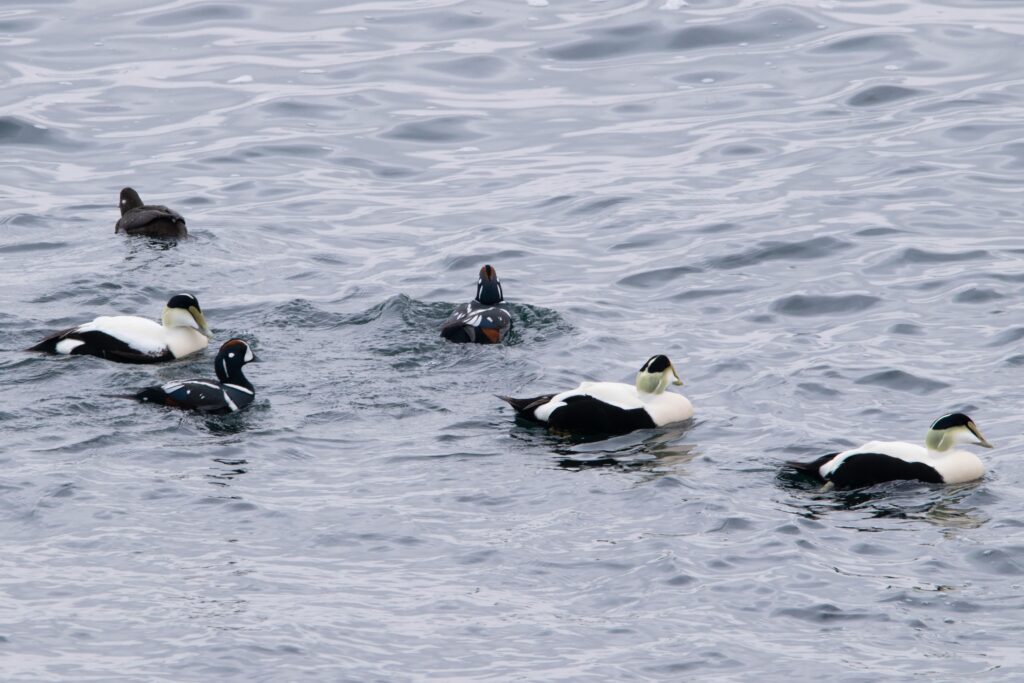
30. Common Eider
The common eider is the largest duck in the Northern Hemisphere, with a bulky body and a distinctive sloped, wedge-shaped head profile. Males are boldly patterned in black and white, while females wear a barred brown plumage that offers excellent camouflage on the nest.
Its down feathers are prized for insulation and have been harvested for centuries in parts of Scandinavia and Iceland, using methods designed not to harm the birds. This tradition continues today on a smaller, more regulated scale.
Eiders nest in dense colonies along northern coastlines, often gathering in the thousands during breeding season.
31. King Eider
The king eider breeds in the high Arctic and winters along northern coastlines further south. Males carry an ornate orange knob above the bill, along with a pale blue-grey crown, giving them one of the most unusual profiles of any waterfowl.
It dives to considerable depths in cold Arctic waters, feeding on mollusks, crustaceans, and small fish along the seabed. Females show a warm, barred brown plumage similar to other eider species.
Long migrations between breeding and wintering grounds can cover thousands of miles along Arctic and subarctic coastlines each year.
32. Spectacled Eider
The spectacled eider is named for the pale, goggle-like patches around its eyes, which give it an almost cartoonish expression. It breeds in remote Arctic tundra across Alaska and Russia, nesting near shallow coastal wetlands.
For years, scientists struggled to locate its wintering grounds until satellite tracking revealed large flocks gathering in openings within Bering Sea pack ice. This discovery solved a long-standing mystery in waterfowl research.
It is currently listed as threatened, with declining numbers linked to changes in Arctic sea ice and predator pressure on breeding grounds.
33. Steller’s Eider
The smallest of the eiders, Steller’s eider shows a compact body with a greenish tinge on the head in breeding males, quite different from the larger, bulkier eider species. Females display a warm brown plumage overall.
It breeds along Arctic coastlines in Alaska and Russia, then winters in dense flocks along ice-free coastal waters further south. Its populations are far smaller and more localized than other eider species.
Currently listed as threatened in parts of its Alaskan range, this species faces ongoing habitat and climate pressures on both ends of its migration.
34. Harlequin Duck
The harlequin duck carries bold, painterly markings of blue, white, and rust that make it one of the most striking sea ducks anywhere. Its compact, rounded body helps it navigate the turbulent water it calls home.
It favors fast-moving mountain rivers in summer, nesting along rocky banks near rapids and waterfalls. In winter, it shifts entirely to rocky, wave-battered coastlines, an unusual seasonal habitat switch among ducks.
Its comfort in violently churning water sets it apart from nearly every other waterfowl species, earning it a reputation as a true whitewater specialist.
35. Long-tailed Duck
Known for its long, whip-like tail feathers, the long-tailed duck also carries a genuinely musical, yodeling call that travels far across open water. Its plumage changes dramatically between summer and winter, more so than almost any other duck.
This species can dive deeper than nearly any other duck, sometimes exceeding 60 feet, hunting mollusks and crustaceans along the seafloor. Long dive times let it exploit food sources other ducks cannot reach.
It breeds on Arctic tundra pools before moving to open coastal waters for the winter months.
36. Surf Scoter
The surf scoter is a chunky black sea duck with a boldly patterned orange, white, and black bill that looks almost too elaborate for such a dark bird. Its nickname, “skunk-headed coot,” comes from the striking white patches on its otherwise black head.
It favors rough, wave-battered coastlines during winter, diving through breaking surf to reach mussels and other shellfish along the bottom. This tolerance for rough water is where its common name comes from.
Breeding takes place on remote boreal lakes across northern Canada and Alaska, far from the crashing coastlines where it spends the winter.
37. White-winged Scoter
The largest of the three scoter species, the white-winged scoter shows a bulky black body broken by a white wing patch, visible mainly in flight or when the bird stretches. A small white crescent below the eye adds another identifying mark.
It dives in coastal waters and large lakes, feeding mainly on mollusks pried loose from the bottom with its strong bill. Flocks often raft together in large numbers during migration and winter.
Breeding occurs on freshwater lakes across the boreal forest, with birds shifting to marine coastlines once the season ends.
ALSO READ: 25 Birds That Sing at Night (Species Names, With Pictures)
38. Black Scoter
The black scoter is almost entirely black, with males showing a bright yellow-orange knob on the bill that stands out sharply against the dark plumage. Females are duller, with a pale cheek patch against an otherwise brownish body.
It breeds in Arctic and subarctic regions, often on remote tundra pools far from human disturbance. Winter brings it to coastal waters, where it dives for shellfish in relatively shallow surf zones.
Its haunting, whistling call is often heard before the bird itself comes into view over open water.
39. Bufflehead
One of the smallest sea ducks in North America, the bufflehead shows a large white patch wrapping around the back of an otherwise glossy black-green head in males. Its compact, rounded shape makes it easy to pick out among larger diving ducks.
It nests almost exclusively in old woodpecker holes, particularly those made by northern flickers, a habit shared with few other ducks. This reliance on cavity nesting ties its population closely to healthy forest habitat near water.
Buffleheads dive frequently and briefly, often popping back up within seconds, which gives them a restless, energetic presence on the water.
40. Common Goldeneye
The common goldeneye is named for its piercing yellow eye, visible even from a distance against its dark green head. A round white cheek patch adds further contrast in breeding males.
It nests in tree cavities, often far from water, then leads newly hatched ducklings on a dramatic overland journey to the nearest pond soon after hatching. Watching a brood make this trip is one of the more memorable sights in waterfowl behavior.
Its wings produce a distinctive whistling sound in flight, loud enough that many birders identify the species by sound alone.
41. Barrow’s Goldeneye
Similar to the common goldeneye, Barrow’s goldeneye shows a crescent-shaped white face patch instead of a round spot, along with a steeper forehead. Males also display more black spotting along the flanks.
It favors mountain lakes in western North America and parts of Iceland, nesting in tree cavities or rocky crevices depending on local availability. This preference for higher elevations sets it apart from its more widespread relative.
Because it relies on specific mountain habitat, localized threats like logging near nesting lakes carry outsized importance for this species.
Part 4: Mergansers (4 Species)
Mergansers are specialized fish-eaters. Their bills are narrow, serrated, and hooked at the tip, built specifically for gripping slippery prey.
They are strong, fast divers and often chase fish underwater for several seconds at a time.
42. Common Merganser
The common merganser is a large, sleek fish duck with a smooth, glossy green head in males and a shaggy reddish crest in females. Its long, thin, serrated bill is perfectly built for gripping fish underwater.
It is often seen on rivers and large lakes across the Northern Hemisphere, sometimes in sizable flocks during migration. Strong swimming ability lets it chase down fast-moving prey with surprising success.
Females nest in tree cavities near water, a habit shared with several other cavity-nesting ducks on this list.
43. Red-breasted Merganser
Slimmer than the common merganser, the red-breasted merganser carries a shaggy, spiked crest that gives it a somewhat wild, windblown look. A rusty breast band in breeding males helps separate it from its closest relative.
It tends to favor coastal and brackish water more than freshwater lakes, often diving in bays and estuaries for small fish. This preference for salty water sets it apart from the more freshwater-loving common merganser.
Courtship displays involve elaborate head-bobbing and stretching, often performed in small groups on open water.
44. Hooded Merganser
North America’s smallest merganser, the hooded merganser carries a fan-shaped white crest that males can raise or flatten at will, creating a dramatic visual display. Females show a smaller, rusty-brown crest by comparison.
It nests in tree cavities near wooded ponds and slow-moving streams, much like the wood duck it often shares habitat with. Ducklings make the same dramatic leap from the nest hole to the ground soon after hatching.
Its diet leans more heavily on small fish, crayfish, and aquatic insects than on the larger fish favored by bigger mergansers.
45. Smew
The smew is a small, striking black-and-white merganser native to northern Europe and Asia. Males look almost entirely white from a distance, with fine black markings around the eyes and back that only become clear up close.
It breeds in forested wetlands across the boreal zone, nesting in tree cavities much like other cavity-nesting ducks. Winter brings it to ice-free lakes and rivers further south in Europe.
Its compact size and pale plumage make it one of the most visually distinctive ducks in the entire merganser group.
ALSO READ: 50 Types of Birds With Long Legs (Species Identification, With Pictures)
Part 5: Whistling Ducks (3 Species)
Whistling ducks, sometimes called tree ducks, stand tall on long legs. Their calls are loud, musical whistles rather than the typical quack.
They are more closely related to geese in behavior, often forming lifelong pairs and standing upright on land.
46. Black-bellied Whistling Duck
The black-bellied whistling duck is a tall, long-necked species with a bright pink bill and legs that make it easy to identify at a glance. A bold black belly contrasts against a warm chestnut chest and back.
It is increasingly common across the southern United States, often perching in trees or on fence posts rather than swimming, a habit unusual for most ducks. Large, noisy flocks are a familiar sight around ponds in Texas and Florida.
Pairs mate for life and share incubation duties equally, a rare trait among most duck species.
47. Fulvous Whistling Duck
Found on every continent except Europe and Antarctica, the fulvous whistling duck shows a tawny-orange body paired with long grey legs and a dark back. Its wide global range is unusual for a duck of this size.
It favors flooded rice fields, shallow marshes, and freshwater lagoons, feeding mainly on seeds and aquatic vegetation at night. This nocturnal feeding habit means it is often heard calling long before it is seen.
Its loud, whistling call in flight gives the entire whistling duck group its common name.
48. White-faced Whistling Duck
Common across Africa and South America, the white-faced whistling duck shows a bold white face that contrasts sharply against a black crown and neck. Its long legs and upright posture give it a distinctly goose-like stance on land.
It gathers in large, tightly packed flocks on shallow lakes and marshes, often numbering in the hundreds. This social behavior continues even outside the breeding season.
Its wide range across two separate continents raises interesting questions among ornithologists about how the species became so broadly distributed.
ALSO READ: 25 Birds With Colorful Beaks (Identification, With Pictures)
Part 6: Stiff-Tailed Ducks (3 Species)
Stiff-tailed ducks get their name from rigid tail feathers, often held upright like a fan. They are compact, chunky divers built for life on open water.
49. Ruddy Duck
The ruddy duck is a small, thickset species with a bright blue bill in breeding males, paired against rich chestnut-brown body plumage. Its stiff tail is often held cocked upright, a signature pose for the entire group.
It rarely walks on land and spends nearly its entire life on the water, only coming ashore briefly to nest among dense marsh vegetation. This near-total aquatic lifestyle is unusual even among diving ducks.
Its introduction to parts of Europe has caused real conservation concern, since it hybridizes with the closely related and threatened white-headed duck.
50. Masked Duck
The masked duck is a shy, secretive species found in dense marsh vegetation across the Americas, from the southern United States down through South America. Breeding males show a striking black face mask against a warm cinnamon body.
It prefers thickly vegetated ponds and marshes, often staying hidden among reeds rather than swimming in open water. This secretive nature makes it one of the harder ducks on this list to actually observe.
Its stiff, upright tail and compact build closely resemble the ruddy duck, though the black facial mask sets breeding males apart clearly.
51. White-headed Duck
Native to parts of Europe, Asia, and North Africa, the white-headed duck shows a pale white head paired with a swollen, bright blue bill in breeding males, one of the more unusual color combinations among ducks. Females are duller, with a greyish head and dark cap.
It is currently considered vulnerable, with wetland habitat loss identified as the primary threat across much of its range. Competition and hybridization with introduced ruddy ducks has added further pressure in parts of Europe.
Conservation programs in Spain have worked for decades to protect remaining populations, with some success in stabilizing numbers locally.
Part 7: Perching Ducks (3 Species)
Perching ducks nest in tree cavities rather than on the ground. Sharp claws let them grip bark and branches with ease.
52. Wood Duck
The wood duck is widely regarded as one of the most colorful ducks in North America, with males showing an almost unreal mix of iridescent greens, purples, and blues set against bold white markings. Females wear a more subdued grey-brown plumage with a distinctive white eye-ring.
It nearly vanished in the early 1900s due to habitat loss and unregulated hunting, but nest-box programs and the Migratory Bird Treaty Act of 1918 helped it recover into one of the continent’s most abundant species today. This recovery remains one of the great conservation success stories in North American wildlife management.
Ducklings leap from the nest cavity, sometimes many feet above the ground, within a day of hatching, bouncing off the forest floor largely unharmed before following their mother to water.
53. Mandarin Duck
Native to East Asia, the mandarin duck is famous for its ornate, almost unreal plumage, featuring orange “sail” feathers on the wings, a fanned crest, and a striking pattern of purple, green, and white across the body. Females are far plainer, with grey-brown feathers and a white eye-ring.
Populations have also established themselves in parts of Europe, particularly the United Kingdom, after birds escaped from captivity decades ago. These feral populations now breed successfully in the wild.
In Chinese and Japanese culture, mandarin ducks have long symbolized love and fidelity, often appearing in traditional art and wedding imagery.
ALSO READ: 30 Stunning Birds With Long Beaks (Species Identification, With Pictures)
54. Muscovy Duck
Native to Mexico, Central America, and South America, the wild Muscovy duck is mostly black with iridescent green highlights and bold white wing patches. Domesticated forms show far more color variation, including white, black-and-white, and buff patterns.
It shows distinctive red, fleshy caruncles around the face and bill, especially pronounced in older males, giving it a somewhat rugged appearance compared to other ducks. This feature makes it instantly recognizable even to casual observers.
Muscovy ducks nest in tree cavities near water, much like wood ducks, and are one of the few duck species domesticated primarily for meat rather than eggs.
Part 8: Shelducks (1 Species)
Shelducks sit somewhere between ducks and geese, both in size and behavior. They are often bold, boldly patterned, and territorial around nesting sites.
55. Common Shelduck
The common shelduck is a striking black, white, and chestnut duck found across Europe and Asia, with a bright red bill that stands out clearly against its bold plumage pattern. Its size and upright stance give it a distinctly goose-like presence.
It nests in burrows, often reused from rabbits or foxes, a nesting habit almost unheard of among true ducks. This underground nesting strategy offers protection from predators and harsh weather alike.
Large numbers gather each summer at a handful of key molting sites, including the Wadden Sea along the North Sea coast, where birds become temporarily flightless while replacing their feathers.
How to Tell Dabblers, Divers, and Sea Ducks Apart
Field identification gets easier once you know what to look for. Body position on the water is usually the first clue.
Dabbling ducks sit high and buoyant, with their tails often tilted upward. Diving ducks ride noticeably lower, since their legs sit further back for underwater propulsion.
Bill shape helps too. Shovelers and mergansers sit at opposite extremes, one broad and flat, the other narrow and serrated for gripping fish.
Takeoff style is another giveaway. Dabblers spring straight up off the water, while divers need a running start, pattering across the surface before gaining lift.
Wing sound matters in low light, when colors are hard to judge. Goldeneyes, for instance, produce a distinctive whistling wingbeat that many hunters and birders learn to recognize before they even see the bird.
ALSO READ: 15 Breeds of Chicken With No Feathers on the Neck (With Pictures, and Care Tips)
Duck Habitats Around the World
Ducks occupy nearly every continent except Antarctica. That range explains why their body shapes, bills, and behaviors vary so widely from one region to the next.
North America hosts some of the richest duck diversity anywhere, including the Mississippi, Central, Pacific, and Atlantic flyways used during migration. These four routes funnel millions of birds between Arctic breeding grounds and southern wintering areas each year.
Europe and Asia share many species through the Palearctic region, including the garganey, common pochard, and smew. Wetlands along major river systems act as critical stopover points during migration.
Africa supports resident species like the yellow-billed duck and white-faced whistling duck, many of which do not migrate at all due to the continent’s relatively stable climate.
Australia, New Zealand, and Pacific islands host isolated species such as the Pacific black duck, along with island endemics like the Laysan and Hawaiian ducks, both found nowhere else on Earth.
Conservation Status Snapshot
Not every duck on this list is thriving. Some remain common across their entire range, while others survive in only a handful of protected sites.
The Laysan duck, Hawaiian duck, and white-headed duck all carry threatened or endangered status due to habitat loss and, in some cases, competition from introduced species. The spectacled eider and Steller’s eider face similar pressure in Arctic breeding grounds affected by shifting sea ice patterns.
By contrast, the mallard, wood duck, and common eider remain widespread and stable, in part because of decades of habitat restoration and regulated hunting seasons.
This mix of success stories and ongoing concerns is exactly why monitoring programs, wetland restoration, and public reporting of sightings continue to matter for the species listed above.
Why Duck Diversity Matters
Ducks are not just charming to watch. They are indicators of wetland health across the entire planet.
More than half of North America’s original wetlands have been lost or degraded over the past two centuries, based on data compiled by conservation researchers. That loss directly threatens duck populations and everything else that depends on the same habitat.
Federal and state efforts have pushed back against this trend. In the United States, Federal Duck Stamp sales have raised more than $1.3 billion since 1934, funding the protection of over 6 million acres of wetland habitat.
Roughly 43 species of waterfowl call North America home, according to conservation data, and up to 43% of federally threatened and endangered species rely directly on wetlands for part of their life cycle. Ducks are woven into that picture more than most people realize.
A Quick Word From Me
I’ll admit something. Before researching this deeply, I assumed most ducks looked roughly the same, brown, quiet, forgettable. That assumption did not survive long.
The mandarin duck alone changed my mind. So did the Baikal teal’s face pattern and the harlequin duck’s odd, painterly markings. Ducks reward a closer look.
Frequently Asked Questions
How many types of ducks exist in the world? Estimates generally place true duck species between 120 and 130, spread across several subfamilies within Anatidae.
What is the most common duck species? The mallard holds that title almost everywhere it lives, thanks to its adaptability to lakes, rivers, ponds, and urban parks alike.
What is the rarest duck in the world? The Laysan duck is among the rarest, with a wild population confined mostly to a single small island in the Pacific.
Do all ducks migrate? No. Species like the mottled duck and the African black duck stay close to home year-round, while others, like the northern pintail, travel thousands of miles each season.
Final Thoughts
Fifty-five species barely scratch the surface of what exists in the duck world, yet they capture nearly every shape, color, and behavior this family has to offer.
Next time you pass a pond, take a second look. There is a good chance more than one of these 55 is paddling right in front of you.
References
- U.S. Fish & Wildlife Service — Ducks at a Distance: A Waterfowl Identification Guide: https://www.fws.gov/media/ducks-distance-waterfowl-identification-guide
- USDA Natural Resources Conservation Service — Wetland Management for Waterfowl Handbook: https://www.nrcs.usda.gov/sites/default/files/2023-08/NRCS-Wetland-Management-for-Waterfowl-Handbook.pdf
- Missouri Department of Conservation — Waterfowl: Bird Identification: https://mdc.mo.gov/hunting-trapping/species/waterfowl/waterfowl-bird-identification
- Washington Department of Fish & Wildlife — Migratory Waterfowl Identification: https://wdfw.wa.gov/hunting/requirements/waterfowl/identification
- University of Florida IFAS Extension (EDIS) — The Wood Duck: https://edis.ifas.ufl.edu/publication/UW180/pdf
- Mississippi State University Extension Service — Wood Ducks in Mississippi: https://extension.msstate.edu/publications/wood-ducks-mississippi
- University of Wisconsin–Stevens Point — Waterfowl and Wetland Ecology Lab: https://www.uwsp.edu/wcw/waterfowl-and-wetland-ecology-lab/